8 Best Home Theater System of 2026: Real Surround, No Wiring Trap

Which home theater system delivers true surround sound without hidden wiring surprises, fake channel counts, or receiver reliability headaches.

A soundbar labeled 5.1 doesn't guarantee five speakers in the room. Some models use virtual processing to mimic rear channels, while others include physical satellites that still need power or audio cables running across the floor. You hear the difference the first time a car pans from front to back: physical rears create a seamless soundfield, virtual processing just gets louder.

Receiver packages deliver separate speakers and room calibration, but they add wiring, setup time, and an extra component that can stop working. Soundbars with genuine rear speakers and a subwoofer cover most TV and movie needs with less complexity. The real trade-off is format support: many Atmos soundbars handle Dolby content only, so Blu-ray collectors with DTS-heavy libraries should be looking at a receiver-based package.

Separate the marketing from the wiring diagram before buying. The right system starts with the content you actually play, then the channel count follows.

About the Sound Score: This comparative score is calculated from a product's published customer rating and review volume. It is not a laboratory measurement or a hands-on test result.

1

Best Overall

ULTIMEA Skywave F40

86 /100
Sound Score Excellent

Key details

Subwoofer
5.25-inch wired BassMX
Atmos / DTS
Atmos, no DTS
Surround Type
Physical rear, up-firing
HDMI / Upgrade
HDMI eARC
View on Amazon

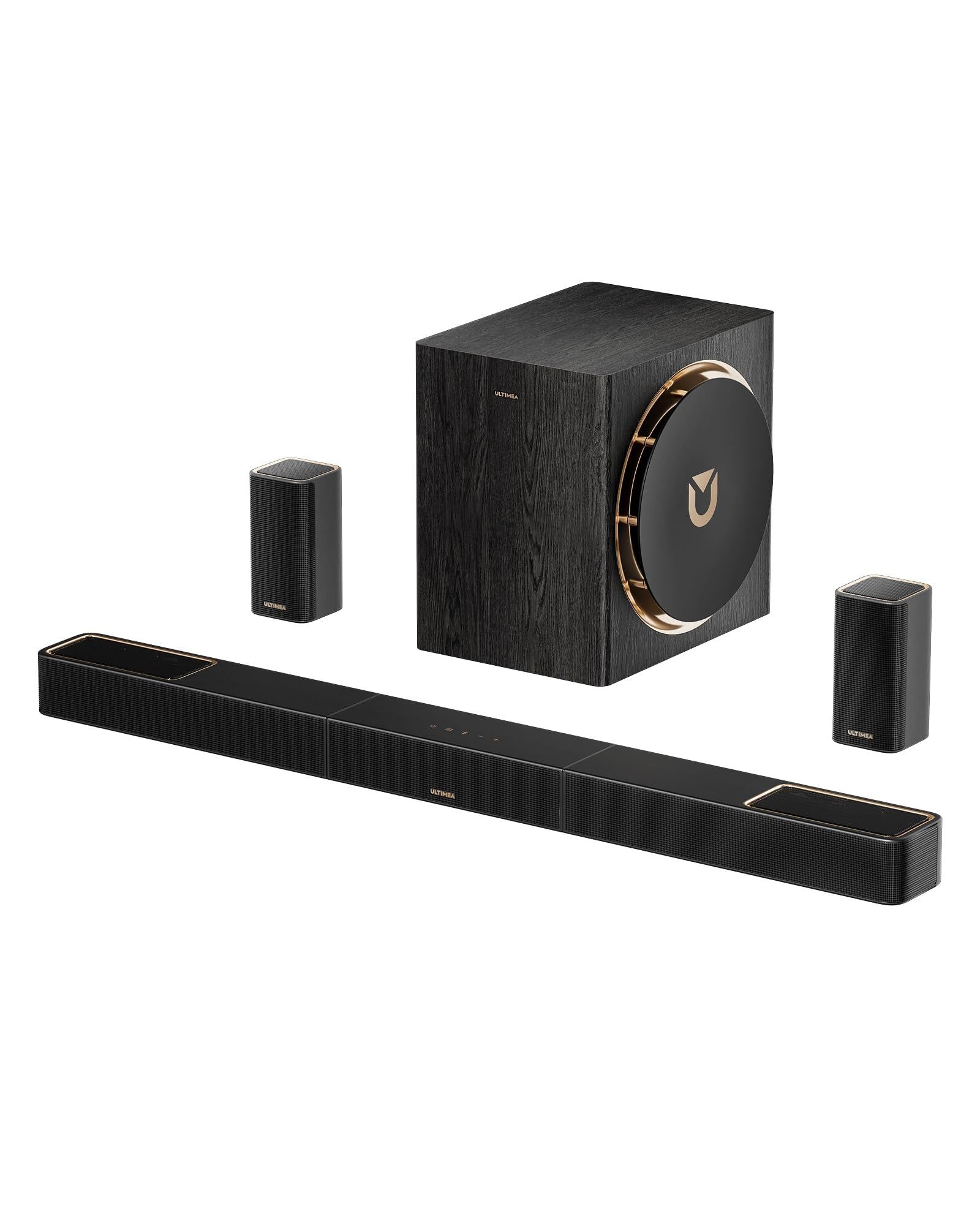
The Skywave F40 pairs physical rear speakers with up-firing Atmos drivers to deliver a true 5.1.2 soundstage from a soundbar layout. Height effects from the up-firing drivers land above the screen, while the two rear channels create a consistent bubble behind the listening position. Center-channel dialogue stays anchored to the TV, and the 5.25-inch sub handles low-end impact without turning into a one-note thump. Streaming apps carrying Dolby Atmos send height metadata through eARC, and the bar places sounds where the mix intends rather than smearing them into a generic wall of audio. The separation between the front, side, and rear channels is wide enough that an action scene moves around the room instead of staying in front of you.

Setup is fast because everything connects to the soundbar hub instead of a receiver. Plug the bar into an eARC port, power the sub and two rear speakers, and automatic pairing takes over within a few minutes. The included remote and app cover volume, input switching, and sub level, so the system rarely needs the TV remote beyond turning the display on and off. Bluetooth 5.4 streams music from a phone or tablet without opening the TV menu, which makes casual listening painless after the TV is off. HDMI eARC carries volume commands and Atmos metadata over one cable, so there is no separate control connection to manage.

This is the right pick for streaming-first households that want surrounds and height channels without buying a receiver. Physical rears go behind the couch, and the sub finds a spot near the front of the room. The main format boundary is that DTS-encoded movies and broadcasts will not play in surround, so anyone with a Blu-ray library built around that format should factor it in before purchase. If movie nights draw mostly from Netflix, Disney+, Prime Video, or Apple TV+, the F40 covers the formats those services actually use. For first-time home theater buyers, the bar also avoids the speaker impedance and crossover decisions that come with a traditional receiver setup.

Compared with traditional receiver packages, the F40 removes the separate amplifier and speaker selection steps. Other soundbars at this price generally simulate surround with virtual processing, while the F40 ships with actual rear speakers and a sub in the box. That makes it a cost-effective way to get genuine 5.1.2 without stepping up to a component system, and the included sub and rears mean the channel count on the box matches what is actually in the room. The price also undercuts typical true 5.1.2 systems, which require a receiver, five speakers, and a subwoofer bought separately.

Pros

  • True 5.1.2 with physical rear speakers and up-firing drivers pulls surround and height effects out of a single soundbar package.
  • Setup takes minutes: connect eARC, power the rears, and automatic pairing handles the rest.
  • Substantial cost saving compared with a receiver plus five speakers and a sub.
  • eARC and Bluetooth 5.4 keep streaming sources connected without extra hardware.

Cons

  • Third-party remote or app conflicts can force a re-pair using the included remote.
  • Rear and sub connections are wired, so cable routing limits where speakers can sit.
Our verdict

The F40 makes genuine 5.1.2 realistic for streaming-first buyers without the receiver or speaker shopping.

Check Latest Price
2

Best Traditional Receiver Package

Yamaha YHT-4950U

89 /100
Sound Score Excellent

Key details

Subwoofer
Powered subwoofer
Atmos / DTS
DTS, no Atmos
Surround Type
Physical surround, wired
HDMI / Upgrade
4 HDMI inputs
View on Amazon

The YHT-4950U pairs a real AV receiver with five satellite speakers, a powered subwoofer, and YPAO room calibration. Four 4K HDMI inputs handle current sources, and Bluetooth brings in phone or tablet audio without using an input. The separate components give this package an advantage over the 5.1.2 soundbar above it: you can replace speakers or add sources without changing the receiver. The next Yamaha package up adds 8K HDMI and MusicCast, but those features matter only if you already own 8K gear or need whole-home audio.

The five satellites and subwoofer produce a genuine surround field with clean separation between channels in a mid-size living room. YPAO adjusts levels automatically, taking the guesswork out of speaker placement. Bluetooth support adds a quick music streaming path without touching a receiver input.

This is for a traditionalist who wants a dedicated receiver and separate speakers, not a no-wire soundbar. It is not for the buyer who wants one slim bar; you will run speaker wire to rears, and the included wire is short enough that a wide room needs a spool. The receiver itself is the variable part of the package — certain units may refuse to power on or drop HDMI output — so use a return-friendly retailer.

Pros

  • Full 5.1 surround with physical satellites and sub fills a mid-size room.
  • Build quality comes across as higher than the package price suggests.
  • Complete receiver-plus-speakers value is strong for a first real system.
  • YPAO auto-calibration handles speaker levels, reducing manual setup.

Cons

  • Some units arrive with shipping damage, so inspect the carton before mounting.
  • A satellite or subwoofer can lose output early in some cases; retain return options.
Our verdict

For a buyer who already plans to run speaker wire, this package delivers a true receiver-based 5.1 setup with room to grow.

Check Latest Price
3

Best High-Power Wireless Atmos Soundbar

ULTIMEA Skywave X50

89 /100
Sound Score Excellent

Key details

Subwoofer
8-inch wireless, 28Hz
Atmos / DTS
Atmos, no DTS
Surround Type
Physical rears, height
HDMI / Upgrade
HDMI eARC
View on Amazon

Adds two true height channels and a larger subwoofer to the receiver-free soundbar format, separating it from the 5.1.2 value pick. Four physical height drivers put real overhead output into the room, and the 8-inch wireless subwoofer gives action scenes the low-end headroom that smaller bars run out of.

The dedicated 5GHz link carries the rear and sub channels cleanly, keeping surround effects anchored behind the listening position. The 760W GaN amplifier keeps dialogue anchored in the center while rear effects stay locked to the action. Highs stay controlled at higher volumes, and the 8-inch sub reaches down to 28Hz without smearing the midrange. The result is a 5.1.4 layout that behaves like one system rather than a bar faking surround.

This system fits streaming-first TV and movie viewers in medium-large rooms who want height-channel immersion without a receiver or speaker-wire runs. DTS support is absent, so Blu-ray and DTS-encoded libraries need a receiver-based alternative; for Dolby Atmos sources, the X50 covers the full channel layout at a mid-range price. Buyers who already have an AV receiver and separate speakers will not need it, but for a room starting from a TV and a streaming box, it is the most direct path to a full Atmos layout.

Pros

  • Four physical height drivers plus rear effects produce a complete 5.1.4 sound field from a soundbar.
  • Rears and sub auto-pair over a dedicated 5GHz link, so installation is mostly setting them in place.
  • Wireless signal holds cleanly for surround duties; only power cables are required at the speakers.
  • Delivers channel-for-channel immersion at a price below separate receiver-and-speaker packages.

Cons

  • Surrounds and sub are wireless for audio, but each still needs a nearby AC outlet.
  • Unit-to-unit quirks can show up as unexpected shutdowns or subwoofer bass tuning that needs adjustment.
Our verdict

For stream-first 5.1.4 Atmos at a mid-range price, the Skywave X50 is the receiver-free way to get real overhead immersion in a medium-large room.

Check Latest Price
4

Best Premium Component System

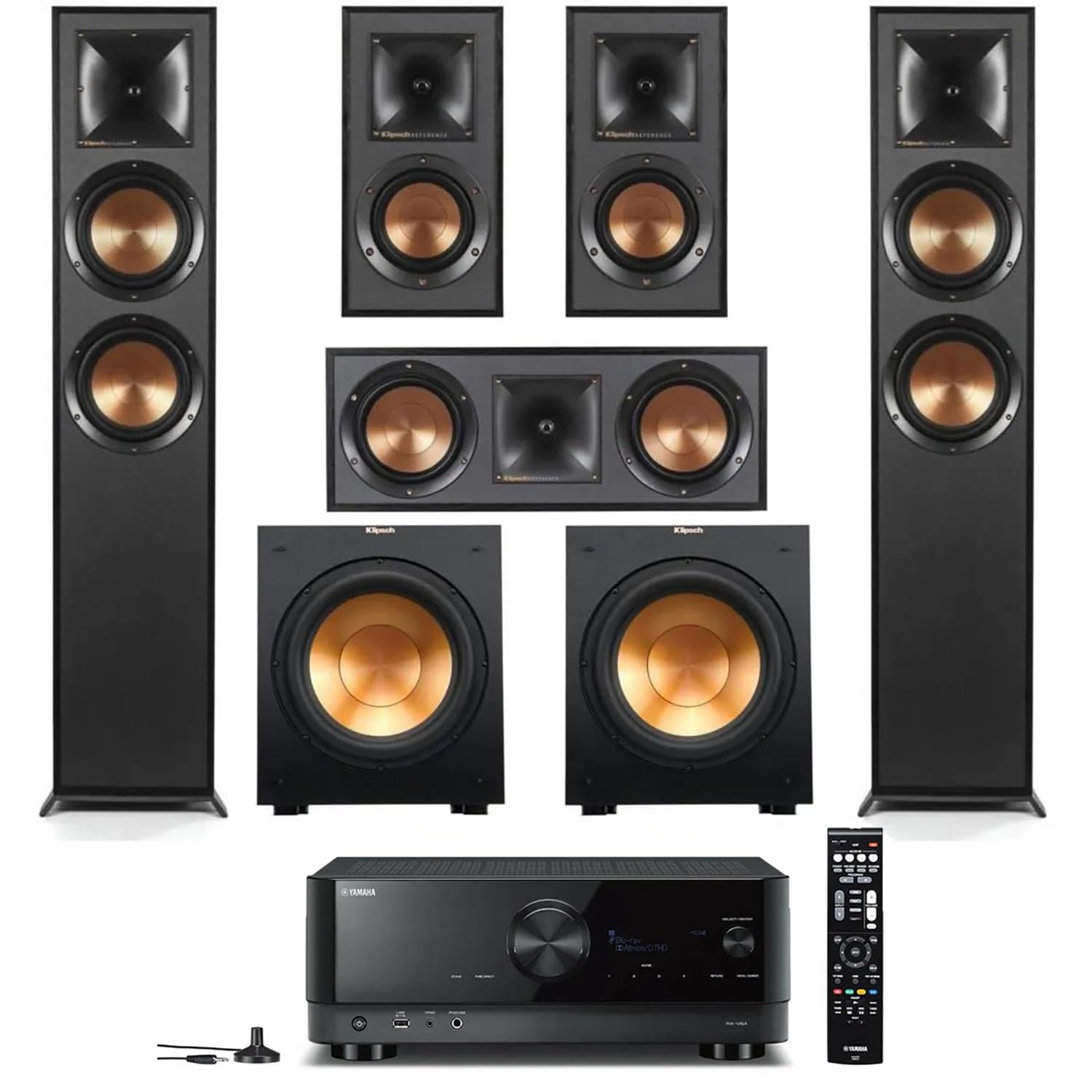
Klipsch Reference 5.2

87 /100
Sound Score Excellent

Key details

Subwoofer
Dual 12-inch powered
Atmos / DTS
Dolby Atmos, DTS
Surround Type
Floorstanding towers, wired
HDMI / Upgrade
Yamaha 7.2 receiver
View on Amazon

The dual 12-inch R-12SW subwoofers and Atmos-enabled R-625FA floorstanding towers give this bundle a physical scale that separates it from soundbar alternatives. The Yamaha RX-A2AB receiver supplies enough amplifier headroom for surround-heavy TV and movie soundtracks, and the 7.2-channel layout leaves room for later expansion.

The system holds its composure across extended movie sessions, with the copper-woofer finish keeping a premium presence in a dark theater room. Setup is a multi-box process, but the towers and subs arrive well-packed, and placement comes down to finding open floor rather than aligning a narrow soundbar with the TV. The dual 12-inch subs produce low-end impact without turning dialogue into a rumbling mess.

This bundle belongs to the buyer with a dedicated home theater room where floorstanding towers can breathe and dual subwoofers have room to pressurize the space. It suits Klipsch fans who want dynamic, high-efficiency output, and the premium price assumes a serious theater budget.

The 7.2-channel Yamaha receiver also makes this a system that can grow, which matters for owners who plan to add surround channels or height speakers later.

💡 Give the subwoofers a few listening sessions to find placement; moving them slightly changes how the low end blends with the towers.

Pros

  • Dual 12-inch subwoofers and floorstanding towers deliver deep, room-filling sound for action-heavy movie tracks.
  • The Yamaha receiver supplies enough amplifier headroom to support future channel additions.
  • Black cabinets with copper woofers hold up visually in a dedicated theater setup.
  • Long listening sessions stay composed without obvious strain at high output.

Cons

  • The premium price is a heavy entry point if the goal is improving a casual TV setup.
  • Floorstanding towers and dual subwoofers need generous open floor, so compact apartments are the wrong setting.
Our verdict

For a room built around movie audio, this bundle delivers the component-level weight that soundbars only approximate.

Check Latest Price
5

Best for Sony TV Owners

Sony BRAVIA Theater System 6

86 /100
Sound Score Excellent

Key details

Subwoofer
Wireless subwoofer
Atmos / DTS
Atmos, DTS:X
Surround Type
Physical rears, wired
HDMI / Upgrade
HDMI eARC only
View on Amazon

The BRAVIA Theater System 6 treats a Sony TV as part of the sound system rather than just a display. The BRAVIA Connect app handles setup, and Voice Zoom 3 works with the TV's processor to lift dialogue while keeping effects intact. The included rear speakers and dedicated center channel complete a true 5.1 layout, with a wireless rear amp box handling the link to the satellites. The bar's cabinet has the dense, finished feel of Sony's higher-end audio components.

Action-heavy movie tracks get clear left-to-right pans across the bar and rears, and the sub adds low-end weight without turning dialogue mushy. The center channel keeps voices anchored during effects-heavy scenes, so you don't have to ride the remote between quiet and loud passages.

This is a strong match for BRAVIA TV owners connecting through HDMI ARC/eARC and willing to place the included rear amp box within reach of speaker cable and power. Buyers using older TVs or consoles without HDMI will find the system depends on that connection, since optical input is absent. At this premium price, the value sits in the Sony ecosystem as much as the speaker hardware.

💡 Use the BRAVIA Connect app during setup so the bar and TV automatically match dialogue and surround presets.

Pros

  • Genuine 5.1 surround with included rear speakers and a dedicated center channel for movie dialogue.
  • BRAVIA Connect setup is nearly automatic with a Sony TV, and Voice Zoom 3 sharpens dialogue.
  • The bar and sub feel dense and well finished, matching a premium home theater setup.
  • Priced fairly for a full soundbar system with physical rears and a subwoofer.

Cons

  • Rear speakers still need speaker wire from the wireless amp box and AC power at each location.
  • Full surround depends on HDMI ARC/eARC; older TVs and consoles without HDMI lose the complete 5.1 experience.
Our verdict

For a BRAVIA household with HDMI ARC/eARC, the Theater System 6 is the simplest way to get complete 5.1 with the TV's own dialogue tools.

Check Latest Price
6

Best for Fire TV / Alexa Households

Amazon Fire TV Soundbar Plus

83 /100
Sound Score Excellent

Key details

Subwoofer
Subwoofer included
Atmos / DTS
Atmos, DTS:X
Surround Type
Physical rears, wired
HDMI / Upgrade
HDMI eARC
View on Amazon

The Fire TV Soundbar Plus is a true 5.1 package for streaming-first home theater: a soundbar with a dedicated center channel, a subwoofer, and two rear speakers that pair automatically with Fire TV and follow the same remote as your TV. Dolby Atmos and DTS:X decoding are included, so movie soundtracks get proper multi-channel placement without a receiver stack.

Setup is closer to adding a streaming stick than wiring a component system. The soundbar finds the Fire TV, the sub and rears connect during the routine, and basic audio adjustments live in the Fire TV interface. Dialogue from the dedicated center stays clear, and the sub adds weight to action scenes without needing to adjust individual channel levels. The tradeoff is tuning: you get the soundbar's built-in processing rather than receiver-grade EQ or per-channel calibration, which is fine for a moderate room and app-based viewing but not for enthusiasts who expect fine control.

This is the right fit for a Fire TV- and Alexa-first household with a moderate room where the bulk of your viewing happens through streaming apps. At a mid-range price, it undercuts comparable component bundles while still delivering real rear channels; the included sub and surrounds are what separate it from virtual-surround bars. The integration is specific to Amazon's ecosystem, so it won't bring the same benefits to a non-Fire TV setup, and the built-in tuning won't replace receiver-grade EQ. Amazon's quality control can vary between units, so the return window is worth treating as part of the setup process.

Pros

  • Cinematic 5.1 sound with a dedicated center channel keeps dialogue clear.
  • Automatic Fire TV pairing and one-remote control cut the setup hassle.
  • Sub and rear speakers are in the box, so a complete 5.1 system needs no separate purchases.
  • Dolby Atmos and DTS:X decoding handle modern and older movie mixes.

Cons

  • Rear speakers may drop pairing after setup, which interrupts surround until they reconnect.
  • Power-on behavior can vary between units, so a quick check before movie night is sensible.
Our verdict

For Fire TV and Alexa households, this is a mid-range true 5.1 package that behaves like an extension of the TV rather than a separate component system.

Check Latest Price
7

Budget Karaoke Parties

Rockville HTS56

86 /100
Sound Score Excellent

Key details

Subwoofer
8-inch powered
Atmos / DTS
No Atmos
Surround Type
Physical speakers, wired
HDMI / Upgrade
Optical, RCA, no HDMI
View on Amazon

The Rockville HTS56 serves up loud 5.1 sound with an 8-inch sub, karaoke mic inputs, LED effects, and a five-band EQ at a budget price. It's a feature-loaded party system rather than a calibrated home theater setup, and for casual listeners that tradeoff pays off. Simpler wiring and multiple inputs (Bluetooth, USB, SD, RCA, optical) keep the appeal broad. Quality-control variance, finicky Bluetooth TV pairing, and occasional noise artifacts can frustrate TV-focused buyers, which is why it doesn't rank higher among theater packages.

Pros

  • Delivers loud, clear 5.1 sound with good bass at a budget price.
  • Packed with inputs, karaoke mics, EQ, and LED effects for the price.
  • Simple hookup and cabling keep setup time short.

Cons

  • In a dark movie room, the LED lights may be distracting during films.
  • No HDMI input: TV audio connects through optical or RCA rather than HDMI.
Our verdict

This budget 5.1 fits when the priority is karaoke and LED-lit party sound rather than critical movie immersion.

Check Latest Price
8

Klipsch Enthusiasts

Klipsch 5.1 + Denon

81 /100
Sound Score Excellent

Key details

Subwoofer
Powered subwoofer
Atmos / DTS
Dolby Atmos, DTS
Surround Type
Floorstanding, wired
HDMI / Upgrade
8K Denon receiver
View on Amazon

Klipsch floorstanding towers, a matching center, bookshelf surrounds, and an 8K Denon HEOS receiver make this a true 5.1 component package for TV and movie audio. Effects pan across the room and dialogue stays anchored to the center channel — the separation a soundbar cannot match. It sits below the larger Klipsch 5.2 bundle in scale and headroom, so a dedicated room with dual subwoofers and Atmos-enabled towers will prefer that bigger system. The Denon receiver has been noted in some units for shutdown or channel-drop behavior after about a year, which makes the warranty worth checking before wall-mounting everything. For buyers already committed to Klipsch and Denon HEOS streaming, this is a luxury living-room system that leaves soundbar-based virtual surround behind.

Pros

  • Crisp highs and deep bass make movie effects immersive while the center channel keeps dialogue clear.
  • Cabinet quality and driver build feel like a step up from entry-level speaker packages.
  • Denon 8K receiver, five speakers, and sub come as one package with strong component value.

Cons

  • The Denon receiver can malfunction after about a year in some units, so warranty support matters for long-term use.
Our verdict

This fits buyers who want component-grade Klipsch sound with Denon HEOS streaming and don't need the dual-sub scale of the larger 5.2 bundle.

Check Latest Price

How to Choose

Channel Count and Rear Speakers

Check the number of physical speakers, not the channel badge. A 5.1 label with no rear speakers uses virtual processing to simulate sounds behind you. That can widen the soundstage, but it cannot match a real speaker behind your seat.

Physical rears need a signal path: wire to the soundbar, wireless pairing to a sub or amp box, or powered modules with their own wall outlet. Confirm the included cables before planning placement.

Dolby Atmos and DTS

Dolby Atmos adds height information by encoding audio objects with position data. Up-firing drivers bounce that sound off the ceiling; receiver systems can drive actual height channels. Ceiling height and reflection surfaces shape the effect.

DTS support is the catch. Many Atmos soundbars decode Dolby formats but not DTS, so DTS Blu-rays fall back to stereo or a limited core. Disc-heavy buyers should lean to a receiver package.

Subwoofer Size and Connection

Subwoofer output scales with driver area. A 5.25-inch woofer works in a small room; an 8-inch or dual 12-inch setup covers larger spaces. Placement and crossover settings matter as much as the cone.

Wired subs have fewer dropouts than wireless subs. Wireless is easier to place, but the sub still needs a wall outlet, and walls or interference can weaken the link.

Physical vs Virtual Surround

Virtual surround uses delay, filtering, and phase tricks to mimic side and rear audio. It works best in the sweet spot, and off-center seats lose the effect.

Wired rears require cable runs. Wireless rears remove the audio cable but still need power, so 'wireless' means wire-free signal, not wire-free installation.

HDMI and Expandability

HDMI eARC carries object-based Atmos from the TV with one cable and supports CEC for one-remote control. Optical cannot carry Atmos height metadata.

Receiver packages allow speaker swaps and channel additions. Soundbars are closed systems: the included sub and rears are tied to the bar's DSP, so future expansion means replacing more of the system.

Frequently Asked Questions