9 Best Line Output Converter of 2026: Keep the Bass You Paid For

Which line output converters actually restore bass that factory stereos roll off, and which just convert a weak signal.

The most common complaint with budget line output converters is not installation difficulty; it is what happens at volume. Factory stereos roll off bass as you turn up, and a passive converter simply passes that shrinking signal to your amp. Your sub gets quieter exactly when you want it louder.

That distinction separates simple signal adapters from real system tools. Active converters detect the roll-off and restore low end before the signal reaches the aftermarket amplifier. They also add remote turn-on and load matching, which matter for late-model factory amps.

The right choice depends on your factory system and how much bass you need. If the stock radio holds bass steady, a budget passive LOC can be enough. If it does not, you need the active bass restoration this guide prioritizes.

About the Sound Score: This comparative score is calculated from a product's published customer rating and review volume. It is not a laboratory measurement or a hands-on test result.

1

Best Overall

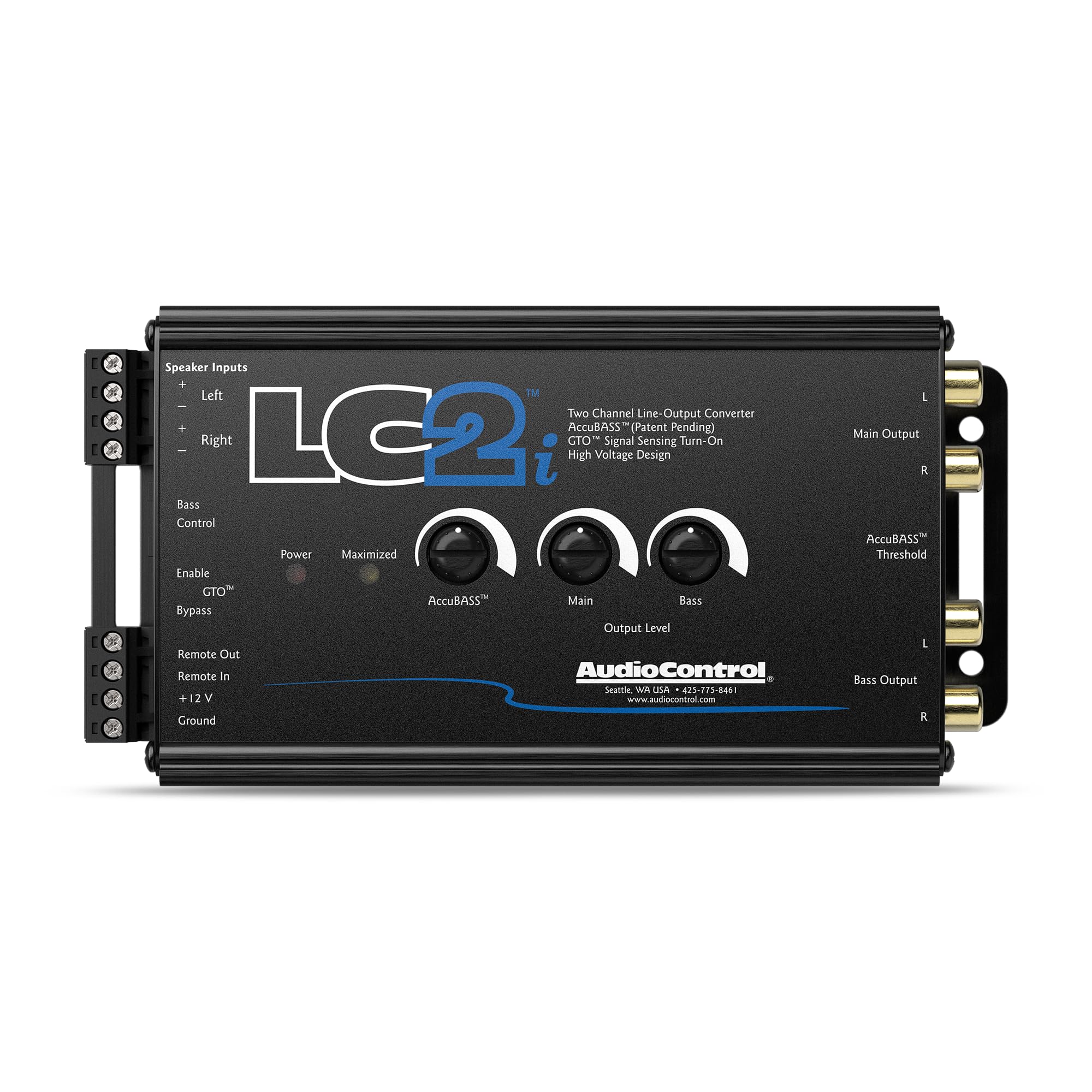
AudioControl LC2i

92 /100
Sound Score Outstanding

Key details

Channels
2-channel
Remote Turn-On
Yes
Gain Adjustment
Yes
Bass Restoration
AccuBASS
View on Amazon

AccuBASS is what separates the LC2i from a passive line output converter. Instead of simply reducing speaker-level signal to line level, the LC2i monitors the factory feed and pulls low end back when the stock radio rolls off bass at higher volume. That means the subwoofer amplifier receives a full bass signal rather than a fading one. The fixed RCA output can feed a second amp or processor, and the variable output gives the sub amp its own level control, so integration stays clean without adding extra parts.

Signal-sense turn-on wakes an aftermarket amp without a separate remote wire, a practical advantage in newer vehicles where the factory radio does not expose a 12V trigger. The compact case fits in a tight dash pocket or under a seat, and the 400W per-channel input ceiling handles factory speaker-level feeds with headroom. Setup asks you to set the output level once, and the variable output makes that match manageable for a careful installer. The harness and controls are clearly labeled, so a tidy install is realistic in a tight dash.

The LC2i is for drivers who want to add a subwoofer to a factory stereo without replacing the head unit, especially when the stock system cuts bass as volume climbs. It also suits installers who need signal-sense turn-on and adjustable output in one unit. If dash-level bass control is a must, the ACR-1 knob is a separate purchase; account for it before wiring the amp. This is not the unit for a four-channel full-range system with fader retention, and budget-only installs are better served by a cheaper passive converter.

The build is a step above entry-level converters, with solid connectors and a case that holds up in a permanent install. At higher volume the output stays clean, which is exactly where a passive converter can show its limits when the factory radio already has roll-off. A threshold screw adjusts where AccuBASS engages, giving you a tuning point for different factory systems. For a subwoofer-only add, this focused feature set avoids the setup time of a multi-band processor. The premium price lands on bass restoration rather than extra features you will not use.

Pros

  • AccuBASS restores low end that factory radios cut at volume, keeping the sub signal full.
  • Works cleanly with factory head units and aftermarket amps, with signal-sense turn-on and adjustable output.
  • Sturdy case and solid connectors hold up in a permanent install.
  • Compact footprint and clearly labeled hookups make installation easy in a tight dash.

Cons

  • Bass-remote control is not included; the ACR-1 knob is a separate purchase for dash-level sub adjustment.
  • In some units, the AccuBASS threshold screw is missing from the box, which puts tuning on hold until a replacement arrives.
Our verdict

The LC2i is the active LOC to measure factory-stereo subwoofer upgrades against.
Check Latest Price
2

Best Budget with Bass Knob

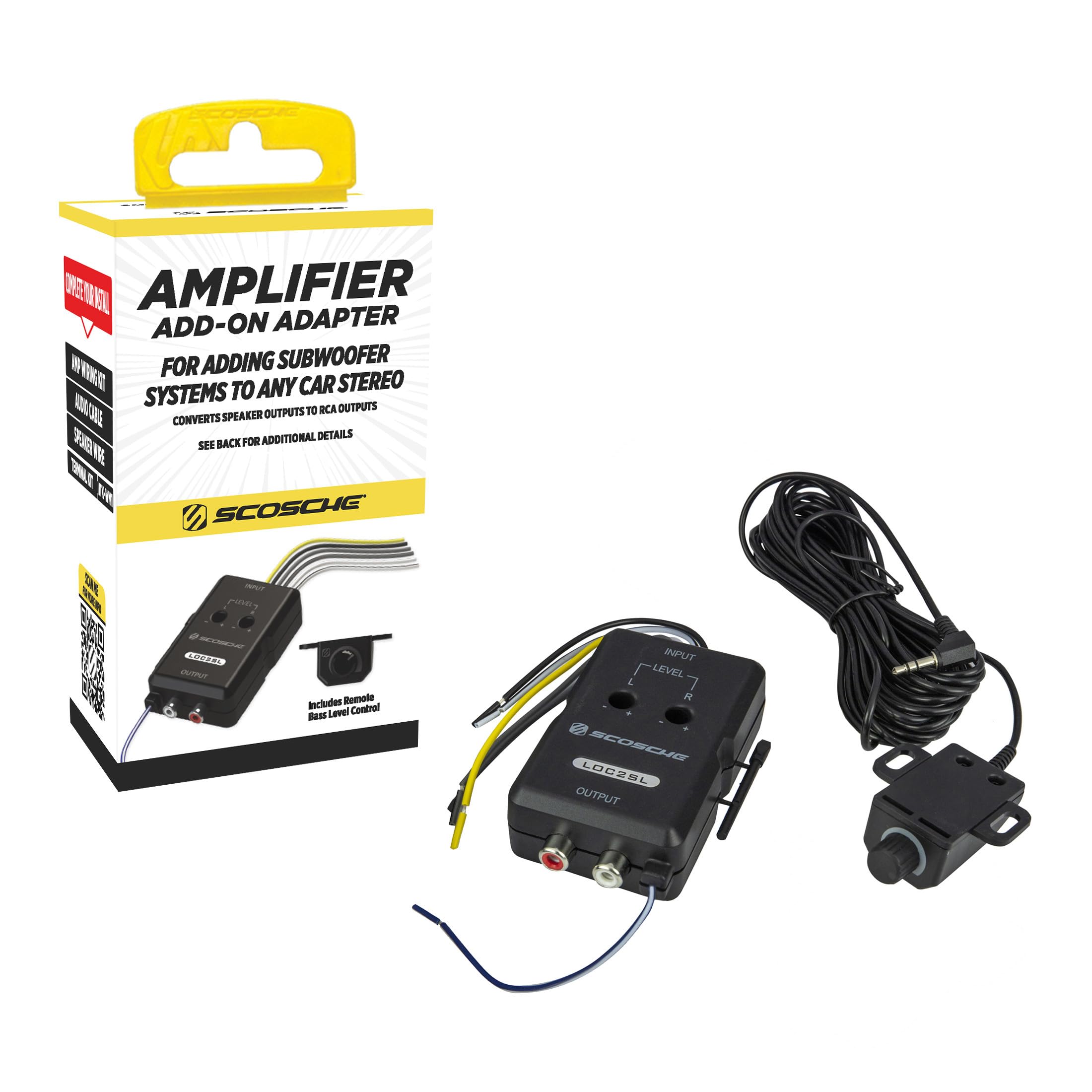
Scosche LOC2SL

89 /100
Sound Score Excellent

Key details

Channels
2-channel
Remote Turn-On
Yes
Gain Adjustment
Yes
Bass Restoration
None
View on Amazon

The LOC2SL combines a wired remote bass knob with a remote turn-on trigger in one budget-friendly package, setting it apart from bare-bones passive converters that only handle level matching. For a factory-stereo subwoofer addition, that removes the separate amp-turn-on hunt and puts sub control within reach of the driver. It is an affordable way to add an aftermarket sub amp without adding another box to the signal path.

Wiring labels and T-taps are included, so tapping factory speaker lines takes minimal fuss. The bass knob adjusts sub level directly, which helps when a playlist changes source material or a passenger wants less low end. The line-level output feeds aftermarket sub amps without extra processing. T-taps fit common factory wire sizes, making the connection process direct.

This is for budget installers adding an aftermarket sub amp to a factory stereo when remote turn-on is needed and the driver wants a bass knob in reach. The remote wire has been inconsistent in some vehicles, so test it before finalizing the amp trigger. Buyers expecting premium build quality in the controls should look elsewhere, but the tradeoff is acceptable when the install budget is the main constraint.

Pros

  • Works with factory stereos and aftermarket amps for subwoofer additions.
  • Wiring labels and T-taps simplify the connection process.
  • Wired bass knob puts sub level control at the driver's seat.
  • Delivers good value for a budget install.

Cons

  • Gain and bass knobs can feel fragile when adjusted; set them once and leave them.
  • Passive only, so factory bass roll-off remains uncorrected without an active processor.
Our verdict

For a factory-stereo subwoofer addition that needs a remote trigger and a reachable bass knob, this is the cost-effective part.

Check Latest Price
3

Best Simple Passive with Remote Trigger

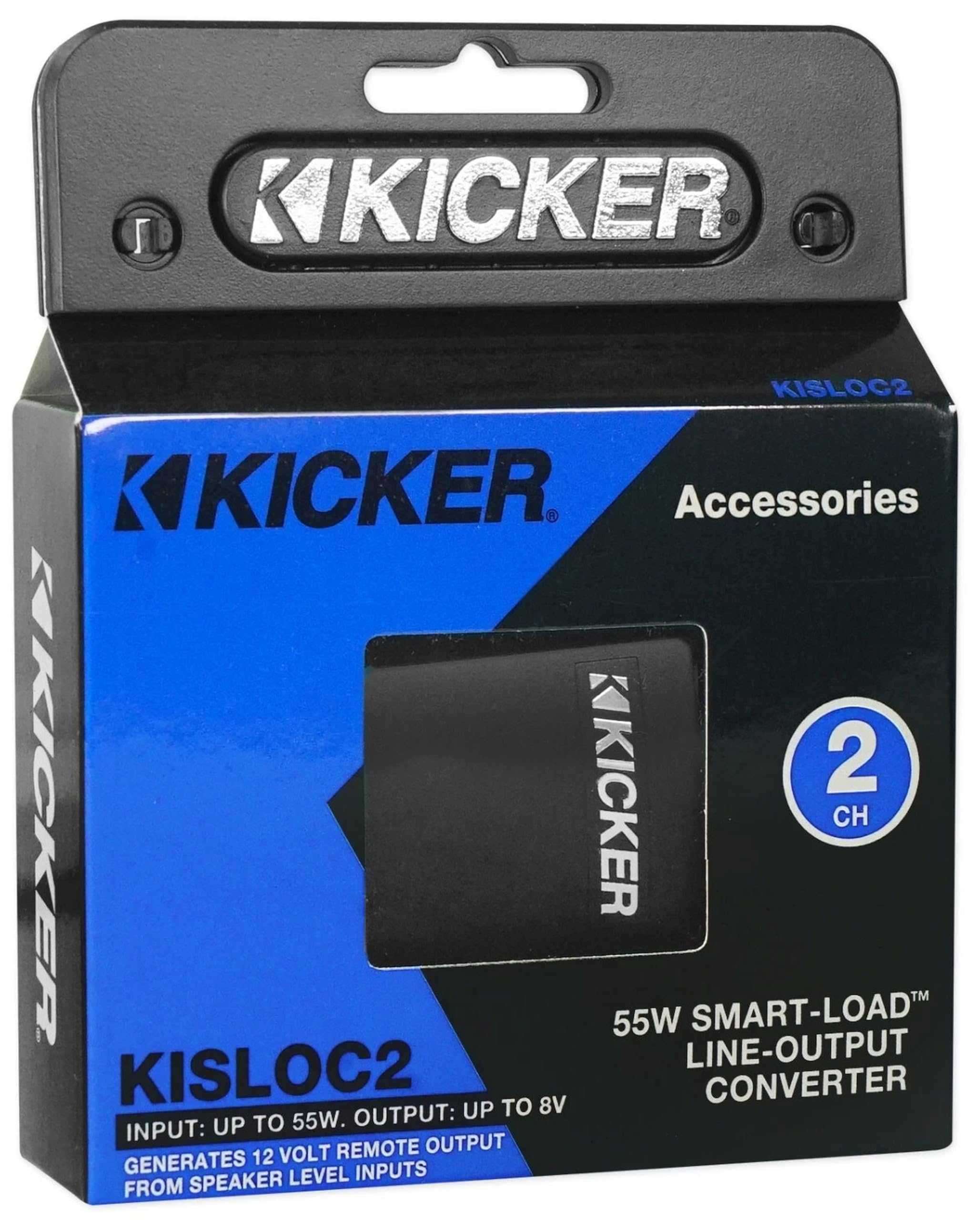
Kicker 46KISLOC2

91 /100
Sound Score Outstanding

Key details

Channels
2-channel
Remote Turn-On
Yes
Gain Adjustment
No
Bass Restoration
None
View on Amazon

The Kicker's defining feature is a built-in remote turn-on that reads DC offset from the speaker lines, so no separate trigger wire has to be routed to the amp. Speaker-wire inputs and RCA outputs cover the entire hookup, and the absence of gain dials keeps the install deliberately simple next to the adjustable passive converters in this class. The two-channel layout maps directly to a single subwoofer amplifier. No extra switches or level controls means there is nothing to misconfigure during the install.

That design pays off in installation speed. The converter pulls both signal and turn-on voltage from the same factory speaker wires, so there is no need to trace down a switched ignition source. The 100mA/12V remote output is sufficient for typical aftermarket amplifier trigger circuits, while the speaker-level input handles up to 55W per channel, safely within the range of standard factory head-unit outputs.

This is a budget addition for a factory radio that already delivers healthy signal to the subwoofer stage. It does nothing for severe factory bass roll-off — an active bass-restoring converter is required in that install.

Pros

  • Built-in remote turn-on reads DC offset, so no separate trigger wire is needed.
  • Speaker-wire hookup is simple
  • Works with newer factory radios and aftermarket amplifiers without extra processing.
  • Budget-friendly price leaves room for the amp and sub it will feed.

Cons

  • Fixed output with no gain adjustment means weak factory signals stay weak.
  • Remote turn-on can be inconsistent in some vehicles, leaving the amp on or not triggering at all.
Our verdict

The Kicker is the right pick when you want a self-generated amp trigger and a budget two-channel line-output converter.

Check Latest Price
4

Best Budget Adjustable Passive

PAC SNI-35

91 /100
Sound Score Outstanding

Key details

Channels
2-channel
Remote Turn-On
No
Gain Adjustment
Yes
Bass Restoration
None
View on Amazon

The PAC SNI-35 is a budget passive line output converter, not a bass-restoration processor. Transformer isolation and a variable level control give it the essentials for adding a subwoofer amp to a factory radio that already holds bass well.

It accepts speaker-level signal from the factory harness and sends an adjustable RCA signal to the amplifier. The two-channel design works with full-range stereo outputs, and the gain dial matches signal strength to amp sensitivity without requiring a separate processor. Transformer-coupled inputs keep ground-loop noise out of the signal path, so clean factory audio stays clean through the sub amp.

This is for budget buyers with a clean factory audio signal and an already-available amp turn-on trigger. It cannot restore bass roll-off, so systems that lose low end at volume point toward an active converter. The internal gain dials are adjustment pots, not bass knobs; set them once during install and leave them alone.

Build quality holds up at the price, and the converter stays out of the way once installed. Because it is passive, the sound quality tracks the factory signal; clean input produces clean output, and no processing is added.

Pros

  • Adds a subwoofer amp to a stock stereo with speaker-level inputs and no external processor.
  • Simple setup that installers can wire into a factory harness quickly.
  • Sound stays clean and low-noise when the factory signal is already clean.
  • Build quality is solid for the price, with transformer isolation doing the signal-lifting work.

Cons

  • No remote turn-on output; a separate remote wire or signal-sensing amp is needed.
  • A unit that is pushed hard or miswired can run hot and lose output.
Our verdict

The SNI-35 does its job without active processing, and its budget price leaves room for the amp and sub it feeds.

Check Latest Price
5

Best Premium with Remote Bass Knob

AudioControl LC2i PRO

91 /100
Sound Score Outstanding

Key details

Channels
2-channel
Remote Turn-On
Yes
Gain Adjustment
Yes
Bass Restoration
AccuBASS
View on Amazon

The PRO version of AudioControl's active LOC bundles the ACR-1 dash remote and load-selection switches, so the full integration toolkit is in the box before any extras are purchased. AccuBASS restores the low end that factory head units dial back as volume rises, which is the core reason to move beyond a passive converter. The standard LC2i covers that same bass restoration for less money, but the PRO's remote and load matching make it the complete package.

Adjustable load selection presents a 20Ω, 60Ω, or 20kΩ load to the factory amp, which keeps late-model systems stable while the PRO pulls signal. Ground isolation removes the noise that can appear when a car's head unit and aftermarket amplifier share imperfect grounding. On the sound side, the RCA outputs stay clean at high volume and the ACR-1 lets the driver adjust bass level without reaching into the trunk.

This unit is aimed at buyers working with factory-amplified systems who want one box to handle bass restoration, remote level control, and load matching. The premium price and occasional QC or shipping-damage issues are the boundary: as long as the unit arrives in good shape, it delivers; if those extras aren't needed, the standard LC2i is the leaner route.

Pros

  • Works with factory radios and aftermarket sub amplifiers without needing extra signal processing.
  • Included ACR-1 dash remote gives driver-level bass control without opening the amp rack.
  • Strong bass control and clean RCA output keep subwoofer integration simple.
  • Clear installation process and instructions reduce setup guesswork.

Cons

  • Premium price makes this overkill for simple two-wire subwoofer adds without remote or load-matching needs.
  • Scuffed faceplates or crackling output can appear on arrival or after install; inspect before mounting.
Our verdict

Factory-amplified cars with bass roll-off get the complete fix here, but only when the remote and load switches are actually part of the plan.

Check Latest Price
6

Best Value Active Bass Restoration

CT Sounds CT-LC2

87 /100
Sound Score Excellent

Key details

Channels
2-channel
Remote Turn-On
Gain Adjustment
Bass Restoration
BassLift
View on Amazon

Active BassLift restores the low end that factory stereos roll off as volume climbs, and the dedicated subwoofer output keeps the sub amplifier's signal separate from the full-range channels. That puts it in a different class from simple signal converters: it actively corrects the signal instead of just converting it. Its price undercuts premium active processors, making BassLift the core feature rather than an expensive add-on. For a single-subwoofer upgrade, this is the functional middle ground between a passive adapter and a full active processor.

The 34-page manual walks through speaker-level input, gain adjustment, and output hookup, so a first-time installer has a concrete reference instead of guesswork. The unit sends a clean, strong signal to aftermarket amps, and the full-range main output and low-pass bass output give the subwoofer amp its own signal path. That split lets the sub amp be set against the sub output and the main amp against the full-range output, which reduces the tuning compromises that show up when both amps share one pair of RCAs.

This is for buyers whose factory system has noticeable bass roll-off and who want active correction without flagship pricing. It also suits installers who want separate main and subwoofer outputs. Durability can vary between units, so it is not for anyone who puts a long-term reliability track record above all else; ultra-budget installs are better served by a simpler converter.

Pros

  • Active BassLift restores bass that factory stereos roll off, so low-end stays present at higher volumes.
  • Clean, strong signal to aftermarket amps helps subwoofer output avoid the weak-signal issue.
  • Good value for an active bass-restoration LOC, with the cost concentrated on low-end correction.
  • Detailed 34-page manual removes much of the guesswork from setup and tuning.

Cons

  • An occasional unit may develop noise or lose output after a few weeks.
Our verdict

Factory bass roll-off is the CT-LC2's target, and the dedicated subwoofer output keeps the install clean while holding the price below premium processors.

Check Latest Price
7

4-Channel Installs

Recoil LOC4

84 /100
Sound Score Excellent

Key details

Channels
4-channel
Remote Turn-On
Yes
Gain Adjustment
Yes
Bass Restoration
None
View on Amazon

Recoil's LOC4 is a budget-friendly way to convert four full-range speaker channels into RCA output for an aftermarket amp. The removable harness makes the wiring point easy to reach before the stereo slides back into the dash, and the adjustable gain lets you match the downstream amp without extra parts. This is a niche pick for factory stereos feeding all four corners, where a 2-channel converter would leave rear outputs unprocessed. If you are only adding a single subwoofer, a simpler 2-channel LOC is the better fit. Quality-control variance is the main reason this stays below the top two-channel LOC picks.

Pros

  • Removable harness makes reaching the adjustments easier once the stereo is out of the dash.
  • Four-channel conversion keeps rear speakers on separate RCA outputs for a full-range aftermarket amp.
  • Reduces hiss and speaker static in factory systems that have audible noise.

Cons

  • Signal clarity can vary between units, so some systems get reduced detail instead of full-range separation.
  • A rear channel can arrive without output, and RCA inputs can be non-functional in some units.
Our verdict

For a full-range factory system that already has decent bass and needs all four channels converted, this budget LOC gets the job done.

Check Latest Price
8

Passive Remote Trigger

PAC LP7-2

87 /100
Sound Score Excellent

Key details

Channels
2-channel
Remote Turn-On
Yes
Gain Adjustment
Yes
Bass Restoration
None
View on Amazon

The LP7-2 pairs a remote turn-on output with a single matched gain dial in a two-channel passive LOC. That combination gives an installer one less wire to run and one knob to balance, while keeping the factory radio as the source. It sits between the budget passive converter without a trigger and the active processors that reshape the signal. The durability variable keeps it out of the top tier: some units may lose output after extended use. If remote turn-on without active processing is the goal, this fits; buyers who need bass restoration or the cheapest passive LOC should look at those alternatives.

Pros

  • Remote turn-on output switches an aftermarket amp on with the car, saving a separate trigger wire.
  • Single matched gain dial keeps left and right channels balanced in one adjustment.
  • Works well for adding an aftermarket amp to a factory stereo without an active LOC.

Cons

  • Output voltage can land below what some amplifiers expect, so input gain needs attention.
  • Some units may stay on after key-off, which can drain the battery.
Our verdict

For an installer who has a clean factory signal and wants remote turn-on plus a matched gain dial without active processing, this is the right passive LOC. If your priority is the lowest price or bass restoration, choose the simpler passive or active option.

Check Latest Price
9

OEM Amp Systems

DS18 V2HL.V2

84 /100
Sound Score Excellent

Key details

Channels
2-channel
Remote Turn-On
Yes
Gain Adjustment
No
Bass Restoration
None
View on Amazon

The DS18 V2HL.V2 is a budget LOC with a speaker emulator that lets select factory-amplified systems keep their amp active while sending RCA output to an aftermarket amp. Signal-sense turn-on removes the need for a separate remote wire, and the compact metal housing installs cleanly in tight spaces. Its niche value is the simulated speaker load, not universal fit. The unit does not boost weak signals, and amp shut-off can be inconsistent in some vehicles. Bass roll-off correction is not included.

Pros

  • Emulated speaker load keeps select OEM amplifiers active during integration with an aftermarket amp.
  • Signal-sense activation removes the need for a separate remote turn-on wire.
  • Build quality holds up better than entry-level LOCs at a budget price.

Cons

  • Weak factory signals may remain below an amp's input sensitivity after conversion.
  • Amp shut-off can be inconsistent in some vehicles.
Our verdict

Buy this for a factory-amplified install where a simulated speaker load is required and the existing signal is already strong enough for the aftermarket amp.

Check Latest Price

How to Choose

Channel Count

A subwoofer amplifier only needs left and right RCA inputs, so a 2-channel LOC is the standard for bass add-ons. A 4-channel converter matters when you are powering an aftermarket amp that drives front and rear speakers.

The hidden cost of 4-channel conversion is complexity: two extra channels means more wiring, more gain pots, and more chances for noise to enter. Buy four channels only if the amplifier actually needs them.

Bass Restoration

Passive LOCs use resistors or transformers to reduce speaker-level voltage to preamp level. They pass the signal through without changing frequency response. If the factory radio cuts bass at high volume, a passive LOC sends exactly that bass-reduced signal to the amp.

Active LOCs with AccuBASS or BassLift detect the roll-off and add the missing low end before the amplifier sees it. That is why a subwoofer install sounds noticeably better with an active unit when the stock radio already weakens bass.

Remote Turn-On

An amplifier needs a 12V trigger to wake up. Some LOCs create that trigger by sensing DC offset in the speaker wire; others use a signal-sensing circuit. Both work until a modern factory radio keeps the audio circuit alive or produces a voltage that confuses the sensor.

A dedicated remote wire from the ignition or head unit is the most predictable fallback. If you cannot run one, choose an LOC with a genuine remote output and check shut-off behavior before reassembling the dash.

Gain Adjustment

Adjustable gain matches the LOC's output voltage to the amplifier's input sensitivity. Set it too low and the sub sounds weak; set it too high and the signal clips. Fixed-output LOCs skip this step but leave no way to compensate for a weak factory signal.

Budget gain dials are set-and-forget parts. Adjust once, verify with a multimeter or by ear, then leave them alone; repeated twisting is what wears out small potentiometers.

Factory Amplifier Load Matching

Late-model factory amplifiers can detect a missing or wrong load and respond with shutdown, warning tones, or uneven output. A load-matching LOC presents the correct impedance to the factory amp so it keeps operating normally while delivering RCA signal to the aftermarket amp.

Cars with factory-amplified systems should be treated as a separate install category. Confirm whether the LOC includes load selection or speaker emulation before wiring anything.

Frequently Asked Questions