9 Best Marine Stereo 2026: Reliable Bluetooth That Lasts

Find a marine stereo with dependable Bluetooth, readable displays, and real water protection for your boat.

A marine stereo has one job that matters more than wattage: keep playing music on the water without dropping your phone or dying after a season. Budget listings often promise marine-grade weather protection, but the real difference shows up in how the circuit board is coated, how the display behaves in direct sun, and whether Bluetooth reconnects when you return to the boat.

The reliable options sit in the middle of the market, where established audio brands apply conformal-coated boards, readable displays, and tested Bluetooth. The cheapest units can work for casual use, but their failure rate makes them a gamble. The premium route buys multi-zone control and IPX7 protection, which matters most on larger boats with separate helm and stern listening areas.

The right choice depends on your boat layout, whether you need CD playback, and how much you are willing to spend for water resistance. This guide sorts those trade-offs by use case so you can match the receiver to the boat, not the other way around.

About the Sound Score: This comparative score is calculated from a product's published customer rating and review volume. It is not a laboratory measurement or a hands-on test result.

1

Best Overall

Kenwood KMR-M332BT

84 /100
Sound Score Excellent

Key details

Display
Sunlight-readable
Sources
USB, AUX, AM/FM
Bluetooth
Yes, external mic
Power Output
200W peak
View on Amazon

The KMR-M332BT handles wet, sunny boat consoles with a conformal-coated circuit board and a high-contrast black-on-white display that stays readable in direct sunlight. The 200W peak four-channel amplifier delivers balanced, powerful sound, which gives a basic two-speaker setup clean volume and enough headroom to fill an open deck. USB, AUX, AM/FM, SiriusXM-ready input, and FLAC playback cover the everyday sources a boater actually uses.

Bluetooth pairing with iPhones is quick and steady, and the included external microphone keeps hands-free calls audible over engine noise. The weatherproof build handles the humidity that collects inside a boat console, and the four-channel output drives two pairs of speakers without strain. Sound stays balanced at higher volumes, which matters when wind and wave noise force you to push the system. That kind of consistency is why it earns a spot as the boat's main stereo rather than a temporary gadget.

This receiver suits boat owners who want a purpose-built marine Bluetooth unit instead of a car stereo mounted where water can reach. It is not for CD collections or for boats that need independent helm and stern zones; those buyers should look at a CD-equipped Kenwood or a two-zone receiver. DIY installers will appreciate the included mic and the labeled wiring, which reduce extra purchases and take the guesswork out of matching power, ground, and speaker leads. The single-DIN body fits standard cutouts, so the swap follows a familiar stereo-install pattern.

At a mid-range price, the Kenwood sits between budget units that treat marine coating as an afterthought and premium receivers that add DSP and zone control. It includes the external mic that some competitors leave as an add-on, while the 2.5V rear and sub preouts make adding an amp or sub later easy. It avoids the app dependency that some premium models require, which suits boaters who do not want to control music from a phone. That focus on useful extras over gimmicks is what separates it from lower-priced marine stereos.

The KMR-M332BT does not chase spec-sheet numbers, and that is to its advantage on a small boat. A clean amplifier section and simple controls add up to a stereo that behaves predictably season after season. It is not the flashiest unit on the market, but it gets the fundamentals right without making you pay for extras you may never use. That kind of restraint is rare in this category. For boat owners who want set-and-forget performance, this Kenwood fits better than a feature-heavy receiver that costs more.

Pros

  • Balanced 200W audio with enough output for open-deck listening and room for amp expansion later.
  • High-contrast black-on-white display stays readable in direct sunlight.
  • Conformal-coated circuit board and weatherproof build handle damp boat consoles.
  • Bluetooth pairing with iPhones is easy and steady, with external mic included for hands-free calls.
  • DIY-friendly wiring makes installation manageable without professional help.

Cons

  • Controlling the stereo from the stern requires Kenwood's optional wired remote; the face buttons only work from the helm.
  • Menu and settings navigation can feel dated, and adjusting audio options may require patience.
Our verdict

Boaters who need a weather-resistant single-zone receiver with Bluetooth, USB, AM/FM, and amp expansion will find this Kenwood a capable fit at a mid-range price.
Check Latest Price
2

Best Value Mainstream

Sony DSXM55BT

84 /100
Sound Score Excellent

Key details

Display
Sources
USB, AUX, AM/FM
Bluetooth
Yes, NFC
Power Output
55W x 4
View on Amazon

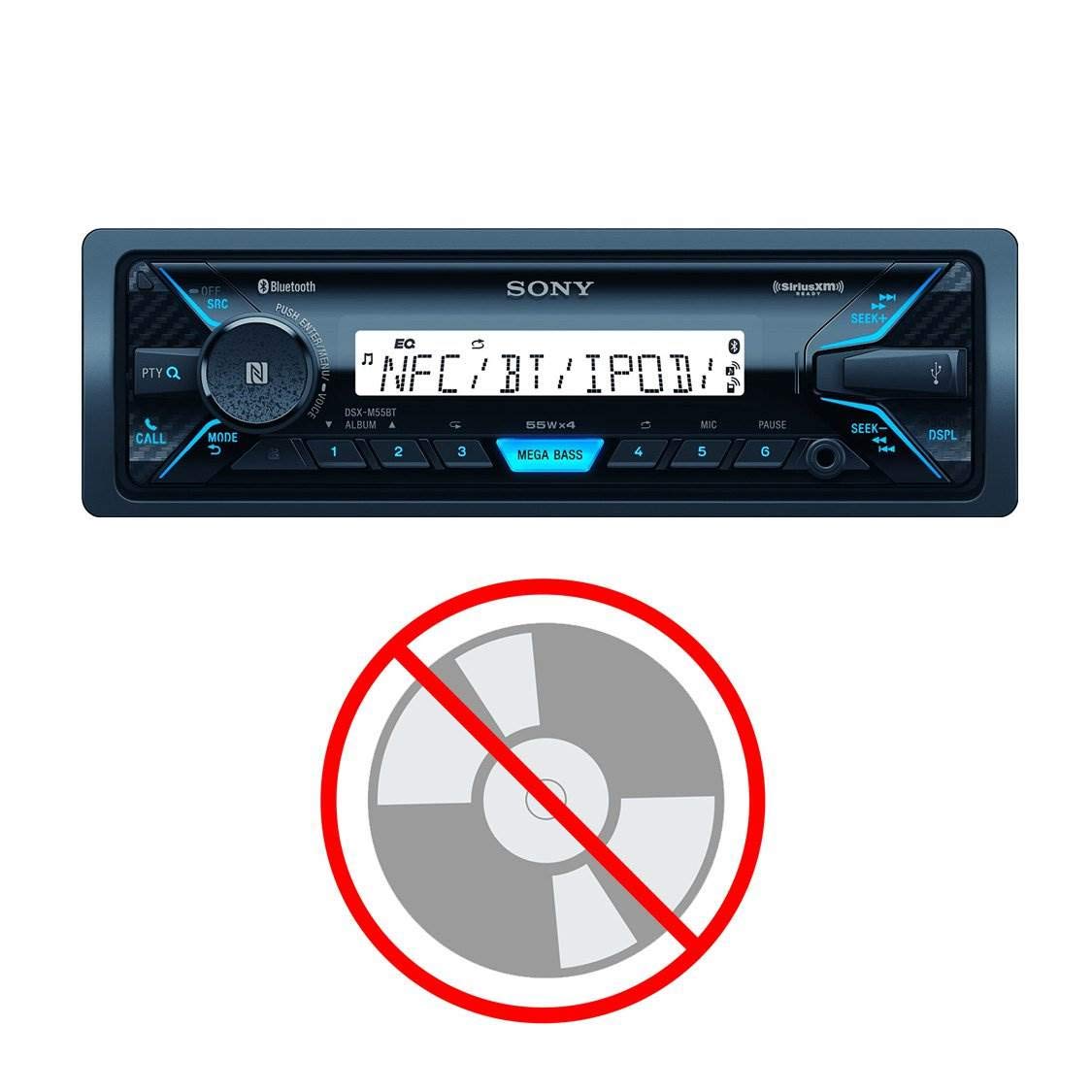
The Sony DSXM55BT delivers strong, bass-friendly sound with a wiring and mounting process that fits most boat dashboards without fuss. Siri and NFC one-touch pairing are built into the same unit that plays USB, AUX, AM/FM, SiriusXM, and Pandora, so a phone-first boater can keep the interface simple. At a mid-range price, it undercuts the top-pick Kenwood while keeping Sony's recognizable tuning.

Clear output with the bass boost engaged is the signature, and the included wireless remote keeps source changes handy at the helm. The marine digital media receiver does not carry an explicit IP rating, so it belongs behind a covered helm rather than fully exposed to spray. Button response and Bluetooth connection are the variables to check before install; some units may require a firmer press on the face buttons, and a saved phone can drop its pairing after a power cycle.

This receiver suits a budget-minded boater replacing an old head unit who wants Sony sound in a simple single-DIN swap. It also suits iPhone users who lean on Siri and don't need a touchscreen or heavy DSP tuning. It is not the pick for buyers who need flawless Bluetooth on every outing or want the same button feel from every unit; durability can vary between units, and a fully exposed saltwater console is a better fit for an IP-rated receiver.

💡 Use NFC one-touch pairing to re-pair your phone quickly after a power cycle.

Pros

  • Strong, clear sound with good bass boost for the price.
  • Mounting and wiring are practical for a single-DIN replacement.
  • Good build quality for a mid-priced marine receiver.
  • Siri and NFC support a simple phone-focused setup.

Cons

  • Button response can vary between units, so some controls may need a firmer press.
  • Bluetooth pairing can be inconsistent; a saved phone may need re-pairing after a power cycle.
  • Durability can vary between units after a season of use.
Our verdict

This is the value-priced Sony for a simple covered-helm boat upgrade where sound and budget matter more than connection certainty.

Check Latest Price
3

Premium Pick for Multi-Zone Simplicity

Fusion MS-RA70

88 /100
Sound Score Excellent

Key details

Display
Monochrome LCD
Sources
AM/FM, USB, AUX
Bluetooth
Yes, app support
Power Output
50W x 4
View on Amazon

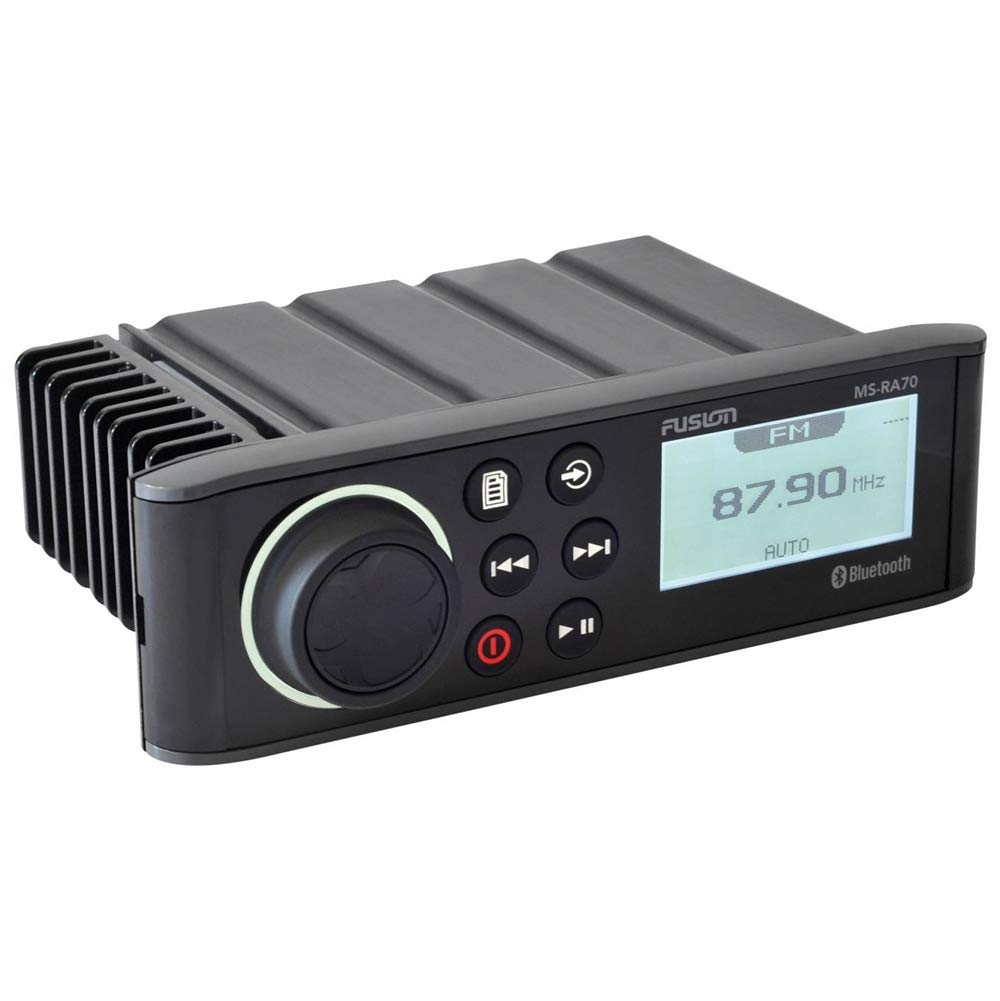
Fusion's MS-RA70 puts IPX7 water resistance and two-zone audio ahead of processing features. The physical button layout lets you change sources and adjust helm or stern volume without hunting through menus. It is the simpler, more direct option in Fusion's marine lineup, and the monochrome display keeps the front panel uncluttered.

Sound quality is strong for a marine receiver, with clean Bluetooth streaming and clear FM reception. Bluetooth pairing is quick, and the four 50-watt channels provide adequate output for small and mid-size boats. Installation is manageable for a typical owner, and the unit's fit and finish feel solid. The optically bonded monochrome LCD stays readable in direct light, and the Fusion-Link app adds optional wireless control without becoming necessary.

This receiver fits owners who want a hosedown-safe head unit with separate helm and stern zones and no need for extensive menu time. There is no built-in DSP or deep EQ; sound shaping is basic, so the right buyer accepts that boundary and focuses on the water-resistance and zone control benefits. For that profile, the MS-RA70 is a high-confidence pick within Fusion's marine line.

Pros

  • IPX7 water resistance tolerates direct spray and rinse-down cleaning.
  • Two-zone audio lets helm and stern run at separate volumes.
  • Sound quality is strong for open-boat listening.
  • Physical controls keep source changes and volume adjustments easy.

Cons

  • Premium pricing sits above entry-level marine receivers.
  • File compatibility and app-control quirks can appear with the Fusion-Link app or non-standard USB files.
Our verdict

For boat owners who prioritize water resistance and independent zone volume, the MS-RA70 delivers both with minimal fuss.

Check Latest Price
4

Best with CD Player

Kenwood KMR-D382BT

82 /100
Sound Score Excellent

Key details

Display
Small display
Sources
CD, USB, AUX
Bluetooth
Yes, dual phone
Power Output
50W x 4
View on Amazon

CD playback plus 13-band EQ and two concurrent phone connections make this Kenwood the step-up marine deck for buyers who want more than the top pick's basic feature set. The conformal-coated board and water-resistant face give it a place at an open helm, while the CD slot keeps physical albums in play and the dual-phone link lets a second crew member stay paired without kicking the first phone offline.

Sound quality holds up at cruising speed, with clean highs and enough amplifier output to drive a pair of marine speakers. The 13-band EQ, Digital Time Alignment, and Drive EQ cover tuning range normally reserved for separates, and installation is simple enough for a weekend project in a standard DIN opening. That combination matters for buyers adding a small amp and component speakers, since the head unit can handle the crossover work instead of relying on the amp's limited controls.

This is a good match for boaters who still own CDs, want two crew phones paired at once, or run a small amplifier and need fine EQ control. The tradeoff is the interface: the display is small, button labels are tightly packed, and durability can vary between units, so a covered helm or canvas shield is worth including in the install.

💡 Reset the clock and source presets while docked before you head out.

Pros

  • CD slot keeps a physical music library usable on the water.
  • Audio stays clear at speed, with clean highs for marine speakers.
  • Two phones can connect at once for shared helm duties.
  • Installation is manageable in a standard DIN opening with basic wiring.

Cons

  • Clock drift can be noticeable, so an occasional reset is part of ownership.
  • Bluetooth-only buyers will pay for CD and deep EQ they do not need.
Our verdict

For CD-carrying boaters who want 13-band EQ and two phones paired at once, this Kenwood is the step-up worth taking.

Check Latest Price
5

Best Compact Gauge-Style

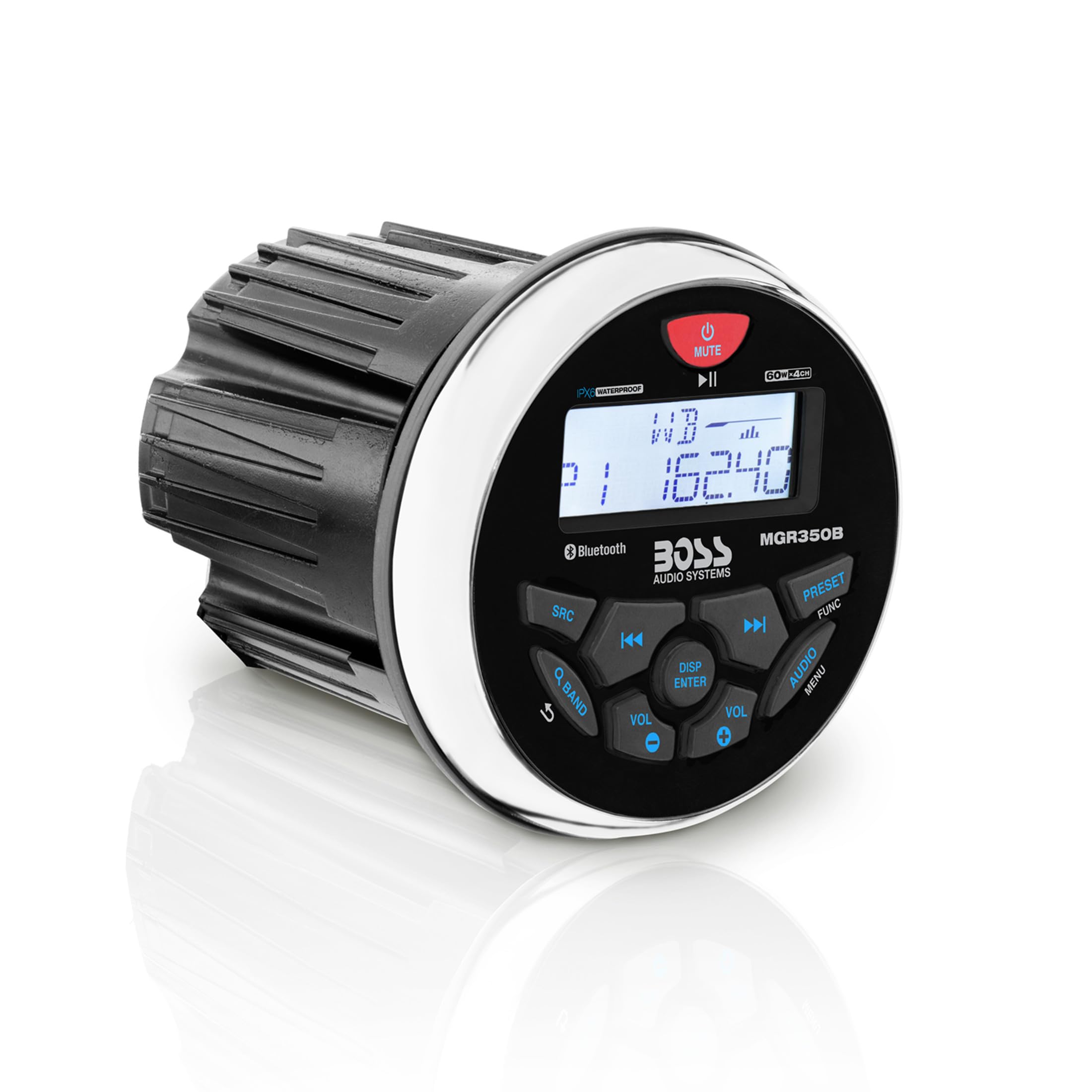
BOSS MGR350B

88 /100
Sound Score Excellent

Key details

Display
Gauge display
Sources
Bluetooth, USB, AUX
Bluetooth
Yes, app control
Power Output
240W peak
View on Amazon

The MGR350B fits a 3-inch gauge opening and packs its own 240W peak amplifier, so boats without a standard DIN slot can still get a Bluetooth/USB receiver in the dash. IPX6 front protection and a conformal-coated PC board take the edge off marine humidity, and the compact body leaves room for other gauges. Sound stays clear at moderate volume, with enough output to drive small cabin speakers without an external amplifier.

Installation is manageable for a DIY owner: wire power, ground, and speakers, then mount the gauge in a 3-inch hole. Controls are minimal, so operation at the helm does not require digging through menus. Bluetooth pairing works cleanly for music streaming, and the USB and AUX inputs cover secondary media without relying solely on a phone connection.

This receiver is for boats with gauge-cluster dash space and a simple stereo need. The 3-inch mounting footprint is the main fit requirement; a traditional DIN opening is not compatible. It also suits owners who prefer to choose their own speakers rather than buy a bundled kit, and the built-in amp keeps the extra gear to a minimum.

Pros

  • Compact gauge-size housing fills a 3-inch dash opening where DIN receivers cannot fit.
  • Sound quality stays clean at normal listening levels from a very small footprint.
  • Installation is a simple wiring and mounting job for a boat owner with basic tools.
  • Bluetooth connects cleanly for music streaming and app control from your phone.

Cons

  • Condensation can build up behind the display in humid conditions.
  • Long-term durability can vary between units.
Our verdict

This is the receiver-only route for gauge-cluster dashboards that need IPX6 protection and built-in amplification without DIN space.

Check Latest Price
6

Tuning and Backup Cam

JVC KD-X560BT

80 /100
Sound Score Excellent

Key details

Display
Sources
USB, AUX, BT
Bluetooth
Yes
Power Output
View on Amazon

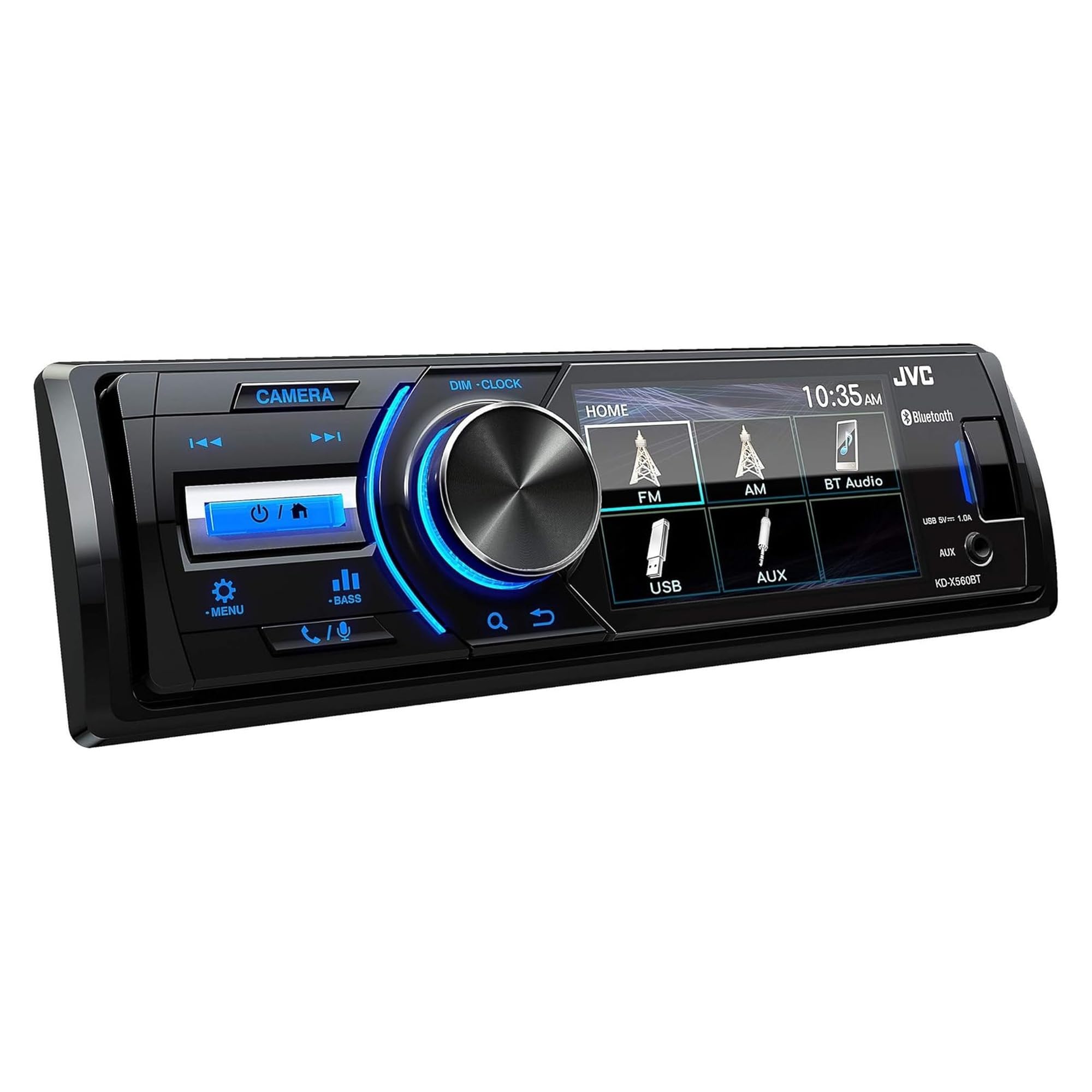
The JVC KD-X560BT is a tuning-first marine receiver: 13-band EQ, time alignment, three preouts, and a rear camera input pack strong control into a mid-range single-DIN unit, with Bluetooth, USB, and AUX covering the basics. Installation is simple for DIY boaters, and sound quality holds up. The menu takes time to learn, and random reboots or memory resets can occur — a real consideration if you depend on the clock or station presets. That keeps it below the top pick, but for value-driven tinkerers planning an amp build, the tuning tools and preouts still carry the day.

Pros

  • 13-band EQ, time alignment, and rear camera input deliver serious tuning and wiring capability for the price.
  • Three preouts make this a practical anchor for an amplifier-driven boat system.
  • Installation goes quickly for DIY boaters, cutting build time on a boat console.

Cons

  • For direct-sun helms, the compact display may wash out.
  • In fully exposed helm duty, the conformal-coated board is not a substitute for a submersion-rated chassis.
Our verdict

For a value-driven tinkerer planning an amp and rear-camera wiring, the KD-X560BT is the right call.

Check Latest Price
7

Smart-Connected Boaters

Pioneer MVH-MS512BS

83 /100
Sound Score Excellent

Key details

Display
Sources
USB, AM/FM, SXM
Bluetooth
Yes
Power Output
4V preouts
View on Amazon

Alexa and Smart Sync set this Pioneer apart from conventional marine radios, and the three 4V preouts give it real headroom for adding an external amplifier. The conformal-coated circuit board is appropriate for open-air boat installations, while USB auto switch makes switching to a connected USB source automatic. Long-term durability in a marine environment is less established than with the top pick. This is best for tech users and powersports crossover buyers who want voice-assistant access and external amp output.

Pros

  • Alexa/Smart Sync control from a paired phone brings hands-free voice commands to the helm.
  • Three 4V preouts give a clean path for adding an external amplifier.
  • USB auto switch simplifies moving between connected media devices.

Cons

  • Compact display suits basic station and readout duty rather than large color album art or visual menus.
  • Alexa voice commands require a paired phone and the Smart Sync app, so a phone-free install loses that feature.
Our verdict

Choose this Pioneer when Alexa control and 4V preout headroom are the priority and the install is a covered helm rather than a fully exposed marine console.

Check Latest Price
8

DSP and Color Display

Fusion MS-RA210

88 /100
Sound Score Excellent

Key details

Display
Color LCD
Sources
AM/FM, USB, AUX
Bluetooth
Yes, app support
Power Output
50W x 4
View on Amazon

The Fusion MS-RA210 brings built-in DSP, an optically bonded color LCD with album art, and multi-zone control to a marine receiver, all wrapped in an IPX6/IPX7 housing. For Garmin-oriented boaters, Fusion-Link and chartplotter integration make this a natural cabin-mate for existing navigation gear.

Menu navigation and Bluetooth pairing can be unintuitive, and occasional signal drops are possible, which makes the higher price over the MS-RA70 harder to overlook. Buyers who want plain controls or a lower entry price are better served elsewhere; this unit targets music-focused owners who will actually use its DSP.

Pros

  • Built-in DSP and optically bonded color LCD make sound shaping and album art easy to see.
  • Garmin/Fusion ecosystem integration allows audio control from chartplotter and Fusion-Link app.
  • Multi-zone output and SiriusXM-ready inputs handle separate helm and stern listening.

Cons

  • Bluetooth streaming can be interrupted by an occasional signal drop during longer listening sessions.
  • Menu navigation and phone pairing can be unintuitive enough to require the manual on first setup.
Our verdict

If you already run Garmin gear and want DSP-driven sound plus a color display, the MS-RA210's premium price buys a music-focused helm. Without that ecosystem, the non-DSP sibling covers most marine basics for a lower entry cost.

Check Latest Price
9

Complete Bundle

BOSS MCKGB350W.6

91 /100
Sound Score Outstanding

Key details

Display
Gauge display
Sources
BT, USB, AUX, NOAA
Bluetooth
Yes
Power Output
180W total
View on Amazon

This bundle answers the speaker-matching problem in one box: a gauge-style marine receiver, two weatherproof 6.5-inch speakers, Bluetooth/USB/AUX/AM-FM, and NOAA weather band all arrive together. The receiver fits a standard 3-inch opening, and the included antenna covers both radio and weather alerts. Installation suits a pontoon or small-boat console without extra purchases.

Moisture can condense behind the display in humid marine air, so a covered helm is the natural setting. Durability can vary between units, and the all-in-one approach prioritizes simplicity over component flexibility. Those boundaries keep it below receiver-only picks for buyers who want to match their own speakers.

Pros

  • One-box kit includes receiver, two weatherproof speakers, antenna, and NOAA radio.
  • Installation is a simple hookup for pontoon and small-boat consoles.
  • Bundle value beats buying receiver and speakers separately.

Cons

  • Bundled speakers are entry-level; critical listeners will want separate components.
  • The receiver is not sold alone in this package for buyers who already own speakers.
Our verdict

For pontoon and small-boat owners who want a single-box stereo with Bluetooth, NOAA weather, and speakers included, this kit works — provided a covered helm and no expectation of component-grade sound.

Check Latest Price

How to Choose

Water Resistance

Marine stereos rely on two forms of protection: conformal-coated circuit boards and IP water-resistance ratings. A conformal coating is a thin polymer layer that shields the board from humidity and splash, while an IP rating like IPX6 or IPX7 tells you how much direct water the faceplate can handle.

An IPX7 receiver like the Fusion MS-RA70 can survive submersion in a meter of fresh water for 30 minutes, which suits open consoles and boats without a full helm cover. IPX6 handles powerful jets but not immersion. If your boat has a covered helm, a conformal-coated board is often enough; if the stereo sits fully exposed, prioritize a true IP rating.

Bluetooth Reliability

Bluetooth problems on boats usually come from pairing memory, antenna placement, and phone compatibility rather than raw range. A receiver that forgets pairings or requires manual re-pairing after every power cycle becomes a daily annoyance, especially on a boat where the phone stays in a pocket or dry bag.

Look for receivers with external mics, clear pairing feedback, and support for dual phone connections if you regularly have a second phone on board. NFC one-touch pairing helps on Sony models, but the more important feature is consistent reconnection when the receiver powers on.

Power and Preamp Outputs

Built-in amplifier power is usually quoted as peak wattage, which sounds impressive but does not reflect continuous output. A 200W peak receiver typically delivers around 20W RMS per channel, enough for two pairs of marine speakers at moderate volume but not for rock-the-cove parties.

If you plan to add an external amplifier later, check for preamp outputs and their voltage. Three pairs of 4V preouts, like the Pioneer MVH-MS512BS offers, make system expansion straightforward; a receiver with only one pair of 2V preouts limits your flexibility.

Display Readability

Direct sunlight washes out many LCD screens, especially budget units with low brightness. A high-contrast black-on-white display, like the Kenwood KMR-M332BT, remains legible in bright conditions, while cheaper vertical LCDs often become unusable at midday.

Some gauge-style BOSS receivers develop condensation behind the display in humid conditions, which can obscure the screen even when the receiver works fine. If your boat sits in a wet environment, choose a display with proven sunlight visibility and consider how the mounting angle affects glare.

Media Sources

Bluetooth streaming covers most modern listening, but source support still matters for specific buyers. USB ports with 2.1A charging let you power a phone while playing FLAC files; AM/FM matters for coastal weather reports; SiriusXM-ready models require an additional tuner module.

CD playback is increasingly rare in marine stereos, which is why the Kenwood KMR-D382BT stands out for boaters with disc collections. If you do not need CDs, a digital media receiver saves space and removes a mechanical component that can fail in a marine environment.

Frequently Asked Questions