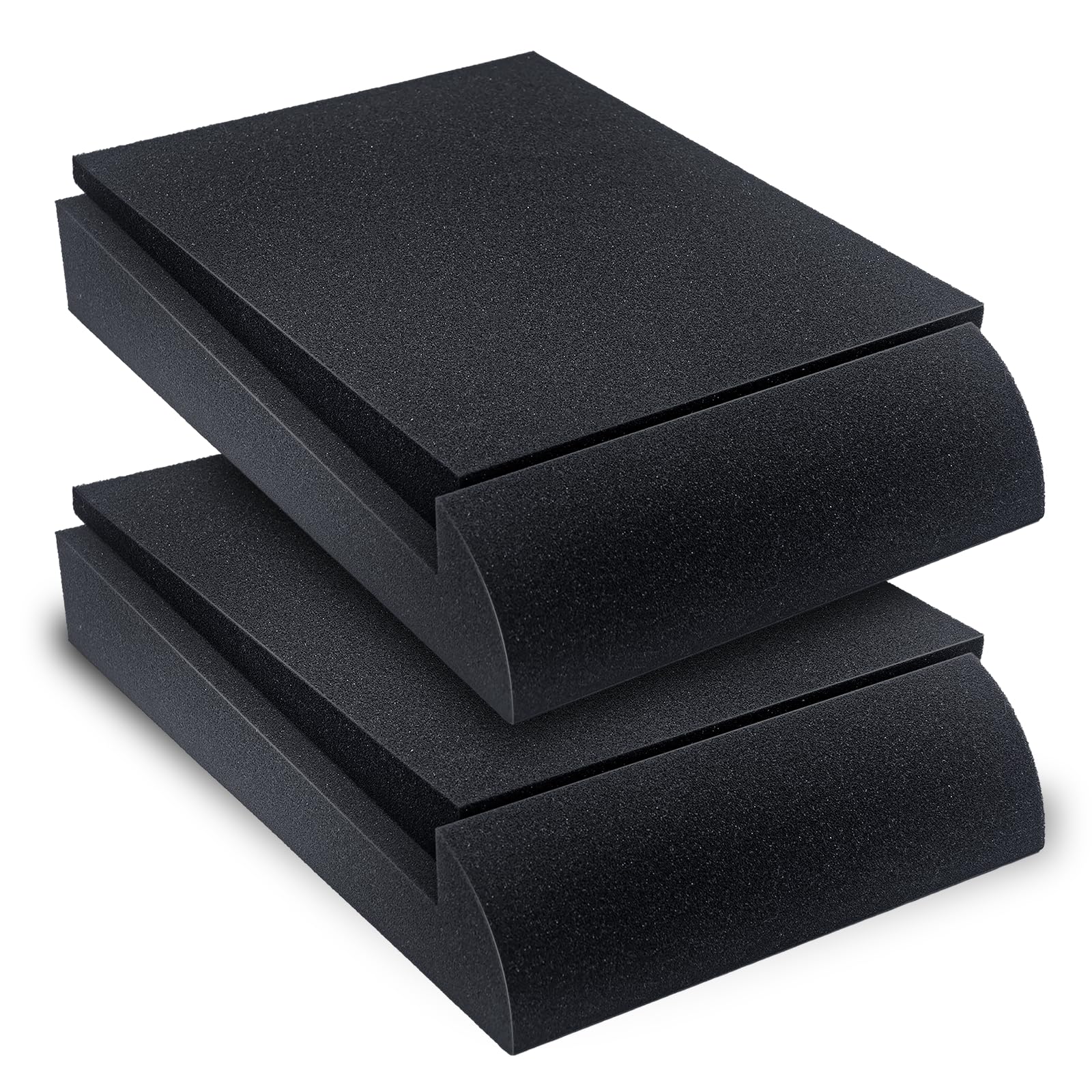
14 Best Speaker Isolation Pads of 2026: The Ones That Tighten Bass

Speaker isolation pads matched to your setup — foam wedges for monitors, feet and platforms for subs — for tighter bass, less rumble.

Most isolation-pad listings overpromise with terms like 'soundproofing' and 'superior isolation.' What these products actually do is decouple a speaker from its surface: vibration stops travelling into the desk, shelf, or floor, which tightens bass and reduces rattles. The room stays as loud as it was; the sound simply gets cleaner.

The right choice depends on what you are supporting. Dense foam wedges suit 3-5 inch monitors and bookshelf speakers on desks, adding tilt while absorbing vibration. Subwoofers need something stronger: screw-in feet, a rigid platform, or a stand with enough load capacity to manage the cabinet's weight and energy.

Match the isolator to the speaker size and mounting style, not the marketing language. A premium mechanical puck can be transformative on one setup and unnecessary on another; the deciding factor is how much vibration your surface actually picks up.

About the Sound Score: This comparative score is calculated from a product's published customer rating and review volume. It is not a laboratory measurement or a hands-on test result.

1

Best Overall

Sound Addicted SMPad 4

96 /100
Sound Score Outstanding

Key details

Installation
Place under speaker
Isolation Type
Dense foam wedge
Pad Dimensions
6.3x8x1.4 inches
Size And Weight
3-4.5-inch monitors, 16 lb
View on Amazon

The SMPad 4 uses 50kg/m³ acoustic foam to hold 3-4.5-inch monitors steady while absorbing the desk vibration that blurs low-end detail. Five tilt positions let you aim tweeters toward ear level, and the foam's density resists compression even after hours of sustained use. The result is a noticeably cleaner low end on crowded desktop surfaces.

Desktop producers with compact near-field monitors will hear the difference as tighter bass and less rattling from the desk surface underneath. The 6.3 x 8-inch footprint fits common models like the Yamaha HS3/HS4, and the 16 lb capacity matches this small-speaker class. Angled configurations help when desk height doesn't naturally place tweeters at ear level, which matters when smaller monitors sit on deeper desks. That combination keeps smaller monitors stable even at higher listening volumes.

Desktop producers and bookshelf speaker owners working with 3-4.5-inch monitors are the right audience. Pair sizing can occasionally be inconsistent, so inspect both pads when unpacking. The SMPad 4 delivers the core benefit of vibration isolation without the premium of a rigid mechanical platform, making it a sensible first studio purchase when the budget is tight.

Pros

  • Dense 50kg/m³ foam keeps compact monitors stable and resists compression under speaker weight.
  • Reduces desk vibration and low-frequency smearing in small near-field setups.
  • Five tilt positions provide flexible tweeter aiming for budget studio builders.

Cons

  • Buyers with 5-inch monitors or subwoofers will find the 16 lb capacity and 6.3 x 8-inch footprint too small.
  • In some cases, one pad can measure slightly smaller than the other, leaving a speaker at a minor angle.
Our verdict

For compact desktop monitors, the SMPad 4 is the practical way to clean up speaker-to-desk coupling without moving to a rigid isolation platform.

Check Latest Price
2

Best Budget Pad

JBER 2-Pack Isolation Pads

94 /100
Sound Score Outstanding

Key details

Installation
Place under speaker
Isolation Type
Dense foam wedge
Pad Dimensions
8x6.3x1.4 inches
Size And Weight
3-4.5-inch monitors, 22 lb
View on Amazon

Near-identical to the top pick in foam density and tilt design, the JBER pad delivers the same basic isolation experience for a smaller outlay. The 50kg/m³ wedge has five adjustable angles and a 22 lb capacity, which covers typical 3-4.5-inch studio monitors while keeping vibration from passing into desks and walls.

This pad suits desktop producers who want adjustable tilt and less low-end smear without paying premium prices. The isolation benefit is desk/floor vibration control, not room soundproofing; anyone expecting acoustic-panel behavior should look at a different product class.

Pros

  • Build quality is strong for the price.
  • Costs well below premium isolation pads while matching their core function.
  • Keeps desk and wall vibration down at higher listening levels.

Cons

  • Buyers needing a 9x12-inch surface should choose a wider riser.
  • Load rating and 8-inch footprint make subwoofers and floor-standing speakers out of scope.
Our verdict

For small-monitor owners who want the essential isolation features without the premium markup, this is the value play in the category.

Check Latest Price
3

Best Subwoofer Feet

SVS SoundPath 4-Pack

96 /100
Sound Score Outstanding

Key details

Installation
Screw-in mounting
Isolation Type
Screw-in elastomer feet
Pad Dimensions
Size And Weight
View on Amazon

Steel-shell elastomer feet mount directly into a subwoofer's threaded inserts, so the cabinet is mechanically decoupled from the floor without the footprint of a platform. The supplied screws cover the common 1/4-20 insert size, and the most noticeable result is cleaner bass and less rattle transferred to walls.

This set suits subwoofer owners with 1/4-20 threaded inserts who want feet rather than a platform, especially in apartments and rooms with hard floors. The full benefit depends on having those inserts; the adhesive fallback extends basic compatibility to other cabinets.

💡 Use the included screws with 1/4-20 inserts when available.

Pros

  • Tightens bass response and reduces boom in rooms with hard floors.
  • Steel shell and elastomer core give a solid feel once mounted.
  • Cuts floor and wall vibration, so neighbors hear less structure-borne thump.

Cons

  • On subs without threaded inserts, the adhesive mount is less secure than the screw-in fit.
Our verdict

The right pick for threaded-insert sub owners who want low-profile isolation feet rather than a platform.

Check Latest Price
4

Best Subwoofer Platform

Sound Addicted VibeBoss P10

91 /100
Sound Score Outstanding

Key details

Installation
Place under subwoofer
Isolation Type
MDF/EVA foam platform
Pad Dimensions
13.7x15.7x2.5 inches
Size And Weight
165 lb, 8-10-inch subs
View on Amazon

The VibeBoss P10 is a rigid MDF platform with EVA and high-density foam layers, rated for 165 lb and sized at 13.7 by 15.7 inches for 8-10-inch subwoofer cabinets. That construction places it a step above foam wedges aimed at small monitors, giving it enough surface area and load capacity for subwoofer duty.

Apartment and condo listeners running a subwoofer in this footprint get tighter bass and less floor thump. The platform substantially reduces structure-borne bass, which is the practical benefit in shared-wall spaces. The surface holds the cabinet steady, and the low profile fits easily into crowded AV setups.

Pros

  • Tightens bass response and improves clarity on 8-10-inch subwoofers.
  • Reduces floor vibration enough for apartment and shared-space listening.
  • Stable 165 lb-rated platform keeps subwoofers planted.

Cons

  • Very high-output subwoofers may still transfer some vibration to the floor.
Our verdict

For 8-10-inch subs in close quarters, this platform is the cost-effective way to cut floor thump without jumping to premium isolators.

Check Latest Price
5

Best Premium Isolators

IsoAcoustics Iso-Puck Mini

90 /100
Sound Score Outstanding

Key details

Installation
Place under speaker
Isolation Type
Mechanical puck isolators
Pad Dimensions
1.7x0.9 inches
Size And Weight
24 lb per side
View on Amazon

The Iso-Puck Mini replaces foam wedges with a rigid mechanical decoupling system, and the result is clearer imaging and tighter bass on bookshelf monitors and desktop stands. Each puck carries 6 lb, so three or four pucks support speakers up to roughly 24 lb per side. This is a premium nearfield listening upgrade, not a subwoofer platform.

It suits audiophiles with quality bookshelf speakers or nearfield desktop monitors where maximum decoupling matters and speakers stay put. The luxury price only makes sense if you hear the tighter imaging and reduced desk vibration; casual listeners may not notice enough benefit. Skip it for heavy floor-standing speakers.

Pros

  • Noticeably improves sound clarity and imaging on quality bookshelf speakers.
  • Effectively decouples speakers from stands and desks, cutting vibration transfer.
  • Preserves tonal balance on high-quality bookshelf monitors.

Cons

  • Pucks can shift when speakers are moved, so re-centering is part of any repositioning.
Our verdict

For nearfield setups troubled by desk vibration, the Iso-Puck Mini's mechanical isolation is the difference between a smeared low end and a controlled one.

Check Latest Price
6

Best General-Purpose Feet

Hudson Hi-Fi 1.25-in Feet

93 /100
Sound Score Outstanding

Key details

Installation
Peel-and-stick adhesive
Isolation Type
Silicone hemisphere feet
Pad Dimensions
1.25-inch round feet
Size And Weight
5-18 lb per pad
View on Amazon

The Hudson Hi-Fi 1.25-inch silicone feet are a direct adhesive isolation add-on for bookshelf speakers, turntables, and desktop amps. The 20-durometer silicone absorbs surface vibration and tightens bass without the bulk of foam wedges or platforms. Four feet cover a 20-72 lb range, which fits typical small-to-mid components on flat stands. The 3M backing makes installation a clean one-step process.

Soft silicone can allow slight wobble on top-heavy components and adhesion may vary by surface, so this approach suits stable, lightweight gear more than tall turntables or rigid-platform setups. For those cases, a stiffer isolator is a better match.

💡 Press each foot firmly after peeling the backing and let the bond set before moving the component.

Pros

  • Absorbs surface vibration on bookshelf speakers, turntables, and desktop amps.
  • Tightens bass and improves clarity without foam bulk.
  • Adhesive holds firmly once pressed onto a clean, flat surface.

Cons

  • No tilt adjustment for near-field studio monitors that need upward positioning.
  • Per-pad rating tops out at 18 lb, so large subwoofers need a higher-capacity option.
Our verdict

A practical first isolation step for lightweight speakers and desktop amps.

Check Latest Price
7

Budget Small Monitors

Ekkogo Isolation Pads

91 /100
Sound Score Outstanding

Key details

Installation
Place under speaker
Isolation Type
Dense foam wedge
Pad Dimensions
8x6.3x1.4 inches
Size And Weight
3-4.5-inch monitors, 16 lb
View on Amazon

Ekkogo's isolation pad uses dense Vibredux HD foam and five tilt angles for 3-4.5-inch monitors, delivering real resonance reduction without the premium price. It works well on desks and bookshelf setups, and the angled positions help aim speakers toward ear level. Its 16 lb capacity and size cap keep it in small-monitor territory—larger speakers or subwoofers need a different solution.

Pros

  • Dense foam feels well-constructed and reduces desk resonance effectively.
  • Five adjustable tilt positions make it easy to aim small monitors without paying for a premium stand.

Cons

  • Carrying a 16 lb limit and made for 3-4.5-inch speakers, it won't suit larger monitors or subwoofers.
Our verdict

Best for small-monitor owners who want tilt options and cleaner desk sound without stepping up to a premium mechanical isolator.

Check Latest Price
8

Yamaha HS5 Monitors

Saiqiang Isolation Pads

92 /100
Sound Score Outstanding

Key details

Installation
Place under speaker
Isolation Type
Dense foam wedge
Pad Dimensions
8x6.3x1.4 inches
Size And Weight
3-5-inch monitors
View on Amazon

Five tilt positions and a stable 8 x 6.3-inch surface make this a cost-effective match for Yamaha HS5-class monitors, and dense foam cuts vibration transfer. The listing's material field says 'plastic' while the bullets say high-density foam, so confirm the current spec before ordering.

Pros

  • Five tilt configurations give compact monitors a stable, angled platform.
  • Dense foam construction reduces vibration and resonance on desk surfaces.

Cons

  • Not for subwoofers or large towers; this is built for compact monitor speakers.
Our verdict

A practical budget pad for Yamaha HS5 owners who want adjustable tilt from a compact desk footprint.

Check Latest Price
9

Hard-Floor Subwoofers

Auralex SubDude-II

92 /100
Sound Score Outstanding

Key details

Installation
Place under subwoofer
Isolation Type
Isolation platform
Pad Dimensions
15x15x1.75 inches
Size And Weight
Subs to 15-inch base
View on Amazon

This platform tightens bass and reduces floor-borne boom on hardwood or shared floors, with a heavy build that stays put. Very high-output subs can still transfer some structural vibration, so it suits cabinets within the 15-inch footprint when low-end control matters. The value pick in this guide covers similar ground; the SubDude-II is the choice when build quality and bass tightness are the priority.

Pros

  • Tightens bass and cleans up low-frequency response without adding boom.
  • Heavy build keeps a large subwoofer planted and reduces structure-borne noise.

Cons

  • The price-to-performance ratio is debatable when a budget platform delivers similar floor isolation.
Our verdict

For subwoofer owners on hardwood or shared floors who prioritize bass tightness and build quality, the SubDude-II fits when the cabinet matches its 15-inch footprint.

Check Latest Price
10

Compact Subwoofers

IsoAcoustics Iso-200Sub

91 /100
Sound Score Outstanding

Key details

Installation
Place under subwoofer
Isolation Type
Subwoofer stand
Pad Dimensions
7.8x10x3.5 inches
Size And Weight
75 lb subwoofers
View on Amazon

This NRC-tested stand isolates medium subwoofers on hard floors, tightening bass and reducing rattle while holding up to 75 lb. It works well for home theater and studio subs. The compact top can undersell larger or down-firing subwoofers, so check the base dimensions first; the premium price keeps it a specialty buy.

Pros

  • Tightens bass and reduces subwoofer rattle on hard floors
  • Stable construction supports subs up to 75 lb with adjustable height

Cons

  • Compact top plate can undersell larger or down-firing subwoofers
Our verdict

Best for medium subwoofers whose base fits the top plate and where improved bass clarity matters more than budget.

Check Latest Price
11

Large Bookshelf Speakers

Pyle PSI03 Riser Foam

89 /100
Sound Score Excellent

Key details

Installation
Place under speaker
Isolation Type
Foam riser
Pad Dimensions
9x12x2 inches
Size And Weight
33 lb per riser
View on Amazon

The 9x12x2-inch high-density foam riser supports 33 lb per riser and offers three tilt positions, making it a broad-footprint option for bookshelf speakers and small subwoofers. Foam-only construction is less rigid than dedicated isolation platforms, so critical-listening setups should look elsewhere. For ordinary floor and cabinet vibration, it’s a cost-effective fix.

Pros

  • Dampens floor and cabinet vibration from bookshelf speakers and small subwoofers.
  • Improves soundstage and focuses sound for typical near-field listening.

Cons

  • Foam-only construction is less rigid than mechanical isolation platforms; critical monitoring setups may want a firmer solution.
Our verdict

Choose this when you want a low-cost vibration fix for casual listening or home theater, and you don’t need the rigidity of a dedicated isolation platform.

Check Latest Price
12

Subwoofers, Turntables

AZEAM 1.25-in Isolation

88 /100
Sound Score Excellent

Key details

Installation
Peel-and-stick adhesive
Isolation Type
Silicone hemisphere feet
Pad Dimensions
1.26-inch round pads
Size And Weight
150 lb per pad
View on Amazon

These 60 Shore A silicone feet are a cheap, high-capacity way to decouple turntables and subwoofers, with a 150 lb per-pad rating and quick peel-and-stick installation. Adhesive feet need a flat, clean mounting surface and offer no tilt, so think basic isolation projects. Cheap and effective for that, but the softer silicone option in this set better suits lightweight monitors.

Pros

  • Peel-and-stick silicone feet cut vibration and cabinet rattle on subs and turntables.
  • Strong adhesive grip keeps heavy equipment planted once the pads are pressed down.

Cons

  • Curved or uneven speaker bases won't get full contact with the adhesive layer.
Our verdict

These are the budget choice for simple subwoofer and turntable isolation projects where adhesive mounting is acceptable.

Check Latest Price
13

5-Inch Monitors

Liquid Stands 5-in Pad

93 /100
Sound Score Outstanding

Key details

Installation
Place under speaker
Isolation Type
Dense foam wedge
Pad Dimensions
12x8x2 inches
Size And Weight
5-inch monitors
View on Amazon

High-density polyurethane foam at 50kg/m³ gives these pads a rigid feel, and five tilt positions help align tweeters with ear level. Bass stays tight and desk vibration drops, which suits desktop monitor listening. The title says 5-inch while the bullets also list 3-4.5-inch monitors, so the delivered variant needs confirmation before checkout.

Pros

  • Dense polyurethane foam holds 5-inch monitors firmly and resists compression.
  • Five tilt positions bring tweeter height closer to ear level for desktop listening.

Cons

  • Listing size claims conflict between the 5-inch title and the 3-4.5-inch bullets, so the delivered variant needs verification.
Our verdict

For desktop listeners running 5-inch monitors, this dense foam riser tightens bass and reduces surface vibration at a mid-range price.

Check Latest Price
14

Compact Audio Gear

Hudson Hi-Fi 0.75-in Feet

90 /100
Sound Score Outstanding

Key details

Installation
Peel-and-stick adhesive
Isolation Type
Silicone hemisphere feet
Pad Dimensions
0.75-inch round feet
Size And Weight
5-18 lb per pad
View on Amazon

These compact silicone feet deliver stable isolation for turntables, small amps, and bookshelf speakers on desktop setups. They are smaller and cheaper than the 1.25-inch Hudson feet, and the 0.75-inch size best serves lighter components. Adhesion can vary on some surfaces.

Pros

  • Stable isolation for compact speakers and desktop audio components
  • Works across multiple devices, including turntables and small amps

Cons

  • Soft pads may deform or wobble under heavier components
Our verdict

For desktop audio users with lightweight gear, these compact feet are a budget-friendly vibration fix.

Check Latest Price

How to Choose

Match Footprint and Weight

Weight capacity is the ceiling before dense foam compresses and couples the speaker back to the desk. A 16 lb-rated wedge is fine for a compact monitor, but a heavy subwoofer will squash it and turn the pad into a vibration bridge. Footprint matters too: an overhanging cabinet reduces stability and lets part of the speaker touch the floor directly.

Check Pad Surface Area

Surface area spreads the load and keeps dense foam from bottoming out. A 6-by-8-inch wedge works for 3-5 inch monitors, while a 9-by-12-inch riser suits larger bookshelf speakers or small subs. If the speaker base overhangs, contact shifts to the hard surface and isolation drops.

Choose the Isolation Mechanism

Dense foam wedges are the predictable choice for lightweight monitors because they decouple and add tilt. Silicone feet vary by durometer: a 20-durometer foot absorbs well and can wobble under heavy gear, while a 60-durometer foot carries more load with less give. Mechanical platforms suit subwoofers because they manage mass and structure-borne energy without relying on foam compression alone.

Angle Adjustability

Tilt positions aim the tweeter at ear level and improve nearfield imaging. The trade-off is that multi-angle pads have less continuous foam under the speaker, so weight lands on a smaller section. If your monitors already sit at ear height, flat pads or feet are simpler.

Installation Method

Peel-and-stick feet are easy but bond permanently and can struggle on textured or oily surfaces. Screw-in feet are the most secure for subwoofers with threaded inserts but require those mounting points. Place-under pads rely on gravity to maintain contact; a top-heavy component on soft silicone feet can shift when bumped.

Frequently Asked Questions