9 Best Stereo Amplifiers of 2026: Real Wattage, Real Inputs

The best stereo amplifiers for turntables, Bluetooth, streaming, and desktop setups — with honest power and input guidance.

Stereo amplifier shopping comes down to a simple mismatch: the wattage printed on the box is rarely the wattage you hear. A compact amp claiming 300 watts per channel can sound thin and strained next to a well-designed 50-watt receiver, and the difference rarely shows up in the specs.

The bigger split is between traditional receiver buyers — who want phono inputs, a tuner, physical controls, and speaker A/B switching — and streaming-first listeners who expect HDMI ARC, app control, and multiroom integration. This guide sorts the market by those real-world uses, not by peak power ratings.

Reliability matters across every price tier, so the picks include models with enough real-world track record to know what they actually do over time. Whether you are powering bookshelf speakers in a bedroom or wired speakers in a whole-home system, the right amp is the one whose inputs and continuous power match your listening habits.

About the Sound Score: This comparative score is calculated from a product's published customer rating and review volume. It is not a laboratory measurement or a hands-on test result.

1

Best Overall

Sony STRDH190 Stereo Receiver

91 /100
Sound Score Outstanding

Key details

Inputs
Phono, RCA, Bluetooth
Form Factor
Full-size receiver
Output Power
100W x2
Streaming Ecosystem
Bluetooth only
View on Amazon

Phono, Bluetooth, and A/B speaker switching come together in one full-size receiver at a price under typical streaming amps. The built-in phono stage accepts a turntable without an external preamp, and the 100W per channel outputs drive passive bookshelf or floor-standing speakers cleanly at normal listening levels. The 6-16 ohm speaker range covers conventional home pairs without much fuss. This mix is hard to find in a single box at this price.

Input coverage extends to four RCA pairs, a 3.5mm jack, and FM with 30 presets, so CD players, portable music players, and radio all have a home. Speaker A/B switching lets one receiver feed two pairs in different rooms, and the low-profile chassis fits a standard AV shelf. Pairing a phone over Bluetooth takes seconds, and the remote controls source and volume. The 3.5mm input lets a computer or tablet join the system without using an RCA pair. The remote also handles FM presets, so you can scan stations from the listening chair. A second set of speakers can be switched off entirely when not needed.

The value picture is strong because the core features sit in a traditional receiver layout: front-panel source buttons, a volume dial, and binding posts that accept bare wire, banana plugs, or pins. That layout keeps setup familiar for anyone who has used a stereo receiver before, and it keeps everyday operation away from app menus. No menus also means no firmware updates to trip over.

The right buyer has a turntable and a pair of passive speakers, wants Bluetooth for casual streaming, and may have a second pair of speakers in another room. The built-in phono input means a turntable can connect directly, and the 3.5mm jack handles a phone or tablet when Bluetooth isn't ideal. The tradeoff is durability: some units can develop shutdown or power-on issues after months of use, so sample-to-sample consistency is worth checking before you park this receiver in a hard-to-reach cabinet.

The receiver also holds its own against cheaper desktop amps on power and input count. The same 100W output that is overkill near-field becomes useful when filling a larger room, and in a living-room stack the chassis size is an advantage rather than a drawback. For buyers who want a simple two-channel setup without network troubleshooting, the traditional layout is a genuine benefit.

Pros

  • Clean, open sound through the main outputs at normal listening levels.
  • Solid no-frills build quality fits a conventional living-room setup.
  • Strong value for a full-featured stereo receiver priced under typical streaming amps.
  • Bluetooth pairing with phones and tablets is easy once the receiver is in pairing mode.
  • One box covers FM, CD, vinyl, and wireless without add-on switches or an external phono preamp.

Cons

  • No Wi-Fi, HDMI ARC, or app control; streaming sources need Bluetooth or an external player.
  • Bass, treble, and balance controls require the remote; the front panel omits tone knobs.
Our verdict

The STRDH190 is the conventional one-box answer for turntable owners who also want Bluetooth, FM, and two speaker zones. If your sources are vinyl, CD, and Bluetooth, it delivers a full-size receiver experience at a price that undercuts Wi-Fi streaming amps.

Check Latest Price
2

Best Budget Compact Amplifier

Fosi BT20A Amp

91 /100
Sound Score Outstanding

Key details

Inputs
Bluetooth, RCA
Form Factor
Compact desktop amp
Output Power
100W x2 max
Streaming Ecosystem
Bluetooth only
View on Amazon

The BT20A is the compact budget amp that focuses on the essentials: Bluetooth and RCA inputs, bass and treble knobs, and speaker outputs in a small aluminum body. It drives bookshelf and patio speakers with clean, low-distortion sound for the price, and the footprint leaves room on a desk or shelf. Unlike the balanced-input desktop amp in this set, it does not require a separate DAC or preamp.

Bluetooth pairs quickly from a phone, and the bass and treble knobs offer basic tone adjustment without opening an app. The compact aluminum case feels sturdier than the entry-level price suggests and hides easily on a shelf or behind furniture. For bookshelf and medium-sized passive speakers, the 100W x 2 maximum Class D output provides enough headroom for normal listening levels.

This suits a bedroom, office, patio, or garage where the source is a phone and the speakers are passive. It is not for turntable setups that need a phono input or for users who want a tuner, remote, or multiple wired inputs; budget phone-first streaming is the sweet spot.

Pros

  • Clean, low-distortion sound with enough power for bookshelf and patio speakers.
  • Compact aluminum chassis fits tight shelves or desks without dominating the room.
  • Bluetooth auto-pairing is quick, so phone-first listening starts without fuss.
  • Strong value for a first amp or budget system.

Cons

  • In rooms with walls or distance between phone and amp, Bluetooth may drop out mid-track.
  • Some units may not power up after extended use or a power outage, so longevity varies between samples.
Our verdict

For a first amp or a patio setup, the BT20A delivers clean sound and a tiny footprint - add a phono preamp if you want vinyl.

Check Latest Price
3

Best Streaming Amplifier

WiiM Amp

92 /100
Sound Score Outstanding

Key details

Inputs
HDMI ARC, Wi-Fi, Bluetooth
Form Factor
Compact streaming amp
Output Power
60W x2
Streaming Ecosystem
AirPlay, Chromecast, Alexa
View on Amazon

The WiiM Amp turns passive speakers into smart speakers with Wi-Fi streaming, HDMI ARC, and subwoofer out in a compact chassis. Its 60W-per-channel amplifier drives typical bookshelf and floorstanding speakers with clear, dynamic sound, while the 24-bit/192kHz DAC keeps hi-res streams clean. The subwoofer out also makes a 2.1 TV setup easy to assemble without a receiver-sized box.

Control runs through the WiiM Home app, which pulls Spotify Connect, TIDAL, Amazon Music, AirPlay 2, Chromecast, and voice assistants into one organized interface. The app is where setup, volume, EQ, and source selection live, and it stays responsive once the amp is on a healthy network. That same app handles multiroom when other WiiM gear is present, covering the main ground the top-pick receiver in this set leaves open.

This is for streaming-first listeners who want a finished amplifier rather than a full AV receiver. HDMI ARC connects a TV, the subwoofer out rounds out a 2.1 system, and multiroom runs through AirPlay 2, Alexa, Google, or other WiiM gear. The main fit boundary is network stability: some users experience Wi-Fi or app connection issues that require router or app troubleshooting, so a solid wireless setup matters.

Pros

  • Clear, dynamic sound with enough power for typical bookshelf and floorstanding speakers.
  • Wi-Fi, Bluetooth, HDMI ARC, and AirPlay 2 bring music, TV, and subwoofer connections into one box.
  • WiiM Home app keeps setup, EQ, and streaming sources in one polished interface.
  • Mid-range price undercuts premium multiroom amplifiers while matching their core feature set.

Cons

  • App-based control is the center of daily use, so a phone-centric workflow does not fit fans of traditional remote control.
  • Turntable and legacy analog sources need an external phono stage or converter because the amp only takes digital and wireless inputs.
Our verdict

For a streaming-first household, the WiiM Amp is the compact integrated amp that makes a pair of passive speakers a multiroom streaming endpoint with HDMI ARC and subwoofer output.

Check Latest Price
4

Best Tube Hybrid with Phono

Dayton HTA200 Tube Amp

87 /100
Sound Score Excellent

Key details

Inputs
Phono, Optical, Bluetooth
Form Factor
Desktop tube amp
Output Power
100W RMS x2
Streaming Ecosystem
Bluetooth only
View on Amazon

The HTA200 pairs a tube preamp stage with 100W RMS per channel of Class A/B solid-state output, and it adds phono, optical, Bluetooth, and a USB DAC in a desktop-size chassis. That combination is the defining difference from the conventional full-size receiver in this comparison: this amp is meant to be seen, with exposed tubes and VU meters that give the front panel a theatrical glow.

Sound stays warm without smearing detail, and vinyl gets a genuine built-in phono stage rather than an afterthought. There is enough power to drive floorstanding and bookshelf speakers with reserve, while the visual presentation makes the unit the centerpiece of a listening room rather than a box to tuck away.

This suits mid-budget listeners who want one chassis for phono, digital, and Bluetooth sources and who consider the amp itself part of the decor. A conventional receiver remains the better pick for remote-first, no-fuss operation; the HTA200 rewards buyers who will use the front panel and give both speakers a quick check after setup.

The build quality backs up the asking price: the chassis feels substantial, controls have a deliberate action, and the input flexibility is hard to match in a dedicated two-channel component at this level. The result is an affordable tube-hybrid that delivers more visual and sonic character than the typical black box.

💡 Keep the remote close to the HTA200; the front-panel controls or the source's app handle day-to-day adjustments better.

Pros

  • Warm, clear sound with impressive depth across vinyl and digital sources.
  • Glowing tubes and backlit VU meters create a vintage look that makes the amp the focus of the room.
  • Strong value for a mid-range hybrid with 100W RMS, phono, optical, Bluetooth, and USB DAC in one unit.
  • Powerful enough for many floorstanding and bookshelf speakers.

Cons

  • Across a room, the remote can be unresponsive
  • A given unit can develop channel imbalance, so confirming both speakers right after setup is wise.
Our verdict

For a vinyl-focused listening room, this is the most character-rich way to get phono, 100W, and modern digital inputs in one mid-priced chassis.

Check Latest Price
5

Best Premium Multiroom

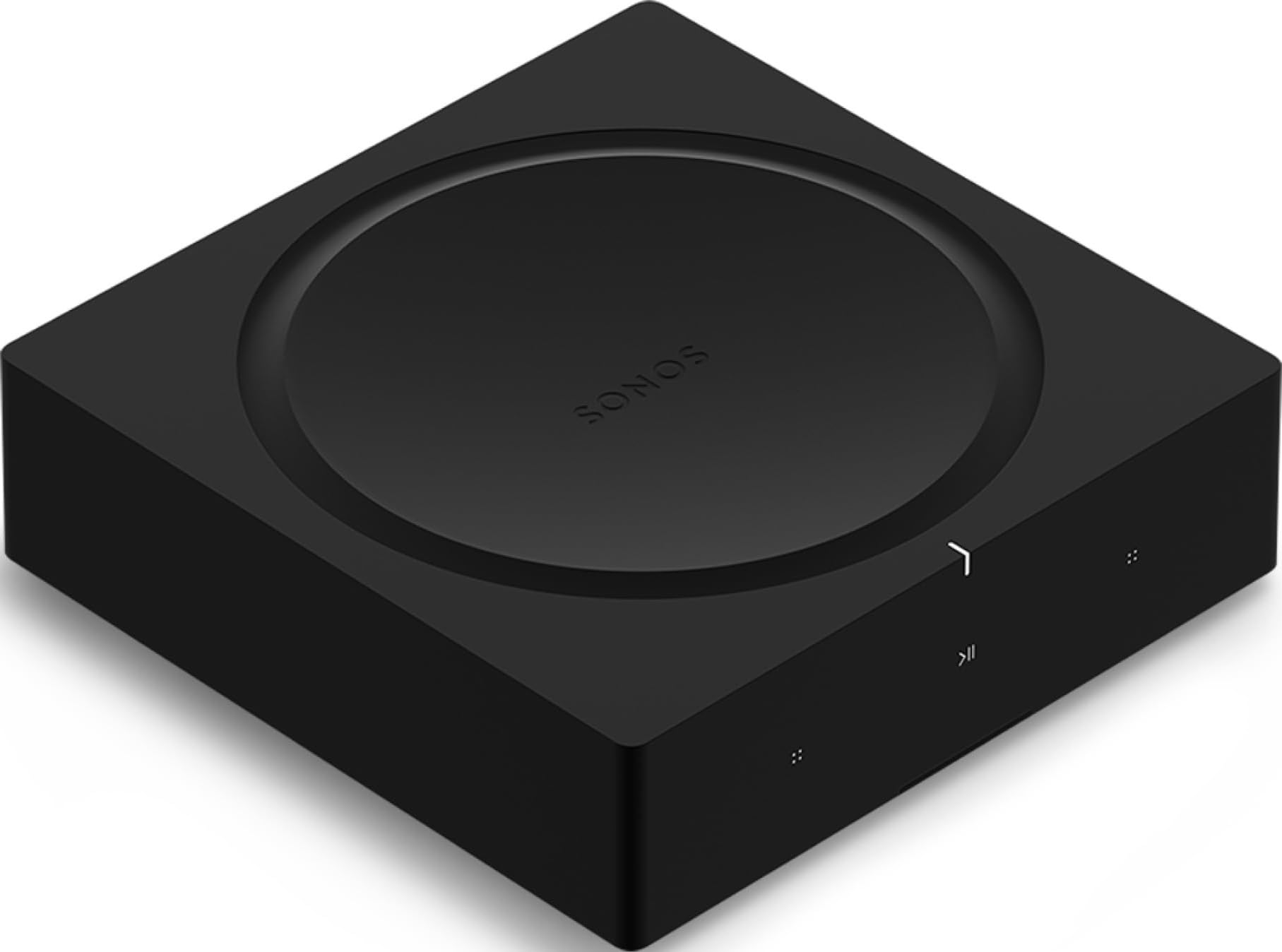
Sonos Amp

87 /100
Sound Score Excellent

Key details

Inputs
Wi-Fi, HDMI, Ethernet
Form Factor
Rack-mount amp
Output Power
125W x2 max
Streaming Ecosystem
Sonos, AirPlay 2
View on Amazon

The Sonos Amp is the cleanest way to make passive speakers part of a Sonos system. The 125W-per-channel amplifier drives bookshelf, patio, in-wall, and architectural speakers from a compact chassis, while the Sonos app replaces the receiver-style interface for input, volume, and grouping. HDMI eARC and AirPlay 2 cover TV and mobile sources without a second remote.

Sound quality holds up with clear detail across voices and instruments, and the amp's role is integration rather than raw receiver bulk. It turns a conventional pair of speakers into a node in a multiroom setup, which is the core appeal for anyone already managing Sonos zones. Moderate volumes leave enough headroom for most passive home speakers.

This is for Sonos households adding passive speakers that need an amplifier — a pair on the patio, in-wall units in a hallway, or bookshelf speakers in a media room. The premium price only makes sense inside that ecosystem; outside it, the mainstream streaming amp in this lineup offers similar HDMI and AirPlay connectivity for less money.

Pros

  • Delivers 125W per channel with clear, detailed sound for passive and architectural speakers.
  • Rack-friendly chassis with integrated heatsink fits a clean, minimalist audio stack.
  • App onboarding and grouping put passive speakers into the Sonos multiroom system without a receiver faceplate.
  • App-based control and Sonos grouping keep the whole system intuitive across rooms.

Cons

  • In some home networks, Wi-Fi can be unstable enough that a wired Ethernet connection is the safer setup.
  • Occasional units may not power up or can drop off the system, so unit-to-unit behavior is worth checking.
Our verdict

For a Sonos household with passive speakers to integrate, the Amp is the bridge; standalone buyers should start with the mainstream streaming amp in this lineup.

Check Latest Price
6

Best Balanced Desktop Amp

Fosi ZA3 Amp

89 /100
Sound Score Excellent

Key details

Inputs
XLR, TRS, RCA
Form Factor
Compact desktop amp
Output Power
180W x2 stereo
Streaming Ecosystem
Wired only
View on Amazon

The ZA3 is the balanced-source option in this lineup: instead of a receiver's phono stage or app controls, it packs balanced XLR and 1/4-inch TRS inputs, a 12V trigger, and op-amp sockets into a chassis that fits on a desk. It is a finished unit, not a bare DIY board, so home audio buyers get a working amp without soldering.

Sound quality is clean and detailed in near-field listening, with crisp treble and enough continuous Class D power for bookshelf speakers. The 180W-per-channel stereo output gives speakers a solid dynamic reserve, and the vented case keeps heat in check even on a crowded desktop. Even after extended listening, the chassis stays comfortable to the touch. The case has the fit and finish of a more expensive component, so it does not look out of place next to a dedicated DAC.

This amp is for desktop listeners who already own a balanced DAC or preamp, and who may want a future pair of mono blocks or some op-amp rolling. There is no Bluetooth or Wi-Fi, so the source has to be wired and upstream. Buyers after a one-box receiver with multiple inputs and a remote should look at the traditional receiver in this set.

Pros

  • Balanced XLR and 1/4-inch TRS inputs plus a 12V trigger work cleanly with a desktop DAC or preamp.
  • Crisp treble and good detail at near-field volumes with enough power for bookshelf speakers.
  • Vented chassis keeps the compact case cool even in cramped desktop setups.
  • Finish and construction feel more substantial than the price tier.

Cons

  • Mono mode wiring is not intuitive on the first pass; the back-panel diagram needs a slow read.
  • Speaker binding posts grip banana plugs cleanly, but bare wire needs extra patience.
Our verdict

Desktop listeners who already own a balanced source get a compact amp that can stretch into mono blocks later, and the swappable op-amps add a low-stakes tuning path. It deliberately skips receiver conveniences, which is the point of a focused wired setup.

Check Latest Price
7

Traditional Receiver

Yamaha R-S202BL Receiver

89 /100
Sound Score Excellent

Key details

Inputs
Bluetooth, RCA
Form Factor
Full-size receiver
Output Power
85W x2
Streaming Ecosystem
Bluetooth only
View on Amazon

The R-S202BL is a clean traditional receiver with 100W-class power, Bluetooth that holds a comfortable range, and a tuner that locks onto stations without drama. Setup is simply connecting speakers and selecting an input; the remote handles volume and source changes, and the full-size chassis keeps controls where you expect them. Tradeoffs are use-case specific: no phono input, so turntable owners need an outboard preamp, and no Wi-Fi or HDMI ARC, leaving Bluetooth and AM/FM as the main sources — a thinner source lineup than the top pick. Occasional power-on lockups or standby shutdowns appear in some units, a caveat that mirrors the top pick. If those limits do not apply, the R-S202BL is a cost-effective way to drive passive speakers with clean power.

Pros

  • Clean 100W-class sound with dependable Bluetooth pairing across a room.
  • Quality entry-level receiver feel with a tuner that holds stations well.
  • Simple setup and physical controls; the remote covers daily use.

Cons

  • No built-in phono stage, so turntable buyers need an outboard preamp.
  • Intermittent shutdowns or standby lockups can occur on some units.
Our verdict

This fits buyers who want a traditional Bluetooth and AM/FM receiver with clean 100W-class power, and who are fine handling vinyl or modern streaming outside this box.

Check Latest Price
8

High-Power Streaming

WiiM Amp Ultra

90 /100
Sound Score Outstanding

Key details

Inputs
HDMI ARC, Wi-Fi, Bluetooth
Form Factor
Compact streaming amp
Output Power
100W x2
Streaming Ecosystem
Alexa, Google, WiiM
View on Amazon

This streaming amp carries the flagship WiiM experience: 100W per channel at 8 ohms, a 3.5-inch touchscreen, RoomFit room correction, and HDMI ARC in a premium-priced chassis that still undercuts traditional high-end separates. Setup runs through a polished app, and output stays clean and controlled with less efficient speakers. The higher price and the AirPlay gap keep it behind the standard WiiM Amp for the typical shopper, though: the standard model already covers the same streaming platform at a lower price. Apple households face a harder limit — AirPlay is not supported, so iPhone users must stream through the WiiM app or Bluetooth (SBC/AAC only), which also leaves Android users without aptX or LDAC.

Pros

  • Delivers 100W per channel with transparent output, enough to drive less efficient speakers without strain.
  • The 3.5-inch touchscreen and app make daily control simple, from source switching to volume.
  • HDMI ARC turns the amp into a two-channel streaming hub for TV audio and music.

Cons

  • Android listeners pairing over Bluetooth are limited to SBC/AAC, with no aptX or LDAC for hi-res wireless audio.
  • iPhone owners cannot cast via AirPlay; the WiiM app or Bluetooth is the only path for Apple devices.
Our verdict

Choose the Ultra when you want the flagship WiiM feature set and your speakers need 100W — just confirm your phone can live without AirPlay.

Check Latest Price
9

Casual Multi-Input

Daakro AK45 Amplifier

85 /100
Sound Score Excellent

Key details

Inputs
Bluetooth, FM, USB, SD
Form Factor
Compact desktop amp
Output Power
Streaming Ecosystem
Bluetooth only
View on Amazon

The Daakro AK45 packs FM, USB, SD, Bluetooth, AUX, and a remote into a compact chassis, and it pairs naturally with small or older bookshelf speakers. Hookup is easy with RCA sources, and bass/treble knobs let you shape the sound quickly. For a garage, workshop, office, or patio, this is an inexpensive way to give passive speakers a second life.

The 300W peak power claim is optimistic; treat the AK45 as a modest low-wattage amp suited to efficient speakers placed nearby. Those boundaries are easy to accept in a cost-conscious secondary setup, but they explain why it remains a budget utility option rather than a serious hifi component.

Pros

  • Compact chassis fits on a workbench or shelf and pairs well with small bookshelf speakers.
  • Easy RCA hookup with simple bass and treble controls for quick tone shaping.
  • Provides enough output for casual garage, workshop, or patio listening.

Cons

  • Bluetooth pairing and range can be inconsistent, especially with distance or obstacles.
  • A single unit may lose one channel after extended use; durability varies between samples.
Our verdict

The AK45 fits a garage, workshop, or patio setup where input variety and a tiny footprint matter more than high-fidelity accuracy. For critical listening, choose a more substantial amplifier.

Check Latest Price

How to Choose

Continuous Output Power

Peak wattage is the number that sells amplifiers; continuous RMS power is the number that actually determines how loud and clean a speaker sounds over time. A compact amp claiming 300 watts peak may deliver only 30 or 40 watts RMS before the power supply runs out of headroom.

Match the amp's continuous power to your speakers and room. For bookshelf speakers in a small room, 30 to 60 watts per channel is usually enough. For floorstanding speakers or larger spaces, look for 80 to 100 watts per channel from a model with a real toroidal or linear power supply, not just a switching adapter.

Inputs and Connectivity

Inputs decide the amp's job. A turntable needs a phono stage or an external phono preamp; a TV setup needs HDMI ARC; a phone-only listener can get away with Bluetooth and a single RCA pair. Many budget amplifiers omit phono or HDMI, so check the connectivity against every source you actually use.

Also consider whether the amp's Bluetooth is an add-on convenience or a core feature. Streaming amps with Wi-Fi tend to be more stable than entry-level Bluetooth-only models, especially when walls or distance are involved.

Speaker Impedance and Zones

Amplifiers are rated to drive specific speaker impedances, usually 4, 6, or 8 ohms. Driving a 4-ohm speaker with an amp only rated for 8 ohms can cause shutdowns or distortion at higher volumes. Check both the amp's rated impedance and your speaker's nominal impedance before buying.

Speaker A/B switching lets you connect two pairs of speakers and alternate between them or play both at once. That is useful for whole-home or outdoor setups, but it means the amp shares its total power across all connected speakers.

Form Factor

A full-size receiver offers physical controls, a tuner, multiple inputs, and usually more robust power delivery, but it takes up real shelf space. A compact desktop amp hides easily and fits on a desk, but often sacrifices inputs and remote control.

Think about where the amp will live and how often you will adjust volume, switch inputs, or use a remote. A small amp that is awkward to reach can be more frustrating than a larger receiver that sits at eye level.

Streaming Ecosystem

Streaming amps are tied to an app ecosystem, and that affects how you control music every day. AirPlay 2 works naturally for iPhone users; Chromecast and Alexa lean Android; Sonos has its own mature multiroom platform with broad music service support.

Network stability matters as much as audio quality. An amp that depends on Wi-Fi for music playback can behave differently from one home to another, so a wired Ethernet port is a useful fallback if your router is close enough.

Frequently Asked Questions