9 Best Stereo Receiver of 2026: Match Phono, Power, Sources

Find the best stereo receiver for 2026 by matching phono, RMS power, and source inputs to your actual speakers and listening habits.

Stereo receiver listings often lead with bold peak wattage, but that number rarely tells you how loud or clean an amplifier will be at the volumes you actually use. The useful number is continuous RMS power, and it is often a fraction of the advertised peak.

The category also mixes traditional two-channel receivers with karaoke/PA boxes and compact desktop amps. For a home stereo, the right question is which inputs and zones you need: phono, Bluetooth, optical, or a second pair of speakers. This guide separates those use cases so you can compare receivers on the features that affect your listening room.

The real trade-off in this group is not price alone. It is whether you need a built-in phono stage and A/B zone switching, or whether a slightly simpler receiver will do. Matching those two decisions to your speakers and sources matters more than chasing wattage numbers.

About the Sound Score: This comparative score is calculated from a product's published customer rating and review volume. It is not a laboratory measurement or a hands-on test result.

1

Best Overall

Sony STRDH190

91 /100
Sound Score Outstanding

Key details

Inputs
Phono, RCA, 3.5mm
A/B Zones
Yes, 2 pairs
RMS Power
100W per channel
Phono Input
Yes
View on Amazon

The Sony STRDH190 is a full-width traditional receiver that pairs 100W per channel with a built-in phono stage, Bluetooth, and A/B speaker switching. That combination lines up directly with what a vinyl-and-Bluetooth listener needs from a two-channel system. The amplifier stays clean and composed at normal listening levels, with enough headroom for bookshelf speakers in medium rooms; highs remain smooth, bass stays controlled, and vocals stay clear when the music gets busy. The phono input accepts a moving-magnet turntable directly, so no external preamp is required. Four RCA analog inputs and a 3.5mm jack round out the source options. The 100W rating is into 8 ohms, which gives it more usable output than a typical compact amp in the same price band.

Bluetooth pairing with phones and tablets is stable during normal listening, and streaming holds without repeated dropouts. The A/B zone switches let one pair of speakers run alone or both pairs play at once, which is the practical setup for a main room plus a second zone. The front panel keeps source, volume, and zone controls plainly labeled, and the chassis has the solid, no-frills feel of mainstream Sony hardware. The FM tuner with 30 presets is a smaller part of the package, but it works as a fallback when you want to step away from your own playlists.

This is a stereo receiver for source switching and amplification, not an AV receiver or a karaoke/PA box. The right buyer is a first-time owner who wants phono, Bluetooth, and A/B speaker distribution without network streaming, Wi-Fi, or HDMI. It is not compact, and it will not stream from a home network. If those inputs are deal-breakers, this is the wrong box; if they are not, the feature set is enough to build a simple two-channel system around.

The main honest caveat is that a subset of units can stop powering on after months of use. Sample-to-sample reliability can vary, so any individual unit may behave differently over time. This is not a safety concern, but it is enough of a long-term variable to keep in mind when comparing similar receivers.

The closest alternative in this group is a 100W receiver without a phono input. The STRDH190 keeps turntable setup simple and adds A/B zone switching, making it the fuller answer for two-channel audio with a vinyl deck. The mid-range price is fair when you factor in the phono stage, Bluetooth, and speaker-zone flexibility. That makes it a better value for first-time buyers than adding a separate preamp to a cheaper receiver.

Pros

  • Amplifier stays clean and composed at normal listening levels, with clear highs and controlled bass.
  • Solid full-width chassis with a plain Sony layout that fits a traditional stereo cabinet.
  • Built-in phono stage, Bluetooth, and A/B speaker switching cover the main use cases at a mid-range price.
  • Bluetooth pairing and streaming hold up during normal listening sessions.
  • Setup is quick and the main controls are clearly labeled for first-time receiver buyers.

Cons

  • Bass, treble, and balance adjustments require the remote; the front panel only handles source, volume, and zone switching.
Our verdict

The STRDH190 covers the full stereo-receiver checklist: phono, Bluetooth, A/B speaker zones, and 100W per channel in one traditional box.

Check Latest Price
2

Best Traditional Bluetooth Stereo Receiver

Yamaha R-S202BL

89 /100
Sound Score Excellent

Key details

Inputs
RCA, AM/FM
A/B Zones
Yes, 2 pairs
RMS Power
100W per channel
Phono Input
No
View on Amazon

The Yamaha R-S202BL is the cleanest simple two-channel receiver in this lineup: 100W per channel, AM/FM, Bluetooth, and A/B speaker selection in a traditional full-size chassis. It does not aim to be an AV receiver, and the absence of HDMI and network inputs keeps the signal path short and the controls obvious.

Sound quality is composed at moderate listening levels, with enough headroom for bookshelf speakers and compact floorstanders. The FM tuner stays quiet across the dial, and Bluetooth pairs quickly from a phone or tablet. Front-panel controls and the remote follow expected stereo-receiver conventions, so setup takes minutes rather than an afternoon.

Yamaha's entry-level build quality shows in the brushed aluminum face and firm buttons. The speaker selector handles two pairs without the multi-room setup of a smart amplifier. At a mid-range price, the package is shorter on frills than on fundamentals.

This receiver is most useful for a phone-first stereo setup with one or two pairs of speakers and no turntable plans. Turntable owners will need an external phono preamp because there is no built-in phono stage; the two line-level RCA inputs are for CD or other line sources. If those boundaries fit your system, the Yamaha delivers exactly the two-channel experience you searched for.

Pros

  • 100W per channel drives bookshelf speakers cleanly and keeps the FM tuner quiet at normal levels.
  • Entry-level Yamaha construction uses a brushed aluminum front and controls that feel firmly damped.
  • The feature set covers two-channel needs without paying for AV circuitry you will not use.
  • Bluetooth pairing is quick and holds a stable stream from a phone across a living room.

Cons

  • Power and standby systems can become unresponsive after extended use in some cases.
Our verdict

For a phone-first two-channel listener, the R-S202BL is the most direct route from Bluetooth to two pairs of speakers.

Check Latest Price
3

Best Compact Utility Amp

Fosi Audio BT20A

91 /100
Sound Score Outstanding

Key details

Inputs
RCA stereo input
A/B Zones
No
RMS Power
100W max per channel
Phono Input
No
View on Amazon

The Fosi Audio BT20A is a palm-size Class D amplifier with enough output for bookshelf and outdoor speakers, placing it as the most space-efficient option in this receiver roundup. The aluminum chassis feels more substantial than its price suggests, and the bass and treble controls offer quick tone shaping without a display or remote.

At normal listening levels the amp stays clean and controlled, with enough headroom for two-way bookshelf speakers in a medium room. Bluetooth pairing is quick for casual streaming from a phone or tablet, and the output remains clear without pushing the volume past a sensible point. It delivers a level of control and build quality that undercuts its price tier.

The compact size suits garage, patio, and desk installations where a full-size receiver would crowd the space. It has enough power for outdoor-rated speakers at reasonable volume, and the aluminum case sits neatly on a shelf or tucks into a cabinet.

This is a secondary-zone amp rather than a full receiver. It has a single pair of speaker outputs, so there is no A/B switching or multi-zone routing. Buyers who need a tuner, phono input, or multiple source switching should look at the traditional receivers in this lineup; the BT20A's single RCA input and Bluetooth pairing serve a garage, patio, or desktop system where a small footprint matters more than feature count.

Pros

  • Clean output at reasonable volumes keeps bookshelf speakers free of audible distortion, even on bass-heavy tracks.
  • Fast Bluetooth pairing gets phone and tablet streaming going with minimal fuss and a stable link inside a typical room.
  • Compact aluminum chassis feels more substantial than its budget positioning suggests and leaves shelf space open.
  • Enough power for patio, garage, and outdoor speaker setups without strain at moderate volumes on two-way bookshelf speakers.

Cons

  • Inputs are limited to Bluetooth and one RCA pair, so there is no tuner or phono stage.
  • Bluetooth may clip or drop when the audio source is eight to ten feet away or near interference.
  • Power surges or outages can leave the amp unable to power on afterward; no built-in surge protection is present.
Our verdict

The BT20A is the right compact amplifier when you need to drive a pair of passive speakers in a garage, patio, or office without dedicating shelf space to a full receiver.

Check Latest Price
4

Best Network / Hi-Fi Streaming Receiver

Onkyo TX-8470

80 /100
Sound Score Excellent

Key details

Inputs
HDMI, RCA, phono
A/B Zones
No
RMS Power
100W per channel
Phono Input
Yes (MM/MC)
View on Amazon

The Onkyo TX-8470 is a network stereo receiver for buyers who want more than a basic amp: Roon Ready, Wi-Fi streaming, HDMI ARC, and a phono stage that handles both MM and MC cartridges live in a proper two-channel chassis. The top pick in this roundup is the simpler mainstream receiver; this one adds streaming and high-res playback without giving up a traditional amplifier layout.

The natural owner is already using Roon or Tidal/Deezer and has a turntable on the side. HDMI ARC makes this a rare traditional stereo receiver that can sit comfortably in a TV-driven system. The tradeoff is in the first session: network and source configuration involves menus and manual steps, so less technical users may find the initial setup frustrating. If a five-minute hookup is a hard requirement, the mainstream alternative is the better direction.

Output is clean and controlled at 100W per channel, with enough current to drive 4-ohm loads and floor-standing speakers without strain. The chassis has the dense, well-built feel of a component that costs more, and the phono stage's MM/MC switch extends its reach beyond typical receivers. High-res files streamed over Wi-Fi come through with clear highs and a quiet background, which is the core reason to choose this over a simpler amp.

Pros

  • Roon Ready and Wi-Fi streaming put Tidal, Deezer, and high-res files in a true two-channel receiver.
  • Clean, detailed output with crisp highs keeps recordings transparent across a wide range of speakers.
  • Premium construction and quality components give the chassis and controls a substantial feel.
  • Drives 4-ohm and floor-standing speakers easily - 100W per channel with usable current reserves.

Cons

  • Bluetooth audio and PC input behavior can require patience; some devices don't handshake cleanly on the first try.
Our verdict

For Roon users, high-res streamers, and turntable owners with an HDMI TV, the TX-8470 is the fuller two-channel choice; mainstream buyers who want basic Bluetooth and FM should stay with the simpler receiver.

Check Latest Price
5

Best Budget Receiver with Phono

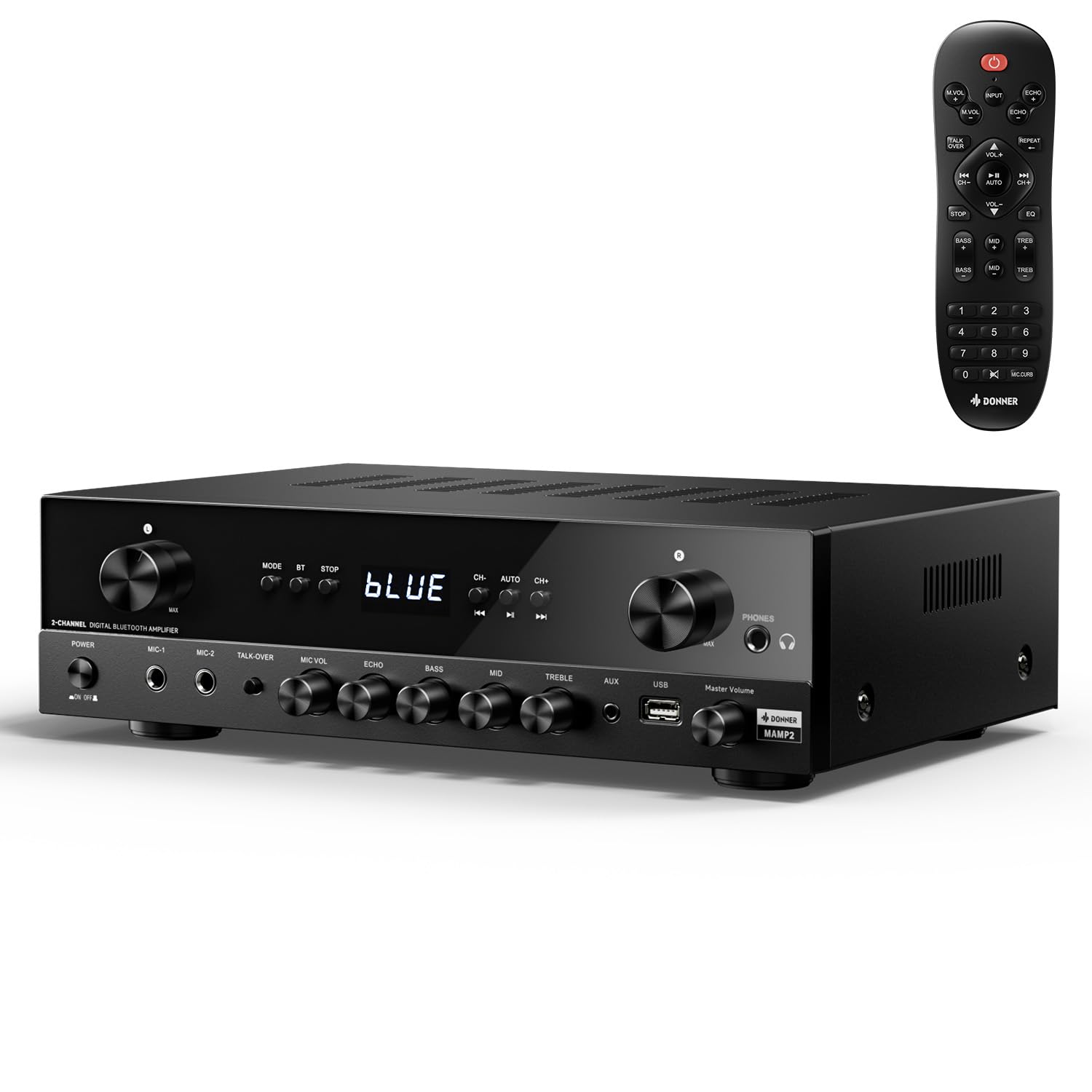
Donner MAMP2

79 /100
Sound Score Very Good

Key details

Inputs
Phono, optical, coaxial
A/B Zones
Yes, A/B
RMS Power
60W RMS per channel
Phono Input
Yes
View on Amazon

The Donner MAMP2 packs a built-in phono stage, optical and coaxial digital inputs, Bluetooth 5.3, USB, and FM into a compact two-channel receiver. That is a wider source list than typical budget amplifiers offer, and the 60W RMS per channel rating is the figure that matters; the 600W peak claim is marketing. A/B-style speaker terminals and a subwoofer output let the same box feed two speaker pairs or a 2.1 setup. The mic inputs are there, but the MAMP2 is not a karaoke mixer; it stays in the stereo receiver lane.

At this price, the amp handles small-to-medium rooms without strain, and the treble, midrange, and bass EQ controls make it easier to match speakers that need tonal adjustment. The compact cabinet feels solidly assembled for a budget component, and the connection layout is clear enough for a quick hookup. With a turntable, TV, and phone connected, the front-panel source selector makes switching between them easy.

The best use is a budget vinyl setup or a TV-plus-turntable combo where source switching across phono, optical, and Bluetooth matters more than brand name. The cooling fan can become audible in quiet listening, and the unit can pop through speakers on a power toggle; those compromises matter in a dead-silent room. Anyone setting up a modest living-room stereo gets a hub that covers the inputs a TV-and-vinyl system needs.

💡 Place the MAMP2 away from your listening position to keep the cooling fan from pulling attention during quiet music.

Pros

  • Built-in phono, optical, coaxial, Bluetooth, USB, and FM cover more sources than the usual budget amp.
  • Compact cabinet with enough output for small-to-medium rooms.
  • Three-band EQ and a well-assembled chassis suit budget speaker matching.

Cons

  • Mic and echo controls add front-panel functions that a stereo-only listener will not use.
  • Powering on or off can send a pop through the speakers.
  • Cooling fan can become audible during quiet music playback.
Our verdict

The MAMP2 covers the source-switching needs of a budget vinyl-and-TV stereo setup better than other amps at this price.

Check Latest Price
6

Garage Bookshelf Systems

WOOPKER AK45 Pro

85 /100
Sound Score Excellent

Key details

Inputs
Bluetooth, FM, USB
A/B Zones
No
RMS Power
50W RMS per channel
Phono Input
No
View on Amazon

The AK45 Pro is a compact two-channel amp with clean output for modest bookshelf speakers in a garage, patio, or desktop setup. Source switching covers Bluetooth, FM, USB, SD, and line-in, which makes it a flexible mini receiver at a budget price. The 400W peak rating is inflated; real output is 50W per channel RMS, so large floor-standing speakers won't have the continuous headroom they need. Bluetooth range can be limited, with some placements dropping out around 10 feet. Those boundaries are acceptable when the speakers are efficient and the listening space is small.

Pros

  • Compact unit delivers clean output for modest bookshelf speakers in small rooms.
  • Useful source flexibility: Bluetooth, FM, USB, SD, and line-in switching.
  • Good sound-per-dollar for garage, patio, and desktop setups.

Cons

  • For turntable users, an external preamp is required; there is no phono input.
  • With uneven speaker placement, there is no balance control to compensate; only bass and treble are adjustable.
Our verdict

This fits a line-level desktop or garage stereo where source selection and compact size matter more than multi-zone switching.

Check Latest Price
7

Budget Multi-Input Stereo

Moukey MAMP1

88 /100
Sound Score Excellent

Key details

Inputs
USB, SD, AUX, RCA
A/B Zones
No
RMS Power
25W RMS per channel
Phono Input
No
View on Amazon

The MAMP1 puts a broad input set — USB, SD, FM, Bluetooth, AUX, and RCA — into a budget two-channel receiver that fits the home stereo search better than a karaoke mixer. Despite the two mic inputs, it remains a source-switching amplifier for bookshelf and floor speakers rather than a PA-style system. The practical limits are the remote and Bluetooth: volume and mode commands from the remote can be missed, so the front panel becomes the main control, and Bluetooth can cut out beyond a few feet or with interference. For a small-room stereo where the phone or media player stays near the amp, those boundaries are acceptable; for couch-level control or throughout-the-house streaming, this is the wrong box.

Pros

  • Drives bookshelf and floor speakers well for budget listening
  • Covers USB, SD, FM, AUX, RCA, and dual mic inputs at an entry-level price
  • Quick setup and simple front-panel controls suit everyday use

Cons

  • Remote volume and mode commands can be missed, so the front panel becomes the main way to adjust sound
  • Bluetooth range is short; a few feet of distance or interference can interrupt music
Our verdict

Buy it for a compact stereo or budget home-theater setup where price, input variety, and speaker drive matter more than remote control; keep the music source within a few feet of the amp. Skip it if you plan to stream from across the room.

Check Latest Price
8

Ultra-Budget Desktop Use

Daakro AK45

85 /100
Sound Score Excellent

Key details

Inputs
FM, USB, SD, AUX
A/B Zones
No
RMS Power
Phono Input
No
View on Amazon

The AK45 is a low-cost stereo amp with a compact chassis and enough clean output for efficient bookshelf speakers in a desktop or garage system. Hookup is minimal via RCA and speaker wire; FM, USB, SD, and Bluetooth broaden the source list. Sparse official specs mean the 300W peak figure should not be read as continuous output, and a channel can go silent after months of use, so this fits casual setups where entry price matters more than long-term certainty.

💡 Keep the Bluetooth source in the same room to avoid dropouts.

Pros

  • Clear, low-distortion sound for small speakers.
  • Well-built for the ultra-budget segment.
  • Simple hookup with RCA and speaker wire.

Cons

  • Bluetooth range and dropouts can be inconsistent when the source moves away from the amp.
  • Usable output is modest, so low-efficiency speakers may run short on headroom.
Our verdict

For a garage, workshop, or desktop rig where entry price outweighs the need for spec transparency and guaranteed longevity, the AK45 is a reasonable two-channel source-switching amp.

Check Latest Price
9

Budget Subwoofer Stereo

Romicta AK50

84 /100
Sound Score Excellent

Key details

Inputs
FM, AUX, USB, SD
A/B Zones
No
RMS Power
50W RMS per channel
Phono Input
No
View on Amazon

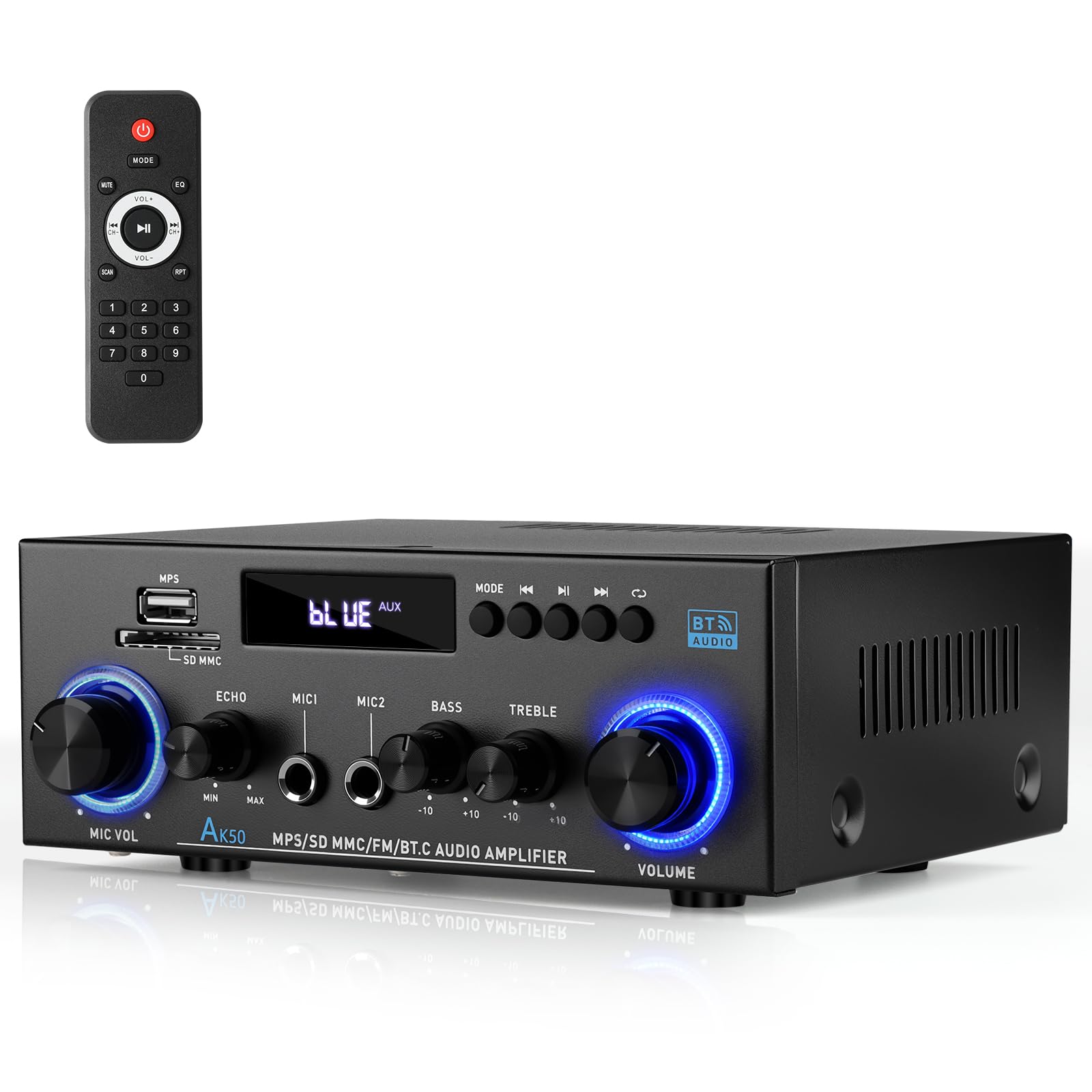
Romicta AK50 pairs a 50W-per-channel RMS rating with a subwoofer line out and Bluetooth 5.0 in a chassis that fits beside a bookshelf speaker. Setup takes minutes: connect speaker wire, choose AUX, FM, USB, SD, or RCA, and the subwoofer output works cleanly for a powered sub. Bluetooth pairing can occasionally require re-pairing, which keeps this from being as frictionless as the more complete receivers in the category.

Pros

  • Clear, balanced output for compact bookshelf speakers
  • Subwoofer line out plus RCA, AUX, USB, SD, and FM inputs simplify source switching
  • Budget-friendly price with 50W RMS per channel and subwoofer integration

Cons

  • Peak wattage is overstated; the continuous output worth comparing is 50W per channel
  • Turntable owners need an external preamp because there is no phono input
Our verdict

For a budget two-channel system built around bookshelf speakers and a powered sub, the AK50 delivers clean sound and a simple hookup.

Check Latest Price

How to Choose

RMS Power vs Peak Power

Amplifier wattage gets reported two ways: peak measures a short burst at a single frequency, while RMS is the continuous power the amp can sustain during music. A receiver advertised at 400W peak may deliver only 50W per channel RMS, which shows up as distortion on dynamic tracks. For 88dB bookshelf speakers, 50W per channel is usable in small rooms; for loud listening and low-impedance speakers, 100W per channel adds necessary headroom.

Phono Inputs

Turntables send a low, un-equalized signal, so a built-in phono stage applies RIAA correction and gain before vinyl sounds correct. Without a phono input, you need an external preamp between the turntable and a line-level RCA jack. Most built-in phono stages handle moving-magnet cartridges; moving-coil cartridges require a more expensive MC stage. For a budget turntable setup, treat built-in phono as a core feature.

A/B Speaker Zones

A/B speaker switching routes power to one pair, the other pair, or both. The practical catch is impedance: two pairs of 8-ohm speakers in parallel present a 4-ohm load, increasing current draw and heat. If you plan two zones, use 8-ohm speakers and choose a receiver with a documented A/B function rather than a single pair of terminals.

Bluetooth Range

Bluetooth version numbers describe the radio profile, not real-world range, and receiver antennas vary widely. aptX improves Android playback and AAC improves iPhone playback, but neither fixes a weak signal. Place the receiver away from Wi-Fi routers and metal racks, keep the source in the same room, and expect wired connections to remain the most dependable path.

Input Flexibility

Input flexibility determines whether a receiver fits your sources. RCA covers CD players and older gear; optical and coaxial handle TVs, consoles, and DACs; HDMI ARC returns TV audio to a stereo amp. Count the optical and coaxial inputs before buying, because adapters add clutter and handshake issues. One phono input, one optical input, and Bluetooth cover most homes.

Frequently Asked Questions