8 Best 4-Channel Car Amplifier of 2026: RMS Power Over Max Watts

How to choose a 4-channel car amplifier by RMS per channel, heat, and OEM inputs — clean power without overpaying for max-wattage hype.

Four-channel amplifier listings often lead with max wattage numbers that are several times the actual continuous RMS output. That gap matters when you are matching an amp to door speakers or components: a 1000W max rating can still leave you with 40–80W RMS per channel at 4Ω. The number to compare is RMS per channel at your speaker impedance, not the headline figure.

The next trade-off is heat and setup. Class D amps run cooler and fit in tighter spaces, while budget Class AB amps cost less upfront but need more ventilation. High-power four-channel amps tolerate less tuning error; gain or crossover settings set too high can show up as whine, static, or overheated speakers.

This guide sorts amps by real output, crossover flexibility, and OEM-friendly inputs, so you can match the unit to the speakers you actually run. A 4-channel amp should add headroom without adding noise or heat problems.

About the Sound Score: This comparative score is calculated from a product's published customer rating and review volume. It is not a laboratory measurement or a hands-on test result.

1

Best Overall

Recoil DI550.4

86 /100
Sound Score Excellent

Key details

Crossover
RMS Power
80W @4Ω, 130W @2Ω
Class & Heat
Class D, low heat
View on Amazon

The Recoil DI550.4 delivers 80W RMS per channel at 4Ω and 130W per channel at 2Ω, with Class D efficiency that keeps output steady in a chassis small enough for under-seat mounting. The 1040W max figure is marketing math; the RMS ratings are what make this amp genuinely useful. It produces clean, loud, distortion-free sound across all four channels, and holds up beyond the first pair of speakers.

Treble stays clean, midrange stays controlled, and door speakers get enough headroom to stay composed at highway volume. At 2Ω the amp handles loads confidently, and bridging two channels into one delivers 260W RMS per channel at 4Ω for a front-stage upgrade without adding a second amp. The power is usable, not just measurable, which is why the amp sounds stronger than its size suggests.

The all-metal shell feels solid for a budget amp, and the compact footprint opens installation spots that bulkier 4-channel amps can't use. The price undercuts many competitors with lower continuous output, so value shows up in both the purchase and the performance. This is not an amp that relies on inflated max-power numbers; the published RMS ratings match what it produces in use.

Set against the low-noise premium option in this group, the DI550.4 trades a quieter noise floor and some fit-and-finish polish for more output per dollar and a smaller chassis. That trade makes sense for a budget four-speaker build, especially when the bridged 2-channel mode can run a solid component set without a second amplifier.

Long-term durability is not as established as the pricier options in this set, so buyers planning to keep an amp for a decade have a real boundary to weigh. It is also not the amp for integrated-DSP builds or extreme SPL output; those projects need a model with built-in processing or a high-power monoblock. For a budget four-speaker build in a daily driver or a compact under-seat install, the Recoil is the balanced pick.

Pros

  • Clean, low-distortion sound through all four channels
  • Full 130W RMS per channel at 2Ω gives 2-ohm speakers real headroom
  • Compact metal chassis fits under seats and in tight panels
  • Budget-friendly price with genuine RMS output
  • Holds up over years of daily use

Cons

  • A single channel can drop out after extended use
Our verdict

For a budget four-speaker build, the DI550.4 delivers real RMS output, compact Class D packaging, and clean sound without the premium markup. The low-noise refinement option costs more for a quieter noise floor; buyers who don't need that get strong value here.

Check Latest Price
2

Best Sound Quality

Alpine S-A32F

89 /100
Sound Score Excellent

Key details

Crossover
HPF/LPF
RMS Power
55W @4Ω
Class & Heat
Class D, low heat
View on Amazon

Alpine's S-A32F delivers consistently clean, detailed sound with honest power ratings — a different priority than the value-oriented Recoil, which offers more output. Class D construction keeps the chassis compact enough for under-seat mounting, and the HPF/LPF crossover lets you keep bass out of door speakers. The low noise floor keeps the amp quiet even when gains are set for moderate-power 4-ohm components.

This amp is for sound-quality enthusiasts running 4-ohm component speakers, especially in compact under-seat installs. The 55W-per-channel output is modest for the premium price, but that tradeoff buys low noise and accurate detail over max SPL. Listeners who value subtle transients and low hiss over raw loudness will hear the difference right away. Budget builds should look elsewhere; this premium price is about clean delivery, not raw output.

Occasional channel-potentiometer cutouts have been noted, so a quick all-channels test after installation is worth doing. The build stays clean and the sound remains transparent at moderate levels, keeping the Alpine worthwhile in a crowded category. That composure is what separates it from cheaper Class D designs in the same power bracket.

Pros

  • Crystal-clear, detailed output across the frequency range.
  • Compact chassis and clean construction fit tight spaces.
  • Power ratings reflect real output rather than inflated peaks.

Cons

  • Small set-screw terminals can be fiddly when connecting speaker wire.
  • Output ceiling is 55W RMS per channel at 4 ohms
Our verdict

The Alpine's premium price buys low noise and accurate delivery — the choice for SQ-focused builds that leave the wattage race to the higher-output Recoil.

Check Latest Price
3

Best High-Power/OEM Upgrade

Taramps TS 1200x4

86 /100
Sound Score Excellent

Key details

Crossover
HPF/LPF/Full
RMS Power
300W @2Ω
Class & Heat
Class D, low heat
View on Amazon

The TS 1200x4 is the high-output route in this comparison: 300W RMS per channel at 2Ω plus high-level inputs and auto turn-on. That combination makes it a factory-radio workhorse rather than a low-power upgrade path. The HPF/LPF/Full crossover controls add flexibility for component speaker systems, and the amp is intended for 2Ω speaker loads as well as bridged 4Ω duty.

This amp is for factory-radio upgrades and component builds where the user sets gains and crossovers with intent. The high-level inputs accept speaker-level signal directly and auto turn-on removes the need for a separate remote wire, so the factory head unit stays put. Noise/static can appear if gain and crossover settings are not careful, and mis-tuning can risk speaker damage. First-time installers looking for plug-and-play sound should look at lower-output options in this comparison.

Build quality is solid for a mid-range amp, and the cost-per-watt is hard to match. The chassis has enough density to feel substantial under sustained use, and the 2Ω rating gives real headroom when speakers can take it. At 4Ω per channel the amp is less spectacular, so pair it with 2Ω-capable component speakers or bridged loads to get the full output.

Pros

  • Provides genuine 300W RMS per channel at 2Ω for loud, headroom-heavy playback.
  • Feels solidly built for its price range, with a dense chassis that handles sustained use.
  • Delivers strong power per dollar, especially against pricier 4-channel options.
  • High-level inputs and auto turn-on simplify wiring when keeping the factory radio.

Cons

  • Published specs omit some measurements, so cross-shopping takes extra digging.
  • Some units have needed early replacement, so longevity varies between samples.
Our verdict

The TS 1200x4 rewards a builder who can set gains and crossovers with serious output per dollar. It is not a set-and-forget amp.

Check Latest Price
4

Best Traditional Class AB Value

Pioneer GM-A6704

87 /100
Sound Score Excellent

Key details

Crossover
Variable HPF/LPF
RMS Power
60W @4Ω, 190W bridged
Class & Heat
Class A/B, runs warm
View on Amazon

The Pioneer GM-A6704 delivers clean, balanced mids and highs from a conventional Class AB design, with 60W RMS per channel at 4Ω and 190W bridged per side. It is the familiar-brand value play in this group, more so than the compact Class D top pick — offering enough power for door speakers and 6x9s without chasing high-current 2Ω loads. That makes it a sensible first amp for a basic four-speaker build rather than a high-output platform.

The variable HPF/LPF crossover handles front/rear or full-range setups, and the Class AB section keeps vocals and cymbals natural at everyday listening levels. At 60W RMS per channel, there is enough current for door speakers and 6x9s without demanding a high-current electrical system. Installation stays simple for a DIYer: mount the amp, connect power and speaker wires, and set the crossover with the onboard dials.

This is for the budget-minded buyer upgrading four factory speakers who wants a familiar brand without adding extra complexity. It runs warm under sustained load and is better suited to mids and highs than subwoofer duty, so leave room for airflow and keep expectations around modest bass reinforcement. Pair it with 4-ohm speakers and a modest sub, if any, and it earns its place in a daily-driver system.

Pros

  • Clean, balanced mids and highs keep vocals and cymbals natural at daily listening levels.
  • Good value for a familiar brand: 60W RMS per channel at 4Ω is enough for door speakers and 6x9s.
  • Usable power covers modest subwoofers without demanding a high-current electrical system.
  • Simple hookup for DIY installs; the variable HPF/LPF crossover helps tune without extra gear.

Cons

  • The 1000W max label is not continuous output; the real spec to compare is 60W RMS per channel at 4Ω.
  • A channel can drop out or an amp can arrive with no output, so bench-test the amp before installing it.
Our verdict

For a clean 4-ohm speaker upgrade on a budget, the Pioneer is the conventional answer: familiar sound, simple install, and enough real output for door speakers.

Check Latest Price
5

Best Premium Feature Set

Rockford R2-500X4

89 /100
Sound Score Excellent

Key details

Crossover
RMS Power
75W @4Ω, 155W @2Ω
Class & Heat
Class D, low heat
View on Amazon

The R2-500X4 combines C.L.E.A.N. gain setup, Punch EQ, balanced differential inputs, and honest continuous power: 75W RMS per channel at 4Ω rising to 155W at 2Ω. That makes it a feature-rich pick for a full-range four-speaker system, especially with a 2Ω component set at the end of the wires.

Sound quality is clean and open, with a dense chassis and secure connectors that give the amp a premium feel. The C.L.E.A.N. routine makes gain matching a deliberate process, using the amp's own clipping detection to set levels without guesswork. Punch EQ adds bass contouring that is useful for door speakers, and the extra 2Ω headroom keeps the amplifier from running out of steam during dynamic passages.

The right buyer is a Rockford Fosgate loyalist replacing a factory unit or feeding a 2Ω component set with premium expectations. The premium price and the need to verify output on the bench before permanent mounting are part of the purchase; this is a tool-driven upgrade, not a watt-per-dollar play. Budget-focused shoppers will get more power per dollar elsewhere, but C.L.E.A.N. setup and Punch EQ are features cheaper Class D amps in this roundup omit.

Pros

  • Clean, clear sound that holds up across all four channels.
  • Dense chassis and secure connectors give it a premium, lasting feel.
  • Rated power is usable: 75W RMS per channel at 4Ω and 155W at 2Ω.
  • C.L.E.A.N. gain setup and Punch EQ simplify tuning and tonal shaping.

Cons

  • Published specifications are sparse, so pre-wire planning and mounting-space checks take extra legwork.
  • Output consistency can vary between units.
Our verdict

A clean-sounding Class D four-channel for 2Ω component builds that favors C.L.E.A.N. setup and Punch EQ over maximum power per dollar.

Check Latest Price
6

Compact 1-Ohm Budget

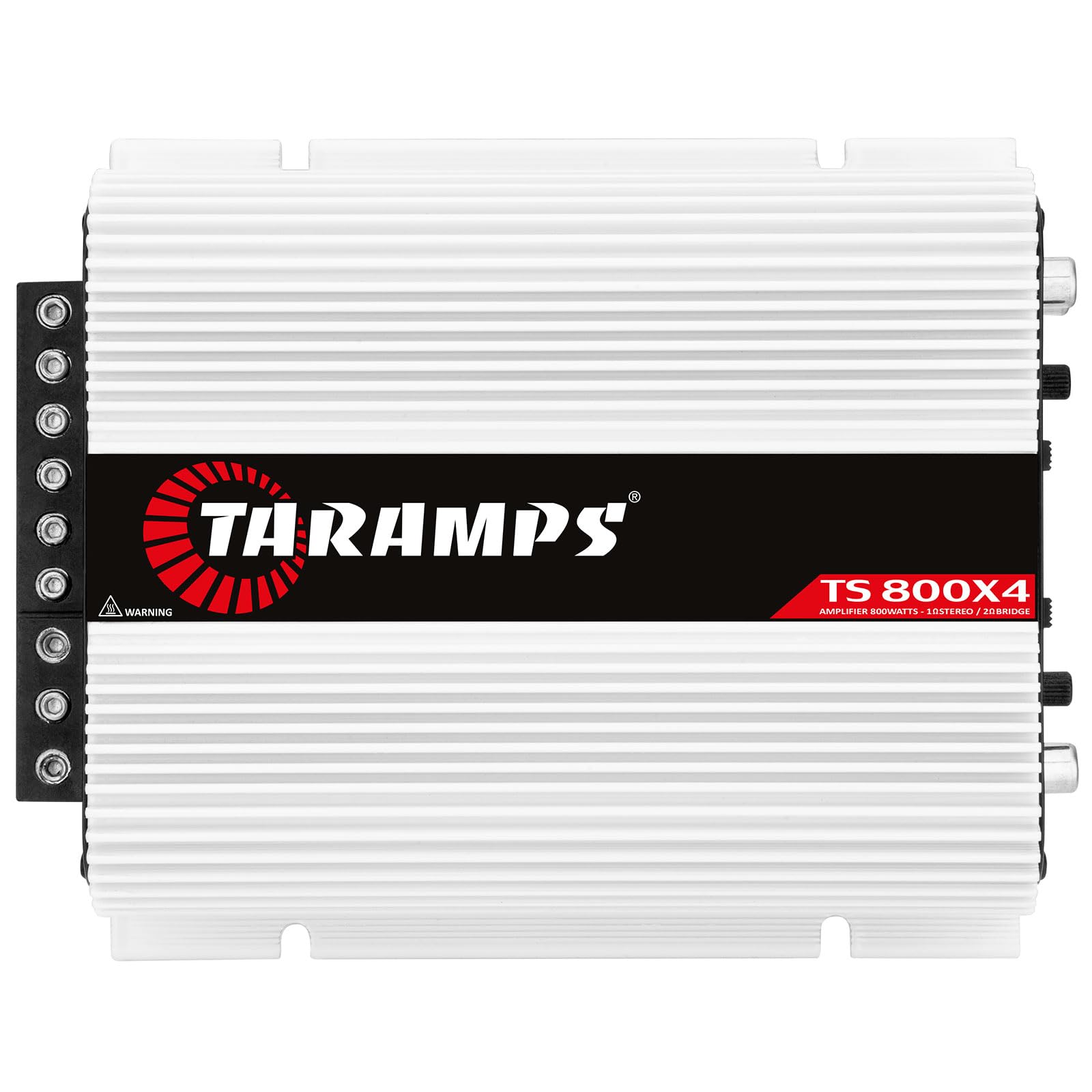
Taramps TS 800x4

86 /100
Sound Score Excellent

Key details

Crossover
HPF/LPF/Full
RMS Power
200W @1Ω
Class & Heat
Class D, low heat
View on Amazon

Delivers 200W RMS per channel at 1Ω in a compact chassis, a standout for tight builds running low-impedance loads. Clean mids and highs and strong bass follow once gain and crossover settings are dialed in, and the entry price is hard to argue with. The 1Ω rating is the compromise: a typical 4Ω door-speaker install won't see the headline power, so this amp suits 1Ω-capable systems or bridged 2Ω duty more than conventional factory-replacement upgrades. High-level inputs and auto turn-on simplify OEM radio integration, though bench-testing after install is prudent because an occasional unit may arrive without output. The TS1200 covers the higher-output and fuller OEM-integration angle if you need more.

Pros

  • Delivers 200W RMS per channel at 1Ω in a chassis small enough for tight installs.
  • Clear mids and highs with strong bass once gain and crossover settings are dialed in.
  • Budget-friendly price with easy installation and high-level inputs for OEM radios.

Cons

  • The headline 200W per channel exists only at 1Ω, so a standard 4Ω speaker upgrade sees lower continuous power.
  • An occasional unit may arrive with no output, so bench-test before installing.
Our verdict

This amp fits when your build already runs 1Ω-capable loads or bridged 2Ω duty and you need compact four-channel power. For a standard 4Ω speaker upgrade, the top pick is a better match.

Check Latest Price
7

Entry-Level Door Speakers

Crunch PDX-1000.4

80 /100
Sound Score Excellent

Key details

Crossover
24dB HP/LP
RMS Power
Class & Heat
Class A/B, runs hot
View on Amazon

The Crunch PDX-1000.4 is the lowest-cost route to a real 4-channel amp for a basic door-speaker upgrade. It has enough output for midranges and 6x9s, and the price leaves room in the budget for speakers. The reason it doesn't rank higher in this category is that the 1000W maximum is not continuous power, and durability plus heat are part of the compromise. For a minimal amp upgrade without much spending, it fits; for clean, high-output audio or a chassis that runs cool in a tight enclosure, the extra budget is better spent elsewhere.

Pros

  • Keeps the upfront cost low for a four-channel amp.
  • Provides enough power for door speakers and 6x9s.

Cons

  • The 1000W max rating does not reflect the continuous power available.
  • Sustained use can heat up enough to require added cooling in tight spaces.
  • Some units can cut out or need a return within the first weeks.
Our verdict

Best for a low-cost door speaker build where price matters more than long-term polish.

Check Latest Price
8

Budget 2-Ohm Power

ORION CBA2500.4

80 /100
Sound Score Excellent

Key details

Crossover
HPF/LPF, bass boost
RMS Power
100W @2Ω, 60W @4Ω
Class & Heat
Class A/B, runs warm
View on Amazon

For a budget 2Ω four-channel build, the CBA2500.4 delivers 100W RMS per channel at 2Ω and 60W at 4Ω with clean mids and highs, and the chassis feels more substantial than its price suggests. It suits buyers who read RMS rather than the 2500W max label. The 4Ω output is moderate but workable for efficient door speakers. Unit-to-unit consistency varies, so this is a budget proposition with boundaries, not a guaranteed long-haul component. For the right installation, it remains a cost-effective way to drive four speakers.

Pros

  • Crisp mids and highs for a budget amp.
  • Substantial chassis feels well put together.

Cons

  • At 4Ω, 60W RMS per channel leaves little headroom for high-output component sets.
  • A channel can be silent on arrival or after extended use, so bench-test before mounting.
Our verdict

Best for a budget 2Ω four-speaker build where you tune by ear and want clean mids and highs without spending much.

Check Latest Price

How to Choose

RMS Power Per Channel

RMS per channel at 4Ω tells you what a 4-channel amp can deliver continuously to common door speakers. At 2Ω, the same amp usually produces more current, which matters if you run multiple woofers per channel or components with lower impedance. The rating should match both the speaker's impedance and the music level you expect.

The hidden trade-off is that many budget amps publish max wattage at high distortion or at impedances you would not use. A '125W x4 max' claim can mean around 40-80W RMS at 4Ω. Use the RMS number, not the max number, when planning headroom.

Class D vs Class A/B Heat

Class D amps switch output transistors at high frequency, which keeps heat down and efficiency high. Class A/B amps deliver a more analog sound but waste more energy as heat, so they run warmer in the same enclosure. Heat is not a deal-breaker if you have airflow, but it becomes a problem when an amp is buried under a seat or behind a trim panel.

A Class D amp suits compact installs and long listening sessions, while a budget Class A/B can work in a larger trunk or rack with ventilation. If the mounting spot is enclosed, choose Class D and check the amp's 4Ω output before buying.

Crossover Flexibility

HPF/LPF/Full control allows the amp to send only the right frequencies to each speaker: high-pass for door speakers so they don't strain on bass, low-pass for a sub, full-range for factory signals. The hidden trade-off is that fixed or limited crossovers push that work to the head unit or a separate crossover.

Variable HPF/LPF is worth having for component systems; a simple Full/HPF switch may be enough for a basic door-speaker upgrade.

High-Level Inputs

High-level/speaker-level inputs let the amp accept the amplified signal from a factory radio, removing the need for a separate line-output converter. Many of these inputs also detect signal and turn the amp on automatically, which simplifies installation.

The trade-off is that factory signals can be noisy or bass-rolled; the amp's input sensitivity must be set carefully to avoid hiss or distortion. If you keep the stock radio, look for an amp with high-level inputs and auto turn-on.

Footprint and Mounting

Physical footprint matters more than most buyers expect because amplifier mounting spots are usually smaller than they look. A compact Class D chassis fits under a seat, inside a fairing, or behind a panel; a longer Class A/B chassis limits where you can mount it.

Measure the available space before choosing, and check whether the amp's crossover and input connections remain reachable once mounted.

Frequently Asked Questions