9 Best Car Amplifier of 2026: Honest RMS Power in Real-World Builds

Match a car amplifier to your speakers with honest RMS wattage, channel count, and factory-radio convenience — without overpaying.

Most car amp listings lead with a max wattage number that no one can actually use. A mono amp marked 2,000W may deliver only a few hundred watts before it distorts, and the result is weak bass or a hot chassis. The number that matters is RMS power at the impedance you plan to run.

That decision also depends on electrical capacity. High-output Class D amps deliver impressive watts per dollar but often need upgraded wiring and careful tuning. Traditional Class A/B amps run cooler in everyday builds, yet put out less power for the same price. Choosing around your vehicle's charging system prevents shutdowns and clipped audio.

The right amplifier is the one matched to the job: a factory-stereo speaker upgrade, a compact subwoofer build, or a full SPL setup each calls for different channels, inputs, and thermal behavior.

About the Sound Score: This comparative score is calculated from a product's published customer rating and review volume. It is not a laboratory measurement or a hands-on test result.

1

Best Overall

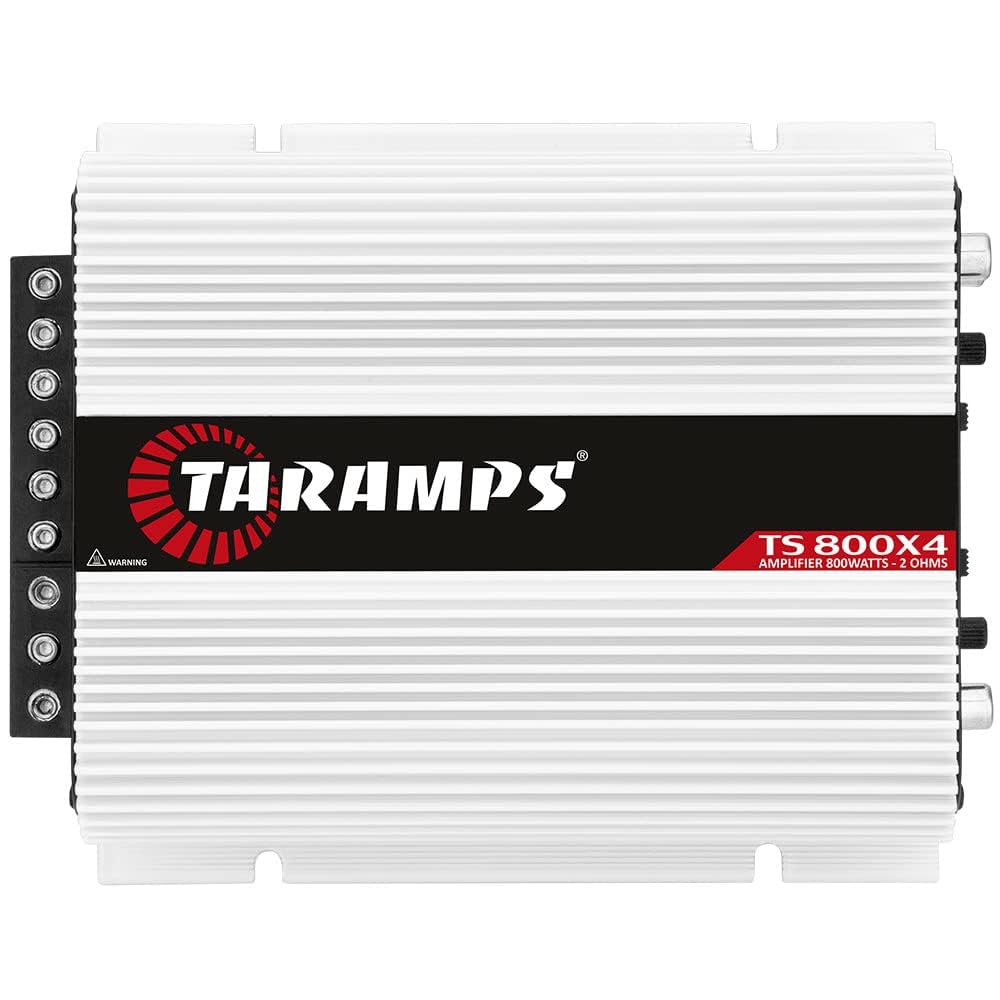
Taramps TS 800X4

90 /100
Sound Score Outstanding

Key details

Inputs
Speaker-level, auto turn-on
Cooling
Efficient Class D design
Channels
4-channel bridgeable
Impedance
View on Amazon

True 800W RMS arrives in a chassis roughly the size of a thick paperback, and those four channels hold clean output across the full-range band. Class D efficiency keeps heat manageable during normal speaker duty, which opens under-seat and behind-panel mounting options that bulkier amplifiers cannot match. The power rating is honest enough to plan a build around without subtracting marketing watts before you start.

Full-range tuning is where this amp earns its keep. Door speakers get enough headroom to play cleanly at higher volume without the harsh edge certain compact Class D amps can bring. The output stays composed from low-mid punch to high-frequency detail, so the upgrade is audible even before a subwoofer is added. That makes it a genuine speaker amplifier, not just a small subwoofer board with four channels attached.

High-level speaker inputs and auto turn-on let a factory radio feed the amp without a separate line-output converter or remote turn-on wire. Bridging the rear channels to a subwoofer while the front channels drive mids and highs creates a workable no-head-unit build with real output. For installers who want to keep the dash untouched, this removes the two biggest wiring headaches from a typical amplifier retrofit.

The TS 800X4 suits someone keeping the stock head unit and adding honest power to upgraded door speakers. The compact chassis is central to that use, fitting spaces where comparable 800W four-channels won't go. This is not a high-current 1-ohm subwoofer amp; leave that role to a mono amp. Buy from a source with a solid return policy and verify the amp before the panels go back on.

Against cheaper four-channels, this amp asks a small premium for measured RMS and factory-radio convenience. That premium is easy to justify for a daily-driver speaker upgrade because the input flexibility and clean output remove the usual aftermarket friction. The price tier still undercuts premium-priced alternatives, which keeps it in range for a budget-to-mid build.

💡 Verify the amp with a quick low-volume bench test before final mounting.

Pros

  • Honest RMS power in a package small enough for under-seat or behind-panel installs.
  • Clean full-range output that makes upgraded door speakers sound noticeably stronger.
  • Speaker-level inputs and auto turn-on remove the need for an LOC or remote wire.
  • Cost-effective power for a four-channel build without paying premium-priced amp money.

Cons

  • Amp-to-amp QC can vary, so a fresh unit may stop producing audio early.
Our verdict

Keep the factory radio, add true four-channel power, and leave serious subwoofer duty to a dedicated mono amp — that is the TS 800X4's lane.

Check Latest Price
2

Best Premium Mono Amp

Alpine S-A60M

88 /100
Sound Score Excellent

Key details

Inputs
Preamp, speaker-level
Cooling
Airflow needed under load
Channels
1-channel mono
Impedance
View on Amazon

The S-A60M delivers a CEA-2006-rated 600W RMS into a single subwoofer channel from a chassis small enough to fit under most seats. Output stays clean at everyday listening levels, and an owner-submitted bench test sheet recorded 667W RMS, so the published number is not inflated. It is a Class D monoblock with both preamp and speaker-level inputs, which makes it easy to connect in builds that keep the factory radio.

Since this is a one-channel amp, it belongs in a dedicated subwoofer build rather than a full-range speaker setup. The compact size simplifies under-seat installs, but sustained high-volume playback warms the chassis; mounting it where air can move around the heatsink keeps output steady.

This Alpine suits buyers who already know they want one sub and would rather pay for clean output than chase wattage-per-dollar records. It is not the budget route, and it will not power door speakers. No bass knob is included, so plan to set gain at the amp or add an aftermarket remote.

💡 Give the amp breathing room under a seat or panel; airflow prevents protection trips at high volume.

Pros

  • Small chassis mounts under seats and hides easily in tight installs.
  • Clean bass delivery stays musical rather than harsh as volume climbs.
  • Rated output is honest; the amp sustains its claimed 600W RMS.
  • Build quality has a solid, finished feel with consistent fit and finish.

Cons

  • Aftermarket remote compatibility can be finicky, so an external level controller may need trial to pair.
  • Mounted in a sealed or cramped space and driven hard, the amp can go into protection until it cools.
Our verdict

Choose the S-A60M when clean, honest bass in a small footprint matters more than wattage-per-dollar. It costs more than a budget mono, but measured output and the compact fit make that premium reasonable for a dedicated subwoofer build.

Check Latest Price
3

Best Budget High-Power Mono

AUDIOZERONE ZE1000.1

87 /100
Sound Score Excellent

Key details

Inputs
RCA only
Cooling
Cool-running under normal use
Channels
1-channel mono
Impedance
1-ohm stable
View on Amazon

True 1,000W RMS at 1 ohm puts the ZE1000.1 in a different class from typical budget mono amps. Output is genuinely strong, and the mono channel stays clean when the sub is demanding. The premium compact mono in this set costs more for lower wattage, while the ZE1000.1 focuses on one job: maximum subwoofer output per dollar.

Thermal behavior is a strong point. The Class D board runs cool enough for normal subwoofer duty, and the compact footprint gives installers flexibility under seats or in a spare-tire well. That performance depends on electrical supply: a dedicated power wire, a solid ground point, and a subwoofer load near 1 ohm are necessary to reach the full RMS rating. On a factory wiring harness, the amp will be current-starved before it gets loud.

The buyer profile is a first-time high-power mono shopper who already has a sub enclosure and proper power wiring, or plans to run it before the amp goes in. The upside is real 1,000W RMS output at a budget price; the tradeoff is a no-frills warranty, and a blown main fuse on arrival is worth checking for. Bench-test before the return window closes. If you need factory-radio speaker-level inputs and auto turn-on, the top pick in this comparison is the better match.

💡 Use 4 AWG or larger power and ground wiring and check the remote turn-on connection before final install.

Pros

  • Delivers true 1,000W RMS at 1 ohm for less than typical lower-power amps cost.
  • Compact Class D footprint mounts easily under a seat or in a spare-tire well.
  • Class D efficiency keeps heat in check during normal subwoofer use.

Cons

  • The remote bass knob connector may need a slight rework before it seats firmly.
  • QC can vary; some units may need warranty service after months.
Our verdict

For a budget mono build with the electrical system to back it up, the ZE1000.1 is the strongest per-dollar path to real subwoofer output.

Check Latest Price
4

Best Traditional 4-Channel

Pioneer GM-A6704

87 /100
Sound Score Excellent

Key details

Inputs
RCA inputs
Cooling
Runs warm when pushed
Channels
4-channel bridgeable
Impedance
View on Amazon

The Pioneer GM-A6704 delivers clean mids and highs with an easy installation process. Its Class A/B design suits aftermarket door speakers and keeps the sound musical rather than harsh. Continuous output is 60W RMS per channel at 4 ohms; bridged, it pairs into 190W x2 for a small sub. The four channels are bridgeable in pairs, giving installers flexibility for a speaker-plus-sub combo. The '1000W max' label is peak marketing, not a continuous rating.

This is the amp for buyers upgrading factory door speakers with aftermarket mids and highs. The rotary high/low-pass filters make tuning simple, and the familiar Pioneer build quality keeps install confidence high. It runs warm when pushed and real RMS is modest despite the 1,000W max claim, so it suits listeners who stay within its comfort zone rather than demand subwoofer-heavy output.

At 4 ohms, the 60W per channel is enough to give door speakers noticeable presence without the edge of higher-power Class D designs. The bridged mode covers small subwoofers that need around 190W, and the compact chassis fits under a seat or in a trunk panel. The rotary high/low-pass filters also make it easy to match most component sets without extra signal processors.

Pros

  • Clean mids and highs from a Class A/B design that suits aftermarket door speakers.
  • Recognizable Pioneer construction and fit-and-finish at a mid-range price.
  • Installation and tuning are easy, with high/low-pass filters on rotary controls.

Cons

  • Under extended full-volume use, heat builds up and can push the amp into thermal protection.
  • Certain subwoofer loads can cause channels to go silent or pair poorly.
Our verdict

A clean 4-channel speaker amp for modest systems and a small bridged sub; leave high-current subwoofer duty to a dedicated mono amp.

Check Latest Price
5

Maximum Power SPL

Taramps Smart 3 Bass

88 /100
Sound Score Excellent

Key details

Inputs
RCA only
Cooling
Channels
1-channel mono
Impedance
0.5-2 ohm
View on Amazon

The Taramps Smart 3 Bass delivers a true 3,000W RMS into 0.5 to 2 ohm loads, putting it in a different output class than the 4-channel top pick in this set. Multi-impedance flexibility means a single amp can drive one sub or a multi-sub bank, and the power figure is real RMS rather than a peak marketing number.

The compact Class D chassis keeps the installation footprint small for the rated output, and heat stays manageable during SPL bursts. Low-end output is deep and hard-hitting, with bass boost and crossover controls that shape the response without an external processor.

The bass boost and crossover are genuinely useful for matching a sub enclosure, and the LED monitor shows supply voltage in real time during setup. Under hard SPL bursts, the amp keeps its composure and the output stays immediate.

SPL competitors and bassheads who already run an upgraded alternator or battery will get the most subwoofer output per dollar here. It needs 0 AWG wiring, an upgraded charging system, and careful gain and impedance tuning; novices with stock electrical systems should choose a lower-power amp.

💡 Use the LED monitor to check supply voltage while setting gain with a test tone.

Pros

  • Genuine 3,000W RMS gives SPL builds competition-level pressure without changing amps.
  • Cost per watt undercuts mainstream monoblocks, leaving budget for electrical upgrades.
  • Compact Class D chassis fits tight spaces despite the high rated output.
  • Deep, hard-hitting sub-bass keeps low-end response loud and tactile.

Cons

  • Tuning is sensitive: clipping and protection can engage if gain and impedance are not set precisely.
  • A unit can cut out or shut down under sustained full-load use, so bench-test before installing.
Our verdict

For bassheads with a prepared electrical system, the Smart 3 Bass is the dedicated SPL value in this set; the output per dollar is hard to match at this power level.

Check Latest Price
6

Best Compact 2-Channel

Pioneer GM-A3702

87 /100
Sound Score Excellent

Key details

Inputs
RCA only
Cooling
Channels
2-channel bridgeable
Impedance
2-ohm rated
View on Amazon

The GM-A3702 is a genuinely compact two-channel amp, small enough to fit under a seat or in the tightest spaces of a golf cart or boat. Its 190W bridged output gives a modest single sub or a pair of upgraded speakers enough power to come alive, and the Class A/B circuit carries Pioneer's familiar clean tonality. That combination of size, output, and brand consistency makes it the obvious pick for simple builds that don't need four channels.

Continuous output is the number that matters: 60W per channel at 2 ohms, or 190W bridged into a single channel. That is enough to drive upgraded speakers or a modest sub in a small box, and it explains why the amp stays compact.

Buyers upgrading from head-unit power in a compact vehicle, golf cart, or boat will find the size and price easy to work with. The thermal and unit-to-unit consistency limits are real: sustained full-volume listening in a hot cabin can overheat the amp, and power delivery can vary between units. For moderate listening levels and a gain setting that stays within the amp's range, it supplies a clean musical upgrade without requiring serious electrical work.

Pros

  • Budget-friendly two-channel power for modest speaker and small-sub builds.
  • Pioneer's clean Class A/B sound quality carries into tiny installs.
  • Compact chassis and clearly labeled controls make mounting and wiring manageable.
  • Entry-level price with the same build character as larger Pioneer amps.

Cons

  • The 500W max rating is marketing; real RMS is 60W per channel at 2 ohms.
  • Bridged output maxes at 190W RMS, leaving large subwoofer systems outside its reach.
Our verdict

Use the GM-A3702 for a simple two-speaker build, a small vehicle, or one efficient subwoofer. It is not a high-power amp, but it delivers what the job actually needs: clean Pioneer sound in a small chassis at a budget price.

Check Latest Price
7

Entry-Level Subwoofer Power

BOSS R1100M

89 /100
Sound Score Excellent

Key details

Inputs
RCA, speaker-level
Cooling
Channels
1-channel mono
Impedance
2-8 ohms
View on Amazon

BOSS's R1100M is a budget-friendly monoblock that puts real bass behind a single 12-inch sub in a sealed enclosure. It is a Class A/B amp with a compact chassis, RCA and speaker-level inputs, and an included high-input cable that keeps installation simple without an aftermarket head unit. The advertised 1100W max is not continuous output; real-world delivery lands near 350-400W, and quality control can vary between units. Treat it as a low-cost starter amp, not a rated-power solution. That tradeoff suits a first-time buyer on a tight budget; it does not cover competition SPL builds.

Pros

  • Delivers clean output with a single 12-inch sub in a sealed enclosure.
  • RCA and speaker-level inputs plus the included high-input cable simplify installation.
  • Compact chassis fits under seats or in tight trunks.

Cons

  • The remote bass knob can feel flimsy or arrive non-functional, complicating on-the-fly adjustments.
  • A unit can enter protection mode instead of continuing to play.
Our verdict

For a first-time sub build on a strict budget, this works as a starter amp when the wattage claim is taken as marketing.

Check Latest Price
8

Small Subwoofer Duty

Pyle PLA2200

84 /100
Sound Score Excellent

Key details

Inputs
RCA inputs
Cooling
Thermal protection circuit
Channels
2-channel bridgeable
Impedance
View on Amazon

The Pyle PLA2200 is a budget-friendly 2-channel Class A/B amp for occasional-use systems: a pair of 10-inch subs under 300W RMS or a beginner upgrading a stock stereo. Installation is simple and sound quality is decent at moderate volume. The 1400W max rating is marketing, not real-world RMS, so match it to small drivers and modest expectations. Heat and durability issues keep it out of the daily-driver category; budget buyers who keep volume moderate will find its boundaries acceptable.

Pros

  • Cost-effective entry point for a first 2-channel car amp build
  • Installation is simple enough for beginners
  • Clean enough sound for small subwoofers at moderate volume

Cons

  • In hot-weather or long full-volume sessions, thermal shutdown can cut output.
  • Some units may develop faults after a few months, so keep your receipt.
Our verdict

If a modest bass upgrade for weekend listening fits your budget and volume habits, this is a cost-effective starter.

Check Latest Price
9

Light Speaker Duty

Pyle PLA2378

85 /100
Sound Score Excellent

Key details

Inputs
Silver-plated RCA
Cooling
Thermal protection circuit
Channels
2-channel bridgeable
Impedance
View on Amazon

The cheapest bridgeable 2-channel in this lineup adds a genuine boost for small speakers at moderate volumes without a major install. Sound quality is clean for casual listening, and the compact chassis fits easily in tight spaces. The subsonic filter gives it a bit of tuning flexibility for simple two-speaker builds. Real output is much lower than the advertised 2,000W maximum, so treat this as a light-use amplifier rather than a serious subwoofer amp. It suits casual listeners on an extremely tight budget who keep volume moderate and accept a modest power ceiling.

Pros

  • Budget-friendly way to add a second amplifier channel to a stock system.
  • Provides enough power for small door speakers at moderate listening levels.
  • Sound quality is clean enough for casual listening at low to medium volume.

Cons

  • Heat can build when the amp is pushed for sustained periods.
  • A specific unit can malfunction within days, so check it soon after installation.
Our verdict

This fits an ultra-budget build where small speakers need a mild boost and full-volume bass isn't part of the plan.

Check Latest Price

How to Choose

Read RMS, Not Max Wattage

Max wattage is a peak marketing figure. RMS is continuous power without distortion and is usually a fraction of the max number. An amp labeled 2,000W max may produce only 400W RMS.

Check the RMS rating at the impedance you plan to run. Using max power as a guide leads to clipping and protection shutdowns. Buy enough RMS headroom to keep the amp below its limits.

Match Channels to Speaker Layout

Channel count should mirror your speaker plan. A 2-channel amp powers two speakers or bridges into a single subwoofer; a 4-channel amp powers four speakers or two channels plus a bridged sub pair.

Bridging combines two channels into one higher-powered channel, letting a compact 4-channel drive a small sub without a separate mono amp. Bridged output is higher but usually into a 4-ohm load. Buy a bridgeable 4-channel now if you plan to add a sub later.

Check Impedance and Ohm Load

Impedance is the load your speakers place on the amp, measured in ohms. Lower impedance draws more current and typically produces more power, so a mono amp rated 1,000W RMS at 1 ohm delivers less at 2 or 4 ohms.

Running at the lowest rated impedance for long periods stresses the output stage and demands steady voltage. Choose an amp with impedance ratings that leave margin for your subwoofer's voice coil and charging system.

Plan for Factory Stereo Inputs

If your car has a stock radio, look for speaker-level inputs and auto turn-on. They tap existing speaker wires and detect signal automatically, so you avoid a line-output converter and remote wire.

Without them, you add parts that can introduce noise and complicate the install. For factory-radio builds, speaker-level inputs make the difference between a clean afternoon install and a frustrating one.

Account for Heat and Electrical Load

Amplifiers turn extra power into heat; Class A/B amps run hotter than Class D at similar output. Sustained high temperature triggers protection mode and shortens component life.

Provide airflow around the heatsink and size power wire for the amp's fuse rating. A 1,000W RMS mono amp can draw around 100A, so 4 AWG copper is a sensible minimum and 0 AWG is needed for multi-amp builds.

Frequently Asked Questions