7 Best Bluetooth DAC of 2026: Match the Right Output to Your Gear

The best Bluetooth DAC for wired headphones, home stereos, and PA systems — based on the specs that actually matter.

Bluetooth DAC listings lean hard on version numbers and lossless codec names, but the real differences show up after you hit play. Source-device codec support, output power, and app control decide whether a receiver sounds great or just okay. That is why the same adapter can feel transformative with one phone and unremarkable with another.

The right Bluetooth DAC comes down to matching the output stage to your gear. A tiny dongle-style receiver with 45mW can make a pair of IEMs sound wonderful, but it will run out of headroom on demanding over-ear headphones. A home adapter with RCA or optical outputs is a different tool entirely from a portable headphone amp.

This guide sorts the category by use case so you can pick the unit that actually fits your listening setup, whether that means balanced 4.4mm output on the go or a simple line-level upgrade for a vintage stereo.

About the Sound Score: This comparative score is calculated from a product's published customer rating and review volume. It is not a laboratory measurement or a hands-on test result.

1

Best Overall Portable Bluetooth DAC

Qudelix-5K

92 /100
Sound Score Outstanding

Key details

Output Type
2.5mm balanced, 3.5mm
Codec Support
LDAC, aptX Adaptive
Control Depth
Parametric EQ via app
Power Topology
Battery, 6-20 hours
View on Amazon

Dual ES9219 DACs, a 2.5mm balanced output, and a full parametric EQ in the companion app make the Qudelix-5K a more capable bridge between wireless sources and wired headphones than the typical portable Bluetooth DAC. LDAC, aptX Adaptive, aptX HD, and AAC are all on board, so the unit adapts to the source device's codec rather than locking you into one. The balanced output delivers 240mW, which gives over-ear headphones real headroom instead of the limited power of smaller receivers, while the 3.5mm unbalanced output still offers 80mW for IEMs and efficient headphones. The 3.5mm jack also works with standard cables, so a balanced cable is optional rather than mandatory.

Multi-device Bluetooth support keeps a phone and laptop connected at the same time, so switching between a desktop and mobile playlist does not require re-pairing. USB DAC mode adds a wired 96kHz/24-bit connection for listening when Bluetooth is not an option, and the same EQ settings are used in both modes. That makes the unit equally at home clipped to a commute bag or sitting on a desk as a dedicated USB audio interface. A phone can stay paired for calls while a second device provides the music stream, which is a practical arrangement for mixed office days.

This is aimed at headphone and IEM owners who want wireless playback without trading away balanced output or EQ control. The 2.5mm balanced jack is less common than 4.4mm, and the app's depth can overwhelm casual users, so it favors buyers who will spend time with the controls rather than those looking for no-app simplicity.

The compact body clips onto a collar or bag strap and is built for regular travel. Battery life spans 6 to 20 hours depending on codec and output level, which covers a full workday of streaming with efficient IEMs. The enclosure keeps the weight low enough that it does not pull on a shirt or bag flap, and the physical design stays out of the way during short walks or longer listening sessions. For users who want a dedicated Bluetooth DAC for wired headphones rather than a full home stereo adapter, this package is easier to carry than a desktop unit and more flexible than a phone dongle.

Pros

  • Parametric EQ with per-band control and stored presets lets users tune wired headphones without external gear.
  • Balanced 2.5mm output delivers 240mW for over-ear headphones, not just sensitive IEMs.
  • Multi-device Bluetooth keeps a phone and laptop paired simultaneously, cutting re-pairing during switching.
  • Compact clip-on body pairs modest size with sturdy construction for daily travel.

Cons

  • The app's headphone library may not include newly released models, so manual EQ setup may be needed.
  • With low-gain recordings, output can sit lower than expected until gain is adjusted in the app.
Our verdict

For portable listeners who want wireless playback without giving up balanced output and EQ depth, the Qudelix-5K is the strongest balanced-output option in this set.

Check Latest Price
2

Best Home Stereo Bluetooth Adapter

Auris Blume HD

92 /100
Sound Score Outstanding

Key details

Output Type
RCA, optical
Codec Support
LDAC, aptX HD
Control Depth
Minimal, plug-and-play
Power Topology
AC powered
View on Amazon

The Auris Blume HD is the safest home-stereo Bluetooth upgrade in this set — a line-level receiver built around RCA and optical outputs rather than headphone amplification. That narrow focus suits a vintage stereo or AV receiver with unused inputs. The bundled RCA-to-AUX cable removes setup guesswork, and Bluetooth 5.3 with LDAC/aptX HD covers high-res streaming from both Android and Apple sources.

This is for the home listener who wants phone or tablet audio on an older system without replacing the amplifier. The output side is line-level RCA and optical only — no headphone jack, no coaxial digital — so buyers who need those connections should look at the portable DAC/amp tier. If your receiver has a spare analog input, the Blume HD slots straight in.

Sound quality holds up across the usual streaming codecs, and the internal 384kHz/32-bit upsampling DAC keeps the line-level signal clean. The long-range behavior is the other differentiator: the receiver maintains a connection well beyond 100 feet in clear conditions, which makes it a good fit for whole-home streaming from one end of the house to the other.

Pros

  • Detailed, clean sound from the internal audiophile DAC across LDAC, aptX HD, and AAC.
  • Setup takes minutes with the included RCA-to-AUX cable and no app requirement.
  • Long-range Bluetooth holds a strong connection across large rooms and distances beyond 100 feet.
  • Longevity: a mature design with a long owner history and consistent performance.

Cons

  • Power-on and connection beeps cannot be disabled.
  • Pairing with voice assistants like Alexa can require resetting the connection.
Our verdict

For a vintage receiver with a spare analog input, this is the line-level Bluetooth bridge that gets out of its own way.

Check Latest Price
3

Best Pro/PA Bluetooth Receiver

blafili B3

89 /100
Sound Score Excellent

Key details

Output Type
XLR, RCA, optical
Codec Support
LDAC, aptX HD
Control Depth
Display, custom name/passcode
Power Topology
AC powered
View on Amazon

The blafili B3 is the only receiver in this set with balanced XLR outputs, making it a direct fit for powered PA speakers, studio monitors, and mixer inputs. The removable RP-SMA antenna extends range to 33 meters, which covers large rooms and outdoor stages where a fixed internal antenna would drop out. Custom Bluetooth naming and passcode options let installers assign the receiver to a specific zone, and silent pairing skips the loud confirmation beeps that annoy neighbors in quiet spaces.

Sound quality stays clean across RCA, optical, coaxial, and XLR outputs thanks to the ESS ES9018K2M DAC and Qualcomm QCC5125 Bluetooth chip. The front display keeps pairing status readable from across the room, and the antenna can be repositioned to avoid line-of-sight drops. Setup is a one-time event: power on, choose an input, and pair from a phone or tablet.

For the home stereo or mixer owner who already has amplification, this receiver adds balanced XLR and long-range Bluetooth without taking over the rack. The line-level design assumes powered speakers or an amp in the signal path, and in a shared RF rack, wireless microphone systems can pick up interference. Test antenna placement before committing to a permanent install.

Pros

  • Balanced XLR output plus RCA, optical, and coaxial cover powered PA speakers, studio monitors, and legacy stereos.
  • Removable antenna sustains a stable connection across large rooms and reduces line-of-sight dropouts.
  • Setup is quick: custom Bluetooth name, passcode, and silent pairing avoid the beep-and-hope routine.
  • ESS ES9018K2M DAC and Qualcomm QCC5125 keep detail intact across analog and digital outputs.

Cons

  • No headphone output
  • In a shared RF environment, wireless microphone systems can pick up interference from the Bluetooth signal.
Our verdict

If your system has an amp or powered speakers and balanced XLR is on the menu, the B3 is the line-level receiver to wire in.

Check Latest Price
4

Best Mid-Range Balanced Portable DAC/AMP

FiiO BTR13

86 /100
Sound Score Excellent

Key details

Output Type
3.5mm, 4.4mm balanced
Codec Support
LDAC, aptX Adaptive
Control Depth
App EQ, three-position switch
Power Topology
Battery, USB DAC mode
View on Amazon

FiiO's BTR13 pairs a genuine 4.4mm balanced output with dual Cirrus Logic CS43131 DACs, rated at 220mW per channel. That is enough headroom for an 80Ω DT770 Pro, while the three-position PC/BT/Phone switch lets one device serve as both phone and desktop amp. The 3.5mm output stays available for conventional IEMs, so balanced cables are optional rather than mandatory.

Bluetooth support covers LDAC, aptX Adaptive, aptX HD, and AAC on a Qualcomm QCC5125 chip, and the companion app adds parametric EQ. The PEQ is useful enough to reshape tuning, but the hardware's clean sound needs less corrective EQ than tuning-first rivals. As a USB DAC the BTR13 accepts up to 96kHz, so the same 4.4mm driver works when you dock it at a desk.

This suits portable listeners who want a balanced 4.4mm output without flagship cost, and desktop/mobile switchers who use the physical mode switch to move between phone and computer without re-pairing each time. IEMs with a balanced cable see the clearest gain; moderately demanding over-ears like the DT770 Pro still get clean headroom. Spend the first session in the FiiO app: firmware updates can be clunky, and the 80% charge-cap default is buried in settings. Buyers who want deep parametric EQ and a 2.5mm balanced ecosystem are better served by the top pick.

Pros

  • Clean output with enough headroom for 80Ω over-ears.
  • 4.4mm balanced output delivers 220mW per channel, a rare feature at this price.
  • Three-position PC/BT/Phone switch makes moving between phone and computer easy.
  • Cost-effective entry to balanced portable audio.

Cons

  • The physical controls are tightly packed; the mode switch and buttons require a glance to operate.
  • Output power is portable-class: enough for IEMs and moderate over-ears, but not for very demanding full-size headphones.
Our verdict

For balanced 4.4mm listening on the move, the BTR13 is the pick; if parametric EQ depth matters more, the 2.5mm top pick carries that role.

Check Latest Price
6

Home Stereo with Display

1Mii B06HD+

87 /100
Sound Score Excellent

Key details

Output Type
RCA, AUX, optical
Codec Support
LDAC, aptX HD
Control Depth
OLED display, remote
Power Topology
Battery backup, 13 hours
View on Amazon

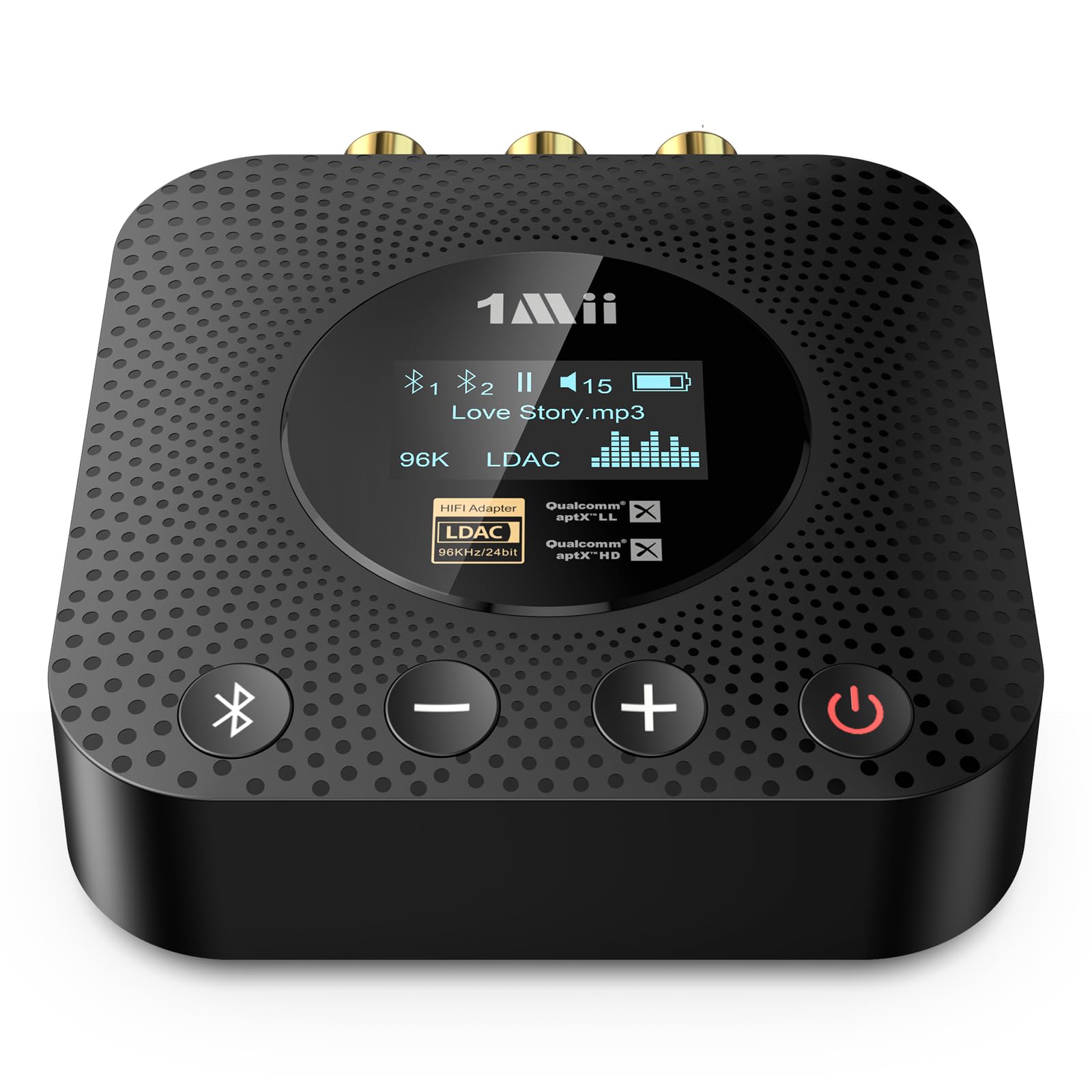
OLED display showing song name, codec, and sample rate makes this one of the more informative home Bluetooth adapters. The built-in battery adds a useful buffer for brief unplugged use, and LDAC/aptX HD streaming stays stable through walls. Output volume can be lower than some home components, so modest systems may need extra amplifier gain; the auto power-off can interrupt listening when a source pauses for a while. These limits keep it behind the Auris Blume HD for dedicated home-stereo duty, but the display and battery make it a strong mid-range pick for people who want to see what they are streaming.

Pros

  • OLED screen shows codec, song name, and sample rate so you know exactly what is playing.
  • Clean, balanced sound with enough detail for everyday music listening.
  • Setup is quick: pair a phone and connect RCA, optical, or coax to a stereo.

Cons

  • Some source devices can require a manual reconnection or encounter pairing hiccups.
  • The built-in battery and OLED screen add cost beyond a basic always-powered adapter.
Our verdict

For home-stereo owners who want an OLED readout and battery backup, this is a strong mid-range fit.

Check Latest Price
7

Budget Home Stereo

UGREEN BT Receiver

88 /100
Sound Score Excellent

Key details

Output Type
RCA, 3.5mm AUX
Codec Support
LDAC
Control Depth
Single-button control
Power Topology
Battery, 15 hours
View on Amazon

The UGREEN receiver brings LDAC and dual-phone pairing to older speakers and simple RCA/AUX setups at an entry-level price. For a legacy stereo lacking Bluetooth, it turns a phone into a streamer without much cost. The dual-phone pairing extends that to two people sharing one system. The Bluetooth 6.0 label is disputed, and the auto power-off after a laptop sleeps plus the single-button, no-display control are the tradeoffs you accept at this price. Sound quality is the reason to pick it over display-equipped adapters that cost more.

Pros

  • Strong budget sound for RCA/AUX streaming to older speakers.
  • Easy pairing with stable dual-phone connection.
  • Build quality feels higher than the entry-level price suggests.

Cons

  • No volume controls on the unit, so level changes must happen at the phone.
  • Bluetooth 6.0 label should be verified; the chip negotiates as 5.3-class.
Our verdict

Fits older speakers that just need a Bluetooth bridge with LDAC and dual-phone pairing, especially when the audio payoff matters more than polished controls.

Check Latest Price
8

Compact Home Adapter

1Mii B06Ultra

85 /100
Sound Score Excellent

Key details

Output Type
RCA, optical, coaxial
Codec Support
LDAC, aptX HD
Control Depth
Volume, 3D sound controls
Power Topology
AC powered
View on Amazon

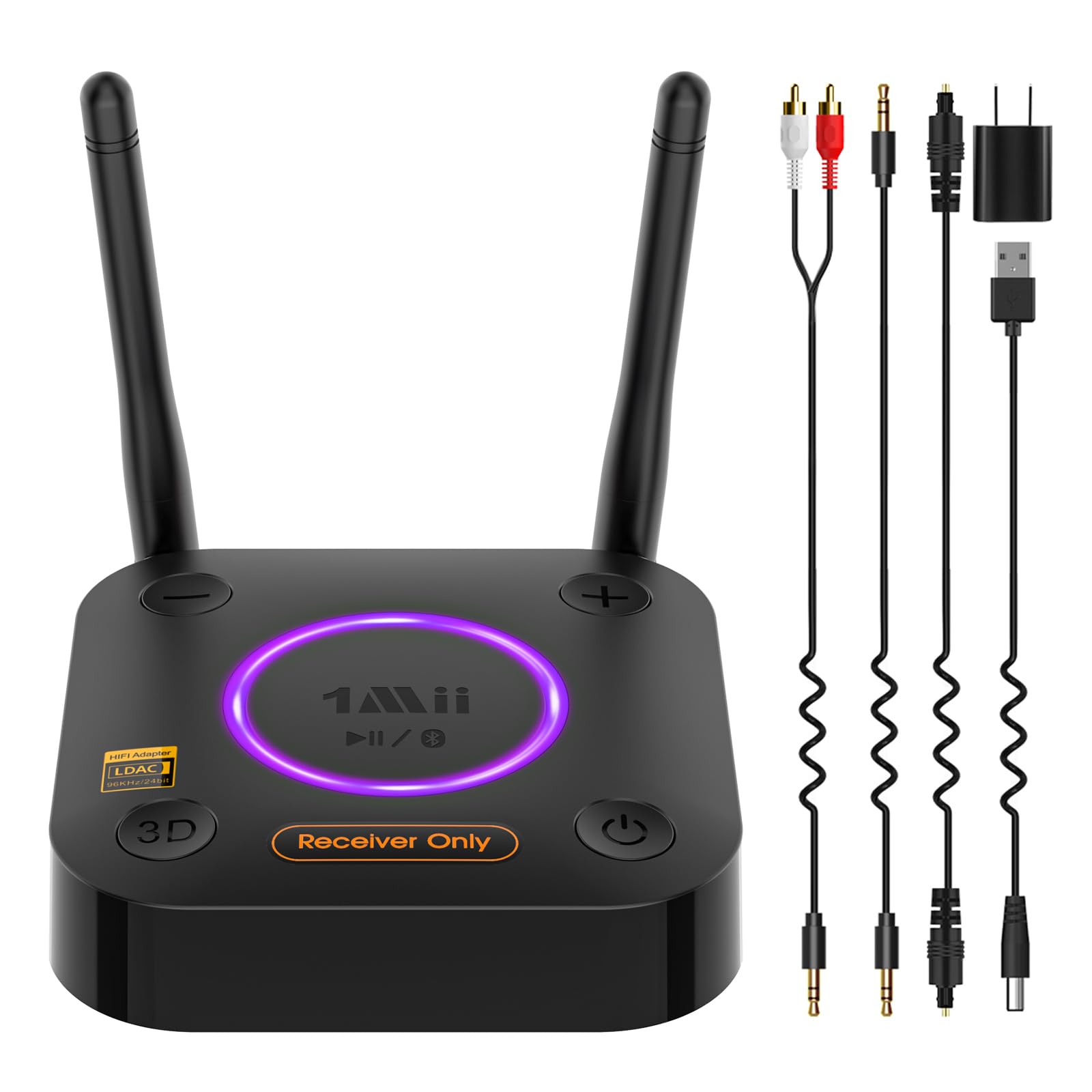
The B06Ultra is a compact, AC-powered home adapter that brings LDAC, aptX HD, optical/coaxial/RCA/3.5mm outputs, and physical volume/track controls to a legacy stereo or powered speakers. It pairs quickly and handles whole-room streaming to a single receiver at a budget-friendly price. The pricier OLED/battery sibling adds a song/codec screen and backup power; this model skips both, and video sources may show lip-sync delay, so music-first use is the intended lane.

Pros

  • LDAC and aptX HD turn a wired stereo or powered speakers into a wireless music system.
  • Optical, coaxial, RCA, and 3.5mm outputs cover a wide range of legacy home audio connections.
  • Physical volume/track controls and 3D surround add functionality without pushing the price into another tier.

Cons

  • Wall layout can shorten Bluetooth range in some homes; open rooms keep the signal.
  • Video sources can show lip-sync delay, so music-first setups are the safer fit.
Our verdict

For a wired home system that prioritizes music over video, the B06Ultra delivers the LDAC upgrade without extra bulk.

Check Latest Price

How to Choose

Codec Support

LDAC and aptX Lossless grab the headlines, but the codec only matters if your phone actually transmits it. iPhones cap out at AAC, so an Android-only LDAC feature adds nothing for iPhone owners. Check your phone's Bluetooth developer settings before paying extra for a lossless-capable receiver.

The audible gap between AAC, LDAC, and aptX HD is small on most TWS-style listening, but becomes more noticeable on revealing wired IEMs and over-ear headphones. If your primary source is an iPhone, buy on DAC quality, output power, and app features rather than chasing codec checkboxes.

Output Type

Output type determines which kind of gear the receiver can actually drive. A 3.5mm headphone jack is fine for IEMs and efficient earbuds, while a 4.4mm or 2.5mm balanced output roughly doubles available power and lowers noise on demanding wired headphones. A line-level receiver with RCA, XLR, or optical outputs is meant for home stereos and mixers, not direct headphone listening.

A portable DAC with only 3.5mm output will still sound great through sensitive IEMs. The need for balanced output appears when you move to 80-ohm-plus over-ear headphones or want extra headroom for dynamic peaks without pushing the amp into distortion.

DAC and Amp Implementation

The DAC chip is the starting point, not the whole story. A dual-DAC design like the ES9219 pair in the Qudelix-5K lowers channel crosstalk and improves stereo separation, but the amp section and power supply determine how that detail actually reaches your headphones. A powerful amp stage matters more for high-impedance over-ears than for sensitive IEMs.

The more meaningful sign of a well-implemented DAC is a silent noise floor. A receiver that hisses between tracks or emits a low hum through sensitive IEMs is poorly designed regardless of chipset. Look for models with clean output and enough voltage swing for your specific headphones.

Power Topology

Battery-powered portable DACs are convenient, but balanced output drains batteries fast. The Qudelix-5K rates up to 20 hours over Bluetooth on the 3.5mm output, yet that figure drops significantly with heavy LDAC streaming and balanced drive. Home adapters that run on AC power avoid battery anxiety entirely and often have better measured output headroom.

Some models, like the 1Mii B06HD+, include a battery as a backup so the unit can be unplugged briefly without interrupting music. A replaceable-cell design like the FiiO Retro Nano keeps a portable DAC alive past its built-in cell's aging cycle. Choose the topology that matches whether you listen mostly at a desk, in your pocket, or on a shelf.

Control Depth

App control and physical controls matter more as EQ becomes a primary reason to buy. The Qudelix-5K's parametric EQ is genuinely flexible, but it requires time to understand. If you want simple volume and track buttons without opening an app, a model with dedicated physical controls like the 1Mii B06Ultra will serve you better.

Companion apps are the most inconsistent part of this category. Reviewers routinely praise hardware while criticizing firmware updates and clumsy menus. Consider whether you will actually use advanced features or just stream and press play; if the latter, a receiver with a display and remote may be the pragmatic choice.

Frequently Asked Questions