8 Best Optical DAC of 2026: Ones That Match Your TV's Output

Find an optical DAC that actually works with your TV, console, or stereo — PCM-only and Dolby/DTS models explained.

Most optical DAC listings lead with 192kHz/24-bit as the headline feature, but a TV's optical output rarely sends anything close to that. It sends either plain 48kHz PCM or a compressed Dolby Digital/DTS bitstream. The distinction decides whether you hear audio or silence.

Choosing the right box comes down to your source, not the chip's maximum sample rate. A PCM-only converter works when your TV is set to PCM. A Dolby/DTS-capable decoder is required when your TV or app locks onto bitstream output. The same applies to connectivity: RCA line out, a 3.5mm jack, or a headphone amp each serve different setups.

That division is why the practical decision starts with the optical output your TV actually sends, then moves to the amplifier or speaker input you need to feed. Match those two points and the rest of the spec sheet matters less.

About the Sound Score: This comparative score is calculated from a product's published customer rating and review volume. It is not a laboratory measurement or a hands-on test result.

1

Best Overall

PROZOR 192K Optical DAC

89 /100
Sound Score Excellent

Key details

Power
USB 5V
Inputs
Optical, coaxial
Analog Output
RCA, 3.5mm
Format Support
PCM only
View on Amazon

The PROZOR optical DAC puts the essential conversion first: optical or coaxial digital in, RCA and 3.5mm analog out, and USB power. The 192kHz/24-bit badge is not the deciding factor here; the clean PCM handling and dual output jacks are the practical reasons to pick it. The marketing focus on sample-rate support misses the actual job: connecting a TV or console to an older amplifier or a pair of powered speakers. That job is about format compatibility and output connectivity, not headline sample rates.

Connect the TV's optical output, run RCA to a receiver or powered speakers, and the converter behaves like a transparent bridge. It accepts coaxial digital as well, which covers older CD and DVD players that use a single RCA-style digital connection. The 3.5mm output gives a second path for a compact desk setup or a second set of powered speakers without swapping cables. In a TV setup, the DAC sits between the television and the amp, draws power from a USB port, and stays out of the signal path once the source is set correctly.

The source sees the converter as a standard PCM DAC, so there is no driver installation and no software to configure. On a TV, the only setup step is telling the TV to output PCM rather than bitstream. On consoles and Blu-ray players, the same menu change applies. After that, the signal stays clean through the converter; the downstream amp or powered speakers decide the final character.

At a budget price, the PROZOR covers the two input formats and two output formats that matter for legacy stereo hookups. That combination is why it holds the default position in this category: it does not try to be a headphone amp, a decoder, or a tone-control station, and it is better off for that focus.

The right buyer is the TV owner with an older stereo receiver that lacks optical input, or someone routing budget console and DVD/Blu-ray audio into an amp. For that buyer, the amp or powered speakers control level and the source has to be set for PCM output before this converter will produce sound. Headphone listeners who need a volume knob or headphone amp should look elsewhere.

The compact enclosure and clean build make it easy to place behind a TV or beside a receiver. The jacks are arranged simply, and the optical connector seats firmly once the cable clicks in. Unit-to-unit consistency can vary, so a quick check of both output jacks after setup is sensible.

💡 Set the digital source to PCM before use; Dolby/DTS streams will not play without a decoder.

Pros

  • Plug-and-play optical/coaxial to RCA/3.5mm conversion works immediately on PCM sources without drivers or menus.
  • Clean sound and a compact metal body keep it unobtrusive in a TV or stereo setup.
  • Budget-friendly way to add optical input to a legacy receiver or powered speakers.
  • Dual RCA and 3.5mm outputs let one converter feed an amp and powered speakers without swapping cables.

Cons

  • Dolby Digital or DTS bitstreams are not decoded; the source must output PCM or feed a separate decoder.
  • A separate USB 5V power source is required; the box includes no adapter.
Our verdict

For TV optical into legacy stereo or powered speakers, this is the budget bridge to start with; the RCA and 3.5mm outputs fit both common connections.

Check Latest Price
2

Best Desktop DAC/Amp Combo

Fosi Audio Q4 DAC Amp

89 /100
Sound Score Excellent

Key details

Power
USB 5V
Inputs
USB, optical, coaxial
Analog Output
RCA, 3.5mm headphone
Format Support
PCM only
View on Amazon

The Q4 is the rare budget DAC that pairs USB, optical, and coaxial inputs with a genuine headphone amp and bass/treble tone controls. That makes it a more complete desktop audio hub than the plain optical-to-RCA converters in this lineup, which stop at fixed-level conversion.

This fits a desktop PC listener who wants one compact box for powered speakers and headphones. Tone controls shape bright or dull speakers without leaving the desk, and the RCA output feeds an amp or powered monitors. The headphone stage targets moderate-impedance cans; high-sensitivity IEMs are better served by a dedicated IEM amp.

The volume, bass, and treble knobs feel substantial, and the metal shell sits firmly on a desk. USB input needs no drivers, so setup is a single cable. Optical and coaxial inputs broaden it beyond a PC-only device, while the clean output separates instruments more clearly than typical motherboard sound.

Considering the DAC, amp, and tone controls in one enclosure, the price sits below buying separate units. It gives a desktop PC listener a single knob to adjust level and a second pair of knobs to compensate for speaker voicing, which is more than the entry-level converters in this roundup offer.

💡 When using optical, set the source to PCM rather than bitstream; the Q4 does not decode Dolby/DTS.

Pros

  • Clean, detailed output makes instruments easier to separate in a mix.
  • Bass, treble, and volume controls are genuinely useful for shaping speaker tone.
  • Solid construction and a competitive price for a DAC/amp combo.
  • Plug-and-play USB setup with no driver installation.

Cons

  • Some units hiss when paired with very sensitive headphones, so the headphone out has unit variance.
  • Long-term durability can vary; output issues may develop after months of use or a power event.
Our verdict

A practical desktop hub for listeners who want tone controls and a headphone amp without a second box.

Check Latest Price
3

Best for Dolby/DTS TV Sources

PROZOR 5.1 DAC Decoder

85 /100
Sound Score Excellent

Key details

Power
Inputs
Optical, coaxial
Analog Output
RCA L/R
Format Support
PCM, Dolby, DTS
View on Amazon

The PROZOR 5.1 decoder pulls Dolby Digital and DTS signals off an optical or coaxial line and delivers them as stereo RCA, exactly what a basic PCM-only converter cannot do. It reads the compressed multi-channel stream from a TV or disc player and sends an analog two-channel signal downstream. That positions it as a bridge for TVs and apps locked into bitstream output, heading to a legacy stereo amp or powered speakers.

Set the source to bitstream and the PROZOR handles the decode internally; the front-panel knob controls level and the rear RCA pair feeds the amp. The 192kHz/24-bit PCM path handles raw PCM sources too, making it a more flexible bridge than a fixed-cable converter.

The 5.1 label means decoding and downmixing, not six analog outputs; this unit outputs two channels. The volume knob is on the unit, and some units can produce a whine at maximum output. If your TV has no PCM option and your amp has no optical input, this is the missing link. Buyers expecting a true multichannel preamp or remote control should look at other categories.

💡 Keep the TV's audio output set to bitstream so the decoder receives the format it exists to handle.

Pros

  • Decodes Dolby Digital and DTS bitstreams that leave PCM-only converters silent.
  • Optical and coaxial inputs accept TV, console, and disc-player sources without a driver.
  • Downmixed stereo output feeds older amps or powered speakers directly.

Cons

  • Volume control lives on the unit, so adjusting level means walking over.
  • Some optical ports may drop audio until the cable is seated again or the TV audio format is switched.
  • A high-pitched whine can appear near maximum volume on some units.
Our verdict

For a TV stuck on Dolby/DTS and a stereo amp with no optical input, this decoder is the low-cost fix; skip it if you need true multichannel analog or remote volume.

Check Latest Price
4

Best Budget Audiophile Line DAC

SMSL SU-1 DAC

84 /100
Sound Score Excellent

Key details

Power
USB-C
Inputs
USB, optical, coaxial
Analog Output
RCA line out
Format Support
PCM, DSD, MQA
View on Amazon

The SU-1 moves the optical DAC genre from simple TV hookup to desktop hi-fi: the AKM4493S decodes PCM to 768kHz/32-bit and DSD512, and both optical and coaxial inputs feed RCA line outputs for an integrated amp or active speakers. Unlike the headphone-first DAC/amp in this set, the SU-1 is meant to sit before a separate amplifier.

The right buyer is a PC-based hi-fi listener who already owns an amp or powered speakers and wants a compact upgrade from motherboard audio. Optical input also opens MQA-CD playback from a disc transport, and coaxial covers other digital sources that output PCM. If you need a headphone jack, or you are just trying to get a TV's optical audio into powered speakers without an amp, this is the wrong tool. Long-term durability can vary; some units develop output issues after months of use.

The compact chassis fits a desktop stack, and the USB-C input is the main computer connection while optical and coaxial handle CD players, consoles, or TVs that output PCM. The presentation is clean and detailed, with a wider soundstage than typical budget converters.

Pros

  • Clear, detailed sound with a wider soundstage than typical budget converters.
  • High-res PCM, DSD, and MQA support at a price that undercuts dedicated audiophile DACs.
  • Compact chassis fits a desktop stack without dominating, and the casing feels solid for the price.

Cons

  • The optical input's protective flap may sit loose on individual units.
  • In quiet near-field setups, occasional pops or background noise may surface on some units.
Our verdict

For desktop listeners with a separate amp or powered speakers, the SU-1 is the line DAC to choose when high-res PCM and MQA matter more than extra features.

Check Latest Price
5

Best Headphone-First MQA DAC

SMSL DS100 DAC Amp

86 /100
Sound Score Excellent

Key details

Power
Inputs
USB, optical, coaxial
Analog Output
6.35mm, 4.4mm headphone
Format Support
PCM, DSD, MQA
View on Amazon

The DS100 is a headphone-first MQA DAC/amp with dual 6.35mm and 4.4mm outputs in a compact CNC aluminum chassis. It accepts USB, optical, and coaxial digital audio and drives headphones directly, so it does not need a separate amplifier.

Sound quality is transparent and quiet. The Cirrus Logic CS43131 keeps the noise floor low enough for sensitive headphones, and both outputs retain the same character. PCM goes up to 768kHz/32-bit, DSD256 is supported, and MQA/MQA-CD decoding is built in. The aluminum body feels denser than the price suggests.

For a desktop unit, the DS100 is small enough to sit beside a monitor without stealing desk space. The 4.4mm balanced output gives high-impedance headphone owners a higher-voltage option beyond the 6.35mm single-ended jack, a feature that suits demanding loads.

This fits headphone listeners with optical or coaxial sources, especially MQA subscribers and owners of high-impedance headphones. Unlike a line-level DAC with RCA outputs, the DS100 is headphone-only: no RCA line output, so it cannot feed powered speakers or a separate stereo amplifier. If a TV is the source, set it to PCM before using the optical input.

💡 For a TV or console on the optical input, switch the source to PCM before playback.

Pros

  • Clear, transparent sound with a quiet noise floor on both headphone outputs.
  • Compact CNC aluminum body that holds up to desktop use without taking much space.
  • MQA plus high-res PCM and DSD in a headphone-first package at a moderate price.

Cons

  • Listeners with 3.5mm-terminated headphones will need an adapter for the 6.35mm jack.
  • No RCA line output, so powered speakers and stereo amps cannot be connected directly.
Our verdict

A compact headphone-first MQA DAC/amp for optical and coaxial listeners; keep it on the desk and skip it if speakers need feeding.

Check Latest Price
6

Vintage Receiver

AUTOUTLET Optical DAC Cable

89 /100
Sound Score Excellent

Key details

Power
USB 5V
Inputs
Optical only
Analog Output
Fixed RCA cable
Format Support
PCM only
View on Amazon

The fixed 7ft cable makes this a two-wire install: optical in, USB power in, RCA out to an old receiver. It converts PCM/LPCM from TVs and disc players without configuration beyond setting the source to PCM; the 192kHz/24-bit spec is irrelevant for that job. The boundaries are no volume control, no headphone output, a non-replaceable cable, and a 5V USB adapter not included. Plugging the DAC into a TV USB port can work; if that port delivers noisy power, use a separate adapter. Static or silence can appear when the source sends Dolby/DTS or when power quality is weak. For a TV-to-vintage-receiver setup where the receiver handles volume and the fixed cable length fits, this is a low-cost bridge.

Pros

  • Plug-and-play operation with TV outputs and legacy amplifiers.
  • Simple installation with no drivers, software, or remote setup.
  • Good basic value and quality for budget home theater audio.

Cons

  • A separate 5V USB adapter is required; the unit doesn't include one.
  • Static or no sound can occur when the source isn't set to PCM or power quality is weak.
Our verdict

This fits a TV-to-vintage-receiver hookup where PCM output is already configured and the receiver has volume.

Check Latest Price
7

Vintage Receiver

LiNKFOR Optical DAC

87 /100
Sound Score Excellent

Key details

Power
USB 5V
Inputs
Optical only
Analog Output
Fixed RCA cable
Format Support
PCM only
View on Amazon

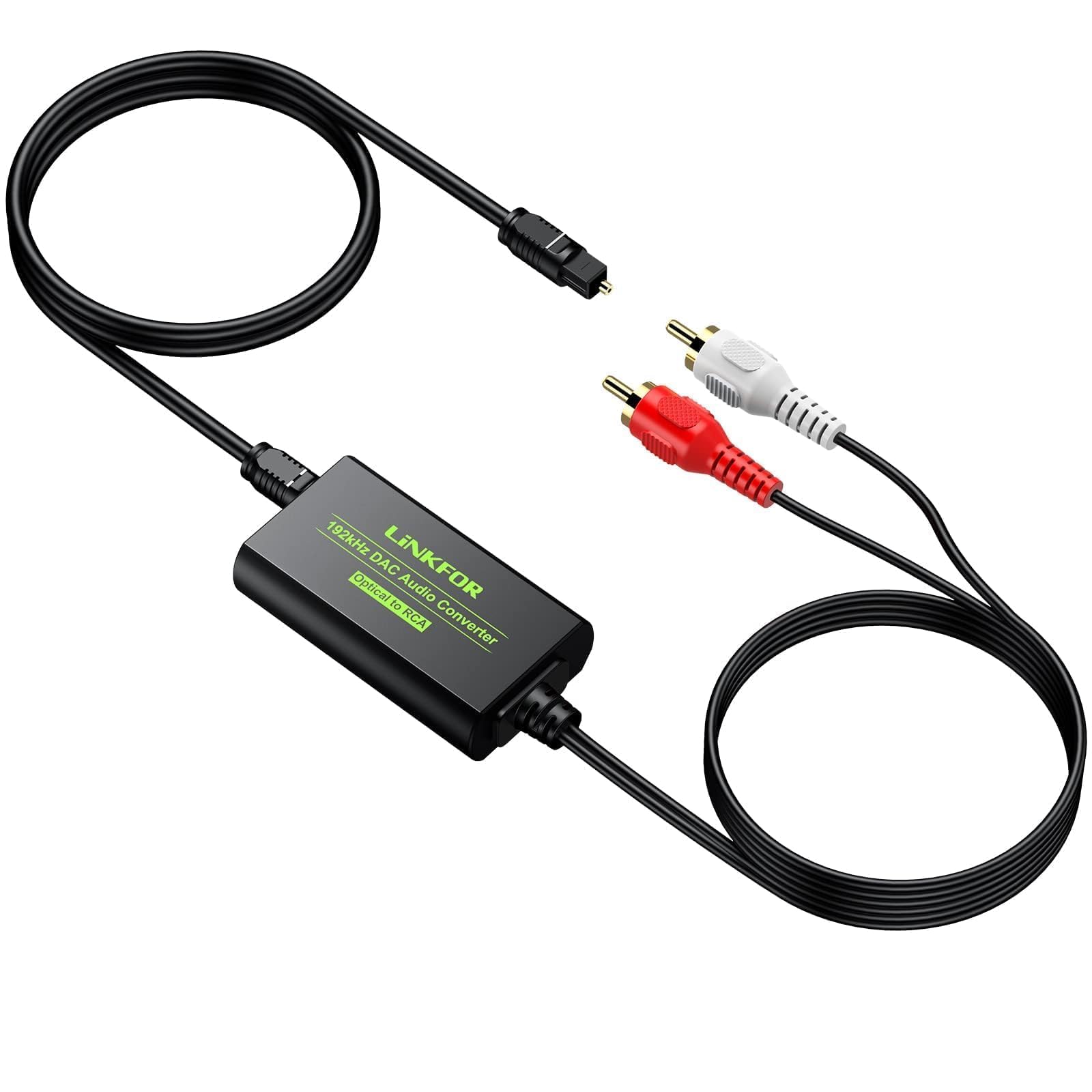
The LiNKFOR turns an older receiver into an optical-ready audio system with a pre-wired 7ft RCA cable. The attached cable keeps the installation tidy — no extra RCA cable to buy, and the USB-powered converter works once the TV is set to PCM. The trade-off is the fixed cable: you can't swap it for a different length, and in a tight cabinet the RCA end can be strained. Static or no-sound can surface when the source sends Dolby/DTS bitstream or when power quality is marginal; switching the TV to PCM clears this when the source is the cause. The comparable fixed-cable option in this guide has tighter QC, but the LiNKFOR remains a budget-friendly fit for a stationary TV-to-receiver hookup.

Pros

  • Plug-and-play setup: connect optical and USB power, then the fixed RCA cable reaches an amp or receiver.
  • Adds a budget optical input to legacy stereo and home theater gear without extra cables.
  • Keeps older receivers and stereo systems in service with a modern TV connection.

Cons

  • Strain on the fixed RCA cable in a tight cabinet can lead to channel dropout, and the connector is non-replaceable.
  • Static or no-sound can surface in some setups and persist until the source or unit is reset.
Our verdict

With the TV set to PCM output, this fixed-cable converter is a cost-effective bridge for a stationary TV-to-vintage-receiver hookup that you won't re-cable repeatedly.

Check Latest Price
8

Legacy Amp

YGiTK 192K Optical DAC

87 /100
Sound Score Excellent

Key details

Power
USB 5V
Inputs
Optical only
Analog Output
Fixed RCA cable
Format Support
PCM only
View on Amazon

Turns a TV's optical PCM signal into analog RCA for a legacy amp with no configuration. The male RCA ends plug directly into AUX or CD inputs, the fixed cable removes the need for a separate interconnect, and a 5V USB port provides power. This is a line-level output for amps or powered speakers, not a headphone amp. Placement is tied to that attached cable, volume control falls to the amplifier, and a spare USB slot must be nearby. The deliberately narrow scope keeps the price low and explains why it sits behind the top pick's broader compatibility.

Pros

  • Works as described out of the box for optical PCM to RCA conversion.
  • Build quality suits the entry-level price.
  • The attached RCA cable saves a separate interconnect.

Cons

  • Only an optical input is available, so sources without a Toslink port are left out.
  • Dolby Digital or DTS bitstreams stay silent unless the source switches to PCM.
Our verdict

Treat this as a set-and-forget add-on for one TV and one amp already in place.

Check Latest Price

How to Choose

Optical and Coaxial Inputs

Optical/Toslink is the port found on most TVs, game consoles, and Blu-ray players, so it is the first input to check. Coaxial is a useful second input for older DVD players or CD transports. The physical input does not change the format problem: both carry PCM or bitstream, and the DAC's decoder still decides whether audio comes out.

If the TV sits far from the stereo, optical also avoids the ground loop that can appear through a shared coaxial connection. That matters more in a vintage receiver setup than in a short desktop cable run.

Analog Outputs

RCA line out is the safest bet for a receiver, integrated amp, or powered speakers. A 3.5mm headphone jack on the same DAC can drive headphones directly, but it may not have the voltage level a fixed-line input expects. Fixed-cable RCA models make installation clean but lock you into a cable length you cannot replace.

Format Support

PCM-only converters accept unencoded stereo only. If your TV sends Dolby Digital or DTS, a PCM-only DAC receives a compressed stream it cannot decode, and the result is silence. A decoder that handles Dolby AC3 and DTS downmixes the bitstream to stereo, which is the fix for TVs and apps that refuse PCM output.

That distinction also explains why a 192kHz/24-bit badge does not solve TV audio: the source sends 48kHz or a compressed bitstream regardless. The DAC's ability to accept that stream matters more than its maximum sample rate.

Volume Control

With no volume control, the amp, powered speakers, or TV handles level. That is fine when a receiver already has a knob and you listen from a seat near it. A DAC with a physical knob or remote helps when the amplifier is out of reach or when your speakers have no volume adjustment.

Power Requirements

Most budget optical DACs run on 5V USB and ship without a wall adapter. Plugging them into a TV's USB port is convenient, but the shared ground can introduce a hum. A dedicated 5V wall adapter or a clean powered USB hub usually eliminates that noise.

Frequently Asked Questions