9 Best JBL Soundbar of 2026: Bass and Surrounds That Fit Your Room

The best JBL soundbar depends on bass depth, rear speakers, and real vs. virtual Atmos — this guide maps each model to your room.

Soundbar marketing leans on wattage, but wattage tells you almost nothing about how a bar sounds in your living room. The specs that actually shape the experience are subwoofer size, whether the rear channels are physical or virtual, and how much calibration the system offers.

That gap matters because a 10-inch subwoofer in a small apartment behaves very differently than the same bar in a large open room. A bar with virtual Atmos can widen the soundstage, but it cannot place effects behind you the way detachable rear speakers can. The right JBL setup matches the room and the way you watch, not the biggest number on the box.

There is also a timing choice: a previous-generation model carries years of owner feedback and often a lower price, while the current version adds room calibration and updated dialogue processing. Both can be smart buys; the difference is which trade-off fits your priorities.

About the Sound Score: This comparative score is calculated from a product's published customer rating and review volume. It is not a laboratory measurement or a hands-on test result.

1

Best Overall

JBL Bar 500 MK2

89 /100
Sound Score Excellent

Key details

Channels
5.1
Connectivity
eARC, Wi-Fi, Bluetooth
Audio Formats
Dolby Atmos
Surround Type
Virtual MultiBeam
View on Amazon

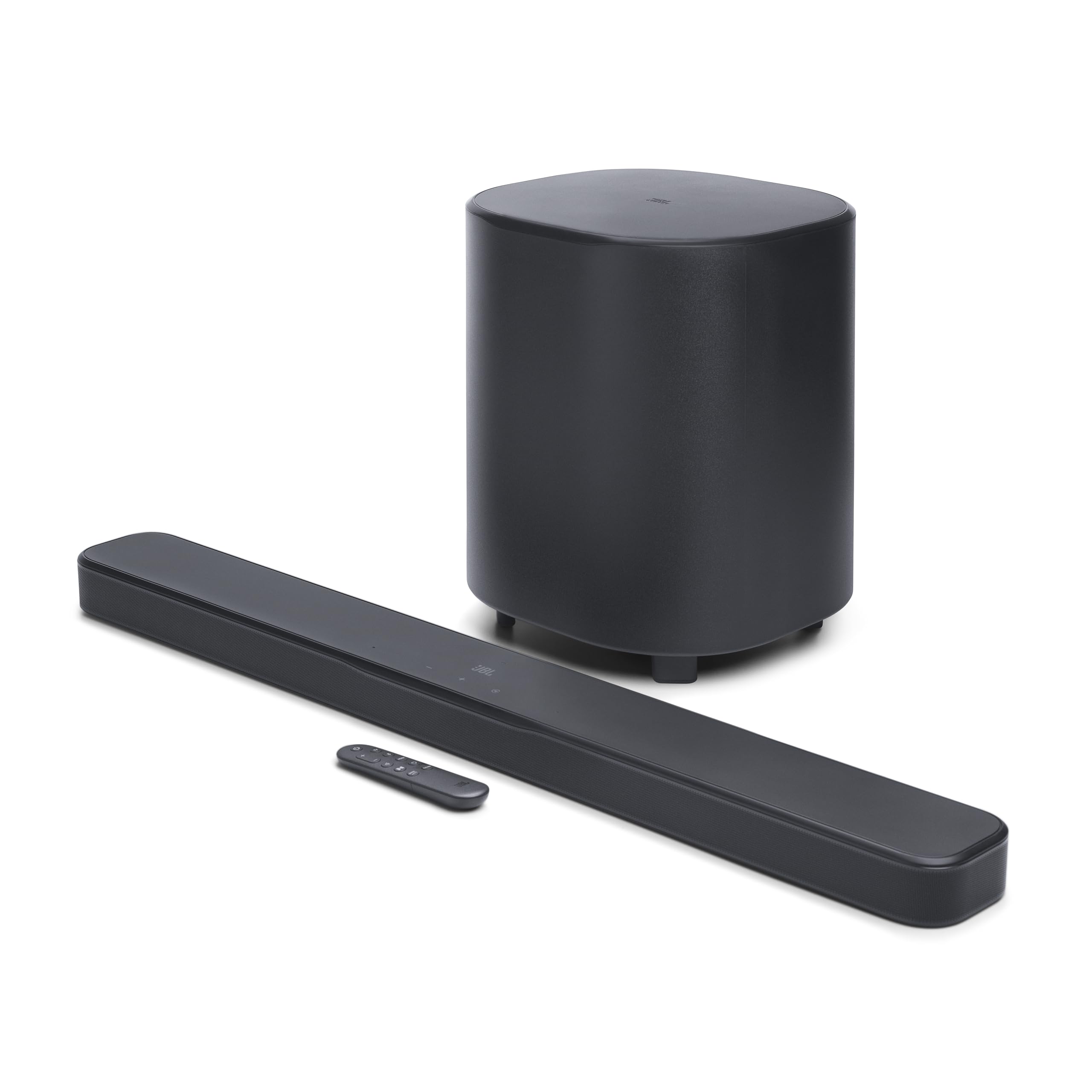
The Bar 500 MK2's current-generation processing is what separates it from the earlier Bar 500: PureVoice 2.0 keeps dialogue clear even in action-heavy scenes, SmartDetails adds subtle high-frequency detail, and Easy Sound Calibration shapes the output to the room. The system runs at 750W with a 10-inch wireless subwoofer, so bass impact is real and the virtual Atmos height layer opens up the soundstage without requiring ceiling speakers. MultiBeam creates the surround bed from the bar alone, and in a mid-size room the effect is a wide, enveloping sound field rather than a narrow TV-front presentation.

HDMI eARC is the easiest setup route: one cable carries audio and control, 4K Dolby Vision passes through, and the bar wakes with the TV remote. Bluetooth and Wi-Fi streaming hold up in everyday use, and the JBL ONE app handles EQ and the calibration routine. The sub pairs wirelessly with the bar, so there is no speaker cable to run across the room.

This is best for home-theater buyers in mid-size living rooms or apartments who want subwoofer bass, clear dialogue, and room-filling virtual surround without rear speakers. Virtual MultiBeam cannot create the localized rear effects of physical detachable speakers, and that tradeoff shows mainly in large open rooms or seating against a back wall; in a typical apartment living room, the virtual surround still carries enough width to make the absence of satellites a minor point.

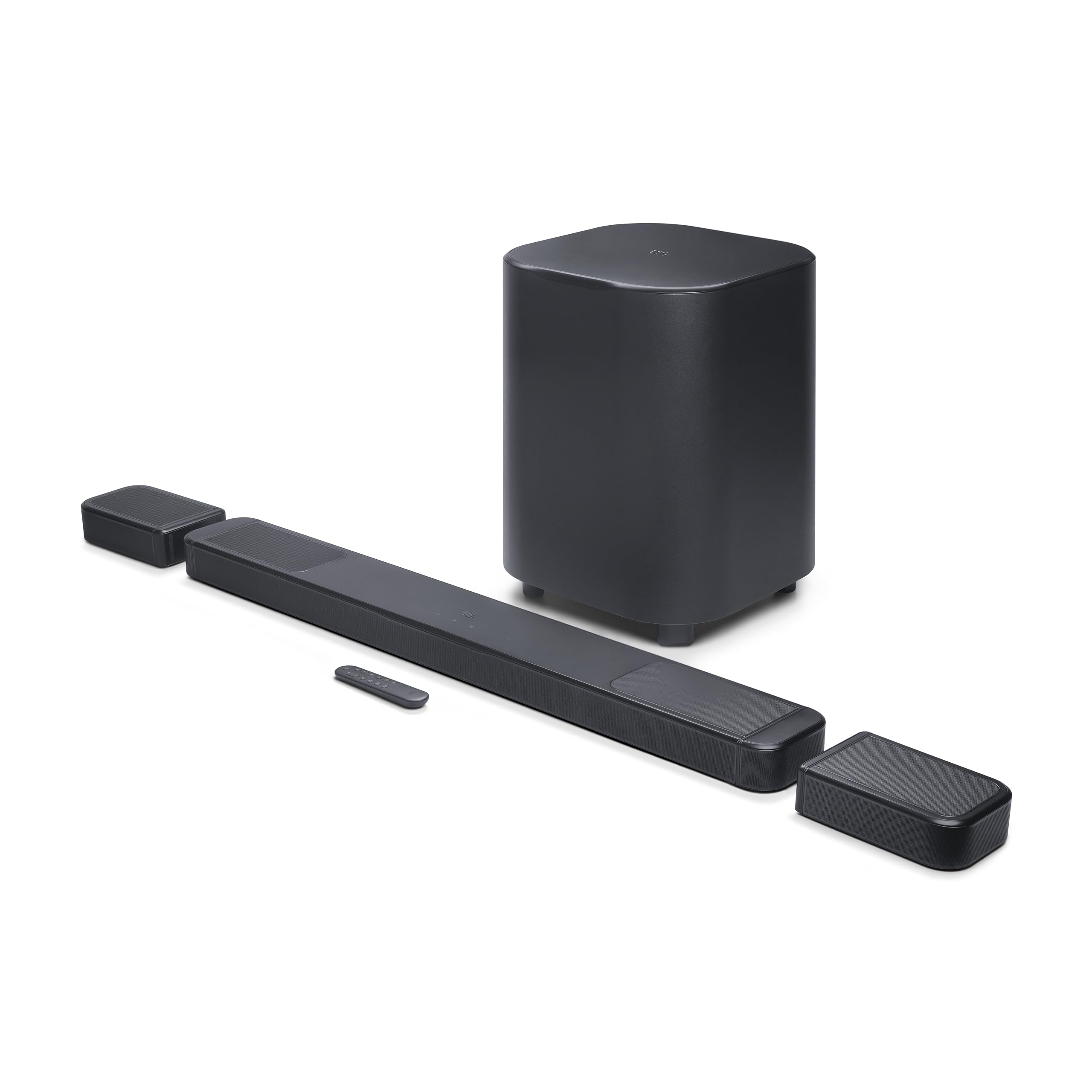
The lineup comparison comes down to how many boxes you want. The compact no-sub bar is smaller and costs less but can't match the 10-inch sub's low end. The detachable-rear models add physical surround channels and, at the top, height drivers and a 12-inch sub; they also add battery charging, more setup, and a higher price. The 500 MK2 sits in the middle with updated processing, no rears to charge, and a 10-inch sub that covers typical apartment and living-room bass needs. That is the niche this model fills.

For the money, the Bar 500 MK2 brings the key features for mid-size home theater: dialogue processing, a real subwoofer, and a short setup. Buyers who do not want detachable rear speakers get that combination without managing extra satellites. In a typical living room, it removes the need to step up to a heavier surround system.

Pros

  • Dialogue stays clear in dense mixes thanks to PureVoice 2.0 and SmartDetails.
  • HDMI eARC setup is plug-and-play, and 4K Dolby Vision passthrough keeps the signal chain simple.
  • The 10-inch wireless subwoofer and Dolby Atmos support a feature set that competes well for the money.
  • Bluetooth, Wi-Fi, TV power sync, and the JBL ONE app cover the everyday control points.

Cons

  • Ultra-compact TV setups must find floor space for the separate 10-inch subwoofer; this is not a single-bar system.
Our verdict

The Bar 500 MK2 defines the practical middle of JBL's soundbar range: real sub bass, current processing, and no satellites.

Check Latest Price
2

Best True Surround Upgrade

JBL Bar 1000 MK2

85 /100
Sound Score Excellent

Key details

Channels
7.1.4
Connectivity
eARC, Wi-Fi
Audio Formats
Atmos, DTS:X
Surround Type
Detachable battery rears
View on Amazon

The Bar 1000 MK2 is the physical-surround step up from the 5.1 virtual model in JBL's current lineup: 7.1.4 channels, detachable battery rears, and up-firing drivers put Dolby Atmos and DTS:X objects behind and above the listening position, not just across the front. The 480W RMS system uses a 10-inch wireless sub to fill large rooms, with HDMI eARC carrying 4K Dolby Vision and Wi-Fi for streaming audio.

App-based setup handles room calibration in minutes, and the detachable surround modules place easily on shelves or end tables without running wire. The subwoofer adds low-end weight for action scenes, while the rear channels give a clearer sense of placement than virtual processing alone. For a system this size, the wireless sub keeps placement flexible and the app trims channel levels to match the room.

Home theater fans who want true rear surround without wiring a receiver, plus gamers after 3D spatial audio, are the right audience. It suits large living rooms and dedicated media rooms. The one setup caveat involves HDMI/eARC: certain source devices may hold the handshake until the bar gets a direct TV connection or a power cycle.

💡 Keep the detachable surround modules charged between sessions so the rear channels are ready when you need them.

Pros

  • Real height and rear-channel Atmos/DTS:X effects place sound around you, not only in front.
  • Detachable battery-powered surrounds set up anywhere without running speaker wire.
  • App-based setup and calibration get the system tuned with minimal effort.
  • Premium-priced, but the full 7.1.4 layout delivers more immersion than typical virtual bars.

Cons

  • HDMI/eARC handshake with certain source devices can trigger a CEC/EDID lockout.
Our verdict

The Bar 1000 MK2 is the JBL to pick when genuine rear-channel Atmos and DTS:X placement matter more than minimal clutter — an immersive 7.1.4 layout for buyers who do not need the 12-inch flagship sub.

Check Latest Price
3

Best Compact All-In-One

JBL Bar 300 MK2

86 /100
Sound Score Excellent

Key details

Channels
5.0
Connectivity
eARC, Wi-Fi, Bluetooth
Audio Formats
Dolby Atmos
Surround Type
Virtual MultiBeam
View on Amazon

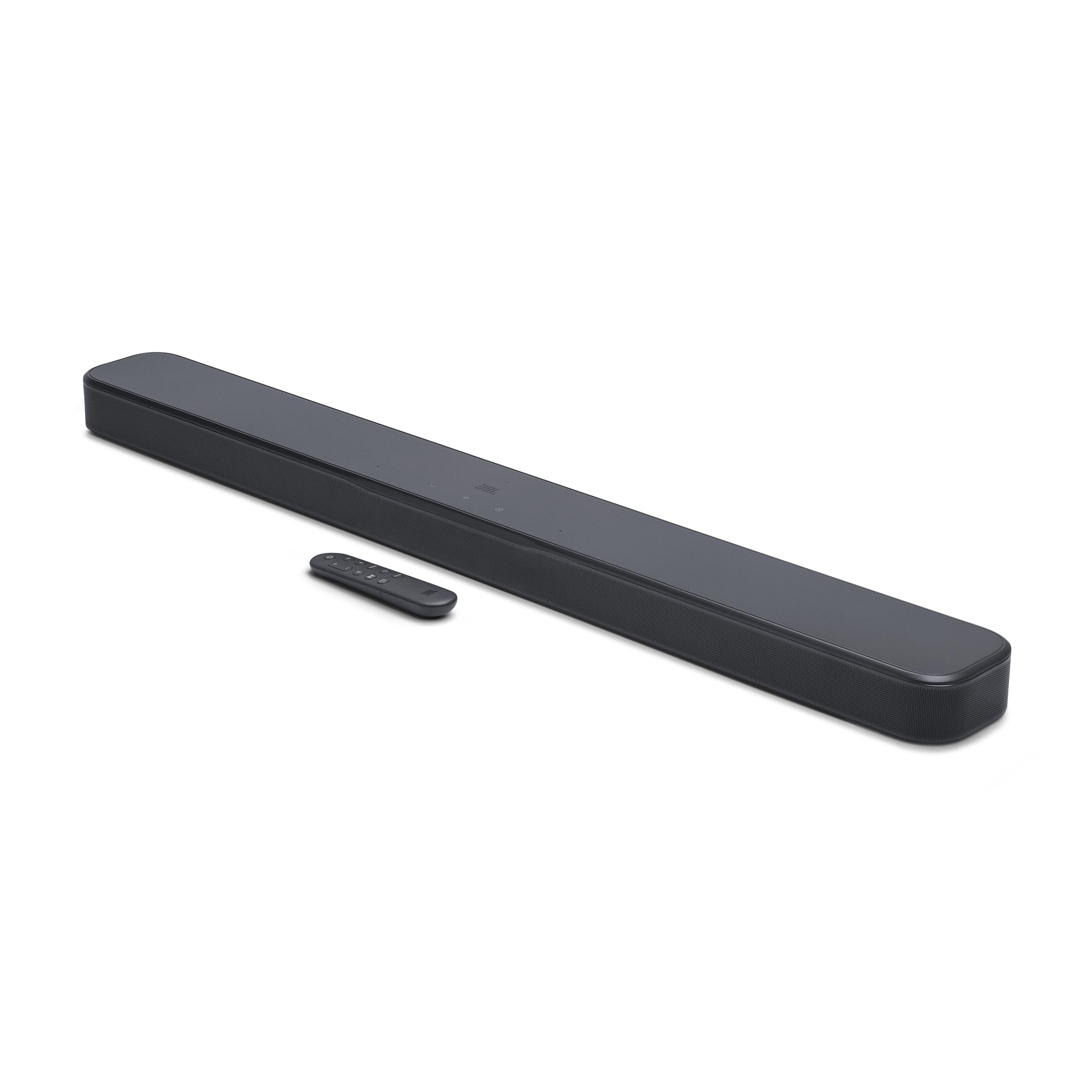
The 300 MK2 delivers 450W, MultiBeam 3.0 virtual height processing, PureVoice 2.0 dialogue enhancement, and Easy Sound Calibration from a single 5.0 cabinet with no separate subwoofer. That puts it a clear step above the entry-level 2.0 bar in this lineup, which lacks Atmos, app EQ, and any room calibration. The 300 MK2 is the compact choice for Atmos and calibration in JBL's current lineup.

Setup is quick over HDMI eARC, and the bar follows the TV's existing remote for power and volume. The JBL ONE app adds EQ and Easy Sound Calibration, so you can tune the output to the room. Dialogue in movies and TV stays clear, and the built-in bass ports give the single cabinet more low-end weight than the form factor suggests.

This bar fits a medium room where a separate subwoofer won't fit, and it serves movie and TV fans who want Atmos and clear dialogue from a single unit. It also suits owners who want app-based control over EQ and calibration. The honest limit is low-end pressure: a 5.0 cabinet can't produce the chest-thump of a wireless 10-inch sub, especially as room size grows.

Pros

  • Strong bass and sound imaging for a single bar with no separate sub.
  • Connects to TV remotes and HDMI eARC with minimal setup effort.
  • Dialogue stays clear in movies and TV.
  • App EQ and Easy Sound Calibration give practical tone control.

Cons

  • Virtual MultiBeam can't create the localized rear effects of physical surround speakers.
  • Built-in bass ports can't produce the low-end pressure of a separate subwoofer in larger rooms.
Our verdict

The 300 MK2 answers the one-box question in JBL's lineup: Atmos, calibration, and 450W without a second component.

Check Latest Price
4

Best Budget Subwoofer Combo

JBL Bar 2.1 Deep Bass MK2

83 /100
Sound Score Excellent

Key details

Channels
2.1
Connectivity
Bluetooth, HDMI, Optical
Audio Formats
Dolby Digital
Surround Type
Stereo
View on Amazon

The JBL Bar 2.1 Deep Bass MK2 is the most affordable way into JBL's separate-subwoofer lineup, pairing a 300W soundbar with a 6.5-inch wireless sub and a connection set that keeps to Bluetooth, HDMI, and Optical. It sits one step above the ultra-compact 2.0 bar in the same range, adding a dedicated sub without jumping into 5.1 territory.

At normal living-room volumes, dialogue stays clear and stereo imaging sounds wider than built-in TV speakers. The separate subwoofer can fill a small-to-medium room without needing a receiver or additional surround channels.

The remote's bass level button covers the main tuning that matters here: dropping the low end for quieter evenings or boosting it for action movies. There is no app or EQ menu to learn.

This is the right call for a first-time soundbar buyer on a budget who wants the presence of a separate subwoofer in a modest living room. The 6.5-inch sub will not replace a 10-inch-class woofer, so buyers coming from bigger bass should move up the JBL range; power-on and subwoofer-output issues can also appear over long-term use, so keeping warranty proof and testing the unit during the return window is sensible.

Pros

  • Clear dialogue and strong stereo imaging at moderate volume make TV and music enjoyable.
  • Separate wireless subwoofer adds low-end weight without the cost of a receiver-based system.
  • Setup and connection are simple enough for first-time soundbar buyers.

Cons

  • Audio format support stops at Dolby Digital, without HDMI eARC or Atmos for object-based sound.
  • Bluetooth pairing can be inconsistent with certain TVs and Blu-ray players when wireless audio is the only link.
Our verdict

A cost-effective 2.1 entry point for buyers who want a separate JBL subwoofer without chasing higher-channel systems.

Check Latest Price
5

Best Flagship Home Theater

JBL Bar 1300X MK2

87 /100
Sound Score Excellent

Key details

Channels
11.1.4
Connectivity
Wi-Fi, HDMI, Optical, Bluetooth
Audio Formats
Atmos, DTS:X
Surround Type
Detachable Bluetooth surrounds
View on Amazon

The 1300XMK2 is the largest JBL bar in the lineup: 1570W, an 11.1.4 channel layout, and a 12-inch wireless sub around a 55-inch main bar. Its detachable surrounds double as portable Bluetooth speakers, which sets it apart from JBL's virtual-surround models.

The scale is the point, but the sub is hot at default settings and can bury the mix until its level is trimmed. That is a setup step rather than a permanent flaw — after calibration the system has the headroom for movie nights in open-concept rooms. In a typical living room, the 55-inch bar and 12-inch sub are more hardware than the space needs.

This is for home theater enthusiasts with large open-concept rooms, a DTS:X or Dolby Atmos source library, and a budget that allows a flagship purchase. It sits above the top pick in size and price, so buyers comparing JBL bars should treat it as the scale option rather than the everyday default. If you mainly watch broadcast TV and do not want physical rear speakers, the current 5.1 MK2 with a 10-inch sub is the easier fit.

💡 Use the app's subwoofer trim during setup; the default level is tuned for very open rooms.

Pros

  • Huge, immersive sound with strong bass and room-filling output.
  • Premium build quality and finish across the bar, sub, and surrounds.
  • Detachable surrounds double as standalone Bluetooth speakers for other-room listening.
  • Delivers the fullest JBL experience for buyers who want flagship-scale home theater output.

Cons

  • In a typical living room, the 55-inch bar and 12-inch sub are more hardware than the space needs.
  • Wireless rear speakers can occasionally drop their connection and require a power cycle.
Our verdict

Choose the 1300XMK2 when the room is large, the seating is spread out, and you want detachable surrounds that also work as Bluetooth speakers. Otherwise, the JBL 5.1 MK2 with a 10-inch sub is easier to live with.

Check Latest Price
6

Best Detachable Surround Value

JBL Bar 700 MK2

86 /100
Sound Score Excellent

Key details

Channels
7.1
Connectivity
HDMI, Optical, Wi-Fi, Bluetooth
Audio Formats
Atmos, DTS Virtual:X
Surround Type
Detachable battery rears
View on Amazon

The Bar 700 MK2 brings detachable rear surround speakers and a 10-inch subwoofer together at a lower price than the Bar 1000 MK2, with a 780W seven-channel system that handles Dolby Atmos and DTS Virtual:X. The physical rears give it an advantage over virtual-only bars in the same price band. It delivers the core function of JBL's bigger detachable-surround systems without the extra height-channel complexity.

Setup is quick: the sub pairs automatically, the rear speakers dock for charging, and the JBL app manages EQ and input selection without requiring the remote. The 10-inch sub delivers deep low-end that stays controlled at moderate volumes, and dialogue remains clear in mixed TV and movie content. In a medium-to-large living room, the detachable rears produce a genuine sense of space instead of a phantom surround effect.

This is the fit for movie/TV rooms up to large living rooms, especially when physical rear immersion is the goal. The rear speakers are battery-powered, and charging behavior can be inconsistent between units. Buyers who won't tolerate any battery-powered rears should look at a virtual-surround bar instead.

💡 Use the JBL app to check rear battery status before starting a long movie session.

Pros

  • Deep low-end from the 10-inch sub gives action scenes weight without dominating dialogue.
  • Detachable rear speakers create genuine surround immersion for movie and TV content.
  • Setup is quick and the JBL app handles EQ and source control cleanly.
  • Delivers detachable-surround immersion at a lower price point than the Bar 1000 MK2.

Cons

  • Battery-powered rear speakers require periodic docking to recharge.
  • The 7.1 layout doesn't deliver the wider 11.1.4 stage of the flagship Bar 1300.
Our verdict

For buyers who want physical rear surrounds without the Bar 1000 MK2 price, the 700 MK2 is the value route to detachable-rear immersion with a 10-inch sub.

Check Latest Price
7

Bedrooms or Offices

JBL Bar 2.0 All-in-One MK2

80 /100
Sound Score Excellent

Key details

Channels
2.0
Connectivity
Bluetooth, HDMI ARC, Optical
Audio Formats
Dolby Digital
Surround Type
Stereo
View on Amazon

The JBL Bar 2.0 MK2 is a well-built, compact 2.0 bar that lifts TV dialogue and volume above built-in speakers without taking up much shelf space. Setup is quick over HDMI ARC, optical, or Bluetooth, and the remote keeps control simple. Its fixed sound signature means no EQ, bass, or treble adjustment, so you cannot tune it to your room; quality control can vary between units, making a return policy worth checking. With no separate subwoofer, bass impact is modest in action movies and games, which is why it trails the 300 MK2 and any subwoofer-equipped JBL for home-theater use. For a bedroom or office where clarity matters more than rumble, it is a strong entry-level buy.

Pros

  • Compact, well-built bar that fits small rooms and sits low in front of the TV.
  • Simple setup over HDMI ARC, optical, or Bluetooth with an easy remote.
  • Budget-friendly option that improves dialogue clarity over TV speakers.

Cons

  • No Wi-Fi streaming or multi-room audio; playback is limited to Bluetooth and wired inputs.
  • No surround processing or height effects, so action scenes stay strictly stereo.
Our verdict

Choose this when the TV lives in a bedroom, office, or small apartment and simple operation matters more than cinematic scale.

Check Latest Price
8

Value-Focused Buyers

JBL Bar 500

88 /100
Sound Score Excellent

Key details

Channels
5.1
Connectivity
Wi-Fi, AirPlay, Chromecast, Bluetooth
Audio Formats
Dolby Atmos
Surround Type
Virtual MultiBeam
View on Amazon

The Bar 500 delivers a full 5.1 layout from a single bar and a wireless 10-inch sub, with virtual MultiBeam surround that fills a medium room without rear speakers. Setup is easy: HDMI ARC, auto-pairing sub, and immediate TV control. For the money, this is a direct route to deep bass and Dolby Atmos processing in a no-fuss package.

What keeps it below the current MK2 is the absence of newer processing like SmartDetails and updated PureVoice; standby loops and Wi-Fi reconnection hiccups can appear on certain units. Buyers who use HDMI ARC or Bluetooth and skip multi-room streaming get the core 5.1 experience for less.

Pros

  • Deep bass and wide virtual surround fill a medium room without rear speakers.
  • HDMI ARC and auto-pairing sub make setup one of the easiest in the JBL line.
  • A 10-inch subwoofer at this price gives cinema-style impact without extra speakers.

Cons

  • No room calibration to tune the sound to your listening space.
  • Dense movie mixes can still bury dialogue even with the PureVoice toggle.
Our verdict

For a budget-focused HDMI ARC setup that doesn't depend on the MK2's extras, the Bar 500 delivers big-sub 5.1 for less.

Check Latest Price
9

Dedicated Home Theaters

JBL Bar 1300X

85 /100
Sound Score Excellent

Key details

Channels
11.1.4
Connectivity
Audio Formats
Atmos, DTS:X
Surround Type
Detachable battery rears
View on Amazon

The prior-generation 1300X pairs an 11.1.4 layout with a 12-inch wireless sub and detachable battery rears that double as portable Bluetooth speakers. That scale fills large home theaters with room-wide Atmos and DTS:X, and the detachable rears keep true surround channels without extra speaker wires.

The tradeoff is generation-specific: the MK2 adds updated processing and features, and occasional audio dropouts or random shutdowns may require a power cycle. For a large dedicated theater, the 1300X still delivers strong value for the right room.

Pros

  • Massive, immersive sound with strong subwoofer performance.
  • Detachable wireless rears set up easily and double as standalone Bluetooth speakers.
  • Controls and EQ provide useful adjustment to tailor the sound.

Cons

  • No automated room calibration; manual EQ is the only path to balanced sound.
  • In a smaller room, the wide bar and 12-inch sub overwhelm the space.
Our verdict

For a large-room home theater on a previous-generation budget, the 1300X delivers flagship Atmos/DTS:X; the MK2 is the alternative if you want the newest processing.

Check Latest Price

How to Choose

Channel Count

Channels describe how many separate audio paths the bar can process. A 2.1 system sends stereo to the bar and bass to the sub; a 5.1 or 7.1 system adds center and surround channels, virtual or physical.

More channels only help when content and room can use them. A well-tuned 2.1 bar in a small bedroom can sound more coherent than a 7.1 bar bouncing virtual effects off close walls.

Subwoofer Size and Power

Subwoofer size is the most honest spec on the box because driver area determines how much air moves. A 10-inch driver reaches lower and pressurizes a room more than a 6.5-inch driver at the same wattage.

Match the sub to room volume, then dial the level down from default. In a small room, 750W with the sub at full can sound boomy; in a large open room, 300W can feel thin.

Rear Speakers vs Virtual Surround

Virtual surround uses reflected sound to create the impression of rear channels without speakers behind you. It widens the stage, but it cannot place a specific effect precisely behind your head the way a physical driver can.

Detachable battery rears add that localization without cables, but they need recharging and re-docking. Choose virtual for simplicity; choose detachable rears if you want effects to move around you.

Atmos and DTS:X Support

Dolby Atmos and DTS:X add height and placement information to a mix. A bar without physical height drivers uses virtual processing to fake the overhead effect; up-firing or detachable channels reproduce it more literally.

The gap shows in action movies and games. For dialog-driven TV, virtual Atmos still improves clarity and width, so the feature is worth having even without a subwoofer.

Connectivity: eARC and Wi-Fi

HDMI eARC carries Atmos and other lossless formats from the TV and lets the TV remote control the bar. Optical caps audio to compressed Dolby Digital, which drops object-based formats.

Wi-Fi is the most stable streaming option, but JBL bars can enter standby during quiet passages and drop the connection. Use eARC, update firmware, and disable auto-standby if the model allows.

Frequently Asked Questions