7 Best Onkyo Receiver of 2026: Dirac, THX, and 8K for Less

The best Onkyo receiver depends on your room, speakers, and sources — Dirac vs AccuEQ, 7.2 vs 11.2, and where HDMI 2.1 matters.

Onkyo receivers have a habit of putting Dirac Live and THX on models that undercut rival prices. That makes them easy to want, but the decision gets complicated once you factor in connectivity. HDMI handshakes, eARC behavior, and network stability are where the lineup splits.

The right choice depends on your speaker layout and your sources. A 7.2 receiver with AccuEQ and 8K HDMI handles a gaming TV and basic Atmos without much fuss. A Dirac-equipped 9.2 model rewards buyers who want precise room correction and room to expand to 5.2.4 or 7.2.4 later.

The goal is to match the receiver to the room you actually have, not the one on a spec sheet. That means skipping channels you will not use and seeking Dirac only when your listening space needs it.

About the Sound Score: This comparative score is calculated from a product's published customer rating and review volume. It is not a laboratory measurement or a hands-on test result.

1

Best Overall

Onkyo TX-RZ50

86 /100
Sound Score Excellent

Key details

HDMI & 8K
8K HDMI 2.1
Amplifier Power
120 W/ch
Room Correction
Dirac Live
Channels & Audio
9.2, 11.2 support
View on Amazon

The TX-RZ50 is the most complete Onkyo for buyers who want Dirac Live, THX certification, and 11.2-channel processing without switching receivers later. Its nine internal amps are rated at 120 W per channel with 250 W dynamic headroom, and the 11.2 processing supports a 7.2.4 speaker layout when you add an external two-channel amp. Dirac Live's full calibration software is included rather than an upsell, which anchors the receiver at the high-value end of Onkyo's premium range. The amplifier section stays composed on demanding soundtracks, keeping dialogue clear even when subwoofers and surround effects are pushing hard. At normal listening levels, the amp drives floor-standing speakers with room to spare, so dynamic swings in action films do not compress.

Eight HDMI ports cover current sources with 2.1/8K, eARC, VRR, and ALLM, so a modern console and 4K/120Hz display slot in without a separate switch. Works with Sonos certification treats the receiver as another Sonos endpoint, and IMAX Enhanced adds a compatibility layer for theater content. Two subwoofer outputs support dual-sub layouts directly, and THX certification matters more in a dedicated dark room than in a casual living room.

This receiver suits home theater enthusiasts with a 7.2.4 roadmap, multi-sub plans, or a Sonos household that wants the AVR to behave like another Sonos zone. Unit consistency is a purchase consideration: QC can vary, and some units develop HDMI board faults or sudden shutdowns after a few months. Buying from a return-friendly retailer and testing HDMI inputs early is part of the setup process.

Compared with the more affordable Dirac-enabled Onkyo in the same lineup, the TX-RZ50's advantage is expansion headroom rather than a different sound. The 9.2 model lacks 11.2 processing, so a future move to 7.2.4 means buying another receiver. The RZ50 closes that gap while keeping the same THX and 2.1 feature set, making it the pick for buyers who want their next receiver to cover more than the current speaker count. A 5.1 or 7.1 room today can grow into Atmos later without a receiver swap.

Pros

  • Full Dirac Live calibration is included out of the box rather than sold as an upgrade.
  • Nine amplifier channels with 11.2 processing allows a 7.2.4 layout with an external two-channel amp.
  • Works with Sonos certification puts the receiver on the same network as Sonos speakers.
  • Eight HDMI 2.1/8K ports with eARC, VRR, and ALLM cover current consoles and displays.
  • THX certification and IMAX Enhanced fit dedicated theater rooms.

Cons

  • Bluetooth and Wi-Fi connections can drop or refuse to pair in some environments; wired Ethernet avoids most streaming issues.
  • Dirac calibration takes longer than typical auto-EQ and expects a laptop and a quiet room for best results.
Our verdict

This is the Onkyo for a 7.2.4 home theater that wants Dirac Live and THX now, with room to expand later.
Check Latest Price
2

Best Value with Dirac Live

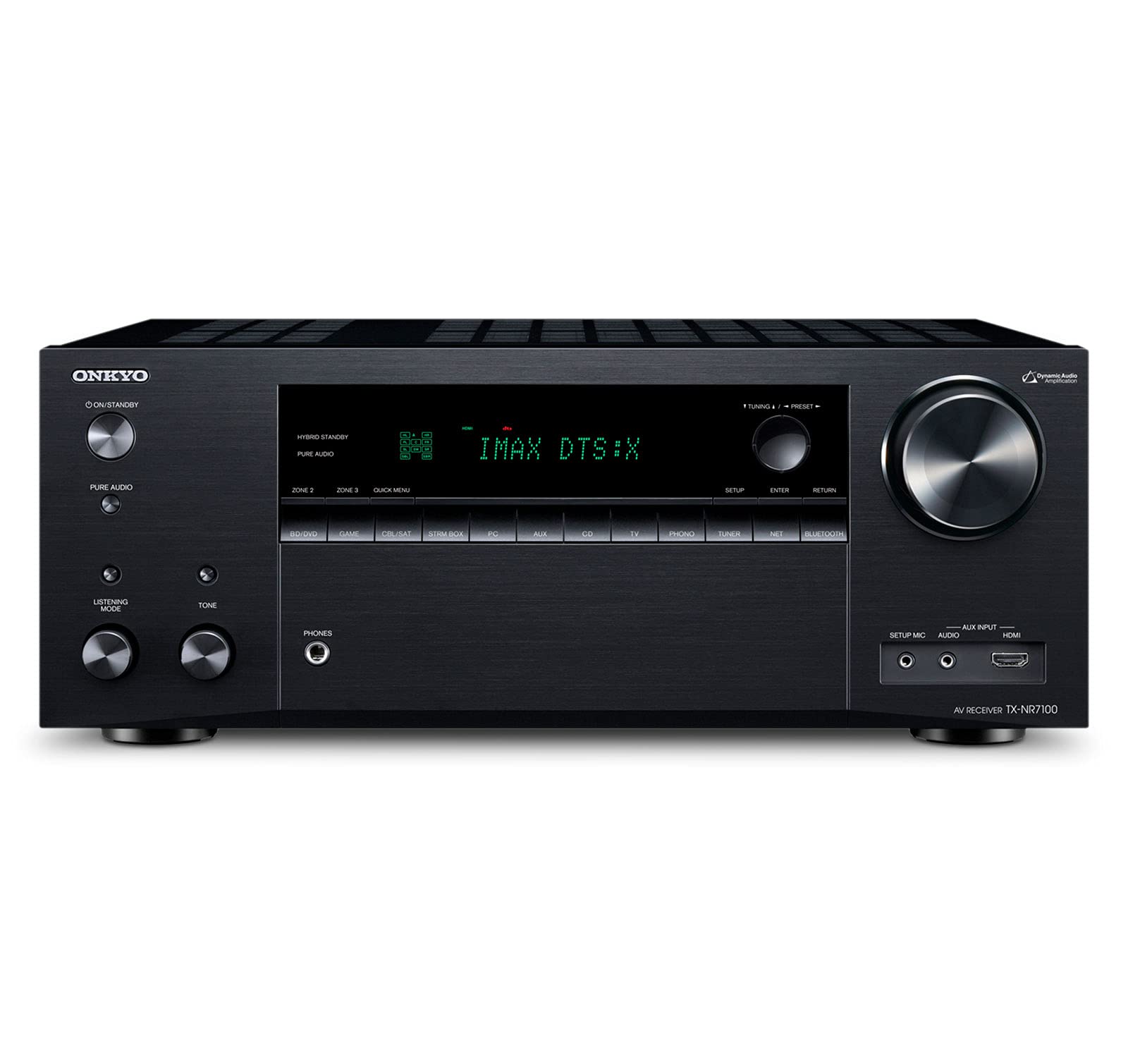
Onkyo TX-NR7100

83 /100
Sound Score Excellent

Key details

HDMI & 8K
8K HDMI 2.1
Amplifier Power
100 W/ch
Room Correction
Dirac Live
Channels & Audio
9.2, Atmos, DTS:X
View on Amazon

The TX-NR7100 is the most affordable Onkyo with Dirac Live and THX on a 9.2-channel platform. That combination gives it a real edge over comparably priced receivers: Dirac adjusts for room-induced bass peaks and timing errors, while THX certification sets a baseline for home theater playback. The 100 W/ch amplifier stage handles moderately efficient towers without strain, and the 8K/40Gbps HDMI 2.1 inputs cover current consoles and streaming boxes. It skips the 11.2 processing of the step-up model, which keeps the price down.

Dirac is the center of the experience. A completed calibration tightens bass response and makes center-channel dialogue easier to follow in busy scenes. The receiver also holds its own with gaming sources, passing full-bandwidth 8K video and keeping HDMI switching responsive.

This is the right receiver for a budget-conscious buyer who has settled on a 9.2 speaker array, wants Dirac Live and THX at a mid-range price, and is willing to spend an evening on calibration. It is also a good fit for gamers who need 8K/40Gbps HDMI 2.1 inputs today. Those who want a zero-friction experience or maximum long-term durability should look at the top pick instead.

💡 Run a second Dirac calibration pass after the first one sounds right.

Pros

  • Dirac Live and THX together at a mid-range price.
  • Calibrated sound quality lifts the listening experience well past basic AVRs.
  • 100 W/ch provides solid output for typical home theater speaker setups.

Cons

  • Dirac calibration takes time; a rushed pass leaves some room issues uncorrected.
  • HDMI/eARC handshakes can need a power-cycle or a different cable with some displays.
  • A new unit can have a silent channel or an unresponsive HDMI input, so inspect outputs early.
Our verdict

The most cost-effective route to Dirac Live and THX in a 9.2 receiver, provided the setup is given the time it deserves.

Check Latest Price
3

Best Mainstream 7.2 with 8K

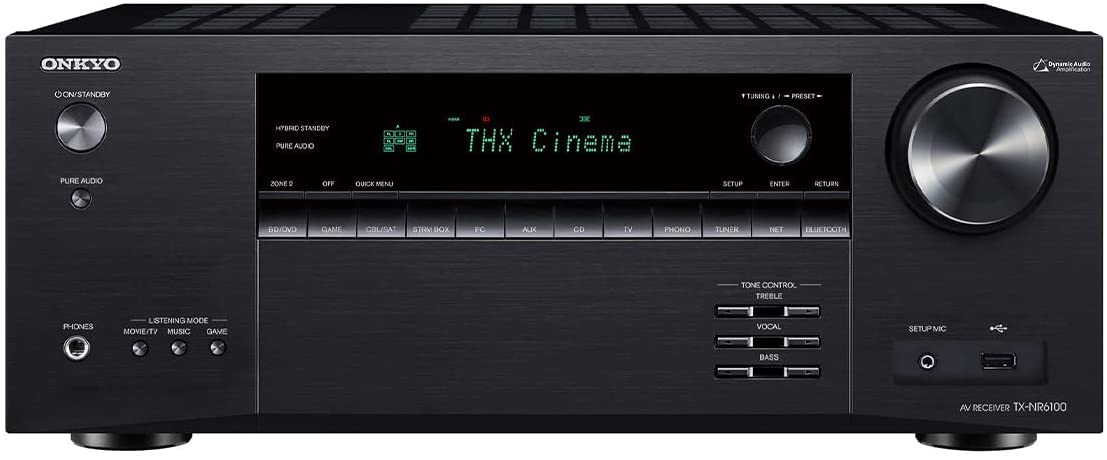
Onkyo TX-NR6100

84 /100
Sound Score Excellent

Key details

HDMI & 8K
8K HDMI 2.1
Amplifier Power
210 W/ch
Room Correction
AccuEQ
Channels & Audio
7.2, Atmos, DTS:X
View on Amazon

The TX-NR6100 is a THX-certified 7.2 receiver with three 8K/40Gbps HDMI 2.1 inputs, Dolby Atmos/DTS:X support, and enough amplification for a 5.2.2 speaker layout. The 8K inputs accept 4K/120 signals from current consoles, which makes it a natural fit for a TV-and-console room that also doubles as a home theater. Build quality is solid for the price, and the port layout leaves room for thicker speaker cable.

The TX-NR6100 targets mid-size rooms where 5.2.2 Atmos and one 8K-capable HDMI path cover the daily sources. Buyers who want Dirac Live or 9+ channels should look at the step-up 9.2 Onkyo model, because this receiver stops at AccuEQ and seven channels.

QC variance is the main caveat: some units may shut down randomly or drop sound. When functioning normally, the feature set and THX certification are strong for the price, but confirm return and warranty terms before purchase, especially if you expect years of service from the amplifier.

Pros

  • Three 8K/40Gbps HDMI 2.1 inputs plus THX certification cover gaming and theater sources in one mid-range box.
  • Setup guides new owners through speaker levels and AccuEQ without needing external calibration gear.
  • Seven amplifier channels provide enough headroom for a 5.2.2 Atmos/DTS:X layout in a mid-size room.

Cons

  • Bluetooth/Wi-Fi pairing and app connectivity can be inconsistent in wireless-only setups.
  • HDMI handshake can produce no-signal or video dropout on some displays.
Our verdict

The TX-NR6100 is the right fit when 5.2.2 Atmos, THX, and 4K/120 gaming are the goals and Dirac or 9+ channels are not part of the plan.

Check Latest Price
4

Best Flagship for Large Theaters

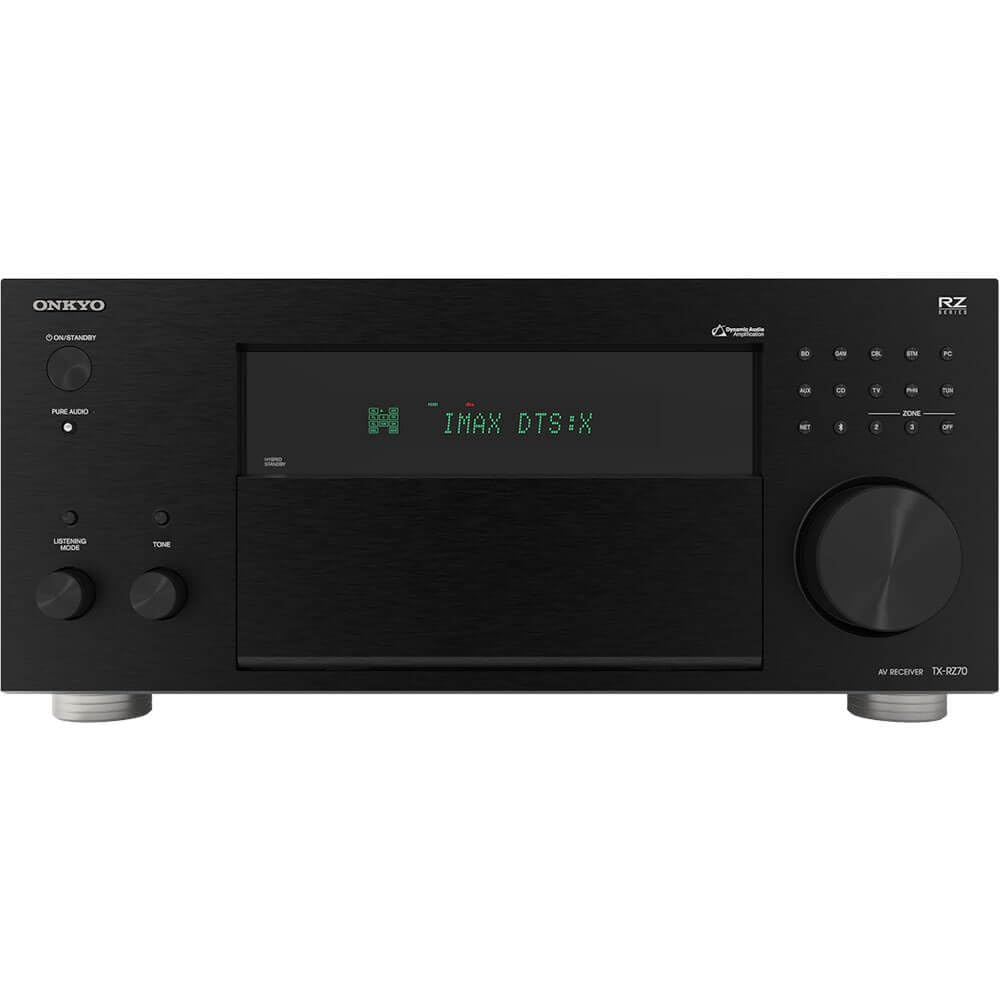
Onkyo TX-RZ70

82 /100
Sound Score Excellent

Key details

HDMI & 8K
8K HDMI 2.1
Amplifier Power
140 W/ch
Room Correction
Dirac Live, Bass Upgrade
Channels & Audio
11.2, Atmos, DTS:X
View on Amazon

The TX-RZ70 is the Onkyo to pick when the room is a dedicated theater and the plan is a 7.2.4 layout. Its 11.2 channels run on a 140 W/ch amplifier that keeps dialogue, effects, and object pans separated even at reference volume. ESS Sabre DACs give the receiver a level of resolving detail that the rest of the lineup does not offer, and the Dirac Live Bass Control upgrade path suits listeners who want precise low-end management after setup.

THX and IMAX Enhanced certifications match what the amplifier is doing: this is a movie-first component, not a lifestyle receiver. Dense Atmos mixes stay clean across 7.2.4 speaker loads, and the amplifier holds its composure through loud passages. The heavy, rigid cabinet keeps transformer vibration out of the soundstage.

This receiver is for a buyer with a large, dedicated home theater who wants a 7.2.4/11.2 system and a clear upgrade path for Dirac Bass Control. It is not for small rooms or mid-range budgets; in those setups the channel count and amplifier power go unused. Occasional HDMI input issues can surface, and premature faults are possible, so buying from a dealer with a transparent return and warranty policy is part of the purchase.

💡 For critical two-channel listening, route music through a separate stereo amplifier connected to the pre-out stage; the receiver's main job in this setup is theater.

Pros

  • Immersive Atmos performance with clean channel separation in a 7.2.4 theater.
  • Amplifier headroom drives demanding speakers at reference volume without strain.
  • Flagship pricing is competitive within the 11.2-channel category.
  • Heavy, rigid cabinet resists resonance for permanent installation.

Cons

  • Two-channel music tone can sound flat next to older amplifier designs for listeners who prioritize stereo.
  • Occasional HDMI input issues can surface, and premature faults are possible, so dealer support and return terms matter at this price.
Our verdict

For a dedicated 7.2.4 theater, this is the Onkyo that delivers the channel count and current to make the room feel like a commercial screening space. Pair it with a dealer warranty that covers the HDMI stage.

Check Latest Price
5

Best Stereo/Music Receiver

Onkyo TX-8470

80 /100
Sound Score Excellent

Key details

HDMI & 8K
HDMI ARC
Amplifier Power
100 W/ch
Room Correction
None
Channels & Audio
2-channel
View on Amazon

Onkyo's TX-8470 is a stereo music specialist: 100 W/ch into two channels, MM/MC phono, Wi-Fi, Bluetooth, HDMI ARC, Hi-Res Audio, and Roon Ready. It skips multichannel processing entirely, which keeps the focus on two-channel sound rather than unused surround channels. That makes it a different animal from the rest of Onkyo's receiver lineup.

Imaging is the first thing you notice. Vocals stay anchored in the center, instruments hold their own space, and the amp has enough current to drive floor-standing speakers at real listening levels. The built-in phono stage accepts both moving magnet and moving coil cartridges, a rare inclusion at this price tier, and the network section covers Roon, Tidal, and Deezer without an extra streamer. Owners of efficient floor-standers will find the headroom sufficient for rock and orchestral listening without pushing the receiver near its limit.

The right buyer is a two-channel listener who wants one box for a record collection, streaming, and a pair of good speakers. This is not a home-theater receiver: Atmos and multichannel are out of scope. It also assumes some configuration time, and Bluetooth pairing plus the rear PC input can be inconsistent, so those are the spots to check before relying on them. A patient setup pass washes out most of the friction; the payoff is a budget-friendly stereo hub that covers analog and digital sources well.

💡 For vinyl-first listeners, connect the turntable to the phono input before the initial setup pass.

Pros

  • Clear stereo imaging keeps vocals and instruments locked in separate spaces.
  • Build and reception quality hold up well for a budget-friendly receiver.
  • 100 W/ch drives floor-standing speakers with enough headroom for demanding music.
  • Two-channel feature set offers strong value in this price tier.

Cons

  • Initial setup can take time and is not fully plug-and-play.
  • Bluetooth pairing and the rear PC input can be inconsistent.
Our verdict

Two-channel listeners get a budget-friendly Onkyo that spends its engineering on phono, streaming, and stereo power instead of unused surround processing. Home-theater shoppers should choose a multichannel Onkyo model.

Check Latest Price
6

Newer 9.2 Setup

Onkyo TX-RZ30

82 /100
Sound Score Excellent

Key details

HDMI & 8K
8K HDMI 2.1
Amplifier Power
100 W/ch
Room Correction
Dirac Live
Channels & Audio
9.2, Atmos, DTS:X
View on Amazon

TX-RZ30 is a current 9.2 RZ-series receiver with Dirac Live, THX, IMAX Enhanced, and pre-outs for external amp expansion. Multichannel sound stays clear, with effects placed accurately around the room, and the setup routine gets speaker levels right without heavy tinkering. It is priced above the value 9.2 receiver in this lineup, yet that cheaper model offers nearly identical Dirac and THX capability for typical home theaters. In some units, surround output can glitch or drop after a few weeks, and Bluetooth or Chromecast audio may disconnect until a restart—so the RZ badge and pre-outs are the real reasons to step up.

Pros

  • Dialogue and effects stay cleanly placed across a 9.2-channel field.
  • Full 9.2-channel playback handles Atmos and DTS:X soundtracks without strain.
  • Auto-calibration gets speaker levels and distances right with minimal tinkering.

Cons

  • Surround channel output can glitch or drop after a few weeks in some units.
  • Bluetooth or Chromecast audio can disconnect until the receiver is restarted.
Our verdict

For a 9.2 theater that plans external amps later, the TX-RZ30 delivers the RZ feature set without the 11.2 expense. It fits when pre-outs and Dirac matter more than saving the difference to the value 9.2 receiver.

Check Latest Price
7

Budget Small Rooms

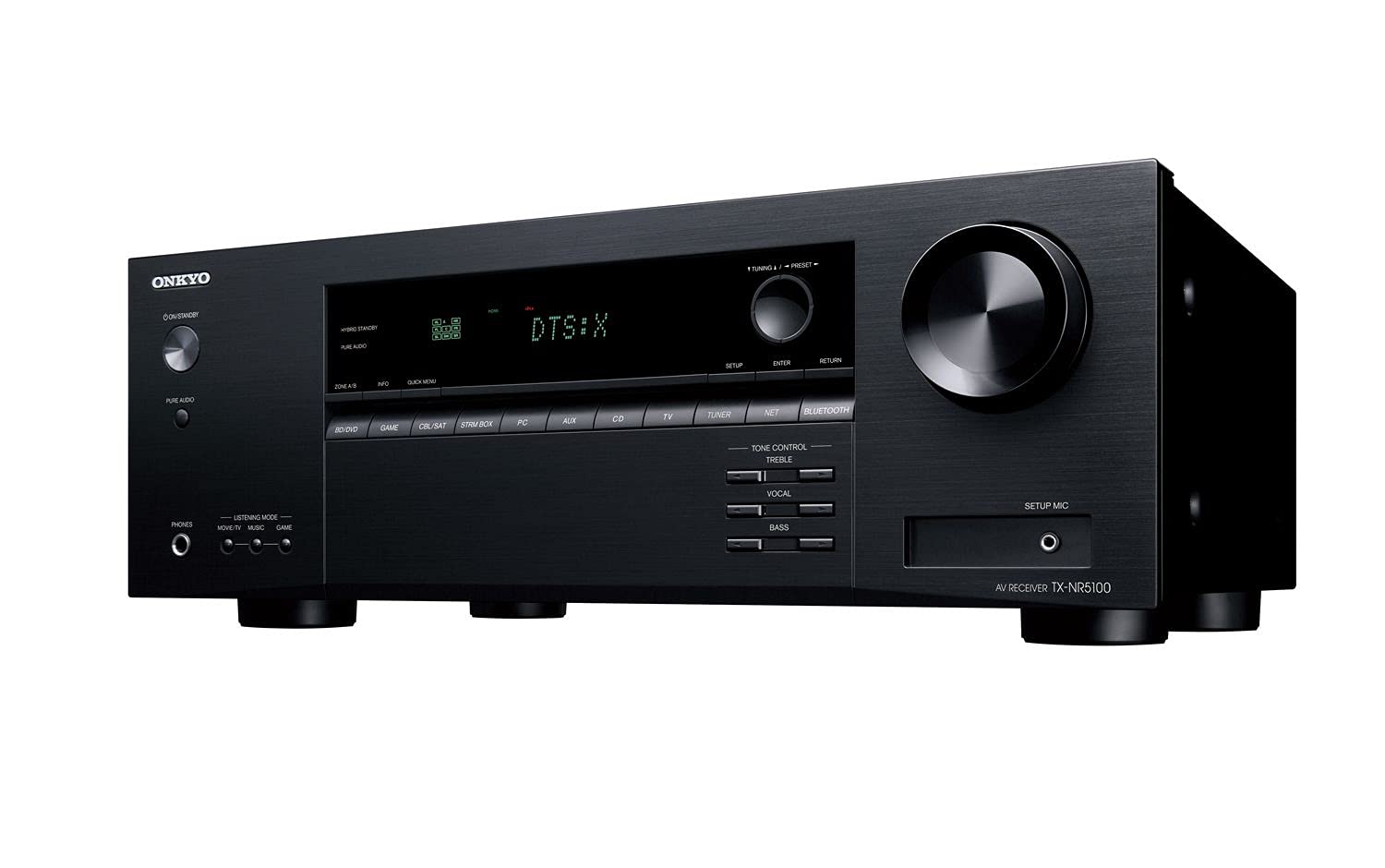
Onkyo TX-NR5100

78 /100
Sound Score Very Good

Key details

HDMI & 8K
8K HDMI 2.1
Amplifier Power
80 W/ch
Room Correction
AccuEQ
Channels & Audio
7.2, Atmos, DTS:X
View on Amazon

Onkyo's TX-NR5100 brings 4K/120 gaming support, VRR, ALLM, and eARC to a budget 7.2-channel receiver, making it a natural fit for compact gaming rooms and casual home theater setups. Its guided setup is approachable for buyers new to AVRs, and Chromecast streaming stays stable during playback. Power output is limited for demanding speakers, so efficient bookshelf or satellite speakers are the right match. HDMI eARC and audio dropouts can appear early, which makes a return-friendly purchase route worth considering. This is why the NR5100 rests below Onkyo's higher-tier models: it satisfies budget-friendly small-room installations but not power-hungry speaker systems.

Pros

  • Guided setup walks first-time AVR owners through wiring, speaker levels, and source naming.
  • Built-in Chromecast keeps phone and tablet audio playing smoothly for daily listening.

Cons

  • Dirac Live and THX room correction are absent, with AccuEQ covering only baseline EQ.
  • Bluetooth pairing may never connect for some users, leaving Chromecast or wired audio as the path.
Our verdict

This is the Onkyo to choose when a compact gaming room needs 4K/120 and eARC without stepping up in price.

Check Latest Price

How to Choose

Channel Count and Atmos

Channel count decides how many speakers you can power. A 7.2 receiver runs a 5.2.2 Atmos layout; a 9.2 adds front or side heights; an 11.2 supports 7.2.4 with four ceiling speakers.

The hidden catch is amplifier allocation. Driving all nine channels from one power supply lowers the current available to each channel, so a 9.2 model may not feel louder than a 7.2 on a modest speaker package. Buy only the channels your room actually has space for.

Room Correction Systems

AccuEQ sets speaker levels and basic EQ quickly, which suits casual listening in a symmetrical room. Dirac Live measures multiple positions and corrects time and frequency response more thoroughly, which matters when seating is off-center or furniture interrupts the sound.

The trade-off is setup. Dirac needs a calibrated mic, network connection, and patience with the app. If you skip calibration, you are paying for a feature you will not use.

HDMI 2.1 and eARC

HDMI 2.1 matters only if your sources support 4K/120 or 8K. The PS5, Xbox Series X, and high-end PCs can use Onkyo's 8K/40Gbps inputs; 4K/60-only setups do not need them.

eARC is where most handshake problems appear. It depends on the TV, cable, and firmware, so no port guarantees flawless audio return. Use a certified ultra-high-speed HDMI cable and update everything before blaming the receiver.

Amplifier Power

Power ratings matter less than speaker sensitivity. A 100 W/ch receiver can drive 90 dB speakers loudly in a normal room, but 4-ohm speakers or large open spaces demand more current than an 80 W/ch budget model can deliver comfortably.

Dynamic headroom matters on movie peaks, not sustained output. A heavier power supply keeps distortion down in big rooms. For small or medium rooms, a modest 80-100 W/ch receiver is enough.

Streaming and Phono

Streaming and phono support define the receiver's role in a music system. Network models add Wi-Fi, Bluetooth, Chromecast, and Sonos integration; the stereo TX-8470 adds Roon Ready and an MM/MC phono stage.

Connectivity stability is separate from features. Crowded Wi-Fi can cause dropouts, so use Ethernet for multi-room playback. If you play vinyl, the TX-8470 is the only one with a built-in phono stage; others need an external phono preamp.

Frequently Asked Questions