9 Best Phono Preamp in 2026: Match Gain to Your Cartridge

Find the phono preamp that matches your MM or MC cartridge, gain needs, and noise-floor expectations — without overspending on features you won't use.

Most phono preamp confusion comes down to matching gain and cartridge type, not price. A moving-magnet cartridge needs a different signal path than a moving-coil cartridge, and a stage that works cleanly with one can hum or distort with the other. Budget models look alike on paper, but the real difference shows up in grounding behavior, loading options, and clean gain.

Before choosing, decide whether you want a warm, characterful stage or a transparent one that gets out of the way. Tube stages add harmonic richness but introduce variables like tube seating; solid-state designs are usually quieter and more predictable. The right choice depends on your cartridge, amplifier, and whether you want to adjust loading or just plug in and play.

Focus on the features you will use: switchable gain for future cartridge upgrades, a subsonic filter for warped records, and solid noise rejection. Buy for the system you have, with an eye on the cartridge you might want next.

About the Sound Score: This comparative score is calculated from a product's published customer rating and review volume. It is not a laboratory measurement or a hands-on test result.

1

Best Overall

Fosi Box X2

92 /100
Sound Score Outstanding

Key details

Outputs
RCA, 3.5mm AUX
Noise Behavior
Ground terminal, tube-related noise
Cartridge Types
MM only
RIAA & Subsonic
RIAA, no subsonic filter
View on Amazon

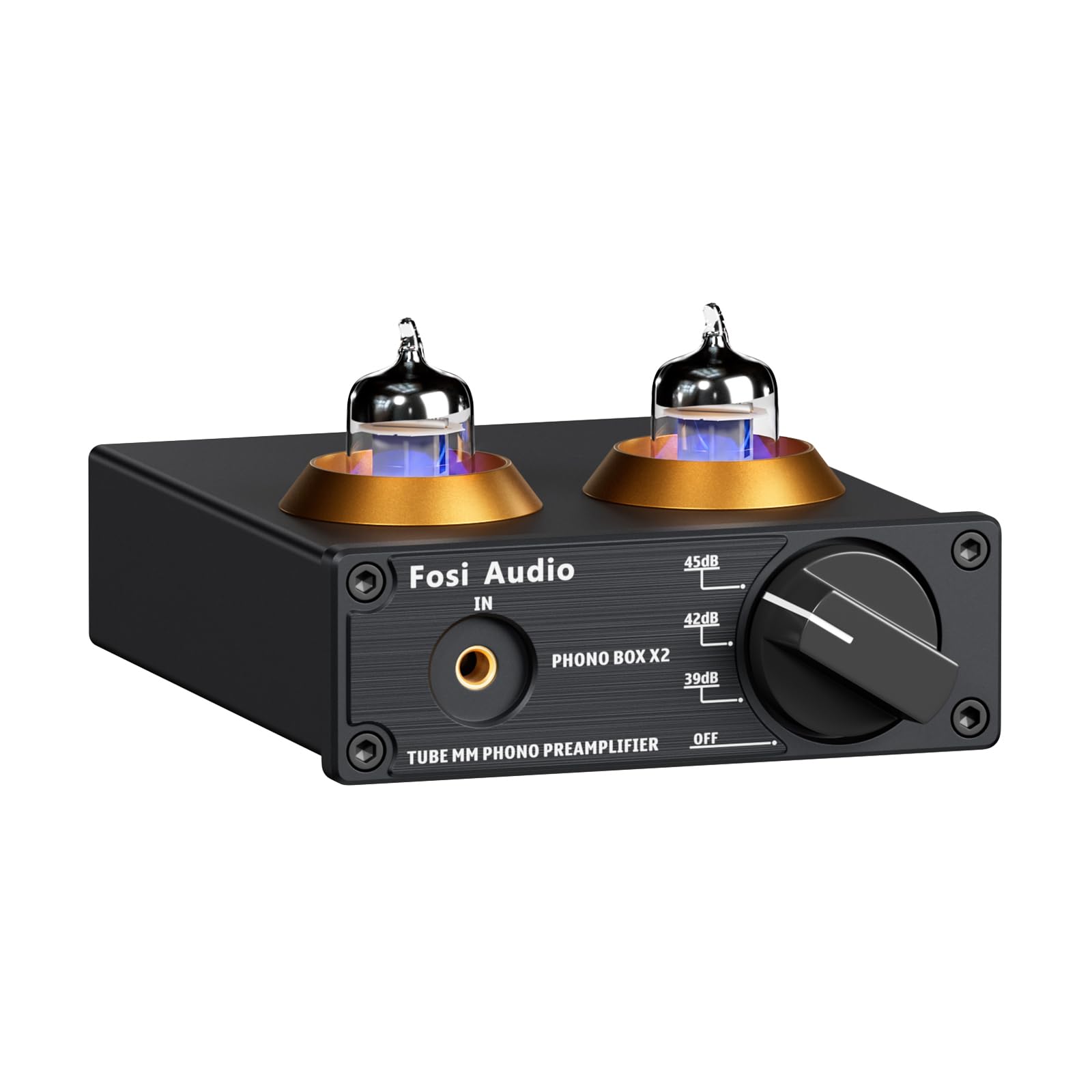
Three switchable gain modes — 39, 42, and 45 dB — let the Box X2 adapt to cartridge output instead of locking you into a single setting. The two 6J1/6K4 tubes add a warm, rounded edge to vocals and upper mids, while the soundstage stays open rather than closing in. That warm harmonic layer is the main reason this preamp stands apart from the solid-state control deck nearby, which offers cartridge loading but not tube voicing. The lowest gain setting suits high-output carts on sensitive powered speakers; the 45 dB mode gives quieter MM pickups the push they need.

On the front, a gain switch makes level matching quick when you move between a receiver, powered speakers, or a Sonos line-in. A 3.5mm AUX input lets a phone or streamer run through the same preamp, so a desktop setup can switch between vinyl and a digital source without another box. The supplied 12V DC adapter keeps the chassis compact, though it does mean a wall plug is part of the installation. The box itself is small enough to sit beside a turntable without dominating a shelf.

Turntable compatibility spans common MM decks. Technics, Fluance, and vintage tables with standard RCA output connect through the rear terminals, and the ground post handles the usual hum-prevention duty. The metal case feels solid for the price, and the glowing tubes make the unit a visual centerpiece on a shelf rather than a black box to hide. The tubes sit in sockets, so swapping in 6K4, 6J1, or 6AK5 types is part of the appeal for tinkerers.

The right buyer is an MM turntable owner looking for a characterful first upgrade rather than a neutral, maintenance-free box. It is MM-only, so moving-coil cartridges need a different preamp, and in some grounding situations the tubes can pass along low-level hum. For MM owners who accept those boundaries, the gain flexibility and tube warmth justify a mid-range price.

Pros

  • Warm, smooth tube character adds presence and an open soundstage to vocals.
  • Three gain settings let you match cartridge output to receivers, powered speakers, or Sonos.
  • Retro glow from the two tubes draws attention without taking up much shelf space.
  • Pairs with Technics, Fluance, and vintage turntables using standard RCA cables and a ground wire.
  • Tube installation is quick, and the front gain switch makes level matching painless.

Cons

  • Moving-coil cartridge users won't get a signal from the MM-only input; a different preamp is required.
  • Low-level hum may surface in quiet passages when the ground wire or tube seating isn't solid; louder rooms mask it.
Our verdict

For an MM turntable owner looking for tube warmth at a mid-range price, the Box X2 is the phono stage that makes the first upgrade audible.

Check Latest Price
2

Best Budget Control Deck

ART DJPREII

90 /100
Sound Score Outstanding

Key details

Outputs
RCA, ground terminal
Noise Behavior
Ground terminal, rumble filter
Cartridge Types
MM only
RIAA & Subsonic
RIAA, rumble filter
View on Amazon

The ART DJPREII separates itself from the tube-flavored top pick by putting adjustable output gain and selectable cartridge loading ahead of tonal character. Front-panel level trim makes matching a receiver's aux input easy, and the loading options let MM users pair different cartridges without buying another preamp. Its sound stays clean and neutral, with a level of clarity that built-in phono inputs can miss.

Vintage RCA and Technics turntables pair well with this stage. The gain knob tames hot cartridges that might otherwise overload an amplifier's aux input, and the rumble filter reduces low-frequency noise from warped records. The front-panel trim is especially useful in DJ-style setups where you need to match levels at a glance.

The right buyer is an MM owner who wants pro-style gain and loading control without paying for a tube stage, a DJ who needs front-level trim, or a budget audiophile looking for a clean, no-nonsense stage. It is not for MC cartridge owners, and anyone with a dark listening room will encounter a bright blue power LED that can be obnoxious. Grounding-related hum can show up if the ground wire is not connected; with a proper ground in place, the stage stays quiet.

💡 Place the unit below eye level or behind a rack rail so the blue LED stays out of sight.

Pros

  • Clear, detailed sound that can replace a murky receiver phono input.
  • Adjustable gain tames hot cartridges and simplifies level matching.
  • Selectable cartridge loading and a rumble filter add flexibility few budget stages include.
  • Solid construction and quiet operation suit vintage turntables.

Cons

  • The blue power LED is bright enough to be intrusive in a dark listening room.
  • Grounding-related hum can appear when the ground wire is not connected or in AC-noisy locations.
Our verdict

For MM owners who want front-panel gain and cartridge loading without a tube-stage budget, the DJPREII is the control deck to get; MC users and light-sensitive listeners should look elsewhere.

Check Latest Price
3

Best Clean MM Upgrade

Fluance PA10

90 /100
Sound Score Outstanding

Key details

Outputs
RCA in / out
Noise Behavior
Shielded, subsonic filter
Cartridge Types
MM only
RIAA & Subsonic
RIAA, subsonic filter
View on Amazon

The PA10's metal-shielded housing and subsonic high-pass filter create a quiet RIAA stage that lets a moving-magnet cartridge present its natural balance. It adds no tube warmth or exaggerated bass; the sound stays clean and transparent rather than pushing a house sound. That makes the PA10 a transparent link between a Fluance table and the rest of the system.

With the ground wire connected, the output stays quiet enough to reveal detail without the hiss that some budget stages allow. The subsonic filter also keeps low-frequency rumble from muddying speakers, which matters on older records or anything with heavy bass energy. The compact metal case has simple RCA in and RCA out, so it drops into an existing turntable-to-amp chain without extra setup steps.

Fluance turntable owners are the natural fit: the fixed-gain design keeps the chain simple, and the metal case protects the low-level signal. Buyers who need adjustable gain/volume control should choose the budget control deck with cartridge loading and rumble filtering instead. The PA10 is not for MC cartridges, and if grounding is not correct a hum can appear; that is a setup check, not a reason to skip a quiet MM stage.

💡 Let the amplifier or powered speakers manage loudness; the PA10 has no gain or volume control.

Pros

  • Clean MM output with clear treble and dead-silent backgrounds in a normal grounded setup.
  • Shielded metal enclosure plus subsonic filter keeps low-frequency rumble from muddying speakers.
  • Polished build quality with a metal housing that holds up in everyday use.
  • Fair price for a focused MM stage that prioritizes signal clarity over extra features.

Cons

  • No gain/volume control, so the amplifier or powered speakers must handle output level.
  • Hum can remain in some grounding layouts; checking the ground wire is the first step.
Our verdict

The PA10 suits Fluance owners who want transparent MM sound from a shielded stage with a subsonic filter.

Check Latest Price
4

Best MM/MC Value

Fosi Box X5

87 /100
Sound Score Excellent

Key details

Outputs
RCA in / out
Noise Behavior
Aluminum chassis
Cartridge Types
MM / MC
RIAA & Subsonic
RIAA equalization
View on Amazon

The Box X5 brings four gain settings — 38, 48, 56, and 66 dB — around OPA1612 op-amps, so MM and MC cartridges can be matched to the input without swapping hardware. The sound is clean and detailed, with crisp highs and solid bass, and it stays even at normal listening levels. That puts it in a different lane from the tube-voiced top pick in this lineup.

System builders can set the gain switch to suit their cartridge and run RCA straight into powered speakers or an amp. The aluminum chassis keeps the RCA in/out connections in a compact footprint, and because the gain modes are the main controls, the setup stays simple. The rear panel is just an RCA pair in, an RCA pair out, and a ground terminal.

At this price tier, MC support and a four-step gain range go beyond the usual fixed-gain MM design. Buyers who switch between turntables or cartridges get a stage that adjusts to the source instead of requiring a different preamp. That flexibility is the main reason it lands as the runner-up rather than a niche option.

This is the pick for MM and MC listeners who want clean transparency and switchable gain without stepping up to premium pricing. It is not for buyers seeking tube warmth or for those who need maximum long-term ownership confidence; a unit can lose a channel or go silent early, so a return window is worth checking.

Pros

  • Clean, detailed sound with crisp highs and solid bass across MM and MC cartridges.
  • Four gain settings from 38 to 66 dB let you match different cartridges without swapping hardware.
  • Performance far above its price point makes it a cost-effective mid-budget option.

Cons

No consistent drawbacks identified in the available review data.

Our verdict

Clean gain flexibility and MC support make the X5 a strong mid-budget stage for cartridge swappers.

Check Latest Price
5

Best Premium MM/MC Flexibility

iFi Zen Phono 3

84 /100
Sound Score Excellent

Key details

Outputs
RCA out
Noise Behavior
Subsonic filter, low noise
Cartridge Types
MM / MC
RIAA & Subsonic
RIAA, subsonic filter
View on Amazon

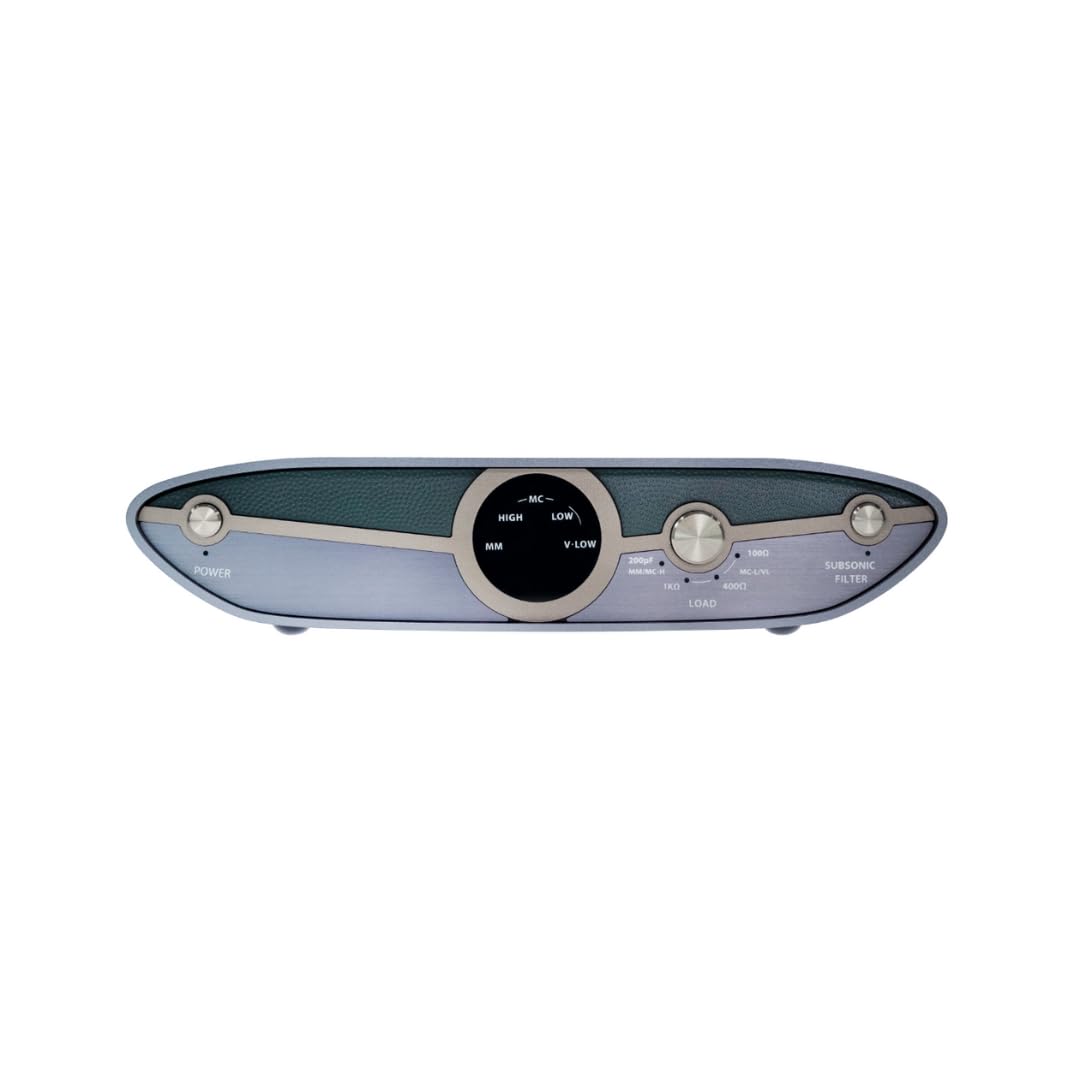
The Zen Phono 3 pairs a 36-72 dB gain range with adjustable loading and an intelligent subsonic filter, so MM and MC cartridges can be matched without an outboard step-up or equalizer. Unlike the DSP-based alternative in this set, it keeps the signal path analog and puts the control in your hands.

The RIAA stage uses TDK C0G capacitors and a low-noise layout that keeps the floor quiet. The presentation is full and detailed: soundstage widens, bass stays tight, and vocals gain a lifelike presence without added edge.

This is for audiophiles with MM or MC cartridges who are willing to read their cartridge specs and set gain and loading accordingly. It is not a no-knob preamp, and budget-first buyers should look at simpler stages. The known boundaries are the short power cable and occasional power-supply defects; place it near an outlet and check the adapter when it arrives.

Pros

  • Full, detailed, low-noise playback with a wider soundstage and tight bass.
  • Strong feature set at the price; competes with pricier phono stages.
  • Adjustable gain and loading let MM/MC cartridges be matched precisely.

Cons

  • The wall-adapter cable is short, so the stage must sit near an outlet.
  • Occasional power-supply defects can arrive with the unit.
Our verdict

MM/MC owners who treat cartridge loading as part of setup get a clean analog stage with real control range before needing DSP correction.

Check Latest Price
6

Best Ultra-Budget Workhorse

Pyle PP999

88 /100
Sound Score Excellent

Key details

Outputs
RCA in / out
Noise Behavior
Ground terminal
Cartridge Types
MM only
RIAA & Subsonic
RIAA equalization
View on Amazon

The Pyle PP999 is the simplest working phono stage in this set: one RCA pair in, one RCA pair out, and a ground screw. It applies RIAA equalization and lifts moving-magnet cartridge output to line level, which is all a receiver or powered speaker without a phono input asks for.

The compact metal enclosure tucks behind a shelf, and the included 12V adapter powers the unit without extra parts. An older turntable with a ground wire connects cleanly when the screw is tightened, so casual listening at moderate volume is where the PP999 fits. At normal listening levels, the output is loud enough to drive typical powered speakers without maxing the volume.

This is for a casual vinyl listener on a tight budget who needs a simple connection from an older turntable to a modern receiver or powered speakers. Noise or hum can appear in poor-grounding setups, and the stage has no gain or loading controls to correct a cartridge mismatch; those who need that tuning should look at the control deck higher up in this roundup.

Pros

  • Phono-to-line conversion works through a basic RCA hookup with a ground terminal.
  • Clear, loud output for casual speakers and receivers.
  • Low-cost fix for receivers and powered speakers without phono inputs.
  • Compact metal body tucks away behind equipment.

Cons

  • Loud passages on worn or hotly cut records can sound thin or strained.
  • Moving-coil cartridges are outside its range; only moving-magnet types are supported.
Our verdict

If your turntable uses a moving-magnet cartridge and your receiver lacks a phono input, the PP999 is an entry-level fix that won't get in the way of the music.

Check Latest Price
7

Compact MM/MC

Pro-Ject Phono Box DC

89 /100
Sound Score Excellent

Key details

Outputs
RCA out
Noise Behavior
THD 0.01%
Cartridge Types
MM / MC
RIAA & Subsonic
RIAA ±0.5 dB
View on Amazon

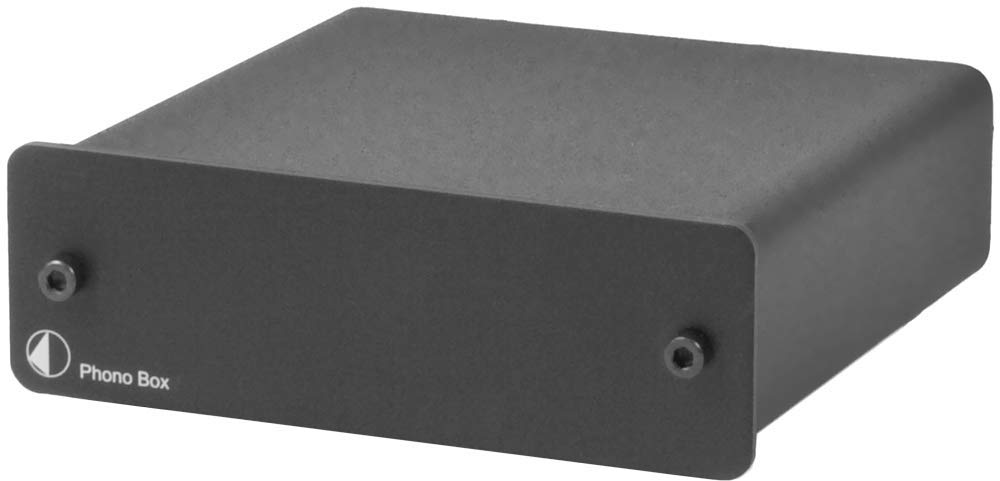
The Phono Box DC is a compact metal-bodied MM/MC switchable phono stage with RIAA accuracy of ±0.5 dB and a quiet, uncolored sound. It pairs well with Pro-Ject turntables and other decks feeding a receiver without a phono input. Setup is RCA plus ground wire with the cartridge-type switch on the rear panel.

The main boundary is fixed loading: the rear toggle selects MM or MC, but there is no resistive adjustment for moving-coil cartridges. Unit-to-unit durability can vary, and a channel may go silent early in individual units. Within those limits, the sound stays clean and the chassis feels substantial.

Pros

  • Transparent, low-noise sound keeps cartridge character intact without added coloration.
  • Compact metal housing feels dense and fits neatly beside a turntable.
  • Rear-panel MM/MC switch handles both cartridge families in one small box.

Cons

  • No tone controls or tube warmth
  • Hum can surface in certain hookups when the AC adapter sits close to signal cables.
Our verdict

For Pro-Ject owners who value build quality and clean, uncolored sound, this compact MM/MC stage fits a mid-range budget without pushing into premium pricing.

Check Latest Price
8

Noisy Record Rescue

Waxwing Phono DSP

93 /100
Sound Score Outstanding

Key details

Outputs
Analog, optical out
Noise Behavior
DSP noise reduction
Cartridge Types
MM / MI / MC
RIAA & Subsonic
DSP EQ, rumble filter
View on Amazon

The Waxwing is a premium DSP stage that pairs app-controlled EQ, gain, cartridge loading, and Magic pop/click suppression with MM/MI/MC support. With Magic engaged, worn records come through with less snap and crackle, and the analog plus optical outputs feed conventional amps or DAC-equipped speakers. The premium price is easier to justify for collectors with deep record shelves than for budget-conscious turntable owners, and the digital signal path is not for analog purists.

Pros

  • Magic pop/click suppression makes worn records far more listenable without scrubbing out the music.
  • App-adjustable gain, EQ, cartridge loading, and noise controls cover MM/MI/MC setups.
  • Detailed dynamics and clean highs give playback a wide, three-dimensional soundstage.

Cons

  • Magic mode reduces surface noise; it does not repair deep scratches or groove wear.
  • All tuning happens inside the phone app; there are no front-panel controls for quick gain changes.
Our verdict

For listeners with a large vinyl library and no objection to processing, this is the stage that makes worn records worth playing again.

Check Latest Price
9

Budget TRS Setups

Jancane AU221-DE

86 /100
Sound Score Excellent

Key details

Outputs
RCA, TRS out
Noise Behavior
Ground terminal
Cartridge Types
MM only
RIAA & Subsonic
RIAA equalization
View on Amazon

The Jancane AU221-DE pairs RCA and TRS outputs at a budget price, giving a mixer, interface, or powered speakers a way to accept a turntable signal without a dedicated phono input. Basic MM playback works well for first-time setups and installation takes minutes; the included 12V adapter keeps the hookup self-contained. This is an also-consider rather than a top-tier budget pick because its performance is acceptable rather than refined. It fits when a simple, low-cost TRS hookup matters more than an open, detailed presentation.

Pros

  • RCA and TRS outputs let mixers or interfaces accept a turntable without a dedicated phono input.
  • Installation takes minutes for first-time vinyl setups.
  • Entry-level price paired with sound and build that satisfies casual listeners.

Cons

  • Tonal balance can turn bassy or muddled on certain speaker systems.
  • A 60Hz hum can appear when the ground path is not ideal.
Our verdict

If your mixer or interface is missing a phono input and you just need a low-cost MM preamp for casual listening, the Jancane AU221-DE fits; if clean, open sound is the priority, allocate more budget.

Check Latest Price

How to Choose

Match Gain to Your Cartridge Type

The two main cartridge types are moving magnet (MM) and moving coil (MC). MM cartridges output around 3-5 mV and work with the majority of affordable preamps, while MC cartridges output well under 1 mV and require additional gain.

If you own an MC cartridge, an MM-only preamp will sound quiet and lifeless. If you plan to upgrade later, choose a stage that supports both from the start, even if you only need MM today.

Gain and Cartridge Loading

Gain controls let you match the preamp's output to your amplifier or powered speakers. Too little gain means you crank the volume and hear noise; too much gain can overload the input and cause distortion.

Loading controls adjust the electrical load the cartridge sees, which changes high-frequency response. This matters most with MC cartridges, but on MM stages a loading switch can tame a bright cartridge or smooth out a dull one.

Noise, Hum, and Grounding

Hum and buzz are usually grounding issues, not defective preamps. The turntable's ground wire must attach to the preamp's ground terminal, and the power adapter should sit away from other AC adapters.

A shielded metal enclosure and a subsonic filter help in rooms with fluorescent lights or nearby transformers. If you hear hum only at certain volumes, the problem is often a ground loop between turntable and amplifier rather than the preamp itself.

Output Connections

RCA line output is standard for most amplifiers and powered speakers. TRS outputs are useful when you connect to a mixer or audio interface because they carry a balanced signal over longer cable runs.

Optical output matters if you want to send the signal directly to a DAC or digital system. Headphone outputs are convenient for desktop setups but often lack a dedicated volume control, so check the preamp's specs before relying on them.

RIAA Accuracy and Subsonic Filtering

RIAA equalization reverses the bass cut and treble boost applied when records are cut. A precise RIAA curve matters because small deviations shift tonal balance, making vinyl dull or bright.

Subsonic filtering removes low-frequency rumble from warped records and turntable noise without affecting the audible range. It is a practical feature for older record collections and for turntables set up on lightweight furniture.

Frequently Asked Questions