8 Best Sony Soundbar in 2026: Match Sub and Channels to Your Room

The best Sony soundbar for your room comes down to subwoofer inclusion, channel count, and real surround needs — not sticker price.

Sony's soundbar lineup spans from compact 2.0 bars to 13-speaker flagships, but the most expensive option isn't always the right one for a living room. Many buyers overpay for virtual Atmos processing when their actual priority is bass and dialogue clarity. A 2.1 system with an included wireless subwoofer often delivers a bigger everyday upgrade than a premium bar without one.

The real trade-off is between simplicity and true surround. Virtual processing can fake height and width from a single bar, but physical rear speakers are the only way to get real rear-channel immersion. If you watch action movies in a medium-to-large room, a 5.1 system with rear speakers will feel more cinematic. If you mainly watch TV in a small space, a simpler bar with a sub is the better spend.

About the Sound Score: This comparative score is calculated from a product's published customer rating and review volume. It is not a laboratory measurement or a hands-on test result.

1

Best Overall Sony Soundbar
Sony HT-S400

86 /100
Sound Score Excellent

Key details

Channels
2.1 ch
Subwoofer
Wireless 160mm
Connectivity
Bluetooth, HDMI ARC
Dolby Atmos / DTS:X
No
View on Amazon

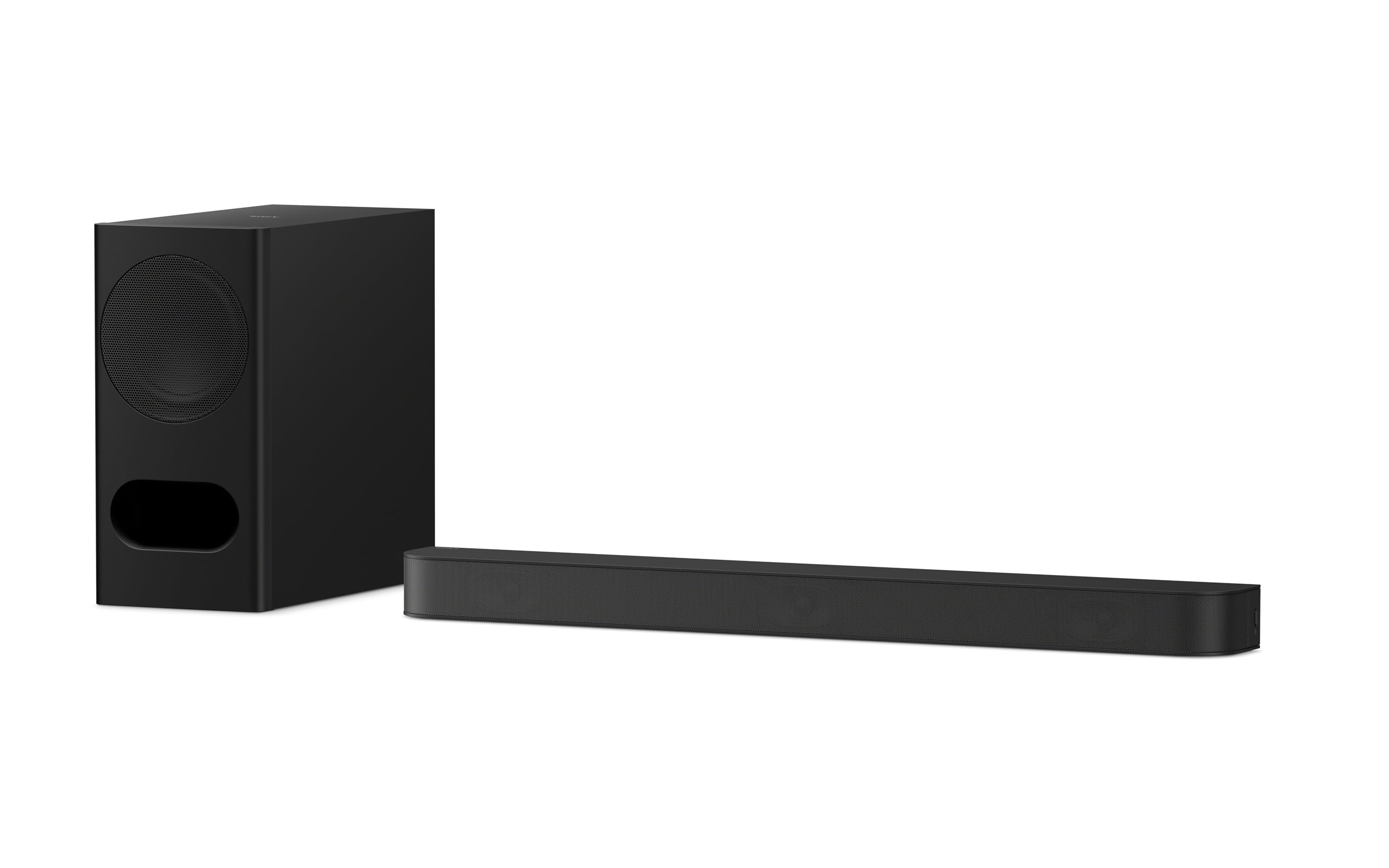
The HT-S400 is the Sony soundbar that gets the 2.1 formula right for a mid-size living room. Its 330W total power is paired with a 160mm wireless subwoofer, so explosions and music carry real weight instead of a thin simulated thump. HDMI ARC turns hookup into a single cable: connect the bar to the TV, power on, and the sub pairs automatically without receiver menus. That combination is what makes it the value pick in Sony's current soundbar range.

At normal TV volumes, dialogue stays clear and centered even when background music or effects are busy. The subwoofer adds presence without smothering voices, and the front soundstage remains coherent across a normal seating area. This is not a high-volume system, though; large open-plan spaces or listening levels that push the bar hard will expose its headroom limit. In a typical living room, it stays composed.

Sony's soundbar lineup splits more by channel count and subwoofer inclusion than by raw watts. The HT-S400 occupies the middle slot: it skips Dolby Atmos height channels to keep the price and setup simple, directing its budget into a real subwoofer and clear dialogue. The compact 2.0 starter bar in this set suits a bedroom or office, while the complete 5.1 Theater System 6 handles the buyer who wants true multi-channel surround. The HT-S400 sits between them as the default for a standard TV room.

Pricing also sorts the lineup clearly. The HT-S400 sits at mid-range, below Sony's Atmos-equipped bars and above the basic 2.0 starter, and for that middle price it includes a wireless sub that higher bars may omit. That placement makes it the pragmatic default for TV and movie sound without a receiver or a four-figure budget.

The buyer this actually serves is someone comparing Sony models for a mid-size TV room, not a dedicated theater. It is for movie and TV watchers who want bass without a receiver and who want HDMI ARC to simply work. The honest tradeoff is that surround is virtual, with no physical rear speakers; if you insist on rear channels, the Theater System 6 is the better match. Unit-to-unit build consistency can vary, so an early shutdown is possible, and keeping the return window in mind is prudent.

Pros

  • Cost-effective 2.1 package with a real wireless subwoofer and enough power for a typical living room.
  • HDMI ARC hookup is quick, and the sub pairs automatically without receiver setup.
  • Punchy bass adds weight to action scenes and music without overwhelming dialogue.
  • Dialogue stays clear at normal TV volumes, so quiet scenes remain easy to follow.

Cons

  • Volume changes can be slow in small steps or jump larger than expected with certain sources.
  • Bluetooth and Roku TV pairing can be inconsistent, so HDMI ARC or optical is the safer connection for daily use.
Our verdict

For a mid-size living room and a Sony-only comparison, the HT-S400 is the bar to choose when bass, dialogue clarity, and no-receiver simplicity are the priorities.

Check Latest Price
2

Best Complete Home Theater System

Sony Theater System 6

86 /100
Sound Score Excellent

Key details

Channels
5.1 ch
Subwoofer
Included
Connectivity
Bluetooth, BRAVIA Connect app
Dolby Atmos / DTS:X
Dolby Atmos, DTS:X
View on Amazon

The full 5.1 layout is in the box: main bar, center channel, two rear speakers, and a wireless sub rated at 1000W together — no AV receiver required. That places it above the entry-level 5.1 Sony system in the current lineup, which delivers rear fill but with a thinner overall balance.

Dolby Atmos and DTS:X support, clear center-channel dialogue, and a sub that adds weight to action scenes make the system feel at home with movies and sports. Setup is close to plug-and-play: the sub connects wirelessly and color-coded cables take the guesswork out of the rear channels. Build quality feels sturdy enough for daily family use.

Streaming and disc playback get plenty of volume headroom, and the 1000W rating shows up as clean output in loud moments rather than harshness at normal listening levels.

This is the pick for a medium-to-large living room or dedicated entertainment area where you can commit to speaker placement. The rear speakers are wired to the wireless amp, and some HDMI or Bluetooth pairing quirks have been reported; small apartments and zero-wire setups will feel that constraint. For anyone willing to route cable, it remains the easiest path to true 5.1 in Sony's lineup — and the reason to choose it over the top pick's virtual surround.

💡 Leave extra slack on the rear speaker wires before mounting so the amp has positioning freedom.

Pros

  • Immersive 5.1 surround with clear dialogue and deep bass from the included center and sub.
  • Setup is close to plug-and-play with a wireless sub and color-coded rear hookups.
  • Build quality feels sturdy and well-made for daily family use.

Cons

  • HDMI or Bluetooth pairing can require a re-sync after a source swap.
  • Rear speakers connect to the wireless amp with wires, so placement is tied to cable runs.
Our verdict

Buyers who prioritize physical rear channels and a sub without a receiver will find the most complete Sony package here.

Check Latest Price
3

Best Mid-Range Dolby Atmos Bar

Sony Bar 6 (HT-B600)

85 /100
Sound Score Excellent

Key details

Channels
3.1.2 ch
Subwoofer
Wireless 160mm
Connectivity
Bluetooth, BRAVIA Connect app
Dolby Atmos / DTS:X
Dolby Atmos, DTS:X
View on Amazon

The Bar 6 pairs a 3.1.2 channel layout with an included wireless subwoofer, putting authentic Atmos height effects ahead of Sony's virtual-surround value bars. Dual up-firing drivers bounce sound off the ceiling, and the center channel keeps dialogue anchored to the screen. It is the cleanest mid-range Sony option for buyers who want a taller front stage and a compact footprint.

Setup runs through the BRAVIA Connect app over HDMI ARC, and the sub joins wirelessly with no rear units to position. The system stays compact, and the app handles source switching and channel levels after pairing.

This fits Sony BRAVIA owners and Atmos-focused movie fans who want height cues from a single bar. The tradeoff is subwoofer tuning: bass and treble balance can be fussy, and the sub can sound muddy at some settings. Buyers who need physical rear surround channels should look at the Theater System 6 instead.

Budget shoppers can get clear TV audio from Sony's entry-level bars, so the Bar 6 makes sense when the height layer and an included sub are part of the plan.

💡 Position the sub away from corners and trim its level in the BRAVIA Connect app to get the cleanest bass.

Pros

  • Dual up-firing drivers create height effects with a wireless sub included.
  • BRAVIA Connect app and HDMI ARC keep setup simple.
  • Center channel anchors dialogue while the sub handles low end.

Cons

  • No physical rear surround channels; rear effects rely on virtual processing and up-firing drivers.
  • Subwoofer tuning can be fussy, and bass/treble balance is harder to adjust than on simpler bars.
Our verdict

Sony's Bar 6 is the compact mid-range route to Atmos height effects, with a sub included and no rear speakers to place.

Check Latest Price
4

Best Premium Flagship Soundbar

Sony Bar 9 (HT-A9000)

81 /100
Sound Score Excellent

Key details

Channels
13 drivers
Subwoofer
Optional, not included
Connectivity
Wi-Fi, Bluetooth, AirPlay 2
Dolby Atmos / DTS:X
Dolby Atmos, DTS:X
View on Amazon

The 13-driver array in the Bar 9 delivers a wide, room-filling soundstage from a single cabinet, and the 585W amplifier keeps dialogue and effects clear at high volumes. 360 Spatial Sound Mapping, Dolby Atmos, DTS:X, and IMAX Enhanced support put height and positional cues ahead of every other Sony bar in this lineup. HDMI 2.1 passthrough preserves 4K/8K HDR, VRR, and ALLM for a PS5 or high-end streamer.

The cabinet has a sturdy, premium feel, and the sound remains composed during dense action scenes. The bar's height and cabinet depth are modest enough for a shelf or wall mount, and the inputs are tucked into a recessed panel. AirPlay 2, Spotify Connect, and Wi-Fi cover streaming without a separate receiver, so the bar fits neatly into a minimalist BRAVIA TV setup.

This is a bar-first system for high-end living rooms with a BRAVIA TV and PS5, not a complete home theater in one box. The bar's virtual processing keeps the presentation immersive even before adding Sony's optional sub and rear speakers, but deep bass and physical surround require those extras. This is not a budget pick; it is aimed at buyers who already plan to grow the system with the optional sub and rears. The app and ARC handshake can be finicky, so a patient setup session is part of the experience; the core sound and HDMI 2.1 passthrough are strong enough to make that effort worthwhile.

Pros

  • Thirteen drivers with 360 Spatial Sound Mapping produce a wide, room-filling soundstage from one bar.
  • HDMI 2.1 passthrough preserves 4K/8K HDR, VRR, and ALLM for PS5 and high-refresh displays.
  • The sturdy premium cabinet suits a high-end living-room aesthetic.
  • Dolby Atmos, DTS:X, and IMAX Enhanced soundtracks play through Wi-Fi, AirPlay 2, or Spotify Connect.

Cons

  • The app and ARC handshake can drop, requiring a reconnect after setup.
  • Deep bass is a separate purchase; the included bar alone stays lean on low frequencies.
Our verdict

For BRAVIA TV and PS5 owners who prefer a premium single bar, the Bar 9 offers the widest soundstage in Sony's lineup and enough HDMI 2.1 headroom for current consoles.

Check Latest Price
5

Best Budget 5.1 System

Sony HT-S40R

82 /100
Sound Score Excellent

Key details

Channels
5.1 ch
Subwoofer
Included
Connectivity
Bluetooth, HDMI, optical
Dolby Atmos / DTS:X
No
View on Amazon

The HT-S40R delivers a true 5.1 layout with physical rear speakers, a center channel, and a subwoofer at an entry-level price. Color-coded connections let you get the four satellites and sub hooked up without a receiver, and the included amp keeps the channel routing automatic. That combination is rare in Sony's lineup below the Theater System 6.

This is the pick for casual viewers who want rear sound placement without stepping up to the pricier full Theater System 6. It is not for anyone expecting a completely wireless setup: rear speakers are wired to the included amp. The tonal balance tends toward thin with no EQ to shape it, and occasional popping or crackling from the rears can appear in some setups.

The Theater System 6 is the next step up if you want a more complete 5.1 package, while the HT-S400 remains the living-room pick when rear channels don't matter. The HT-S40R sits between them: lower entry cost than the Theater System 6, actual rear placement over the HT-S400's virtual surround. For buyers weighing Sony's lineup, it is the least expensive way to get real rear speakers and a sub in one box.

Pros

  • Entry-level price gets a true 5.1 layout with four physical speakers, a center channel, and a sub.
  • Color-coded connections make hookup simple without a receiver.
  • Included rear speakers create real surround placement that virtual bars cannot match.

Cons

  • The wireless link between soundbar and amp can be finicky to pair when the amp is tucked behind furniture.
  • In a large room, rear-channel volume can run low relative to the fronts.
  • Subwoofer output can vary between different rooms and speaker layouts.
Our verdict

The right Sony system for a dedicated movie room where physical rear placement matters more than tonal polish.

Check Latest Price
6

Small TVs

Sony HTS100F

86 /100
Sound Score Excellent

Key details

Channels
2.0 ch
Subwoofer
None, bass reflex
Connectivity
Bluetooth, HDMI ARC, optical
Dolby Atmos / DTS:X
No
View on Amazon

The Sony HTS100F is the entry point in Sony's soundbar line, and it earns that role by making TV dialogue noticeably clearer than built-in speakers. HDMI ARC or optical hookup takes minutes, and Bluetooth streams music from a phone or tablet. At a budget price, the compact 2.0 bar suits small bedrooms, office TVs, and first-time soundbar buyers who want a low-cost TV audio upgrade.

The key tradeoff is a 2.0 design without a subwoofer: low end is modest, music can sound thin at higher volumes, and occasional Bluetooth dropouts can require re-pairing. S-Force Front Surround adds some width to the bar's output, which helps casual TV viewing.

Pros

  • Simple HDMI ARC or optical hookup gets clear TV audio running in minutes.
  • Budget-friendly price delivers a meaningful upgrade over built-in TV speakers.

Cons

  • In a large open living room, the stereo bar lacks the room-filling surround of a multi-channel system.
  • A unit can arrive unable to power on, so checking return policy is worthwhile.
Our verdict

The HTS100F fits small bedrooms and office TVs where simple setup and clear dialogue matter most.

Check Latest Price
7

Entry Atmos Buyers

Sony Bar 5 (HT-B500)

77 /100
Sound Score Very Good

Key details

Channels
3.1 ch
Subwoofer
Wireless 160mm
Connectivity
Bluetooth, HDMI ARC
Dolby Atmos / DTS:X
Dolby Atmos, DTS:X
View on Amazon

The Bar 5 is the least expensive way into Sony's Dolby Atmos and DTS:X processing with a wireless sub in the box, and its Vertical Surround Engine handles height cues in a compact 3.1 layout. Dialogue stays clean and bass stays smooth for a bar this size, and setup is genuinely quick. The entry price comes with boundaries: Bluetooth and HDMI ARC connections can drop on occasion. In the Sony lineup, the HT-S400 delivers more power for less money and the Bar 6 adds physical up-firing drivers, which keeps this model at the entry point of the range — a tradeoff that suits a compact room more than a high-volume home theater.

Pros

  • Clean dialogue and smooth low end for a compact bar.
  • Setup takes minutes with HDMI ARC or Bluetooth.
  • Dolby Atmos and DTS:X plus a wireless sub at a mid-range price.

Cons

  • In a living-room setup that runs throughout an evening, an individual unit can power down on its own.
Our verdict

For a compact TV room that wants Atmos and a wireless sub without paying for up-firing speakers, the Bar 5 covers the essentials at a mid-range price.

Check Latest Price
8

Existing Sub Owners

Sony Bar 8 (HT-A8000)

79 /100
Sound Score Very Good

Key details

Channels
11 drivers
Subwoofer
Optional, not included
Connectivity
Wi-Fi, Bluetooth, AirPlay 2
Dolby Atmos / DTS:X
Dolby Atmos, DTS:X
View on Amazon

The Bar 8 delivers a wide, detailed soundstage from 11 drivers and passes HDMI 2.1 with VRR and ALLM, so console features stay intact. That makes it a fit for streamers and gamers who want a single-bar setup without rear speakers and already own a subwoofer; the box does not include one, and app-based setup can be frustrating. The Bar 6, which includes a wireless sub, remains the easier recommendation for typical living rooms. For BRAVIA TV owners, Acoustic Center Sync adds a reason to consider the Bar 8 despite the setup steps.

Pros

  • Rich, loud sound from 11 drivers
  • HDMI 2.1 passthrough with VRR and ALLM keeps 4K/8K gaming features from a single bar.

Cons

  • HDMI-ARC audio may drop on some TVs, requiring a power cycle to restore.
  • The Sony app can lose paired devices, so reconnecting becomes a periodic chore.
Our verdict

If you already have a compatible Sony subwoofer and want HDMI 2.1 from a compact bar without rear speakers, the Bar 8 fits; if you need bass in the box, the Bar 6 covers that at a lower system cost.

Check Latest Price

How to Choose

Channel Configuration and Rear Speakers

A 2.0 bar is a dialogue-focused upgrade for small TVs. A 2.1 bar adds a separate sub for bass, and a 3.1 bar adds a dedicated center channel. Real surround requires physical rear speakers placed behind the listening position, which is the biggest layout decision in this category.

Virtual surround processing from a single bar can widen the soundstage but cannot convincingly place sound behind you. If the sofa is against a wall or wires cannot reach the back of the room, spend on a subwoofer instead of rear channels. If there is open floor space behind the seating area, a 5.1 system with rear speakers will feel more immersive.

Subwoofer Included or Separate

A separate subwoofer moves air in a way that built-in bass reflex ports cannot. Most 2.1 and 3.1 Sony systems include a wireless sub that still needs a power outlet; 'wireless' only removes the audio cable.

Several premium Sony bars ship without a subwoofer, which keeps the footprint small but pushes the cost of real bass into an optional purchase. If action movies and music are part of your regular listening, choose a package with the sub in the box.

Dolby Atmos and DTS:X

Atmos adds a height layer above the front and surround channels. In a soundbar, height cues are created by up-firing drivers that bounce sound off the ceiling or by virtual processing that tries to fake it. Ceiling type and height determine how convincing either approach sounds.

A 3.1.2 bar with physical up-firing drivers is the minimum for audible Atmos in a typical room. A 2.1 or virtual-only bar will not deliver reliable height effects, so treat Atmos as a feature that matters only if you watch a lot of compatible streamed movies.

HDMI ARC and Bluetooth Stability

HDMI ARC is the best single-cable hookup because the TV remote can control soundbar volume. It carries Dolby Digital from built-in apps. Optical works as a fallback but does not carry volume commands from the TV.

Bluetooth is a phone-music option, not a dependable TV connection. Sony bars are prone to ARC handshake and Bluetooth pairing quirks; when that happens, switch the source and re-pair, or keep an optical cable connected as a troubleshooting backup.

Expanding With Sub or Rears

Many lower-priced Sony bars have no expansion path, so the system you buy is the system you keep. The flagship Bar 8 and Bar 9 accept optional Sony subs and rear speakers, making them a better fit if you plan to build a full system over time.

If your goal is one-and-done simplicity, buy the bar with the sub and rear channels included now. If you expect to upgrade later, pay the premium for a bar that supports add-ons or choose a system that already includes rears.

Frequently Asked Questions