9 Best Subwoofer Cable of 2026: Fit, Shielding, and In-Wall Safety

The best subwoofer cable is about connector fit and in-wall safety, not marketing specs. Match one to your receiver and sub length.

Most subwoofer cables look alike on the box: gold-plated RCA ends, dual shielding, a flexible jacket. Once you route one from receiver to sub, the real differences show up in connector retention and bendability. A loose plug can buzz or cut out, and a stiff cable can strain the jack in a tight cabinet. Those physical details decide whether the cable disappears or becomes a recurring annoyance.

The spec sheet matters too. Many budget cables say 'subwoofer' but don't state true 75-ohm impedance or carry a CL2/CL3 in-wall rating. For most home theater runs, a genuine 75-ohm coax with solid shielding is the safe target. If the cable passes through a wall, the CL rating matters more than connector finish.

Another reality: shielding alone won't cure ground-loop hum. When hum comes from the electrical system, a premium cable won't eliminate it. Fix the grounding path first, then choose a cable with secure connectors and enough flexibility for the route.

About the Sound Score: This comparative score is calculated from a product's published customer rating and review volume. It is not a laboratory measurement or a hands-on test result.

1

Best Overall

Monoprice 10ft 75-ohm Coax

92 /100
Sound Score Outstanding

Key details

Impedance
75 ohm
Shielding
Copper braid
Connector Fit
Straight RCA
In-Wall Rating
CL2
View on Amazon

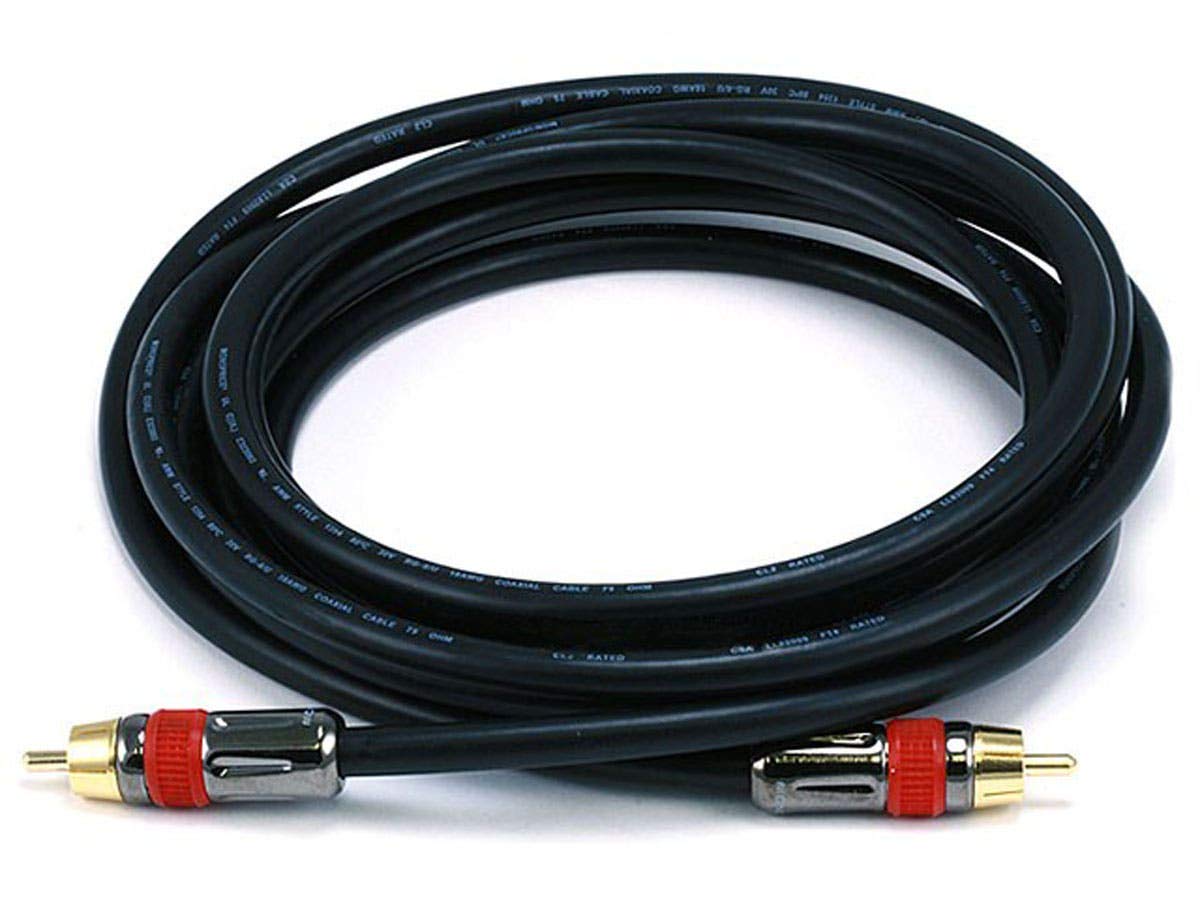
The Monoprice 10ft is a true 75-ohm RG-6/U coax with CL2 in-wall rating, copper braid shielding, and a protective jacket that handles normal routing without kinking. That combination puts it ahead of basic RCA cords for subwoofer/LFE duty, where the 75-ohm spec and shielding make the difference between quiet bass and an audible hum. The copper braid is not just a layer on a spec sheet; it is the part of the cable that keeps a 10-foot run clean between receiver and powered sub.

The RCA connectors seat with a firm click and hold their position on standard subwoofer outputs. That grip matters because a loose plug on an LFE input is the kind of intermittent connection that shows up as a thump or drop in bass. In normal use the cable stays put once the connection is made, and long distances across a room do not introduce noise into the signal.

The right buyer is someone wiring a receiver's subwoofer/LFE output to a powered sub with a 10-foot path that can follow a gentle arc. That means open floor space or a media console with room to work. If the route has clearance, the Monoprice handles the job without a premium price.

The 10-foot length is a practical middle ground for everyday subwoofer placements, leaving enough slack for a low line along the wall while avoiding a coiled pile of excess cable. The CL2 rating adds in-wall flexibility, so the same cable can move behind baseboard or through a wall if you decide to clean up the install later. Monoprice backs it with a lifetime warranty, which takes some of the risk out of a cable that will be tucked out of sight. A cable you plan to run once and leave in place benefits from the thicker jacket and solid connectors.

The real value is the combination: 75-ohm RG-6/U, copper braid shielding, CL2 rating, and connectors that hold — all without boutique pricing. A cheaper cable might cover one of those points, but the full set is what separates this from the budget crowd. That combination makes it a sensible default for a single-cable subwoofer hookup.

Pros

  • Thick, well-made cable with strong connectors that seat firmly.
  • Long-distance subwoofer runs stay clean and hum-free.
  • True 75-ohm performance without the boutique cable markup.
  • Deep, clean bass with no audible hum on standard LFE connections.
  • Solid construction handles repeated hookups and setup changes.

Cons

  • Stiff jacket, especially near connectors, makes tight-radius bends awkward in cramped A/V cabinets.
Our verdict

The Monoprice 10ft is the cable to choose for a proper 75-ohm LFE run with CL2 rating and connectors that stay put.

Check Latest Price
2

Best Value 75-Ohm Pick

KabelDirekt 15ft RCA Sub

93 /100
Sound Score Outstanding

Key details

Impedance
75 ohm
Shielding
Foil + aluminum braid
Connector Fit
Straight RCA
In-Wall Rating
Not specified
View on Amazon

Explicit 75-ohm construction and dual foil-and-braid shielding make this 15-foot cable a strong budget option for subwoofer installs. It carries the specs that matter for a clean LFE connection: correct impedance, gold-plated RCA ends, and enough shielding to keep hum out of a longer run. A 36-month warranty backs the budget price.

Between a receiver's subwoofer output and a powered sub, the KabelDirekt delivers clean bass without adding noise. Standard A/V receivers and powered subs accept the gold-plated plugs without issue. The 15-foot length covers typical room layouts, and the cable's appearance is tidy enough for an open AV cabinet. Bass stays tight and controlled, with no audible hum or buzz.

Value-focused buyers who need a no-frills 15-foot subwoofer cable get the important performance here. The tradeoff is connector QC: a tip may bend under heavy side stress, and some jacks seat the plug loosely enough to need a nudge. If the run is exposed and you're comfortable checking the connection when you first set it up, this cable fits. For wall runs, the CL2-rated top pick is the better choice.

Pros

  • Connects cleanly between subwoofer outputs and powered subs.
  • Dual foil-and-braid shielding keeps long runs quiet.
  • Gold-plated plugs fit securely on standard RCA jacks.
  • Budget price offers strong value for a 15-foot run.

Cons

  • Some RCA jacks may hold the plug loosely enough to need reseating.
  • Connector tip durability can vary between units under side stress.
Our verdict

Strong value for a 15-foot exposed subwoofer run; the 75-ohm performance and shielding are what you're paying for.

Check Latest Price
3

Budget Long-Run Champion

Amazon Basics 35ft Subwoofer

96 /100
Sound Score Outstanding

Key details

Impedance
Not specified
Shielding
Not specified
Connector Fit
Straight RCA
In-Wall Rating
Not specified
View on Amazon

A single 35-foot run sets this Amazon Basics apart from shorter subwoofer cables in the category, and the budget price keeps long receiver-to-sub distances from becoming an expensive problem. Gold-plated RCA ends and a PVC jacket cover the functional basics without extra flair.

The coax construction holds the LFE signal clean across the full 35 feet, and the PVC jacket stays flexible enough to route around furniture and console edges. Bass remains tight even when the sub sits on the opposite side of a large room.

A faint hum can appear when the receiver and subwoofer are on different circuits, but the expected result is clean bass with no audible noise. That makes this cable a practical option for exposed runs where distance is the main challenge.

This is for a buyer with a receiver on one side of a large room and a powered sub 20 feet or more away. The fixed 35-foot length is more cable than a compact media space needs, and the lack of a CL rating keeps it out of wall cavities. If your run is closer to 15 feet, the shorter 75-ohm budget cable is easier to manage.

💡 Coil the extra length near the subwoofer and secure it with a clip to keep walkways clear.

Pros

  • Reaches subwoofers placed 20-plus feet from the receiver.
  • Gold-plated RCA ends and PVC jacket hold up in everyday use.
  • Delivers clean bass without distortion over a 35-foot path.
  • Budget-friendly price for a full 35-foot subwoofer run.

Cons

  • A faint hum can appear when the receiver and sub sit on different circuits.
  • The PVC jacket lacks a CL rating, ruling out in-wall installation.
  • The fixed 35-foot length is excessive for compact rooms with a near-field sub.
Our verdict

When the sub sits far enough that 35 feet is the right reach, this cable delivers a clean signal without a premium price; shorter setups should pick a smaller option.

Check Latest Price
4

Best Home Theater All-Rounder

BlueRigger 15ft Subwoofer

93 /100
Sound Score Outstanding

Key details

Impedance
Not specified
Shielding
Dual shielded
Connector Fit
Straight RCA
In-Wall Rating
Not specified
View on Amazon

The BlueRigger 15ft is a dual-shielded subwoofer cable with 24K gold-plated RCA ends, a heavy jacket, and a lifetime warranty. Its copper-clad center conductor keeps the signal quiet across a 15-foot run, which covers typical receiver-to-sub distances without pushing into premium-priced territory.

The cable behaves like a purpose-built subwoofer line rather than a generic RCA patch cord. Signal stays quiet with no audible hum, and bass response remains defined through low-frequency material. It outperforms the stock cables that ship with powered subs, which makes it a strong first upgrade.

Home theater owners who need a single 15-foot run from a receiver's subwoofer output to a powered sub are the right audience. This is the all-round cable for that setup: the length fits typical rooms, and the warranty supports a permanent install. On unusually loose RCA jacks, the plug can sit loose and may need reseating, so checking the fit before a permanent install is worthwhile. Budget-only shoppers will find cheaper alternatives, so this is not the entry-level pick.

Compared with the top pick's 10-foot cable, the BlueRigger gives up the shorter routing envelope for five extra feet of reach. In rooms where the sub sits across from the receiver, that extra length is what makes the connection feasible without adding another cable.

💡 If the RCA end feels loose after insertion, push it fully home and verify the connection before final placement.

Pros

  • Dual shielding and a heavy jacket keep the subwoofer signal quiet along the full 15-foot length.
  • Gold-plated RCA ends seat well in standard receiver and subwoofer inputs.
  • Lifetime warranty adds long-term coverage at a mid-range price.

Cons

  • On unusually loose RCA jacks, the plug can sit loose and require reseating.
Our verdict

For a standard 15-foot receiver-to-sub run, the BlueRigger is a practical all-round choice: long enough, quiet, and covered by a lifetime warranty.

Check Latest Price
5

Best for Hum/Noise Troubleshooting

Blue Jeans LC-2 10ft

92 /100
Sound Score Outstanding

Key details

Impedance
Not specified
Shielding
Dual copper braids
Connector Fit
Straight RCA
In-Wall Rating
Not specified
View on Amazon

Two high-coverage copper braids and roughly 12 pF/ft capacitance set the LC-2 apart from foil-and-braid budget cables. The low capacitance preserves the analog signal over a 10-foot run, while the braid density blocks the induced noise that causes a subwoofer to idle with a hum when power cables run nearby. Machined gold-plated RCA plugs seat firmly, so the connection doesn't work loose during equipment vibration or cable movement.

For a receiver-to-subwoofer LFE connection, the payoff is a quieter idle and better-defined bass after swapping out a generic RCA. The low-capacitance design is about eliminating noise, not changing the subwoofer's character, which suits a system where the cable has already caused audible hum. The dual braids cover more surface area than a single foil layer, and the cable is noticeably heavier as a result.

This cable fits buyers who have already heard hum from a budget subwoofer cable and want low-capacitance analog shielding to remove it. The premium price and thick construction are more than basic setups need, so if your sub sits next to the receiver on a clean outlet and no noise is present, a budget 75-ohm coax will do the same job for less.

Pros

  • Dual high-coverage copper braids suppress induced hum before it reaches the subwoofer's input.
  • Low capacitance keeps the analog signal clean over a 10-foot run and preserves bass detail.
  • Gold-plated RCA plugs with solid metal barrels seat firmly and hold during cable movement.
  • For a system with recurring subwoofer hum, the premium price is recovered by not swapping cables.

Cons

  • Fixed 10-foot length is fine for typical home theater, but longer runs need another cable.
  • Not marketed as a 75-ohm digital coax, so S/PDIF connections are outside its scope.
Our verdict

For hum-prone LFE runs, this is the cable that ends the troubleshooting loop.

Check Latest Price
6

Premium System Match

SVS SoundPath 5M RCA

95 /100
Sound Score Outstanding

Key details

Impedance
Not specified
Shielding
56-strand shield
Connector Fit
Straight RCA
In-Wall Rating
Not specified
View on Amazon

Cold-fused gold RCA plugs and a cotton-braid jacket give the SVS SoundPath a connector feel that separates it from budget coax cables. The multi-strand copper conductor and heavy 56-strand shield with aluminum shell are built for long LFE runs from a receiver to a powered sub, and the 5m length covers common layouts without a coupler. The cold-fused gold plating also resists the corrosion that can creep into cheaper contacts over time.

Snug connector retention is the practical standout: the plugs seat firmly and stay put, which is exactly what a subwoofer connection needs to avoid intermittent buzz. The braid handles bends better than a stiff RG-6 jacket, so routing through a cabinet is less of a fight, and the low-frequency signal stays clean through the run. For a single-RCA subwoofer cable, that secure mechanical lock matters more than exotic conductor materials.

This is for SVS subwoofer or receiver owners who want brand-matched components and for buyers who value connector feel. The premium price buys a well-built cable, but it won't eliminate ground-loop hum in a system with existing grounding issues — that remains a system-level problem.

Pros

  • Cold-fused gold plugs and a braided jacket make the cable feel substantial during installs and cable management.
  • Snug RCA fit keeps a subwoofer connection from working loose or buzzing at the jack.
  • Multi-strand copper conductor with heavy shielding keeps the LFE signal clean from receiver to powered sub.
  • Build quality holds up to repeated plugging and cable routing in a home theater rack.

Cons

  • At a premium price, the extra spend goes toward connector feel and brand matching more than a measurable signal upgrade.
Our verdict

For SVS system owners and connector-focused buyers, the SoundPath is the premium interconnect to pick.

Check Latest Price
7

Tight Spaces

SOUNDFAM 90° 10ft

90 /100
Sound Score Outstanding

Key details

Impedance
Not specified
Shielding
Copper braid + foil
Connector Fit
Right-angle RCA
In-Wall Rating
Not specified
View on Amazon

The SOUNDFAM 90-degree subwoofer cable combines gold-plated RCA plugs with copper-braid and foil shielding at a budget price, making it a practical fix for a sub jack tucked against a wall or inside a shallow cabinet. The 10-foot braided jacket handles tight bends without kinking, and signal transfer is clean for typical LFE runs. The main compromise is connector fit: the plugs can feel slightly loose on certain jacks, so it's worth seating them firmly before finalizing an install. That fit uncertainty is what keeps it from ranking above more consistent cables in the same price range.

Pros

  • Right-angle plugs clear shallow cabinets and wall-mounted TVs without forcing a tight bend.
  • Gold-plated connectors and braided jacket give a durable feel at a budget price.
  • Clean signal for subwoofer LFE runs with no hum in typical hookups.

Cons

  • The fixed 90-degree housing is a poor match for jacks that need a straight, rigidly locking connector.
Our verdict

For a subwoofer jack pressed against a wall or cabinet shelf, this 90-degree cable is a budget-friendly way to finish the run without kinking.

Check Latest Price
8

Short in-Wall Runs

Monoprice 6ft 75-ohm Coax

88 /100
Sound Score Excellent

Key details

Impedance
75 ohm
Shielding
Copper braid double shield
Connector Fit
Straight RCA
In-Wall Rating
CL2
View on Amazon

The 6-foot Monoprice is a true 75-ohm RG-6/U cable with a copper braid double shield and CL2 in-wall rating. Its braided jacket and metal RCA ends feel more substantial than entry-level coax, and for a receiver LFE output to a nearby powered subwoofer it carries the signal without hum or dropouts. The stiff jacket and 6-foot length limit flexibility and broad room layouts, so this is best treated as a fixed short-run cable rather than a general-purpose interconnect — that fixed scope keeps it out of the general-purpose slot.

Pros

  • Braided jacket and metal RCA ends hold up well in fixed subwoofer connections.
  • Double shielding and true 75-ohm construction carry subwoofer LFE cleanly over short runs.
  • Mid-range price stays far below specialty subwoofer cables while adding CL2 in-wall safety.

Cons

  • Connector seating can be snug or loose depending on the receiver or subwoofer jack, so the fit deserves a quick check.
Our verdict

For compact, close-proximity subwoofer connections or a code-friendly wall pass-through, this 6-footer fits the job.

Check Latest Price
9

Budget 15-Foot

FosPower 15ft RCA Subwoofer

94 /100
Sound Score Outstanding

Key details

Impedance
Not specified
Shielding
Dual braided + foil
Connector Fit
Straight RCA
In-Wall Rating
Not specified
View on Amazon

Dual braided-and-foil shielding keeps hum out of the signal over a 15-foot run, and the gold-plated RCA ends deliver clean bass to a powered subwoofer. The cable works best when it is connected once and left alone: on some gear, the plugs may sit loose enough to interrupt the connection, and the jacket can feel thinner than the higher-ranked cables in this guide. Rough handling may also pull a tip away from the barrel. That mix of price and performance is strong for a casual home theater setup, but inconsistent fit and durability hold it back from a wider recommendation.

Pros

  • Good build quality for the budget tier, with substantial dual-layer shielding in a flexible 15-foot jacket.
  • Clean signal and noticeable bass clarity on standard subwoofer runs.
  • Simple hookup with standard RCA inputs on subwoofers and receivers.

Cons

  • On some jacks, the RCA plugs may sit loose enough to cause intermittent signal drop.
  • Rough handling can separate a plug tip from the barrel, and the jacket may feel thinner than expected.
Our verdict

This cable is a cost-effective choice for a fixed 15-foot subwoofer run that won't be disturbed. If the connection is jostled or rerouted often, a more expensive cable with tighter connector fit is worth the extra money.

Check Latest Price

How to Choose

75-Ohm Impedance

A 75-ohm coax matches the impedance of the S/PDIF and LFE outputs found on most receivers. Mismatched impedance creates signal reflections at the connector, which can soften bass response or cause digital errors. For an analog subwoofer run the risk is modest, but choosing a cable that states 75 ohm removes a variable.

Dual Shielding

Dual shielding uses a foil layer plus a braided conductor around the center signal wire. The braid blocks low-frequency interference from power cords, while the foil catches higher-frequency buzz from wireless gear. Together they cover the noise sources most likely to appear along a subwoofer run.

Connector Retention

RCA connectors hold by friction between the plug's outer barrel and the jack. A plug that is slightly too small can feel fine at first, then work loose from cable weight or vibration, causing buzz or dropouts. A firm collar and a snug fit are worth more than any plating finish.

If your receiver and subwoofer have unusually deep or loose jacks, look for a connector with a wider barrel and avoid pulling the cable tight. Right-angle connectors reduce leverage in cramped spaces, but they cannot fix an undersized plug.

Length and Flexibility

Use the shortest cable that reaches the subwoofer without tension. Extra coiled footage acts as a spring, pulling on the RCA jack and increasing the chance of a loose connection. Stiff RG-6/U cable makes this worse near the connector.

For tight bends around furniture, a softer jacket or right-angle plug relieves stress. For long in-wall runs, choose RG-6/U and be prepared for a stiffer pull.

CL2/CL3 In-Wall Rating

CL2 and CL3 ratings certify that the cable jacket passes fire-safety tests for installation inside walls. An unrated cable pulled into a wall can violate local building codes and may not hold up to the same abrasion and temperature conditions.

If there is any chance the cable will travel through a wall, buy the rated version from the start. It costs little more and eliminates a code problem that can later force you to pull the cable out.

Frequently Asked Questions