
4 Best Surround Sound Speakers of 2026: Physical Rear Speakers That Actually Surround

Find surround systems with real rear speakers and true Dolby Atmos for TV and movies without an AV receiver.

Most 'surround' soundbars advertise 7.1 or Atmos channels while relying on virtual processing and small drivers. The channel number on the box is a poor predictor of immersion: a 5.1 system with physical rear speakers often sounds more enveloping than a virtual 7.1 bar with no speakers behind you.

The real divide in this category is whether the system ships with actual rear or surround speakers. The second is whether the TV sends a discrete multi-channel signal over HDMI rather than a downmixed stereo feed. Both are more important than the brand or the wattage claim.

This guide keeps the focus on complete packages that create a true multi-channel bubble for TV and movies. Budget options need monitoring for long-term reliability, so returns and warranty coverage matter as much as the price tag.

About the Sound Score: This comparative score is calculated from a product's published customer rating and review volume. It is not a laboratory measurement or a hands-on test result.

1

Best Overall

ULTIMEA Skywave F40

86 /100
Sound Score Excellent

Key details

Channels
5.1.2
Dolby Atmos
Yes
Connectivity
HDMI eARC, Optical
Physical Rears
2
View on Amazon

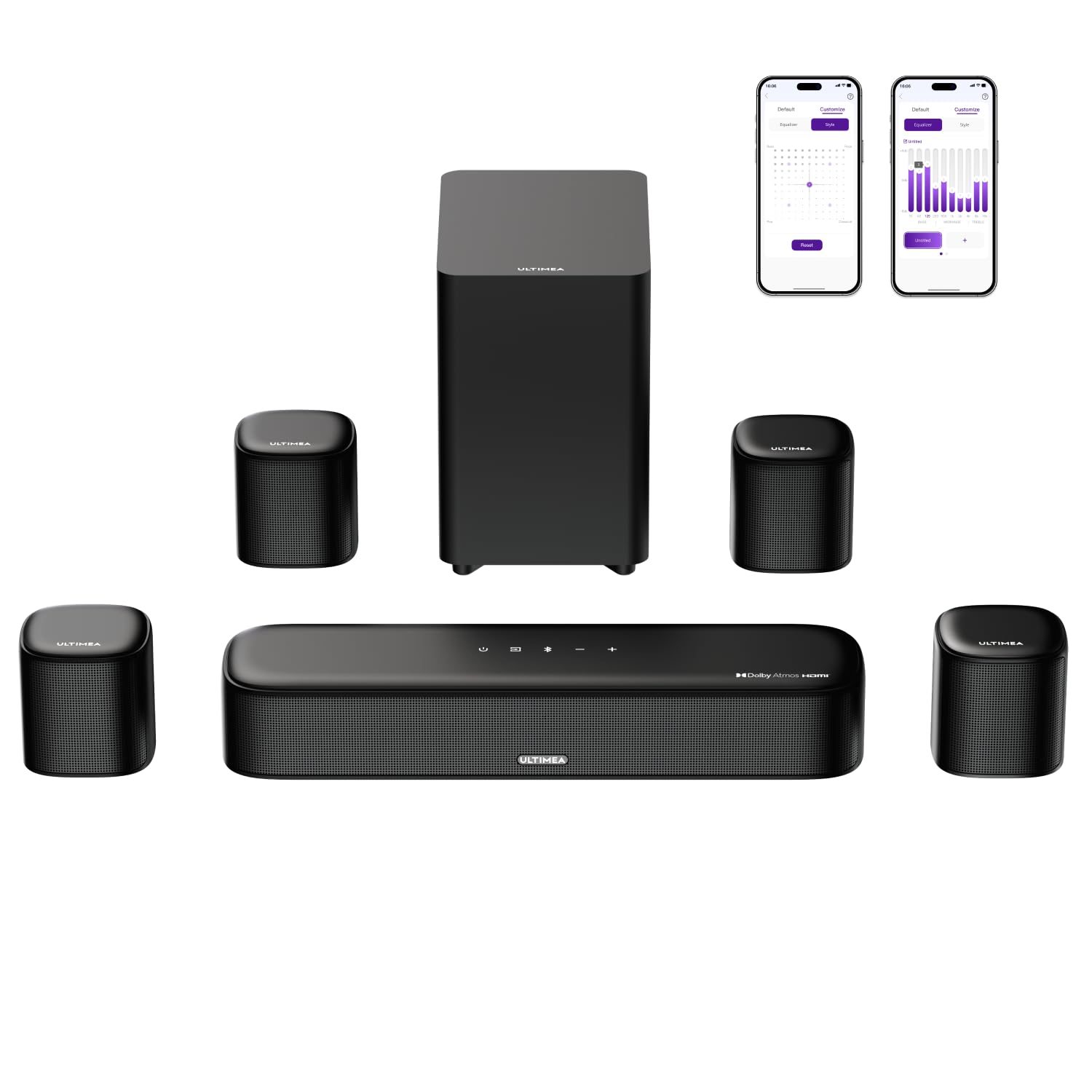
The Skywave F40 creates a true 5.1.2 Dolby Atmos field from two up-firing drivers and two physical rear speakers. Height cues come from actual drivers pointed at the ceiling, and the rear channels sit behind the listener instead of being synthesized from the front bar. Dialogue and front effects stay crisp and clear, with the center channel anchoring voices even when effects move around the room. This is a genuine multi-channel presentation rather than an upmixed approximation.

HDMI eARC is the cleanest hookup, letting the soundbar receive the Atmos bitstream directly from a compatible TV. Optical input covers older sets, and Bluetooth 5.4 handles quick phone streaming. The 5.25-inch wired subwoofer stays compact and easy to place, which matters in a bedroom or den where a larger box would dominate the space. For a mid-range soundbar, this is the practical connection set, with eARC as the primary path for Dolby Atmos content.

This is the system for TV and movie viewers in small-to-medium rooms who want genuine surround and height effects without moving up to a receiver. DTS-heavy disc collections are the one boundary: DTS-encoded content may need the TV set to output PCM because the soundbar does not decode DTS. Dolby-based streaming and Blu-ray audio stays inside the supported path. The target buyer streams from apps, uses a modern TV with eARC, and wants the footprint of a soundbar instead of a rack of components.

The physical rears complete the surround bubble in a way virtual soundbars cannot, and the compact front bar keeps sightlines open. The crisp front stage carries over to moderate volumes, so it works for evening TV without constant remote adjustments. The whole package sits at a mid-range price while covering the usual connection options: HDMI eARC, optical, and Bluetooth. That combination—real height drivers, real rear speakers, and a simple hookup—is what separates this from soundbars that use processing to fake the same channel count.

Setup follows a simple path: connect the soundbar to the TV's eARC port, place the rears behind the seating area, and let the bar handle Atmos decoding. The included sub and rear speakers connect without a separate receiver, so there is no amplifier setup to walk through. For a buyer coming from a TV's built-in speakers, the first session with a streaming movie will show the difference immediately.

Pros

  • True 5.1.2 Atmos with two physical rears and up-firing height drivers creates a real surround bubble.
  • Delivers full Atmos height and rear effects without requiring a separate AV receiver.
  • The bar, subwoofer, and rears configure in a few minutes without calibration software.
  • HDMI eARC carries Atmos over one cable, and Bluetooth 5.4 handles casual phone streaming.

Cons

  • The compact 5.25-inch subwoofer can't pressurize a large open room.
  • The small soundbar's volume ceiling shows when seating distance stretches beyond a compact living room.
Our verdict

TV and movie watchers in compact rooms get a genuine Atmos height layer and real rear speakers without taking on a receiver.

Check Latest Price
2

Best Mainstream Brand

LG S40TR Soundbar

85 /100
Sound Score Excellent

Key details

Channels
4.1
Dolby Atmos
No
Connectivity
Bluetooth, Optical, USB
Physical Rears
2
View on Amazon

LG built the S40TR around a clean 4.1 layout: a soundbar, a wireless sub, and two physical rear speakers. For LG TV owners, the main win is integration — one remote controls volume and power, and the system connects without an AV receiver. That leaves the coffee table free of a second remote, while the rear speakers create a surround field that is actually coming from behind the listener rather than simulated by the bar.

In small and medium rooms, the S40TR delivers clear dialogue and a believable surround image for TV and movies. The sub adds enough low end for normal viewing, and the two rear channels make off-screen effects like rain or traffic easier to locate without cranking the volume. Crosstalk between the bar and rears is well controlled, so panning effects move smoothly from side to side.

This system suits LG TV owners in compact or medium spaces who want a simple multi-channel upgrade. It is not an Atmos or true 5.1/7.1 layout, and the rear speakers still need power connections — placement depends on nearby outlets. Occasional sub or rear dropouts have been noted, and bass thins in larger open rooms, so keep the room size in mind.

💡 Keep the sub on the same side of the room as the soundbar to maintain a stable wireless link.

Pros

  • Clear, detailed audio for small and medium rooms, with a genuine surround feel.
  • Pairing with LG TVs is simple, and one remote controls the whole system.
  • Physical rear speakers add noticeable immersion for movies and TV.

Cons

  • The included manual gives little direction for running cables to the rear speakers.
  • Premium price for a 4.1 that lacks the Atmos feature set of cheaper rivals.
Our verdict

The S40TR is the LG-ecosystem 4.1 that puts physical rears and one-remote control ahead of height channels.

Check Latest Price
3

Maximum 7.1 Immersion

ULTIMEA Aura A60 Pro

85 /100
Sound Score Excellent

Key details

Channels
7.1
Dolby Atmos
Yes
Connectivity
HDMI eARC, Optical
Physical Rears
4
View on Amazon

Four physical surrounds give the A60 Pro a rear sound field that virtualized soundbars cannot match. Paired with a 7.1-channel soundbar and a wired 5.25-inch sub, it delivers Dolby Atmos through HDMI eARC without requiring an AV receiver.

Setup is easy: connect the soundbar to a TV's eARC port, position the surrounds behind the seating area, and the system handles the rest. Bluetooth 5.4, optical, AUX, and USB inputs keep older sources in play, while the wired subwoofer needs a clean cable path in the furniture layout.

Sound quality is rich enough for long movie sessions. Rear channels carry distinct effects, and the subwoofer delivers bass that fills a small-to-medium room without burying dialogue. The four physical surrounds create a noticeable sense of space behind the listener, which is the main reason to choose this over a virtual-surround bar.

The A60 Pro suits movie and TV fans with a small-to-medium living room who want physical rear speakers without stepping up to a receiver and separate speakers. In open-concept rooms beyond the recommended footprint, the 420W output can stretch thin; the top pick's compact Atmos refinement is a better fit for those larger spaces.

Pros

  • Rich rear speaker detail and strong subwoofer output make movie soundtracks feel full without a receiver.
  • Setup is easy enough for a first-time soundbar owner; HDMI eARC handles the Atmos path.
  • Four physical surrounds plus Dolby Atmos at a mid-range price undercuts most separates systems.

Cons

  • Audio can drop out without warning during playback, which makes the system less suited to anyone who cannot accept an occasional interruption.
Our verdict

The A60 Pro gives small-to-medium living rooms a dense seven-channel sound field without moving to an AV receiver. For that use case, it is the most complete physical-surround package at a mid-range price.

Check Latest Price
4

Receiver Owners

Saiyin 5.0 Bookshelf Set

84 /100
Sound Score Excellent

Key details

Channels
5.0
Dolby Atmos
No
Connectivity
Speaker wire
Physical Rears
2
View on Amazon

This passive bookshelf set gives AV receiver owners a genuine 5.0 layout — four surrounds and a center channel — at a budget price below typical virtual soundbar pricing. Driven by your own amplifier, the speakers hold clear, distortion-free sound across dialogue and music, and the wood-grain cabinets feel more substantial than the price suggests. This is not a plug-and-play TV package: it requires a separate AV receiver and speaker wire, and the 5.0 configuration leaves bass duty to an external subwoofer. For buyers already invested in amplification, that tradeoff is the natural path to real multi-channel audio; for anyone expecting a ready-to-run system, a soundbar with wireless rear speakers fits better.

Pros

  • Clear, undistorted output with external amplification
  • Low entry price for a real 5.0 bookshelf setup with a dedicated center channel.
  • Cabinets have a solid feel and a wood-grain finish that fits a living-room shelf.

Cons

  • Separate AV receiver and speaker wire are required; the sticker price is not the total setup cost.
  • No subwoofer is included, so deep movie bass depends on adding one to the system.
Our verdict

For AV receiver owners who want a genuine passive 5.0 layout without soundbar-style premiums, this set fits — provided you bring your own amplifier and subwoofer.

Check Latest Price

How to Choose

Physical Rear Speakers

A 5.1 system with two physical rear speakers creates a genuine surround bubble: effects pan across the room and behind your head. A virtual 7.1 system processes the same two front channels to fake the rear image, which works only when you sit near the sweet spot and the room is quiet.

More rear speakers does not always mean better. Two well-placed rears at ear level behind your seating position matter more than four small drivers spread across the side walls. Check how the rear speakers connect: wired rears require running cable, while 'wireless' rears still need power cords.

Dolby Atmos Support

Dolby Atmos adds height channels that make rain, helicopters, and overhead effects sound like they are coming from above. Soundbars achieve this with up-firing drivers that bounce audio off the ceiling, or with virtual processing that tries to fake it. Up-firing drivers work best with flat, low ceilings under 12 feet.

True Atmos also requires the source, the app, and the HDMI connection to all carry Atmos metadata. If your TV only has ARC (not eARC), some Atmos formats may not pass through. DTS support is separate: many budget Atmos soundbars cannot decode DTS, so disc collectors need to check codec compatibility before buying.

HDMI eARC Connectivity

HDMI eARC is the only connection that reliably carries multi-channel PCM and Dolby Atmos from your TV to a soundbar. Optical cables are limited to compressed 5.1 and cannot carry Atmos at all. If your TV lacks eARC, a soundbar with no HDMI input will force you into stereo or virtual surround.

The practical rule: choose a system with HDMI eARC if you watch streaming services that offer Atmos. For older TVs with only optical, a system like the ULTIMEA Aura A40 becomes a better fit than brands that assume eARC.

Subwoofer Type

A powered subwoofer delivers the low-frequency effects that make movie explosions feel physical. Wired subs get a guaranteed connection but limit placement to the cable run. Wireless subs are easier to position but can drop or re-pair unexpectedly, especially on budget systems.

Subwoofer size matters as much as the wireless claim. A compact 5.25-inch driver pressurizes a small room but struggles in a large open-concept space. If your listening room is big or connects to a kitchen, look for a 6.5-inch or larger driver and a higher peak power rating.

Dialogue Clarity

Clear dialogue is the feature you will notice most during TV shows and dramas. A dedicated center channel or a soundbar with a strong center driver keeps voices locked to the screen instead of muddying them into the mix. Many budget systems include a voice-enhancement mode, but the hardware still needs a decent center driver.

Some systems with rear speakers let you adjust the rear volume independently. That matters in real rooms where the couch is against a wall or the rears sit closer to one ear than the other. Without this control, you may constantly adjust volume during quiet scenes.

Frequently Asked Questions