11 Best Wireless Handheld Microphones 2026: Receivers That Last

Find wireless handheld microphone systems that mate with your existing PA, mixer, or karaoke input and hold their receiver charge over time.

A wireless handheld microphone system seems like a simple purchase until it arrives at the wrong input on your speaker. The category spans UHF and 2.4 GHz designs, AA-powered and built-in rechargeable mics, ecosystem-specific dongles and standard XLR receiver outputs. Many buyers discover that difference only after the box is open.

Receiver power is the most common long-term pain point. Mics may sound clear on day one, but if the receiver stops charging or the mic cuts out across a room, the system stops being useful. In practice, matching the battery design and frequency type to your setup matters more than chasing the longest listed range.

This guide sorts the picks by the inputs and use cases that actually determine fit: ecosystem speaker owners need a different system than churches running four simultaneous mics, and home karaoke singers have different needs than mobile DJs. The right choice is the one that plugs into what you already own and keeps working.

About the Sound Score: This comparative score is calculated from a product's published customer rating and review volume. It is not a laboratory measurement or a hands-on test result.

1

Best Overall Wireless Handheld Mic System

Phenyx Pro PTU-71-2H

92 /100
Sound Score Outstanding

Key details

Outputs
XLR/6.35mm mixed
Battery Type
4 AA included
Wireless Band
UHF auto-scan
Build And Range
Metal body, 328 ft
View on Amazon

Auto-scan UHF tuning earns its keep the first time a venue's RF environment shifts: the receiver finds a clean frequency pair without manual trial and error. The two handhelds deliver a clear, forward vocal tone that suits singing, emcee work, and worship speech. All-metal transmitter and receiver construction feels sound for a mid-range dual-mic system, and the mixed XLR/6.35mm output connects to standard PA gear and mixers without requiring a proprietary speaker ecosystem. Each handheld carries selectable UHF positions, which gives the receiver room to steer around local interference.

Line-of-sight range holds up across large rooms and outdoor stages, with stable reception when the mics move through a stage or aisle. The 328-foot figure assumes a clear line of sight; walls, metal racks, and nearby UHF traffic reduce that distance. In venue layouts, clean frequency selection matters more than chasing the maximum range spec, and the auto-scan process is quick enough to rerun during sound check if a new source of interference appears.

The right buyer for this two-mic system is a mobile DJ, karaoke host, or worship team; it covers dual presenters or singers without moving into four-channel rack territory. The AA battery design means keeping spares or rechargeable AAs in the gig bag is part of ownership, and the combined power/mute switch can be awkward for first-time speakers during hand-offs. Buyers who want built-in rechargeable mics should place this lower on the list, but for standard PA users the tradeoff is manageable.

The system stays focused on the dual-mic task: two handheld transmitters, one receiver, and a single mixed feed for the PA. That keeps setup uncluttered for karaoke and spoken word, while larger productions may need additional channels.

💡 Run a short mute/unmute hand-off rehearsal with first-time speakers before the service or set so the switch position becomes familiar.

Pros

  • Clear vocal tone cuts through singing, emcee work, and speech without harshness.
  • Auto-scan tuning finds a clean frequency pair quickly in changing RF conditions.
  • Metal transmitter and receiver construction holds up to setup and teardown cycles.
  • Long line-of-sight range keeps reception stable across large rooms and outdoor stages.

Cons

  • No built-in rechargeable battery system; handhelds run on AA batteries.
  • Combined power/mute switch may be awkward during live hand-offs.
Our verdict

Choose this system when the job is two presenters or singers, a standard PA, and a need for quick frequency changes without ecosystem lock-in.

Check Latest Price
2

Best for JBL PartyBox Owners

JBL PartyBox Wireless Mic

96 /100
Sound Score Outstanding

Key details

Outputs
PartyBox dongle
Battery Type
Built-in rechargeable
Wireless Band
2.4 GHz digital
Build And Range
—
View on Amazon

The JBL PartyBox Wireless Mic removes the separate receiver entirely: two rechargeable 2.4GHz mics pair through a dongle that plugs into the PartyBox. Setup is plug-and-play, with no receiver dock to place or charge. The two-handheld set supports duets without adding a second receiver. The cardioid pattern keeps vocal reproduction clear while the rechargeable cells cover long sessions, and the wireless link holds steady around the speaker.

This is a karaoke upgrade for current JBL PartyBox owners, not a general-purpose wireless system. It works only with PartyBox speakers and has no onboard gain or echo, so volume and effects stay on the speaker. That boundary suits casual family parties and home entertainment where instant pairing matters more than per-mic mixing or standalone receiver outputs. That makes it a practical add-on for singing and speech rather than a replacement for a mixer-based system.

💡 Set mic levels on the PartyBox before the first singer takes the stage.

Pros

  • Vocal reproduction comes through clearly with minimal feedback.
  • Pairing to a JBL PartyBox is plug-and-play, with no receiver to configure.
  • The rechargeable mics last through long karaoke sessions.

Cons

  • Gain, volume, and echo adjustments are absent from the handheld mics.
  • No XLR or standalone receiver output exists for other PA or mixer use.
Our verdict

Existing PartyBox owners get a clean, receiver-free way to add two wireless handhelds. Anyone without a PartyBox should choose the top pick for standard outputs.

Check Latest Price
3

Best 4-Channel System for Stages & Churches

Phenyx Pro PTU-7000-4H

88 /100
Sound Score Excellent

Key details

Outputs
XLR/6.35mm mixed
Battery Type
8 AA included
Wireless Band
UHF auto-scan
Build And Range
Metal body, 328 ft
View on Amazon

The PTU-7000-4H expands the two-mic auto-scan format into a four-channel package for venues and production teams that run multiple presenters at once. Each handheld rides on its own UHF frequency group, and the receiver keeps the hookup simple with XLR and 1/4-inch mixed outputs. The metal receiver, included AA batteries, and 328-foot line-of-sight range make it practical to deploy without extra proprietary gear.

This is for churches, schools, and mobile production teams that need four wireless handhelds on a single receiver, and it suits spoken word and live vocals better than casual home karaoke. The premium price reflects the channel count and auto-scan convenience, so buyers who need only one or two mics should look at the two-channel pick in this set. Solo hosts and smaller rooms get more hardware than they use for a single presenter.

💡 Mute or roll gain down slightly during hand-offs to reduce handling thumps.

Pros

  • Clear vocal tone and enough headroom for speech and live singing at this price
  • Four handsets with auto-scan tuning deliver strong multi-mic value for events
  • Auto-scan setup and frequency selection keep show-day operation quick

Cons

  • Handling noise can be noticeable during mic hand-offs, especially when passing mics live
Our verdict

For venues and production teams that need four handhelds on one receiver, this is the more capable four-channel choice over the two-mic pick.

Check Latest Price
4

Best Value UHF Dual-Mic for Karaoke Hosts

TONOR TW-820

91 /100
Sound Score Outstanding

Key details

Outputs
XLR/6.35mm out
Battery Type
2 AA per mic
Wireless Band
UHF, 15 channels
Build And Range
Metal mics, 200 ft
View on Amazon

The TONOR TW-820 gives karaoke hosts a pair of metal UHF handhelds with 15 adjustable channels, a 200-foot open-space range, and XLR/6.35mm output without moving into entry-level 2.4GHz territory. That output flexibility makes it a drop-in for powered speakers or mixers, while the metal transmitters feel better suited to mobile gigs than the ultra-budget plastic alternatives. The 15 channels are manually adjustable, which is enough for small rooms without paying for auto-scan convenience.

Mobile DJs, karaoke hosts, and small venues get the right fit when they accept AA swaps and keep a wired backup in the rack. Unit-to-unit QC and battery drain can vary, so occasional dropouts are possible; that shifts this toward working hosts who treat wireless as a convenience rather than the only path to the PA. The standard XLR and 6.35mm outputs also mean no proprietary speaker ecosystem is required.

💡 Keep spare AA cells at the receiver and swap them before the indicator gets low; weak batteries can look like range trouble.

Pros

  • Clear, powerful vocal sound carries well for karaoke and speech.
  • Metal UHF dual-mic build feels like a step up from budget wireless.
  • Simple setup and open-space range fit small venues and mobile hosts.

Cons

  • Transmitters run on AA batteries rather than built-in rechargeable cells.
  • Unit-to-unit QC may cause brief signal interruptions in RF-congested rooms.
Our verdict

Keep the wired backbone ready and the AA drawer stocked.

Check Latest Price
5

Best Budget Dual-Mic for Home Karaoke

FIFINE K036

89 /100
Sound Score Excellent

Key details

Outputs
6.35mm, 3.5mm, RCA
Battery Type
4 AA batteries
Wireless Band
UHF 520-578 MHz
Build And Range
80 ft range
View on Amazon

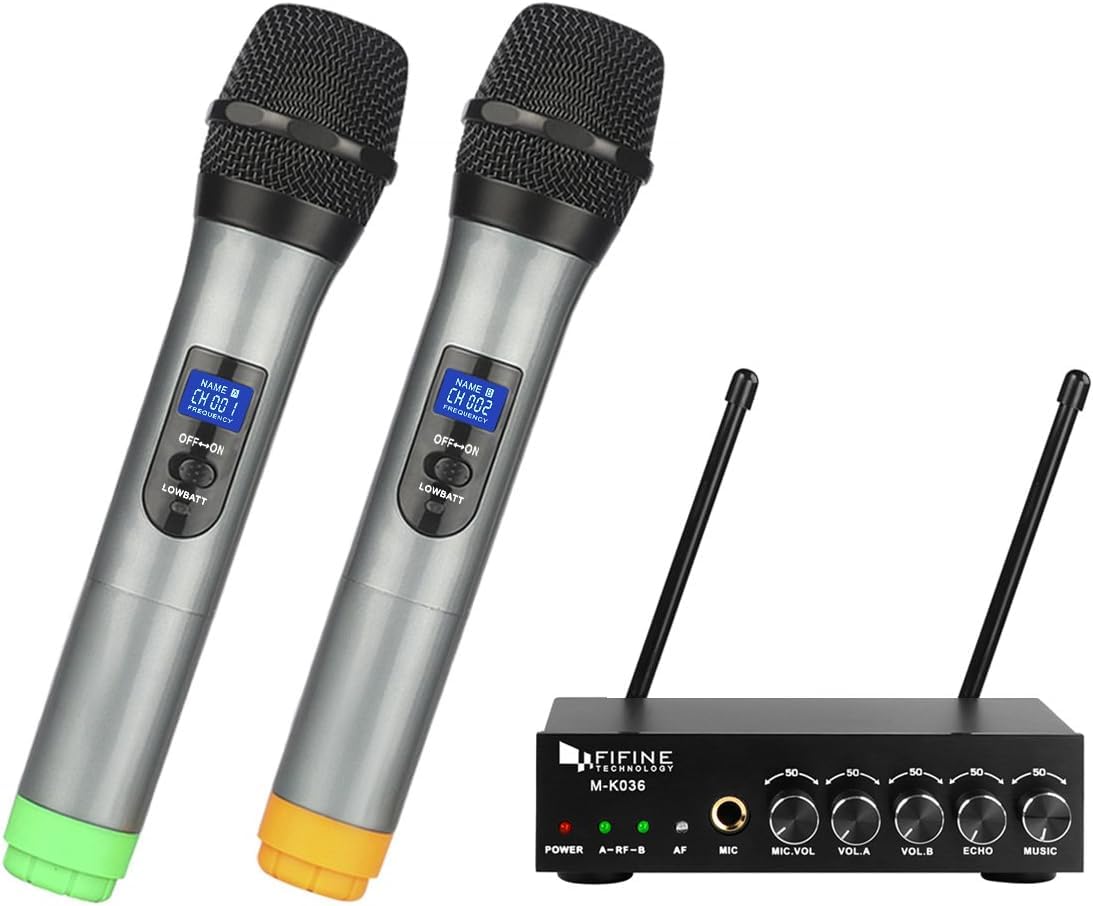
Unlike the rechargeable RGB party mic set, this system keeps the wireless link on standard UHF and includes 6.35mm, 3.5mm, and RCA cables, so it plugs into home stereos, powered speakers, and karaoke mixers without a proprietary speaker. The two handheld mics provide independent volume and an echo effect, while the 1/4-inch aux input accepts a phone or tablet for backing tracks. That makes it a small karaoke command center instead of one more speaker-specific accessory.

This fits house parties, family karaoke nights, and casual duets where echo, fast setup, and per-person volume matter more than critical sound. The noise floor can include static or hiss on some units, so lively rooms are the right setting rather than quiet studio or critical listening. It also runs on AA batteries rather than a rechargeable dock, which makes spares easy to keep on hand for long sessions.

💡 Set both mic levels and echo with backing music playing before guests arrive, so the mix already works in a full room.

Pros

  • Clear sound with useful echo effect for casual singers.
  • Strong home karaoke value at a mid-range price.
  • Easy setup with included 6.35mm, 3.5mm, and RCA cables.

Cons

  • The 80-foot range is sized for indoor rooms and shorter clear-line runs, not wide outdoor venues.
  • The noise floor can include static or hiss on some units in quieter rooms.
Our verdict

For lively home karaoke and family duets, the K036 delivers echo, quick hookup, and cable flexibility without pushing the budget.

Check Latest Price
6

Best JBL Dual-Mic with Receiver

JBL Wireless Two-Mic System

91 /100
Sound Score Outstanding

Key details

Outputs
—
Battery Type
2 AA mics, rechargeable receiver
Wireless Band
UHF dual-channel
Build And Range
—
View on Amazon

JBL's receiver-based system gives PartyBox owners a true UHF dual-channel option instead of the dongle-style setup. Two AA-powered handhelds feed a compact receiver that connects to select JBL PartyBox speakers, keeping a traditional handheld wireless path with minimal pairing steps and no app sync. Vocal clarity is strong and tuned for karaoke, with a sound signature that suits party vocals and casual speech.

This is for JBL PartyBox owners who want two handheld mics without adding a standalone PA or mixer. The receiver's internal battery can stop charging over time and is not user-serviceable, so this is a casual karaoke set rather than daily gig equipment. If you own a compatible PartyBox and accept that battery boundary, the two-microphone package is a cost-effective way to add singing and speech to parties.

💡 Keep the receiver charged before a party and avoid storing it fully drained for extended periods.

Pros

  • Strong vocal clarity with JBL-style presence for karaoke and party vocals.
  • Plug-and-play UHF dual-channel setup with compatible JBL PartyBox speakers.
  • Includes two handheld mics at a mid-range price for JBL PartyBox owners.

Cons

  • The receiver is limited to select JBL PartyBox speakers, so it cannot feed a standalone mixer or PA.
  • The receiver's internal battery can stop charging over time and is not user-serviceable.
Our verdict

JBL PartyBox owners get a dedicated two-mic UHF path without moving to a full PA system.

Check Latest Price
7

Casual Family Karaoke

TONOR TW-220

88 /100
Sound Score Excellent

Key details

Outputs
6.35mm, 3.5mm adapter
Battery Type
600mAh built-in
Wireless Band
2.4 GHz
Build And Range
50 ft range
View on Amazon

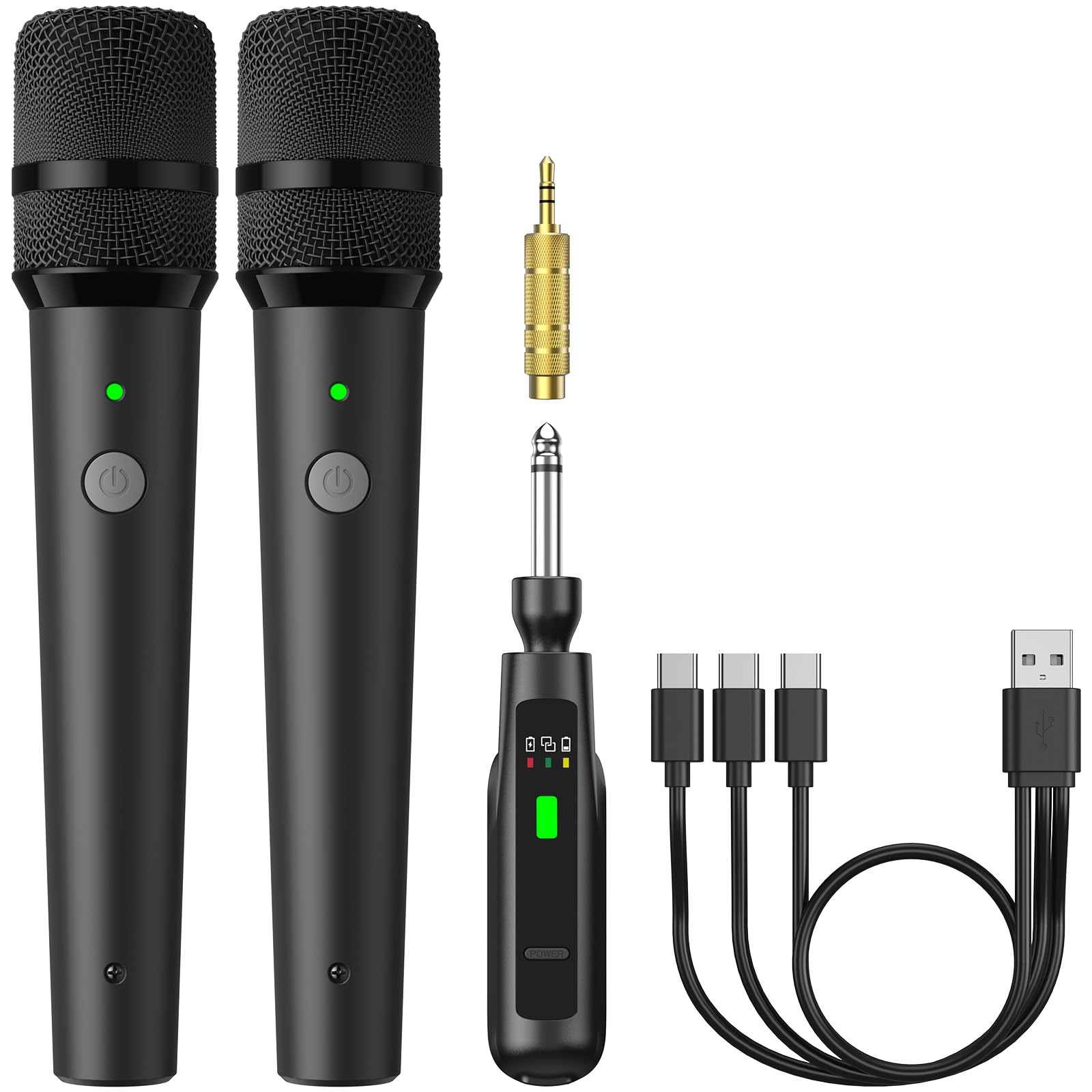
The TW-220 covers the casual karaoke basics without requiring a proprietary speaker ecosystem. Two rechargeable 2.4 GHz handhelds and a compact USB-C receiver connect through the included 6.35mm plug and 3.5mm adapter, so setup is quick for small rooms and family use. The tradeoff is use-case based: a 50-foot range and receiver charging durability limit it to occasional, short-range sessions rather than larger venues or frequent professional use.

Pros

  • Plug-and-play setup works right away for karaoke, parties, and casual speech.
  • Sound quality is good for an entry-level wireless set at this price.

Cons

  • A 50-foot range keeps this in small rooms and line-of-sight use.
  • Receiver charging can become intermittent before the microphone batteries show wear.
Our verdict

For buyers who only need two handsets in one small room and charge occasionally, this set fits the bill without stretching a budget.

Check Latest Price
8

Budget Home Karaoke

Bietrun UHF Dual Mic

89 /100
Sound Score Excellent

Key details

Outputs
6.35mm, 3.5mm adapter
Battery Type
Receiver rechargeable, AA mics
Wireless Band
UHF, 15 channels
Build And Range
Metal mics, 160 ft
View on Amazon

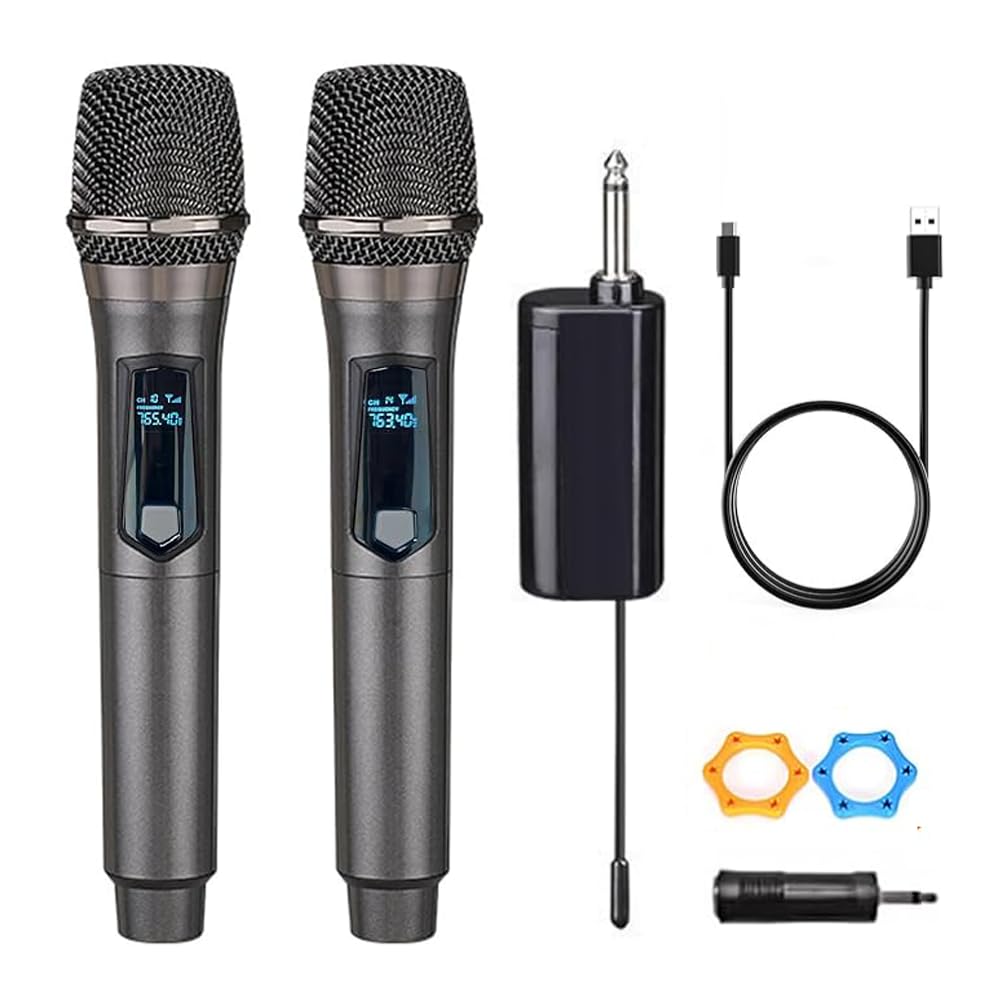
The Bietrun UHF Dual Mic covers the fundamentals for wireless vocals: two metal handheld mics with 15 adjustable UHF channels, a rechargeable receiver, and easy connection to powered speakers or mixers through the 1/4-inch output with 3.5mm adapter. Sound clarity and low handling noise are strong for a budget kit, and the metal mics feel more durable than the price suggests. Receiver charging may vary between units, so this is a casual-use set rather than a daily professional workhorse.

Pros

  • Complete dual-channel UHF setup covers karaoke and casual speech without extra gear
  • Clear sound and low handling noise are strong for the budget range

Cons

  • Longer sets can outlast the receiver charge, so keep a wired backup for continuous speech
Our verdict

This fits casual home karaoke, small parties, or occasional speech sessions where the charging boundary is acceptable.

Check Latest Price
9

Party Karaoke

ECHOMUSSY Dual Wireless Mic

87 /100
Sound Score Excellent

Key details

Outputs
6.35mm, 3.5mm adapter
Battery Type
1200mAh per mic
Wireless Band
2.4 GHz
Build And Range
200 ft range
View on Amazon

The ECHOMUSSY is a rechargeable 2.4 GHz dual-mic system built for party karaoke, with RGB LEDs, per-mic volume, and USB-C charging. The handhelds deliver crisp, clear vocal output with minimal background noise, and the receiver accepts both 6.35mm and 3.5mm connections for compatible speakers or PAs. The main tradeoff is tonal character: vocals can come across bass-heavy or slightly clipped on some voices. That use-case boundary keeps it in casual hosting and family event territory rather than neutral voice monitoring.

Pros

  • Crisp, clear vocal output with minimal background noise
  • Long battery life and USB-C charging for extended sessions

Cons

  • Not a neutral studio sound for audiophile voice monitoring
Our verdict

For party karaoke, family events, and casual hosting where LED atmosphere and rechargeable convenience are the priority, this set fits.

Check Latest Price
10

Portable Karaoke

AFUOO W60 Pro

86 /100
Sound Score Excellent

Key details

Outputs
6.35mm, 3.5mm adapter
Battery Type
2 AA mics, 1 AA receiver
Wireless Band
2.4 GHz
Build And Range
All-metal body, 200 ft
View on Amazon

AFUOO W60 Pro packs two all-metal 2.4GHz handheld mics, included AA batteries, and a carry bag with a 200-foot range for short emcee gigs and portable karaoke. Sound quality is strong for the size and price, and the storage bag simplifies transport. Auto-shutdown after inactivity, occasional signal cutouts, and high AA battery draw make it risky for long, uninterrupted events, so this kit fits pause-tolerant short jobs.

Pros

  • Strong sound quality for the size and price
  • Portable all-metal kit with carry bag and included AA batteries

Cons

  • Runs on AA batteries rather than built-in rechargeable cells
Our verdict

This is a budget-friendly portable kit for short emcee gigs and karaoke where the event has natural breaks and spare AA batteries are part of the plan.

Check Latest Price
11

Budget Home Karaoke

HUACAM Rechargeable Dual Mic

86 /100
Sound Score Excellent

Key details

Outputs
6.35mm, 3.5mm adapter
Battery Type
1200mAh built-in
Wireless Band
UHF fixed frequency
Build And Range
200 ft range
View on Amazon

The HUACAM set delivers clear, noiseless vocal pickup for the price and pairs automatically once powered on. The fixed-frequency UHF design is the main technical boundary: it suits quiet home RF settings, not crowded venues or professional events. Battery and charging consistency can vary, and that tradeoff keeps this an occasional-use karaoke pick rather than daily-event gear. The included 6.35mm and 3.5mm adapter covers basic karaoke machines and small speakers.

Pros

  • Clear vocal pickup with low noise for this price tier
  • Two mics and a receiver with 1200mAh built-in batteries at budget cost

Cons

  • Battery and charging consistency may vary between units
Our verdict

Choose this for light-duty home karaoke where two rechargeable mics cost less than a single pro handheld; for event-grade flexibility, step up to an auto-scan UHF system.

Check Latest Price

How to Choose

Frequency Agility

Start with frequency agility. UHF systems with auto-scan or tunable channels can move away from local TV and wireless interference, while fixed-frequency 2.4 GHz designs share airspace with Wi-Fi routers and Bluetooth traffic. In a living room that may be fine; in a venue with dozens of phones and access points, 2.4 GHz can produce dropouts. If you will ever run two systems or perform in new rooms, choose UHF with scanning.

Simultaneous Mics

Match the channel count to the number of people who will speak or sing at once, not just the number you own. A two-channel receiver cannot add a third transmitter later; you would need another receiver and separate frequencies. Four-channel systems make sense for worship teams and panel events, but they are overkill for solo home use.

Battery Topology

Battery design affects long-term reliability. AA-powered mics are easy to keep alive with spare batteries and a quick swap mid-event. Built-in rechargeable mics are cleaner until the charging circuit or receiver battery wears out, which is the most common failure point in this category. If you choose rechargeable, confirm the receiver can operate while charging.

Output Connections

Check the output before anything else. Many wireless systems end with a 6.35mm or XLR receiver output, while ecosystem-specific models only work with one brand of speaker. AUX-only or Bluetooth-only speakers will not accept a standard mic-level signal. The right output is the one that matches an input you already own, not the one with the longest feature list.

Build and Range

Claimed range is measured line-of-sight outdoors, not through walls or bodies. Metal receivers and mic barrels survive drops and travel better than plastic, but real indoor range is usually shorter than the box suggests. If you will work across a stage or through a crowd, choose a metal UHF system with at least 100 feet of line-of-sight spec and lower your expectations for solid walls.

Frequently Asked Questions