12 Best Audio Mixer of 2026: USB That Matches Your Workflow

Match an audio mixer to how you actually record, stream, or perform — without falling for channel counts that don't fit.

Most mixer listings lead with channel counts and effect presets, but the real frustration starts at the USB port. An analog mixer with 'USB' usually sends a stereo mix-out, not separate tracks, so a board that looks right for recording can quietly limit your edit.

That doesn't mean the mixer is broken. It means the right board depends on how you work: live bands need preamp count and physical faders, streamers need chat/game/mic separation, podcasters need clean multi-mic recording. A mixer is only 'good' when its routing matches the job.

This guide sorts mixers by that workflow rather than by the numbers on the box, so you can pick a board that records, streams, or performs the way you actually use it.

About the Sound Score: This comparative score is calculated from a product's published customer rating and review volume. It is not a laboratory measurement or a hands-on test result.

1

Best Overall

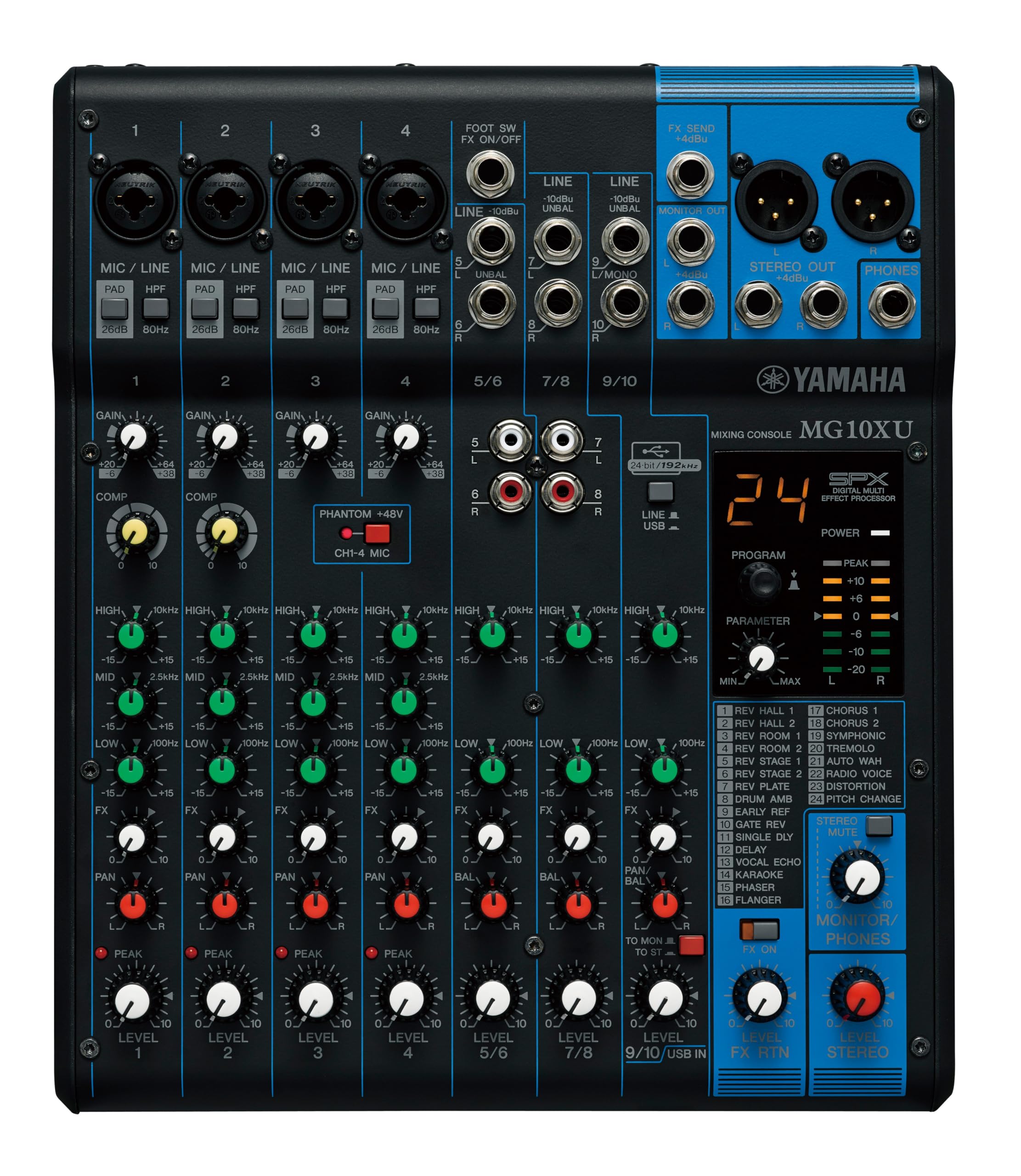
Yamaha MG10XU

92 /100
Sound Score Outstanding

Key details

Effects
SPX effects
Mic Channels
4 XLR, 10 total
USB / Recording
Stereo USB out
Preamp / Phantom
D-PRE, 48V
View on Amazon

The MG10XU delivers clean D-PRE preamps, usable SPX effects, and a well-organized 10-input channel strip in a compact mixer. Each mic channel has a one-knob compressor, 3-band EQ, and high-pass filter, so small-venue setups don’t need extra outboard processing. The preamps handle dynamic mics without excessive noise, and the overall sound quality holds up at this price point.

The SPX effects give you reverb and delay without pedals or rack units, and the USB connection puts the mixer to work as a computer recording front end. Physical faders and rotary gains are placed for quick adjustment during a live set, and the channel layout is consistent enough that you don’t need to hunt for functions. For a home studio, the same board can handle a vocal mic and a keyboard at the same time.

It suits solo performers, small bands, podcasters, and streamers who want an analog board with USB connectivity. The USB output can be quieter than expected, so it rewards careful gain staging before you hit record. For those uses, the MG10XU keeps signal flow simple: one board, a pair of speakers or monitors, and a computer.

Pros

  • Clean D-PRE preamps with one-knob compressors and 3-band EQ make vocals and instruments sit well in a small mix.
  • Built-in SPX effects cover reverb and delay needs without extra pedals or rack gear.
  • One compact analog board handles live sound, home recording, and podcasting with a USB stereo feed.

Cons

  • Larger bands or multi-mic podcast panels can outgrow 10 inputs quickly.
  • USB carries only the main stereo mix, so multi-track recording needs a separate audio interface.
Our verdict

The MG10XU covers more small-format mixing jobs from one physical board than most USB mixers in this tier — live sound, podcasting, and stereo capture included.

Check Latest Price
2

Best for Streamers & Gamers

TC-Helicon GoXLR

93 /100
Sound Score Outstanding

Key details

Effects
Voice FX, sampler
Mic Channels
1 XLR, 4 channels
USB / Recording
Multi-channel USB
Preamp / Phantom
MIDAS preamp, 48V
View on Amazon

The GoXLR is a streaming-first broadcast mixer with motorized faders, a MIDAS preamp, sampler, and voice FX in one Windows-native box. It separates game, mic, chat, and music onto dedicated channels, and the hardware feels like a polished broadcast control surface. Sample pads and voice FX are assignable from the companion app, which keeps live adjustments on the mixer itself. This setup suits Windows streamers and broadcast podcasters who want one-box vocal processing and a hardware soundboard. The boundary: the GoXLR runs only on Windows and depends on the companion app, so Mac/Linux users need another route.

💡 Set sample and routing profiles before streaming, and keep the companion app open during use.

Pros

  • Motorized faders and a broadcast-style layout give quick hands-on control over game, mic, chat, and music routing.
  • Deep routing separates game, mic, chat, and music for precise live mixing.
  • Once the companion app is configured, the daily workflow is easy to manage.

Cons

  • In long streams, sampler or voice FX stutter can interrupt the mix and may require a restart.
Our verdict

The GoXLR is the right fit for Windows streamers who want broadcast routing, vocal FX, and a sampler in one box; Mac/Linux users should consider alternatives.

Check Latest Price
3

Best Compact Digital Mixer

Behringer FLOW 8

92 /100
Sound Score Outstanding

Key details

Effects
Built-in FX, EQ
Mic Channels
2 XLR, 8 channels
USB / Recording
Stereo USB out
Preamp / Phantom
2 MIDAS, 48V
View on Amazon

The FLOW 8 brings digital mixing into a compact format with two MIDAS preamps, 60mm faders, Bluetooth, and USB connectivity. The FLOW app handles EQ, effects, and monitor adjustments from anywhere in the room, while the physical faders remain available for quick hands-on changes.

This suits solo performers, podcasters, and small home studios that want digital flexibility without a tablet-only rack workflow. Bluetooth pairs one device at a time, and occasional audio glitches may interrupt a session, so keep a restart path in mind for live sets.

Pros

  • Compact frame with faders and MIDAS preamps fits in a gig bag without losing hands-on control.
  • Clean signal path and built-in FX cover live vocals, podcast calls, and studio capture without extra outboard gear.
  • Bluetooth app control lets you adjust EQ and effects from the listening position, a practical plus when the mixer is offstage.

Cons

  • The 8-input ceiling means bigger band or multi-mic sessions call for a higher-channel board.
Our verdict

The FLOW 8 is the small-format digital mixer for solo acts, podcasters, and home studios that want app flexibility without leaving faders behind.

Check Latest Price
4

Best Podcast Production Console

Rode RODECaster Pro II

87 /100
Sound Score Excellent

Key details

Effects
Compressor, EQ, gate
Mic Channels
4 XLR, plus USB
USB / Recording
Multi-track USB recording
Preamp / Phantom
Revolution preamps, 48V
View on Amazon

The RODECaster Pro II is a desktop podcast production console built around four Revolution preamps, APHEX processing, SMART pads, and multi-track recording. Where the top pick in this roundup covers general analog/USB mixing duties, this unit focuses on podcast and streaming workflows, with Wi-Fi, Bluetooth, USB, and Ethernet connections handled in one chassis.

The right buyer is a multi-host podcast team or streamer who wants studio-grade voice processing without assembling separate preamps and interfaces. It is not a budget beginner mixer or a live sound board; power supply and USB QC issues can appear in a minority of units, so early testing of a new unit is advised.

Pros

  • Premium build quality and impressive hardware.
  • Crystal-clear sound quality and professional processing.
  • Easy to connect and use for its intended workflow.

Cons

  • Live sound engineers needing more than four XLR channels will outgrow this desktop console.
Our verdict

For podcast and streaming teams that want integrated processing, multi-track recording, and premium hardware in one box, the RODECaster Pro II is the right console.

Check Latest Price
5

Best Budget Streaming Starter

FIFINE SC3

89 /100
Sound Score Excellent

Key details

Effects
Voice changer, sound pads
Mic Channels
1 XLR, 4 channels
USB / Recording
Stereo USB out
Preamp / Phantom
48V phantom
View on Amazon

The SC3 brings a single XLR input, 48V phantom power, voice changer, and sound pads into one plug-and-play desktop mixer. Individual volume controls for mic, game, chat, and music keep live mixing intuitive for first-time streamers.

Solo streamers moving from USB mics get the core XLR upgrade without the learning curve of a broadcast console. The noise floor and USB power limits can reduce headroom with demanding XLR mics, so this is a casual streaming tool rather than a transparent studio front end or multi-mic podcast hub. For that audience, the voice effects and simple layout matter more than pristine audio.

Pros

  • Budget-friendly XLR mixing with 48V phantom power, voice changer, and sound pads in a single box.
  • Beginner-friendly layout with intuitive volume controls for game, chat, and music.
  • Voice changer modes and sound pads add fun to live streams without extra software.

Cons

  • In a quiet room, hiss or static may be audible when the preamp is pushed.
  • USB power can limit gain headroom with demanding XLR mics, so low-output mics need careful staging.
Our verdict

A sensible entry point for solo streamers who want XLR, voice changer, and sound pads without leaving the budget tier.

Check Latest Price
6

Best Portable Analog with Effects

Yamaha MG06X

92 /100
Sound Score Outstanding

Key details

Effects
Digital effects
Mic Channels
2 XLR, 6 channels
USB / Recording
No USB
Preamp / Phantom
D-PRE, 48V
View on Amazon

Ultra-portable analog mixer: the MG06X squeezes two D-PRE preamps, a six-channel layout, and built-in digital effects into a rugged metal chassis that fits on a keyboard or desk. This is the portable board for a quick mic-and-keyboard mix.

Home karaoke, solo performers, and keyboard players mixing one mic with a few line sources get a clean-sounding board that is easy to set up. No USB output means computer recording requires an external interface; the larger USB-equipped model in this set is the alternative. The six-channel layout won't cover bigger multi-mic productions, but neither limit matters for the small rigs this board targets.

Pros

  • Rugged metal chassis holds up through regular gigging and set changes.
  • Built-in digital effects cover live and karaoke sets without extra pedals.
  • D-PRE preamps keep vocals and keyboards clear in a small mix.

Cons

No consistent drawbacks identified in the available review data.

Our verdict

The MG06X is the compact mixer to keep for live gigs, karaoke nights, and keyboard rigs that stay in the analog world.

Check Latest Price
7

Live Bands

Behringer XR18

92 /100
Sound Score Outstanding

Key details

Effects
FX, EQ, dynamics
Mic Channels
16 XLR, 18 channels
USB / Recording
18x18 USB
Preamp / Phantom
16 MIDAS, 48V
View on Amazon

Live bands and project studios get 18 channels of MIDAS-preamplified mixing plus 18x18 USB capture in a single rack unit. Mixing is controlled from a tablet app, which makes it a strong fit for digital-first operators and a narrower match than the traditional boards in this set.

Pros

  • One rack unit handles a full band's input list with 18 channels and 12 buses for monitor mixes.
  • The 18x18 USB port captures every channel to a computer while the mixer keeps running the live show.

Cons

  • No physical faders
Our verdict

Best for bands, venues, and project studios that prioritize channel count and multitrack USB in a rack package.

Check Latest Price
8

Solo Performers

Mackie ProFX6v3

88 /100
Sound Score Excellent

Key details

Effects
GigFX 24 effects
Mic Channels
2 XLR, 6 channels
USB / Recording
2x4 USB
Preamp / Phantom
Onyx 60dB, 48V
View on Amazon

The Mackie ProFX6v3 is a compact 6-channel analog/USB board that handles karaoke, podcasting, and guitar/voice mixing with 60dB Onyx preamps and usable GigFX reverb/delay. The USB connection is stereo-only, and Mac USB recognition can be intermittent for some users, so Mac-only multi-track recording is outside its scope.

Pros

  • 60dB Onyx preamps keep voice and guitar clean at high gain, reducing the need for extra boost.
  • Built-in GigFX reverb and delay cover the effects solo performers need for live sets and recordings.

Cons

  • Mac USB recognition can be intermittent, so Mac-only users who depend on a stable connection should plan around it.
Our verdict

For solo performers and content creators who want high preamp gain and usable effects without a big footprint, this compact board fits a desk-based setup.

Check Latest Price
9

Karaoke, Podcasting

Pyle PMXU43BT

86 /100
Sound Score Excellent

Key details

Effects
16-bit DSP FX
Mic Channels
2 XLR, 4 channels
USB / Recording
Stereo USB out
Preamp / Phantom
48V phantom
View on Amazon

Bluetooth, USB, MP3 playback, 48V phantom power, and DSP FX come together in a compact budget mixer that suits karaoke and casual podcasting. Setup is simple and sound quality holds up at this price. The lack of pan/balance controls and occasional Bluetooth pairing hitches make this a starter or backup board rather than a precise production mixer.

Pros

  • Packs Bluetooth, USB, MP3 playback, 48V phantom power, and DSP effects for one low price.
  • Works well for karaoke and podcasting right out of the box.

Cons

  • Bluetooth pairing can be inconsistent, so connecting a phone or tablet may take a few attempts.
  • Without pan/balance controls, stereo placement for multi-input mixes is limited.
Our verdict

For casual karaoke nights and starter podcasts, this budget board gets Bluetooth and USB mixing done without complicated routing.

Check Latest Price
10

Keyboardists, Drummers

Mackie Mix5

87 /100
Sound Score Excellent

Key details

Effects
No effects
Mic Channels
1 XLR, 5 channels
USB / Recording
No USB
Preamp / Phantom
48V phantom
View on Amazon

The Mix5 is a clean, compact analog mixer for keyboardists and drummers who need a small monitor submix on stage. It offers 48V phantom power and simple rotary controls at a budget-friendly price. The feature set is deliberately minimal — no USB or effects — and headphone monitoring is tied to the main output, so independent cueing isn't possible.

Pros

  • Simple, portable mixing without extra baggage.
  • Fair budget value for a no-frills compact mixer.

Cons

  • Headphone feed follows the main fader, so you can't cue a channel with the house mix down.
Our verdict

Fits keyboard and drum rigs where a clean, compact submix matters more than independent headphone cueing.

Check Latest Price
11

Home Studios

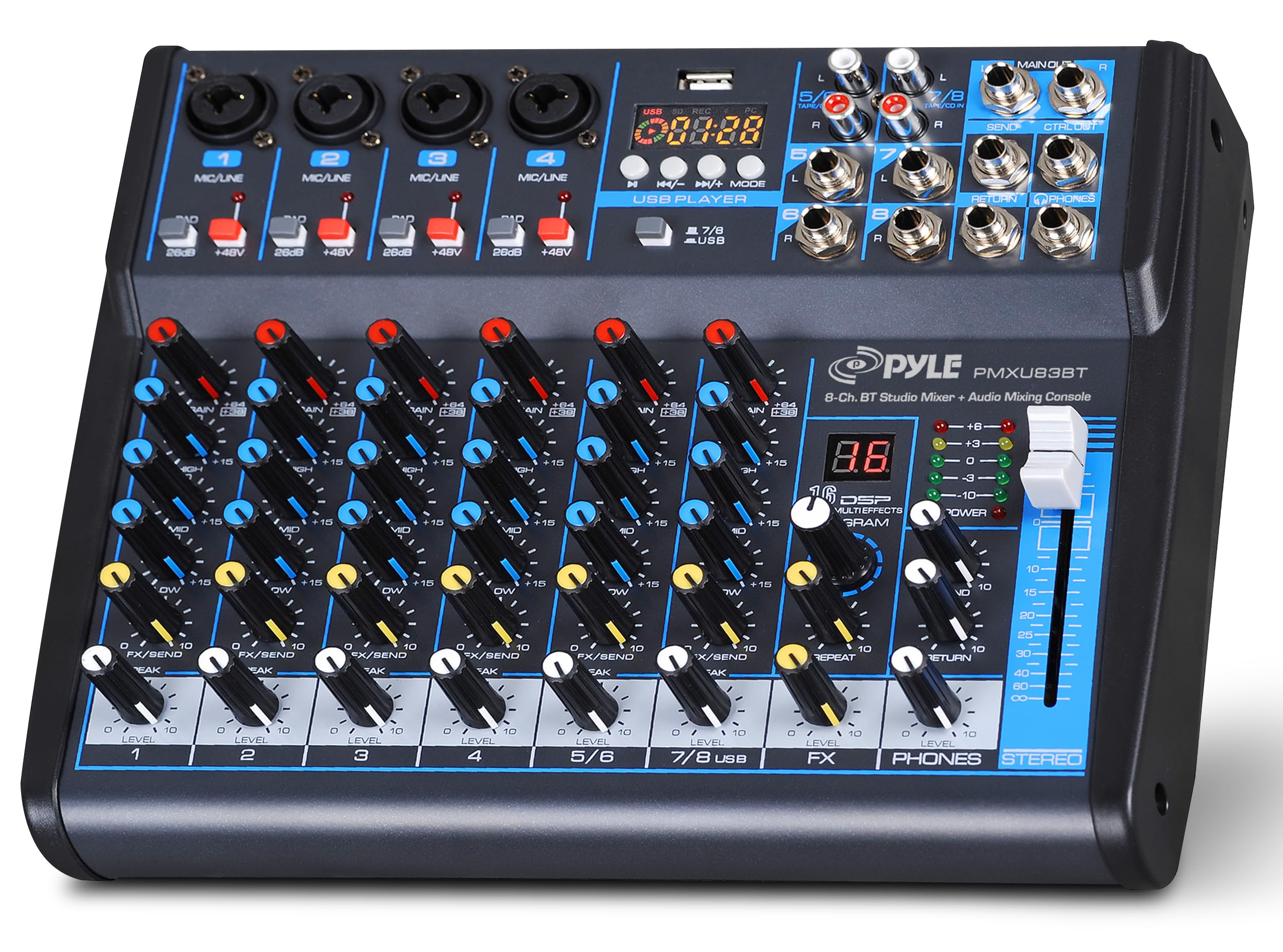
Pyle PMXU83BT

86 /100
Sound Score Excellent

Key details

Effects
16-bit DSP FX
Mic Channels
4 XLR, 8 channels
USB / Recording
Stereo USB out
Preamp / Phantom
48V phantom
View on Amazon

The PMXU83BT delivers eight channels, Bluetooth, USB, DSP effects, and 48V phantom power at a budget-friendly price, which suits home studios, small gigs, and multi-mic podcasters. Sound and Bluetooth/USB consistency can vary between units, so it trails mid-range boards in repeatability. For a compact, low-cost mixer with this much routing, those trade-offs are acceptable.

Pros

  • Eight-channel layout plus Bluetooth, USB, DSP FX, and phantom power bundle a lot of utility at budget pricing.
  • Setup is simple and the chassis feels sturdy enough for moving between home and small gigs.

Cons

  • Output and Bluetooth/USB consistency can vary, so critical recordings or live sets may need extra gain or connection checks.
Our verdict

If your mixing needs are casual-to-intermittent — home recording, karaoke, occasional small gigs — this eight-channel board offers more routing per dollar than comparably priced alternatives, provided you can accept some unit-to-unit variability.

Check Latest Price
12

Keyboard Sub-Mix

Moukey MAMX3

89 /100
Sound Score Excellent

Key details

Effects
No effects
Mic Channels
0 XLR, 8 line
USB / Recording
No USB
Preamp / Phantom
No mic preamps
View on Amazon

Eight line inputs with mono/stereo routing combine keyboards, drum machines, and synths before the main desk. The MAMX3 is a budget-friendly sub-mixer for cramped rigs. It is line-level only: no XLR mic inputs, and audible hiss can appear with a poor power supply. That boundary is acceptable for keyboardists who keep it out of mic duty.

Pros

  • Small footprint suits a crowded desktop or keyboard top.
  • Mono/stereo per-channel routing handles stereo synths and mono drum modules in one box.

Cons

  • Hiss can be noticeable in some setups, especially with certain power supplies and grounding.
Our verdict

Fits best when you need to merge several line-level instruments into one aux feed and already have a main mixer or interface handling microphones.

Check Latest Price

How to Choose

Mic Channels and Input Count

Mic/XLR input count matters more than the total channel number. A mixer that claims 10 channels may only have four XLR mic inputs, with the rest stereo line channels meant for keyboards, phones, or drum machines.

Count your actual microphones first. If you need six mics for a roundtable podcast, a 6-channel mixer with two XLR inputs will not cover the session, no matter how many line inputs it has.

USB and Recording Behavior

USB on an analog mixer is usually a stereo mix-out, not a multi-track interface. The mixer sums all channels to a stereo pair before sending it to the computer, so you cannot isolate one mic in post.

If you need individual tracks for editing, choose a digital mixer or a multi-track USB interface. For a live stream or a rough recording, stereo mix-out is fine and saves money.

Onboard Effects

Built-in effects are convenience features, not substitutes for studio processing. On analog mixers, effects are applied after the preamp, so the quality of the effect circuit and the preamp limit the final sound.

For live use, reverb and delay on a compact Yamaha or digital FX on a Mackie are enough. For polished podcast processing, look for a mixer with compression, EQ, and noise gate on every mic channel.

Preamp Gain and Phantom Power

Preamps determine how clean your microphone signal reaches the mixer. Low-gain preamps force you to push the input trim, which raises the noise floor and makes a budget mixer sound hissy.

Check the gain spec and the phantom power switch. A mixer with 48V phantom can drive condenser mics, but USB-powered budget mixers may not deliver enough current for demanding XLR mics.

Physical Controls and Workflow

Faders, pan knobs, per-channel EQ, and independent headphone monitoring determine how quickly you can react during a live set or a recording session. Small rotary mixers often hide the monitor routing behind the main output.

If you need to cue a track while the house mix is quiet, verify the headphone output can monitor a separate bus. App-controlled digital mixers trade physical faders for tablet mobility.

Frequently Asked Questions