9 Best Bluetooth Bookshelf Speakers in 2026: Real Near-Field Matches

How to match Bluetooth bookshelf speakers to your room, sources, and bass expectations without overpaying for unused power.

Most powered bookshelf pairs get marketed as 'room-filling,' but the majority of 4-inch models are near-field tools: they sound best on a desk, beside a turntable, or in a small room. Bass claims are the other gap. A 3- or 4-inch woofer can only do so much; the upgrade path is a subwoofer output or a 5-inch driver, not a higher wattage number.

The main buying fork is source compatibility. A pair with optical or coaxial inputs can sit under a TV and handle digital audio simply; a pair with higher amplifier power serves music-first rooms better. Few complete packages do both at a sensible price, so decide whether TV or music comes first.

Match the pair to your actual sources and room boundaries. Get those right, and you get clean sound without paying for unused power.

About the Sound Score: This comparative score is calculated from a product's published customer rating and review volume. It is not a laboratory measurement or a hands-on test result.

1

Best Overall

Edifier R1280DB

93 /100
Sound Score Outstanding

Key details

Controls
Remote, bass/treble knobs
Sub Output
No
Input Options
Optical, coaxial, dual RCA
Output And Drivers
42W RMS, 4-inch woofer
View on Amazon

Optical, coaxial, dual RCA, and Bluetooth all fit into a compact 4-inch pair that covers desktop, TV, and casual vinyl duties without a separate receiver. The 13mm silk dome tweeter keeps voices and high strings crisp in near-field listening, while the 4-inch woofer delivers controlled bass rather than room-shaking weight. Side-panel bass and treble knobs allow quick tonal adjustment when the speakers sit close to a wall or on a desk. The overall balance stays even at moderate volume, so vocals remain clear and low frequencies do not blur into the midrange. For a speaker this size, the high end is the more noticeable strength; it adds air to acoustic guitar and dialogue without becoming harsh. Even at the top of its comfortable range, the sound stays composed rather than forced.

Unboxing takes a few minutes: the box includes the speakers, remote, remote battery, RCA cable, and speaker cable. The wired connection between the two cabinets is standard enough to replace if you need a longer run, and the active speaker carries all controls and inputs. Source changes are predictable because the remote or side buttons cycle through Bluetooth, optical, coaxial, and RCA. The LED input indicator removes guesswork when switching between a TV and a phone, and the included remote handles volume, mute, and input selection without reaching for the speaker. Pairing with smartphones and tablets is quick, which matters when someone wants music without fiddling with a receiver.

Buyers who want one pair for a desk, dresser, or compact TV stand will find this set covers computer audio, television dialogue, and casual vinyl. It works with a turntable that has line-level or Bluetooth output, but there is no phono preamp and no subwoofer output, so deeper low-end expansion calls for a different model. For a small living room or bedroom, the footprint and controls keep the setup tidy.

Among Edifier's lineup, this is the connectivity-first model: it pairs optical and coaxial with Bluetooth and RCA in a way that the higher-output sibling does not. That makes it an easy reference point for a TV that needs digital audio without a soundbar. At this mid-range price, the input selection is wider than what typical budget pairs offer, so buyers can skip an external DAC or receiver. The cabinet is compact enough for a monitor stand and solid enough to feel like a permanent component rather than a temporary desktop fix.

💡 Set the TV's digital audio output to PCM if the optical input produces static; this clears surround-format incompatibility.

Pros

  • Clear, balanced near-field sound with crisp highs and controlled bass.
  • A wider input set than typical budget pairs, adding optical, coaxial, and Bluetooth at one mid-range price.
  • Bluetooth pairing with phones and tablets is quick, with no extra setup.
  • Compact cabinets with a realistic wood-grain finish suit a desk or media console.
  • Unboxing and daily operation are easy, with side-panel bass and treble knobs for quick tuning.

Cons

  • The included remote can be range-sensitive, so a direct line of sight to the active speaker is sometimes necessary.
  • In a large open room, the 42W RMS output reaches its ceiling sooner than a larger powered pair; on a desk or small-room TV stand, it is enough.
Our verdict

The Edifier R1280DB is the compact 4-inch pair to choose when optical, coaxial, and Bluetooth all need to live in one small powered speaker.

Check Latest Price
2

Best for Music-First Rooms

Edifier R1700BT

93 /100
Sound Score Outstanding

Key details

Controls
Remote, EQ knobs
Sub Output
Yes
Input Options
AUX/PC
Output And Drivers
66W RMS, 4-inch woofer
View on Amazon

The R1700BT delivers 66W RMS through a 4-inch woofer and 19mm silk tweeter, with aptX HD for wireless music and a side-mounted bass/treble EQ. That extra power over the top pick shows up in the low end and midrange body, so drums and vocals carry weight without a subwoofer. The included remote and RCA/AUX inputs cover the essentials, and the cabinet construction gives the pair a stable platform at higher volumes.

The sound carries the full spectrum with weight behind kick drums and bass lines, enough output to fill a living room or home office without strain. The 4-inch woofers hold together at moderate-to-high volume, and the silk tweeter keeps cymbals and vocals smooth. The natural wood finish and heavy cabinets look at home on shelves, desks, or speaker stands.

This pair is for desktop and living-room listeners who prioritize 2.0 music playback and don't need optical, coaxial, or HDMI connections. TV users should choose the top pick for optical/coaxial input; buyers planning to add a subwoofer should get the sub-out sibling instead. If you are building a simple music-first setup around a phone, computer, or turntable with its own preamp, the R1700BT covers that use without extra boxes.

💡 Use the AUX/PC input when you want latency-free audio; Bluetooth is convenient for casual listening.

Pros

  • Loud, clear, and well-rounded for the cabinet size, with a punchy lower midrange.
  • Output and build quality make this a strong value in the mid-range powered-speaker class.
  • Heavy MDF cabinets and a natural wood finish blend into living rooms and offices.
  • Setup is simple: connect the source, set the side EQ, and start listening.

Cons

  • The remote's response can become intermittent for long-term owners; side controls cover the same commands.
  • Bluetooth can drop or reset occasionally in dense wireless environments.
  • At maximum volume, a little distortion appears; the clean volume ceiling sits just below max.
Our verdict

The R1700BT is the music-first 2.0 pick for rooms where TV optical and subwoofer expansion aren't part of the plan; choose the top pick for those connections or the sub-out sibling for 2.1.

Check Latest Price
3

Best Studio-Style Connectivity

PreSonus Eris Accent BT

87 /100
Sound Score Excellent

Key details

Controls
Remote
Sub Output
Yes
Input Options
USB-C, optical, coaxial, RCA
Output And Drivers
60W peak, 4-inch woofer
View on Amazon

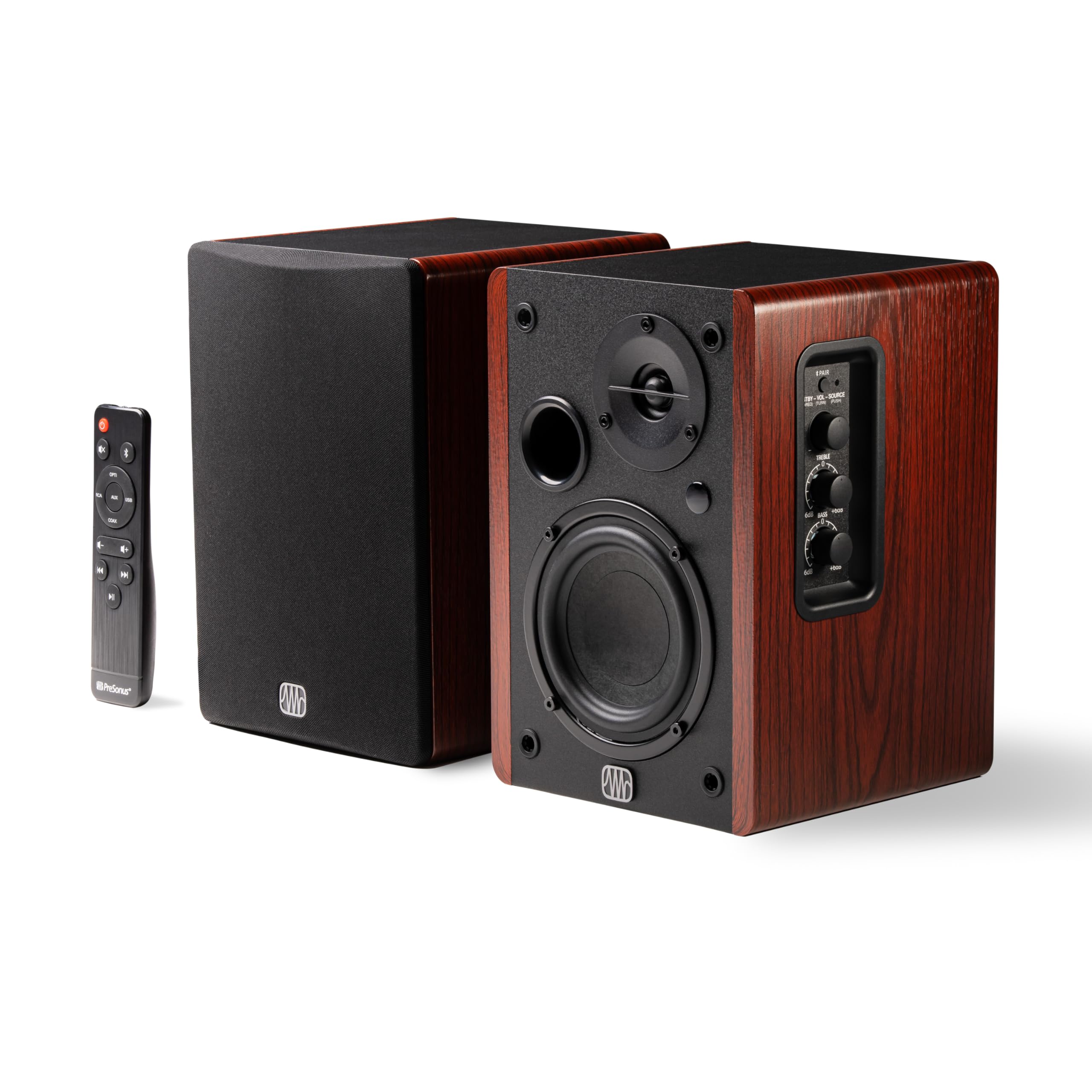
The Eris Accent BT packs the deepest input array in this compact powered-pair class: USB-C, optical, coaxial, RCA, AUX, Bluetooth 5.3, and a sub out. That breadth matters when one pair has to move between a desktop PC, a phone, and a TV without swapping cables.

The voicing follows the studio-monitor playbook: flat and clean, with wide stereo staging and vocals that sit naturally in the mix. The 60W peak and 4-inch woofer stay composed at desk and small-room levels, which is the territory this pair is built for.

The sub out is the connection to use when you want more low end later; adding a powered sub turns this pair into a compact 2.1 setup without buying new speakers. Bluetooth 5.3 covers phone playback, and the included remote keeps volume within reach.

This pair suits desktop producers, small-room music listeners, and anyone who wants one set for a computer, phone, TV, and a future subwoofer. The 60W peak and 4-inch drivers are near-field, so very large rooms are outside its comfort zone; TV-heavy living-room setups are better handled by the top pick's optical and coaxial balance.

Pros

  • Flat, clean sound with wide staging and realistic vocals suits desktop monitoring.
  • USB-C, optical, coaxial, RCA, AUX, Bluetooth, and sub out cover nearly every source.
  • Monitor-style voicing and connection depth land at a mid-range price.

Cons

No consistent drawbacks identified in the available review data.

Our verdict

Desktop producers and small-room listeners get monitor-style sound, deep connectivity, and a sub out for later 2.1 expansion.

Check Latest Price
4

Best Premium with Built-In Phono

Klipsch R-51PM

92 /100
Sound Score Outstanding

Key details

Controls
Remote
Sub Output
No
Input Options
Phono, 3.5mm, USB
Output And Drivers
120W peak, 5.25-inch woofer
View on Amazon

The built-in phono preamp, 5.25-inch woofer, and horn-loaded tweeter put the R-51PM in a different class from the compact 4-inch powered pairs in this roundup. It delivers dynamic, clear, high-volume sound that fills a living room, and Bluetooth pairing works with most phones and computers without issue.

Buyers with a turntable and a medium-to-large room are the right audience: the R-51PM replaces a separate amplifier or receiver with a direct phono connection. A magnetic-grille cabinet gives it the visual presence of a high-end stereo pair, not a desktop monitor. The main boundary is connectivity: there is no optical, coaxial, or HDMI ARC, so TV sound is better handled by the top pick. Some units may produce static or hum on certain inputs at higher volumes, so that QC caveat is part of the entry price for this model.

Style is central to the R-51PM's appeal. The magnetic grilles can be removed to reveal the horn, and the cabinet has a high-end visual presence that most budget powered pairs lack. That finish, combined with the ability to drive a medium-to-large room without an amplifier, is what the premium price pays for.

Pros

  • Delivers dynamic, clear output with horn-loaded highs and surprising low end for a 5.25-inch woofer.
  • Built-in phono preamp connects a turntable directly, with no receiver needed.
  • Bluetooth pairing works with most phones and computers without connection fuss.
  • High-end look with magnetic grilles adds visual presence to a listening room.

Cons

  • Remote control can be inconsistent from across the room.
  • Some units can shut down on their own after months of use.
Our verdict

The R-51PM is the no-receiver turntable pick for buyers who want real output and high-end looks; the top pick remains the better TV companion.

Check Latest Price
5

Best Budget with Subwoofer Out

Saiyin 40W Bookshelf Speakers

88 /100
Sound Score Excellent

Key details

Controls
Remote
Sub Output
Yes
Input Options
Optical, coaxial, RCA
Output And Drivers
80W peak, 4-inch woofer
View on Amazon

The Saiyin 40W bookshelf pair combines Bluetooth 5.3, optical, coaxial, RCA, and a subwoofer output in a compact cabinet at a budget price. The top pick in this roundup brings the same useful TV and desktop inputs; this pair goes further with a dedicated sub out, which makes it the one to choose when a 2.1 system is part of the plan.

With a 4-inch woofer and a 0.5-inch silk dome tweeter, the sound is full and clear at near-field distances, and the low end has more body than the driver size suggests. The sub out exists because the built-in woofer does not produce true deep bass on its own; in a small-to-medium room, these speakers handle a desk or casual TV setup without strain. Bluetooth pairing with phones and PCs is quick, and the connection holds through normal listening. The wood-style cabinets look more expensive than the entry-level price.

This pair fits desktop listeners, casual TV viewers, and record-player owners who want Bluetooth in the package and a subwoofer output for later. QC variance and remote issues are real, so verify return and warranty terms before buying; that caveat is less of a concern when the price and input set fit the plan.

💡 Front-panel controls cover volume, input, and power without needing the remote.

Pros

  • Full, clear sound with more low-end body than a 4-inch woofer usually delivers.
  • Crisp output and a solid cabinet make it a sturdy budget desktop pair.
  • Sub out plus optical, coaxial, RCA, and Bluetooth covers TVs, PCs, and phones.
  • Multiple cables in the box and simple controls get it running quickly.

Cons

  • The included remote can be unresponsive; a replacement remote may respond reliably where the stock unit does not.
  • A unit can arrive without output or lose output early; the return window matters for this one.
Our verdict

For a desktop or small TV setup where a subwoofer is part of the plan, this budget pair delivers the needed inputs and a sub out without jumping to mid-range.

Check Latest Price
6

Best Compact Turntable Companion

Audio-Technica AT-SP3X

93 /100
Sound Score Outstanding

Key details

Controls
Power/volume dial
Sub Output
No
Input Options
RCA
Output And Drivers
30W, 3-inch woofer
View on Amazon

The AT-SP3X is the compact, clean turntable companion in this roundup. It pairs a 3-inch driver cabinet with multipoint Bluetooth and a simple RCA hookup, so an Audio-Technica turntable can sit on a desk without extra boxes. The top pick adds optical and coaxial inputs for TV flexibility, but this pair keeps the footprint smaller and the front panel uncluttered.

For a 3-inch design, the AT-SP3X plays fuller than the size suggests. Vocals and acoustic instruments stay clear, and the compact cabinets avoid the boxy tone that can appear in small powered speakers at normal desk volume. The volume dial doubles as the power control, and toggling between a wired turntable and a phone is quick once you have paired a device.

This pair suits close-range listening: a record player on a desk, a bedroom shelf, or a computer setup where you sit within arm's reach. The 30W output and 3-inch driver limit max volume and deep bass, so this is a refined near-field speaker rather than a room-filling system. RCA and Bluetooth cover the source needs of a turntable-plus-phone setup without input clutter.

Pros

  • Compact 3-inch design delivers crisp, rich full-range sound for its size.
  • Out-of-the-box setup is quick and direct, especially with Audio-Technica turntables.
  • Bluetooth multipoint keeps two devices paired and switching between wired and wireless sources is easy.

Cons

  • No optical, HDMI, or subwoofer output
  • Premium price for a compact 3-inch pair; the design and AT pairing carry much of the value.
Our verdict

For a desk or small bookshelf with a turntable nearby, the AT-SP3X delivers clean sound and an easy wired/wireless workflow in a small footprint. It suits buyers who prioritize brand-matched looks and compact controls.

Check Latest Price
7

TV/movie Rooms

ULTIMEA BS-3

83 /100
Sound Score Excellent

Key details

Controls
App EQ, remote
Sub Output
Yes
Input Options
HDMI ARC, optical, USB
Output And Drivers
70W RMS, 5.25-inch woofer
View on Amazon

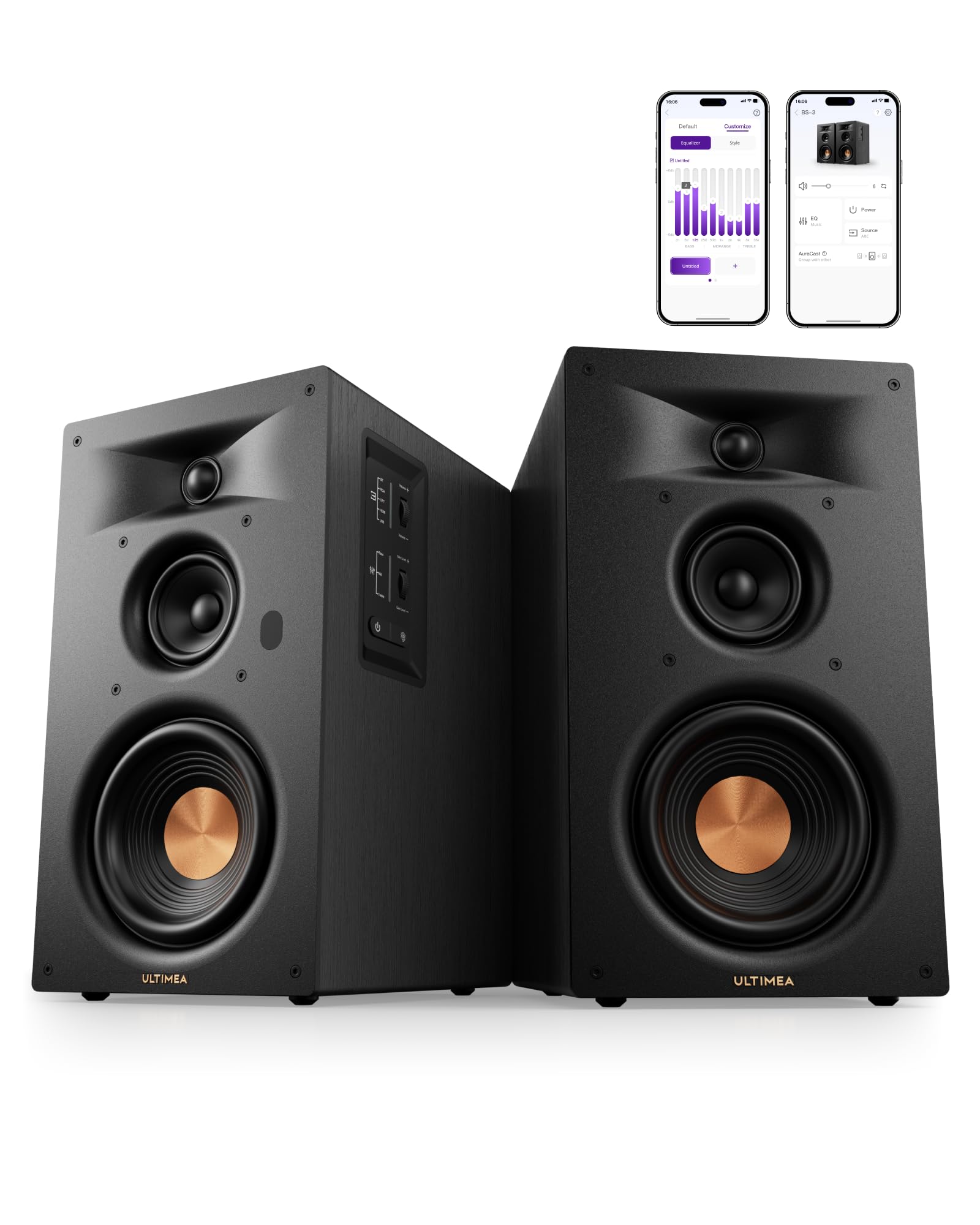
The BS-3 is built around TV and movie sound: HDMI ARC, a 5.25-inch woofer, and an app with Clear Dialogue give it a soundbar-style appeal without a soundbar. The 3-way design adds a dedicated midrange, which helps voices stay intelligible during action scenes. Bluetooth, optical, RCA, and USB are all here, so the inputs cover TV hookups without extra adapters. It is not for ultra-compact desktop setups; the cabinet and bass output overwhelm a small desk. It sits a step below the top pick because its TV-first feature set is more specialized than that pick's broader connection set.

Pros

  • Deep bass for a bookshelf speaker, with clear dialogue and good separation from the 3-way design.
  • Unusual feature mix for the price, including HDMI ARC, app EQ, and a subwoofer output.
  • HDMI ARC, Bluetooth, and multiple inputs make TV hookup easy.

Cons

  • HDMI ARC can be finicky; the TV source may need to be set to PCM.
  • A unit can arrive without power, so test it soon after delivery.
Our verdict

If your primary listening happens around the television, the BS-3's ARC-first design is the reason to consider it over the all-rounder top pick.

Check Latest Price
8

Budget Desktop Use

OHAYO 60W Desktop Speakers

87 /100
Sound Score Excellent

Key details

Controls
Volume knob
Sub Output
No
Input Options
USB, RCA, AUX
Output And Drivers
60W peak, 3-inch woofer
View on Amazon

The OHAYO 60W pair brings MDF cabinets, a 3-inch carbon fiber woofer, and Bluetooth, USB, RCA, and AUX inputs to a small desk setup. Sound stays crisp for casual music and gaming near-field, with more bass punch than the driver size suggests. Plug-and-play behavior means laptops and phones pair without fuss. The catch: there is no subwoofer output and no optical or coaxial input, so TV soundbars and 2.1 builds belong elsewhere. For a tidy PC desk buyer, the OHAYO remains a capable near-field pair with real input flexibility.

Pros

  • Crisp, balanced near-field sound with tight bass for a 3-inch desktop speaker.
  • MDF cabinets and a clean, compact design fit typical desk spaces.
  • Quick pairing and simple connection to laptops and phones.

Cons

  • Volume knob can be insensitive when making small level changes from a desktop.
  • In a quiet room, the Bluetooth connect/disconnect voice announcements play at full volume with no disable option.
Our verdict

For desktop-only buyers who value multiple connection options and a low-profile look, the OHAYO is a sensible budget alternative.

Check Latest Price
9

Desktop PC Use

Sanyun SW208

88 /100
Sound Score Excellent

Key details

Controls
Volume, treble, bass knobs
Sub Output
No
Input Options
USB, AUX
Output And Drivers
60W peak, 3-inch woofer
View on Amazon

The Sanyun SW208 gives budget desktop listeners a compact stereo pair with Bluetooth 5.0, a USB digital input with 24-bit DAC, and analog tone controls on the front panel. The 3-inch carbon fiber woofers and 60W peak output handle near-field music and casual video sound without strain. Input flexibility is the boundary: USB and AUX cover computers and phone docks, but there is no optical, coaxial, or sub out, so it is not a TV or subwoofer-ready pick. Large-room listening will run past what 3-inch drivers can deliver; this is a small-room desk speaker with simple controls and a budget price.

Pros

  • USB digital input with a 24-bit DAC gives computers a cleaner audio path than analog aux.
  • Treble and bass knobs on the front panel allow tuning without software or a remote.
  • Bluetooth 5.0 pairing works with phones and tablets for quick connection at a desk.

Cons

  • The 60W peak and 3-inch woofers are enough for near-field listening; large rooms will want more output.
  • Without optical, coaxial, or sub out, this pair cannot serve as a TV hub or grow into a 2.1 setup.
Our verdict

This fits when your primary listening spot is a desk and you want a simple Bluetooth/USB pair with tone controls; skip it if you need TV inputs or subwoofer expansion.

Check Latest Price

How to Choose

Bluetooth and Pairing Stability

Bluetooth version is a rough guide, not a guarantee. A speaker with Bluetooth 5.3 can still drop audio if the antenna sits behind a metal cabinet or the source device hops between Wi-Fi and Bluetooth.

For mixed phone and computer use, look for multipoint or a solid pairing history in the listing. If you only stream from one device, even a Bluetooth 4.2 speaker can work fine.

Input Options

Optical and coaxial inputs let a speaker receive digital audio from a TV or console, bypassing the TV's own DAC. That is why a pair with digital inputs can replace a soundbar.

The catch is surround-format output: if the TV sends Dolby Digital or DTS over optical, many speakers cannot decode it and produce static or silence. Set the source to PCM/Stereo in the TV menu. HDMI ARC offers the same convenience for newer TVs, but it still needs the TV set to stereo PCM unless the speaker explicitly decodes multichannel.

Amplifier Output and Driver Size

Peak wattage numbers on budget speakers are marketing. RMS output is the continuous figure that matters, and driver size determines how much air moves at a given volume.

Doubling amplifier power adds only about 3dB of headroom, which is audible but not dramatic. A 5.25-inch woofer will produce more bass authority than a 4-inch woofer even when both are rated at the same wattage.

Subwoofer Output

A subwoofer output lets you add a powered sub later without replacing the speakers. That single port is worth more than a high peak wattage claim if you like bass-heavy music or home-theater effects.

Without it, a 2.1 upgrade means switching speakers entirely or splitting the signal externally, which adds cost and complexity.

Quality of Remote and App Controls

Remote controls are the most inconsistent part of this category, so treat a bundled remote as a convenience, not a reason to buy. Most use IR, which needs a clear line of sight and loses range as the battery weakens.

App-controlled EQ is more flexible where it exists, but apps can be abandoned after a few years. If you plan to set the tone once, physical bass and treble knobs are the most durable control scheme.

Frequently Asked Questions