8 Best Marine Speakers of 2026: Pairs That Fit and Last

The best marine speakers for boats, RVs, and off-road rigs — matched to your cutout, power handling, and real marine exposure.

Marine speaker listings love to shout about waterproofing and peak wattage, but those numbers rarely tell you whether a pair will fit your boat or stay clean at cruising volume. The speakers that get returned are usually the ones bought on peak wattage alone: the outer frame is too wide for the pod, or the amp pushes past the continuous rating until the sound turns harsh. Match the cutout, RMS power, and mounting depth before you buy.

Most buyers face a trade-off between proven, easy-fitting 6.5-inch speakers and a more polished upgrade with extra style or finish. A mid-range speaker with a sealed motor, UV-treated cone, and clean RMS handling covers the majority of boats; premium versions add visual polish and slightly refined highs, but only if the mounting hole has clearance.

The same rule applies across sizes: 5.25-inch models fit tight fairings, while 6x9-inch frames trade easy fit for more cone area. Match the speaker to the hole you have, not the one you wish you had.

About the Sound Score: This comparative score is calculated from a product's published customer rating and review volume. It is not a laboratory measurement or a hands-on test result.

1

Best Overall

Polk DB652 6.5-inch Marine

90 /100
Sound Score Outstanding

Key details

Impedance
Cutout / Frame
Mounting Depth
Power Handling
100W RMS
View on Amazon

The Polk DB652 is the safest, most broadly applicable 6.5-inch marine coax in this lineup, with an IP56-rated build, 100W RMS handling, and a cutout size that matches typical boat and RV openings. The 0.75-inch silk-dome tweeter keeps highs clean without turning brittle, and the woofer delivers solid midrange presence at cruising volume. This is a drop-in speaker rather than a tuning project, which suits a mainstream boat owner who wants good sound without measuring templates.

On a pontoon or deck boat, the pair fills the seating area with clear vocals and enough mid-bass to keep music enjoyable over engine and wind noise. The 4-ohm load works with standard marine head units, and the 100W RMS ceiling gives room for a compact amplifier if you want extra headroom later. The supplied grilles hold up to sun and spray without the cosmetic fading seen on budget coaxials.

At a mid-range price, the DB652 undercuts premium marine coaxials while keeping the weather testing that matters: IP56 salt-fog, UV, and humidity protection in a grille that mounts flush without adapters. That combination makes it a sensible first upgrade for a boat still running factory paper-cone speakers.

This is the right pick for a first-time marine speaker buyer doing a 6.5-inch OEM replacement on a pontoon, deck boat, or runabout. It is not for 5.25-inch or 6x9 cutouts, and aggressive saltwater use without a freshwater rinse can lead to intermittent output or voice-coil damage over time. Mainstream boaters who can offer basic care get a cost-effective speaker that fits without adapters.

Pros

  • Clear highs and solid mids from the silk-dome tweeter keep music intelligible at cruising volume.
  • Mid-range pricing puts IP56 marine protection and a weather-sealed build within reach of stock-system upgrades.
  • Drops into standard 6.5-inch openings without adapters; a factory speaker swap takes about an afternoon.
  • Loud enough for open-boat listening; 100W RMS leaves headroom for a small amp later.

Cons

  • 6.5-inch cone area moderates low-bass output; 6x9 options deliver more low-end.
Our verdict

The DB652 is the balanced 6.5-inch marine coax for a mainstream boat: clear sound, simple fit, and a fair mid-range price for a wet-weather speaker.

Check Latest Price
2

Premium Sound Upgrade

Kicker KM65 6.5-inch Marine

87 /100
Sound Score Excellent

Key details

Impedance
Cutout / Frame
Mounting Depth
Power Handling
130W max
View on Amazon

Kicker's KM65 treats the grille as part of the upgrade by including both charcoal and white covers in the box. That alone sets it apart from the other 6.5-inch pairs in this group, which usually force you to work with a single factory look. The 0.75-inch tweeter adds high-end detail that makes long listening sessions easier, and the sealed motor plus UV-treated cone and surround handles spray and direct sun.

On stock head-unit power, the KM65 produces clearer mids and a less strained top end than the OEM speakers it replaces. The mounting pattern fits standard 6.5-inch openings, and the wiring connection is manageable for a weekend install. The 130W max rating is generous, but the pair performs well below that, so an amplifier is useful but not required.

Quality-focused boat owners replacing tired factory 6.5-inch speakers will find this pair a strong match. Output issues can surface within the first weeks or months, so inspect both speakers and test them at moderate volume right after installation.

Pros

  • Clear, detailed highs on factory head-unit power
  • Charcoal and white grilles included so the speakers can match the boat's trim.
  • Drops into standard 6.5-inch OEM openings with a manageable weekend install.
  • A noticeable sound upgrade over stock marine coaxials without extra components.

Cons

  • Premium price sits above entry-level 6.5-inch coaxials, so budget-first buyers pay extra.
  • Weather sealing handles spray and sun, but it is not a promise of indefinite submersion.
Our verdict

For a 6.5-inch boat speaker that can pull double duty as a sound upgrade and a styling cue, the KM65 is the one to consider.

Check Latest Price
3

Best Compact 5.25-Inch

Polk DB522 5.25-inch Marine

92 /100
Sound Score Outstanding

Key details

Impedance
Cutout / Frame
Mounting Depth
Power Handling
100W RMS
View on Amazon

The DB522 is a 5.25-inch coax with IP56 sealing, a silk-dome tweeter, and 100W RMS for open-vehicle listening. Its shallow, compact frame clears tight fairings and factory pod openings that larger marine coaxials won't fit. The 4-ohm load works with standard factory head units, so the wiring side of an upgrade stays simple.

This is the size-down from the 6.5-inch top pick, aimed at RV panels, camper walls, motorcycle fairings, and small boat cockpits. The main caveat is tonal: in some fairings or behind factory grilles, treble can sound bright or tinny, and a tone control adjustment can fix it.

Sound stays clear and present at fairing-mounted ride speeds, while the silk dome tweeter keeps vocals and guitar details in place. Small amps or stock power both get good results from the 100W RMS rating, and the sealed build takes the worry out of splashes and sun.

The DB522 is not a substitute for a larger cone if you have 6.5-inch holes; it is the right choice when the opening is fixed at 5.25 inches and the space is shallow, with a balanced sound that fills a cockpit without dominating it. That positioning makes it a common upgrade for older campers, pontoons, and weekend fairing builds.

Pros

  • Clear, loud, balanced sound for a compact 5.25-inch coax in open vehicles and small cabins.
  • IP56-sealed build handles marine spray, moisture, and outdoor exposure.
  • Drops into factory 5.25-inch openings and shallow pods without cutting.
  • A meaningful upgrade over factory speakers without jumping to premium pricing.

Cons

  • Low-bass output is modest without an amplifier or subwoofer.
  • Bright or tinny treble can show up in some fairings or behind factory grilles.
Our verdict

The DB522 is the 5.25-inch size-down for tight openings, delivering clean, louder-than-stock sound in fairings and campers while the 6.5-inch sibling covers standard boat pods.

Check Latest Price
4

Best for Powersports / High Output

Rockford M0-65B 6.5-inch

90 /100
Sound Score Outstanding

Key details

Impedance
Cutout / Frame
5.38-inch cutout
Mounting Depth
2.52-inch
Power Handling
65W RMS
View on Amazon

The M0-65B backs its marine claim with a usable 65W RMS rating and Element Ready sealing, making it a more focused option for exposed off-road and boat installs than the top pick's universal drop-in approach. It is not trying to be every 6.5-inch replacement; it is built for locations where weather sealing matters as much as output.

Output stays clear and loud at volume, with enough headroom to hold its own against wind and engine noise. The weather seals have held up in mud, snow, rain, and temperature swings, which is the kind of exposure open-vehicle audio actually faces. The 65W RMS figure gives a realistic power target for pairing with an amplifier, rather than a peak number that only looks good on paper.

Buyers with open roll-bar pods, UTV dashboards, or boat panels that can accept a wide grille are the target here. The attached grille pushes the outside diameter past 7 inches, so confirm pod clearance before ordering; tight factory enclosures and low-profile builds sit outside its range. If the opening fits, the M0-65B is a strong match for daily outdoor exposure.

With a 5.38-inch cutout and 2.52-inch mounting depth, installation is routine for a 6.5-inch speaker. The 2-year warranty adds protection for an exposed location, and the price stays mid-range rather than premium.

💡 Confirm the pod opening before ordering; the attached grille needs more than 7 inches of clearance.

Pros

  • Clear, loud output that holds up at volume in open vehicles.
  • Element Ready sealing protects against water, salt, dust, and UV.
  • Easy installation when the 5.38-inch cutout is available.
  • Strong value for a mid-range marine coax.

Cons

  • The attached grille pushes the outside diameter past 7 inches, so standard 6.5-inch pods may reject it.
Our verdict

The M0-65B is the right call when the mounting location has room for the wide grille and you need weather-ready power for an open vehicle.

Check Latest Price
5

Budget Value

Pyle PLMR62 6.5-inch

88 /100
Sound Score Excellent

Key details

Impedance
Cutout / Frame
5.31-inch cutout
Mounting Depth
2.48-inch
Power Handling
200W peak
View on Amazon

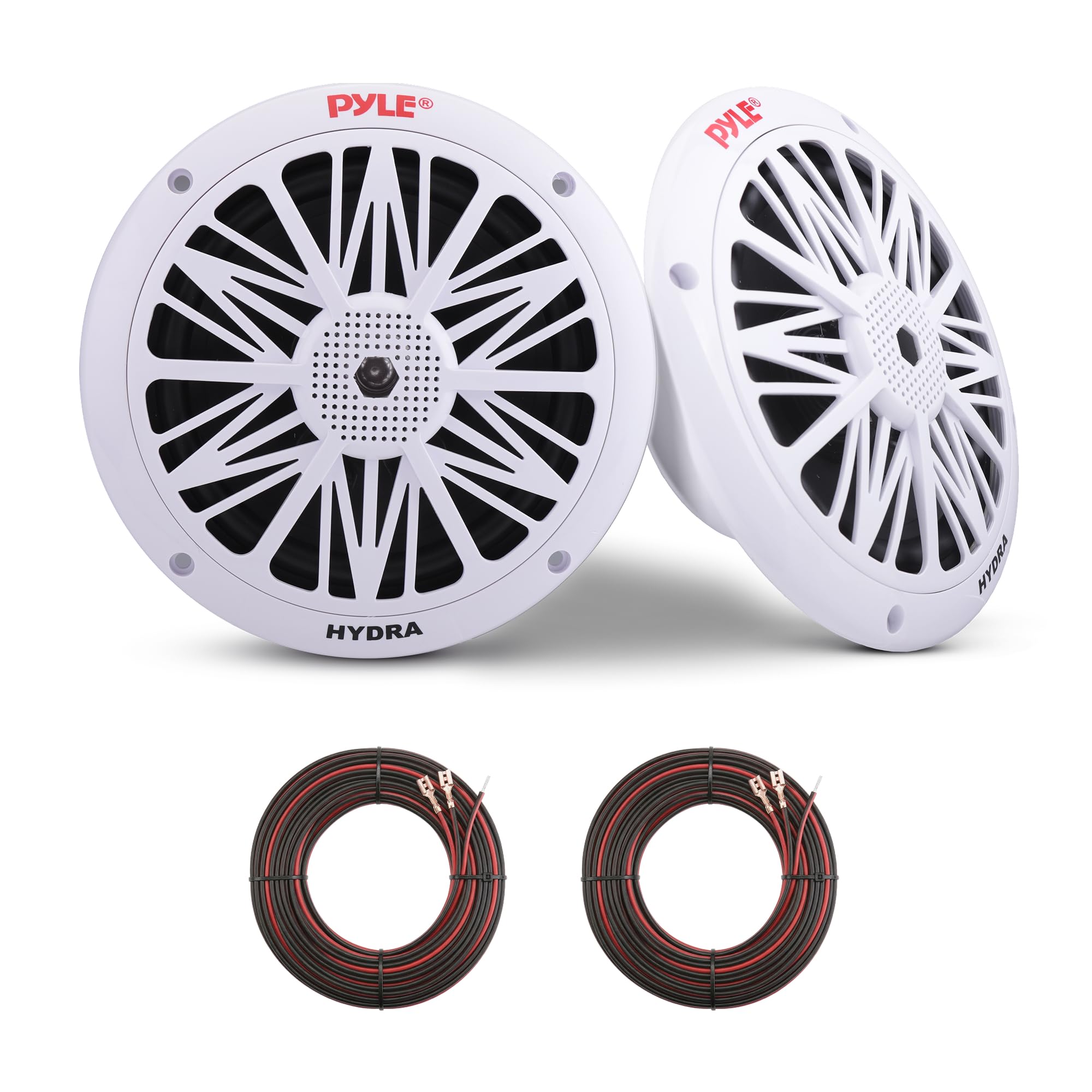
Pyle's PLMR62 is a budget 6.5-inch marine coax that delivers fuller sound than the price tag implies, and its 5.31-inch cutout fits standard factory openings without guesswork. This pair won't produce the cone-area bass of a 6x9, but for casual listening the vocals stay present and the treble remains calm.

At 90 dB sensitivity and 4 ohms, it responds well to factory head-unit power or a modest outboard amp, so the install stays simple for DIY owners. The 2.48-inch mounting depth clears shallow pods, and the white grilles look natural on pontoons and covered deck boats. The 5.31-inch cutout is a standard factory size, which keeps the swap to basic hand tools.

This pair belongs in budget pontoon builds, covered deck boats, or DIY replacements for worn 6.5-inch stock speakers where casual outdoor listening is the goal. If listening happens at anchor, dock, or slow cruise, this is likely all the speaker you need. The tradeoff is expected at this price: durability and quality control vary, with some units developing static or going quiet within weeks to months, so test both speakers as soon as they are wired and exchange any noisy pair early.

Pros

  • Clear, full sound for a budget 6.5-inch pair
  • Very strong value; the price-to-performance ratio leaves room for other boat upgrades.
  • Easy drop-in fit for standard 6.5-inch openings with a 5.31-inch cutout and 2.48-inch depth.
  • Clean white grille and trim fit pontoon and deck-boat interiors without an aftermarket look.

Cons

  • High-output amplified use pushes this budget coax past its role; casual cruise-volume listening is the intended use.
  • Harsh saltwater and long direct-UV exposure are outside its comfort zone; a shaded freshwater boat is the safer setting.
Our verdict

The PLMR62 is the right call for a budget-minded 6.5-inch replacement that values clear sound and easy fit over premium build; it delivers without demanding premium wiring or a big amp.

Check Latest Price
6

Also Great

Four Kicker 6.5-inch coaxials make this a coverage-first buy for pontoons and deck boats with multiple factory openings. It is not a critical-listening pair; the value shows when you replace all four speakers at once. A single premium pair from a higher-featured rival offers more detail for two-location upgrades, while the four-pack's per-speaker cost favors full-boat installs.

This fits owners replacing all four boat speakers who want one order to cover the whole boat. Mounting hole patterns can vary between applications, so confirm fit before ordering.

Pros

  • Four-speaker pack covers a whole boat with clear sound at a lower per-speaker cost.
  • Plug-and-play fit for factory openings cuts installation time on a full set.
  • Output stays clear and audible across the boat at cruising volume.

Cons

  • Retail packaging and included screws are not guaranteed, so the box needs checking.
  • Four-speaker total cost is higher than a single pair, so two-location upgrades should look elsewhere.
Our verdict

For a four-speaker pontoon or deck-boat refresh, the pack delivers the coverage; verify mounting and kit contents before ordering.

Check Latest Price
7

Budget 6X9 Pods

Pyle PLMR692 6x9-inch

87 /100
Sound Score Excellent

Key details

Impedance
Cutout / Frame
6.06-inch x 8.98-inch
Mounting Depth
3.45-inch
Power Handling
260W peak
View on Amazon

The Pyle PLMR692 uses a true 6x9 cone to deliver fuller bass than the 6.5-inch budget options at a similar price, which makes it a strong value in golf-cart pods, boat cans, and DIY boxes. That cone area is the main argument: more low-end for less money, provided you are mounting into a space that can accept the frame. It is not a set-and-forget factory replacement, though. The rear frame can exceed standard 6x9 openings, and unit-to-unit consistency varies, so verify the cutout and inspect the pair soon after installation. Buyers who need a no-surprise drop-in should focus on the slimmer 6.5-inch alternatives in this guide.

Pros

  • Big 6x9 cone delivers noticeably fuller bass than budget 6.5-inch pairs.
  • Budget-friendly way to get a large cone area for custom pods and DIY builds.

Cons

  • Rear frame can be larger than standard 6x9 openings, so measure the cutout first.
  • A pair can go silent within a few months, so bench-test it right after install.
Our verdict

This pair is worth it when you are already building or adapting a 6x9 enclosure for a boat, golf cart, or DIY audio project. Verify the opening and bench-test early, then let the extra cone area do the work.

Check Latest Price
8

Budget RV Replacements

BOSS MR50W 5.25-inch

89 /100
Sound Score Excellent

Key details

Impedance
Cutout / Frame
4.94-inch cutout
Mounting Depth
2.2-inch
Power Handling
150W max
View on Amazon

Clear, easy-going sound and a clean white marine look make this pair a natural fit for pontoon, RV, and toy-hauler cabins. The 4.94-inch cutout is only part of the fit picture: the outer flange runs larger than a typical nominal 5.25-inch speaker, so an existing factory hole may need to be opened up. That makes measuring the opening before you order the single most important step. For casual listening near the water, output is lively and the weather-resistant build holds up to splashes. Its also-consider status comes down to that oversized outer diameter and the fact that a slimmer 5.25-inch option handles fairings and factory openings more easily.

Pros

  • Clear, balanced sound for casual listening on a boat or RV.
  • Budget-friendly price brings a two-speaker marine setup within reach.
  • White marine grille and weather-tolerant build fit the look of pontoons and towables.

Cons

  • Sound favors casual listening, so critical ears may want a more detailed driver.
  • Outer diameter runs large for a nominal 5.25-inch speaker, so the cutout may need enlarging.
Our verdict

Buy it for an affordable RV or pontoon refresh when you can confirm the opening — not as a guaranteed drop-in for every 5.25-inch hole.

Check Latest Price

How to Choose

Cutout and Frame Fit

Nominal speaker sizes describe the cone, not the flange. A 6.5-inch speaker can need a cutout anywhere from 5.3-inch to 6.75-inch depending on the basket and attached grille, so a model that fits one boat may not fit another.

The outer frame width is the part people miss. If the frame is larger than the opening, you may need to enlarge the hole or use an adapter, which is not an option in factory pods, fairings, or sealed enclosures. Measure the opening and the speaker's flange width before ordering.

RMS and Amplifier Matching

Peak wattage is a short-burst rating; RMS is the continuous power the voice coil can handle while playing music. If the amp or head unit sends more continuous power than the speaker's RMS rating, the voice coil heats up, the impedance drops, and distortion rises.

The mechanism matters: a clipped signal from an overdriven amp creates heat faster than a clean signal at the same volume. Match the amp's RMS output to the speaker's RMS rating and keep the gain below the point where the sound turns harsh.

Marine Protection

Water resistance is a coating; marine durability is a construction plan. Sealed motors keep moisture out of the voice-coil gap, polymer baskets resist corrosion, and UV-treated cones and surrounds do not become brittle in direct sun.

An IP rating tells you what a speaker survived in controlled tests, not what it will survive after a season of salt spray and pressure washing. Rinse salt off after use and treat the rating as a boundary rather than a promise.

Mounting Depth

Mounting depth is the distance from the bottom of the flange to the rear of the motor. A speaker can pass the cutout test and still hit a window track, roll bar, or hull reinforcement behind the panel.

Shallow-mount speakers reduce motor size to fit tight spaces, which usually reduces low-end output. Buy a speaker built for your actual depth instead of forcing a deep-frame model into a shallow pod.

Impedance and Amplifier Load

Almost every marine coax in this class is 4Ω because that is the load most head units and marine amps are designed around. If you change speakers to a different impedance, the amp delivers more or less power than before.

Wiring multiple speakers to one channel changes the load again. Keep the total impedance matched to the amp's rated range, and check the series/parallel arrangement before connecting more than one pair.

Frequently Asked Questions