8 Best Wireless Bookshelf Speakers in 2026: Inputs That Fit

Find wireless bookshelf speakers that actually fit your setup: digital inputs, subwoofer options, and codecs matter more than wattage ratings.

Most powered wireless bookshelf speakers check the Bluetooth box, but Bluetooth alone does not decide whether a pair will fit your setup. The actual differences are in digital inputs, subwoofer outputs, and phono stages — the connections that determine whether your TV, turntable, or desktop PC can plug in without extra gear.

A common choice is between saving money on a simple powered pair or spending more for a subwoofer output so you can add deep bass later. That trade-off matters more than wattage: a 4-inch woofer can go only so low, and no Bluetooth update will change the physical size of the driver.

The right pair for most rooms is the one whose inputs match the sources you already own and whose driver size fits the space. Start there, and the category becomes much simpler.

About the Sound Score: This comparative score is calculated from a product's published customer rating and review volume. It is not a laboratory measurement or a hands-on test result.

1

Best Overall

Edifier R1280DB

93 /100
Sound Score Outstanding

Key details

Remote And EQ
Remote, bass/treble
Digital Inputs
Optical, coaxial
Driver And Power
4-inch, 42W RMS
Subwoofer Output
View on Amazon

The Edifier R1280DB is built around one practical idea: a powered speaker pair that accepts whatever you already own. Optical and coaxial inputs connect a TV or console directly, RCA handles a turntable with a built-in preamp or a computer interface, and Bluetooth adds a phone or tablet without a dock. The cabinets are compact enough for a bookshelf, but the output is larger than the driver size suggests. A 42W RMS amplifier drives a 4-inch woofer and 0.51-inch silk tweeter in each cabinet. The silk tweeter keeps high frequencies smooth rather than piercing, and the voicing leans warm without muffling dialogue. The result is a small-room speaker that never sounds shouty, even after hours of playback.

On a desk, the low end has enough weight for hip-hop and soundtracks, though it will not rattle the room. Midrange presence keeps vocals and movie dialogue in front of the mix. Bluetooth pairing is a simple source-select operation, and the wireless connection holds once paired. For TV use, optical auto-detection means the speakers wake to the active input without hunting through settings each time. That makes long listening sessions easy to settle into.

Setup is about as short as powered speakers get: connect the included cable between the left and right speakers, plug the active cabinet into power, and pair over Bluetooth or connect a source cable. There is no receiver, no center channel, and no configuration menu. Side-panel bass and treble knobs allow room tuning without an app. That makes the R1280DB an easy recommendation for a first pair — the total cost stays well under a passive-speaker-and-amp combination, and the optical input alone would otherwise push you into a higher price bracket.

The sweet spot is a desktop or small-room TV and music setup, especially for a buyer who does not already own an amplifier and wants to avoid the expense of a separate box. If your plan includes adding a subwoofer later, the lack of a subwoofer line-out points you to the subwoofer-ready sibling instead. For those buyers, the R1280DB is the obvious starting point for a first powered pair.

Pros

  • Warm, balanced sound with enough clarity for TV dialogue and long music sessions.
  • One box covers the amplifier, Bluetooth, and digital inputs
  • Bluetooth pairing is quick, and optical/coaxial/RCA cover modern and older gear without extra adapters.
  • Unbox, connect the speaker cable, plug in, and pair

Cons

  • The included remote can miss commands unless aimed directly at the speaker.
  • In larger rooms, the 42W output will run out of headroom before filling the whole space.
Our verdict

For a first powered pair, the R1280DB is the one to choose when optical input, Bluetooth, and small-room output are the priority.

Check Latest Price
2

Best Budget With Subwoofer Output

Saiyin 4-inch Bookshelf Speakers

88 /100
Sound Score Excellent

Key details

Remote And EQ
Remote, top buttons
Digital Inputs
Optical, coaxial
Driver And Power
4-inch, 40W x2
Subwoofer Output
Yes
View on Amazon

The subwoofer-ready 40W x2 pair with optical, coaxial, and Bluetooth 5.3 sits near the bottom of the price range. Unlike the smaller Saiyin without a sub out, this one can grow into a 2.1 setup while keeping digital and analog inputs. The 4-inch woofer and 0.5-inch silk tweeter give it more body than the smaller option, with enough output for small to medium rooms. The compact cabinet also fits a desk, shelf, or TV stand without dominating the space.

The 40W x2 output fills a small living room without strain, and the presentation stays balanced at moderate volume. At higher output, the 4-inch woofer runs out of headroom before a larger 5-inch pair would. Top-panel buttons cover volume, input, and power, so basic control doesn't depend on the remote.

Budget buyers who want subwoofer expansion without abandoning optical/coaxial inputs are the clearest match. Turntable line-out via RCA fits cleanly, while optical and coaxial handle modern TVs and game consoles. Like the smaller Saiyin, remote and unit consistency can vary, and high-frequency detail is polite rather than analytical. Accept those boundaries and the subwoofer output alone sets it apart at this price.

💡 Set the TV or console to PCM/stereo output before using the optical input.

Pros

  • Subwoofer line-out at a budget price, with digital inputs still included.
  • Good sound and strong value for a budget pair.
  • Bluetooth pairing holds up in normal use.
  • Setup is quick, with top-panel controls and multiple input options.

Cons

  • Across a room, the remote can miss commands or need direct aiming.
  • During the first days of ownership, input or function behavior can vary enough to warrant testing every input.
Our verdict

A rare budget path to a small 2.1 system with optical, coaxial, and Bluetooth all in one powered pair.

Check Latest Price
3

Best Music-Focused Upgrade

Edifier R1700BTs

92 /100
Sound Score Outstanding

Key details

Remote And EQ
Remote, bass/treble
Digital Inputs
None
Driver And Power
4-inch, 66W RMS
Subwoofer Output
Yes
View on Amazon

The R1700BTs is the music-first alternative to the all-round top pick: 66W RMS, aptX HD Bluetooth, and a subwoofer line-out in a larger bookshelf cabinet.

The 66W amp gives the pair a rich, natural sound with clean headroom in a medium room, while the 4-inch woofer and 19mm silk tweeter keep vocals and acoustic instruments focused.

This is for music listeners who want Bluetooth from a phone or PC and a future subwoofer path. TV users should note the lack of optical or coaxial inputs, leaving RCA/AUX or Bluetooth as the connection. Bass depth depends on adding a subwoofer; on its own, the low end stays modest.

Pros

  • 66W RMS delivers rich, natural sound with more headroom than the all-round top pick.
  • aptX HD Bluetooth keeps Android and hi-fi users wire-free without sacrificing fidelity.
  • Subwoofer line-out opens a 2.1 system path without adding a separate amplifier.
  • Strong value for a music-first powered speaker in the mid-range tier.

Cons

  • Remote feel and range can vary; the side-panel knobs remain the fallback.
  • Sits at a mid-range price, so strict budget buyers may prefer a cheaper Bluetooth pair.
Our verdict

For desktop listeners who plan to add a subwoofer, the R1700BTs is the version that keeps the system compact while leaving room for deeper bass.

Check Latest Price
4

Best Premium Powered Bookshelf

Klipsch R-51PM

92 /100
Sound Score Outstanding

Key details

Remote And EQ
Remote, speaker controls
Digital Inputs
USB digital
Driver And Power
5.25-inch, 120W max
Subwoofer Output
View on Amazon

With a 5.25-inch woofer and Tractrix horn tweeter, the R-51PM is a powered bookshelf pair that brings Klipsch's dynamic, room-filling sound to a turntable-first system. The built-in phono stage accepts a record player directly, and Bluetooth covers wireless audio from phones or tablets.

The horn tweeter gives vocals and acoustic instruments a clean, forward presence, while the woofer produces punchy bass in medium-size rooms. With 120W peak power, the pair handles music and TV dialog without a separate amplifier or receiver.

Inputs include phono/line, 3.5mm, and USB digital, so a computer or compact TV can connect without an AVR. The included remote controls volume and source switching from across the room, and the USB input lets desktop listeners bypass a computer's internal sound card.

This is for vinyl listeners who want a powered pair without adding a phono preamp, and for TV owners who want better sound without an AVR. In quiet listening rooms, some units produce a faint hiss or hum, and amplifier behavior can vary between units, so this pair favors buyers who play music at normal levels rather than listen at idle.

Pros

  • Dynamic, clear sound fills a room from a bookshelf-size pair.
  • Bluetooth streaming from phones, tablets, and laptops is simple to set up.
  • Built-in phono input removes the need for a separate preamp with a turntable.
  • The premium price is easier to justify given the build and sound.

Cons

  • No Wi-Fi streaming or HDMI ARC; Bluetooth is the only wireless connection.
  • The premium price is a barrier for strict budget shoppers.
Our verdict

Vinyl listeners get Klipsch's horn-loaded dynamics and a phono input in a powered pair that needs no separate receiver.

Check Latest Price
5

Best Studio-Style Versatility

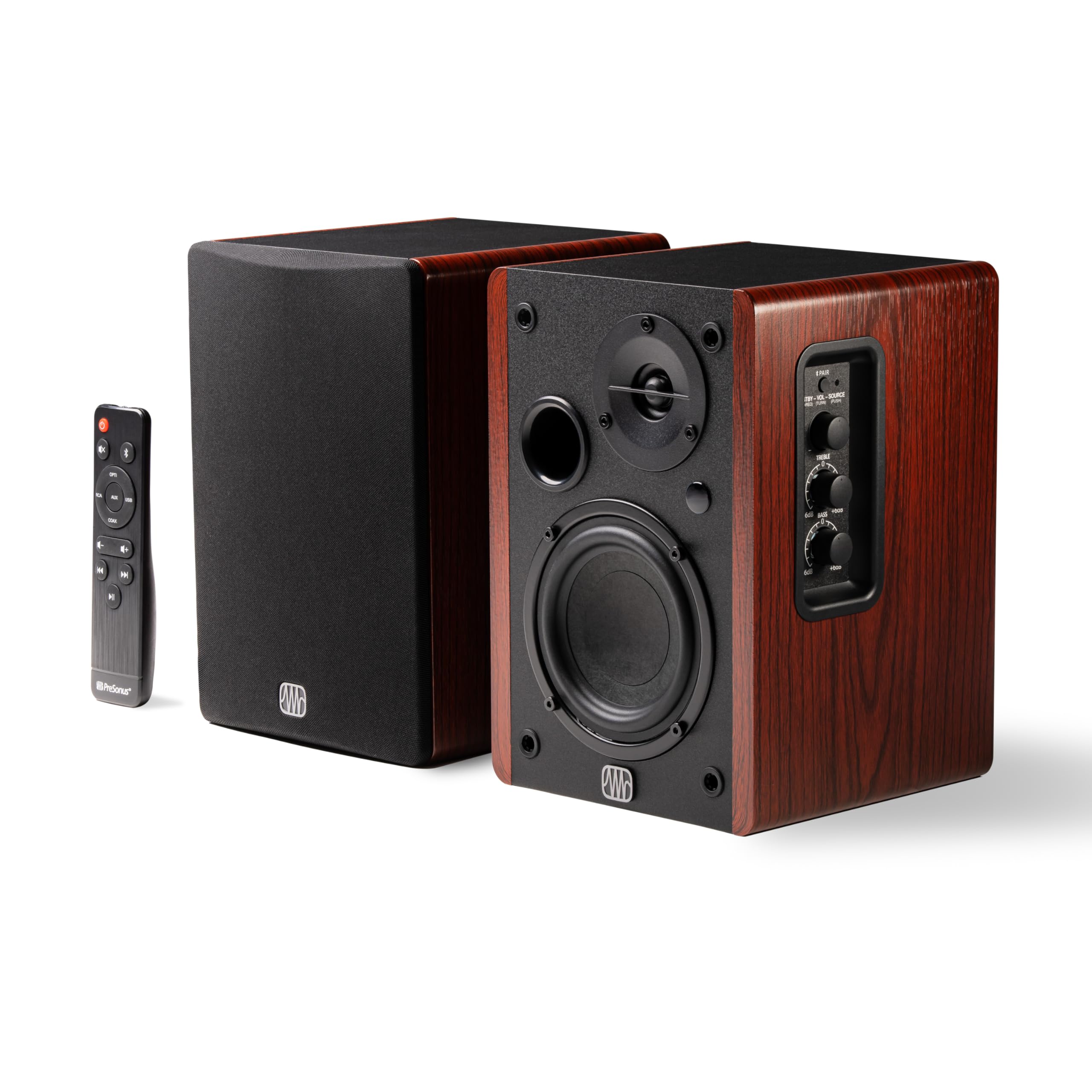
PreSonus Eris Accent BT

87 /100
Sound Score Excellent

Key details

Remote And EQ
Remote, front controls
Digital Inputs
USB-C, optical, coaxial
Driver And Power
4-inch, 30W x2
Subwoofer Output
Yes
View on Amazon

The PreSonus Eris Accent BT pairs studio-monitor voicing with a digital input set rarely found on powered bookshelf speakers in this class. A 60W stereo system drives a 4-inch woofer and 13mm silk tweeter, producing a flat, clean soundstage with realistic vocals and a wide sweet spot. USB-C, optical, coaxial, RCA, and Bluetooth 5.3 cover nearly any source, with the USB-C port making it a direct match for modern laptops. The cabinet stays compact while keeping enough low-end control for close-up music work.

Desktop creators and compact TV setups are the natural fit. The near-field output level is the main boundary: this pair rewards close listening and accurate tone over high-volume room-filling playback. Bluetooth pairing works without issue for routine playback, but source switching can occasionally call for a fresh pair. Buyers who want bass punch for desktop gaming should aim at the 5-inch MEVOSTO alternative instead.

The subwoofer output is the feature that extends its usefulness. Add a powered sub and the Eris Accent BT becomes a 2.1 system without swapping speakers or losing the monitor voicing. The remote and front-panel controls keep source changes quick, which matters when moving between optical from a TV, USB-C from a laptop, and Bluetooth from a phone. Input flexibility lets one pair stay connected to several devices at once.

Pros

  • Flat, clean, wide soundstage with realistic vocals.
  • USB-C, optical, coaxial, RCA, and Bluetooth 5.3 cover nearly any source.
  • Subwoofer output creates a clear path to 2.1 expansion.

Cons

  • Bluetooth pairing may occasionally need a fresh pairing after switching sources.
  • Large-room party-level output is outside what the 4-inch woofer can deliver.
Our verdict

The Eris Accent BT is the input-rich monitor for desktop creators who want studio tone, USB-C and optical hookups, and a subwoofer path.

Check Latest Price
6

Desktop / Gaming

MEVOSTO DS19 Powered Speakers

88 /100
Sound Score Excellent

Key details

Remote And EQ
Remote, bass/treble
Digital Inputs
USB
Driver And Power
5-inch, 36W RMS
Subwoofer Output
View on Amazon

The MEVOSTO DS19 brings Bluetooth 5.4, USB digital audio, and a 5-inch woofer to a desktop setup at a mid-range price. Sound quality is strong for the size and cost, and the compact wood cabinet fits a shelf without looking out of place. USB input is the key differentiator: it connects directly to a PC and keeps the signal path clean for gaming and music. The missing optical input rules out TV use and keeps this below the main picks; desktop buyers are the intended audience, and default bass can sound boomy to some listeners, though the bass knob provides a quick adjustment.

Pros

  • Sound quality is strong for the size and price, with the 5-inch woofer carrying near-field punch.
  • USB, Bluetooth 5.4, AUX, and RCA cover most desktop source needs without an extra receiver.
  • Compact wood cabinet sits neatly on a desk or shelf.

Cons

  • 36W RMS output is sized for close-range listening; large rooms will need more amplifier power.
  • No subwoofer output, so 2.1 expansion is off the table.
Our verdict

For desktop users who want USB audio and a 5-inch woofer without paying for a studio monitor, this is a sensible mid-range option.

Check Latest Price
7

TV / Movie Setups

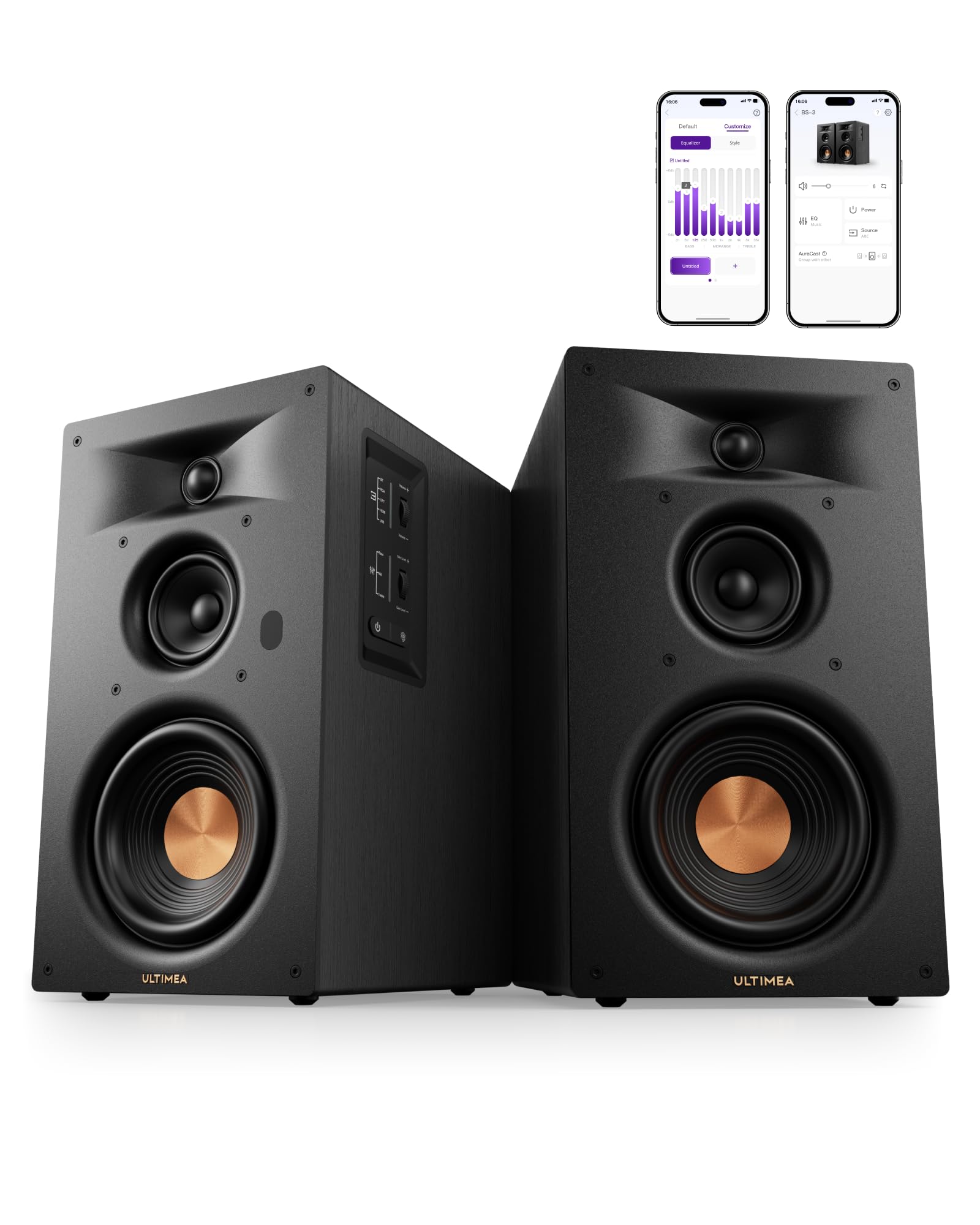
ULTIMEA BS-3 Powered Speakers

83 /100
Sound Score Excellent

Key details

Remote And EQ
App EQ, remote
Digital Inputs
HDMI ARC, optical, USB
Driver And Power
5.25-inch, 70W RMS
Subwoofer Output
Yes
View on Amazon

The BS-3 pairs a three-way driver layout with TV-first inputs, including HDMI ARC, app EQ, and a subwoofer output — a rare feature stack for compact powered speakers. ARC reduces the TV connection to one cable, and the dedicated midrange keeps dialogue clear at moderate volumes. That same focus makes it less useful as a plain Bluetooth speaker; buyers who don't need ARC or app EQ can find simpler pairs for less. It earns a look alongside the top pick when the TV connection and app-based tuning are exactly what you plan to use.

Pros

  • Three-driver staging keeps dialogue clear and bass full for TV and movie soundtracks.
  • HDMI ARC input provides a direct TV connection with integrated control.
  • Subwoofer output lets you add low-end muscle later without replacing the speakers.

Cons

  • EQ adjustments require the companion app; there is no manual EQ on the cabinet.
  • A freshly unboxed pair can be non-functional, so test before mounting.
Our verdict

The BS-3 fits TV and game rooms where HDMI ARC, app EQ, and future subwoofer expansion are on the list. For plain Bluetooth music duty, simpler pairs make more sense.

Check Latest Price
8

Computer Desktop

OHAYO C6 Computer Speakers

87 /100
Sound Score Excellent

Key details

Remote And EQ
Volume knob
Digital Inputs
USB
Driver And Power
3-inch, 30W x2
Subwoofer Output
View on Amazon

The OHAYO C6 fits RCA, AUX, USB, and Bluetooth 5.3 into a compact 3-inch MDF cabinet without dominating the desk. It plays comfortably at moderate near-field levels and keeps enough low-end for music and gaming, but it is less full-range than true bookshelf models. There is no optical input, so TV setups with digital audio need another option. Front volume knob action can vary between units, so give it a quick turn on arrival. For a computer desk that needs one compact powered pair for music, games, and background sound, these boundaries are reasonable.

Pros

  • Compact 3-inch MDF cabinets keep a small desk footprint and still carry enough low-end for music and games.
  • Bluetooth 5.3 pairs quickly and holds a connection across a normal desktop range.
  • RCA, AUX, USB, and Bluetooth inputs cover a computer desk without needing a separate amplifier.

Cons

  • No subwoofer line-out, so adding a sub later requires a different powered speaker.
  • Front volume knob action can be coarse or uneven on some units.
Our verdict

For a small desk setup that stays near the monitor, the OHAYO C6 is a compact match when desktop audio is the whole job.

Check Latest Price

How to Choose

Bluetooth Version and Codec Support

Bluetooth version determines the maximum data rate and which audio codecs the speaker can negotiate. AptX HD and LDAC preserve more detail over wireless, while standard SBC compresses harder and can sound less detailed during long listening sessions.

Codec support matters most when the speaker is the main music system. For a TV or desktop secondary pair, stable pairing and low latency matter more than aptX, and iPhone users should focus on AAC support rather than Android-only codecs.

Digital Inputs

Optical, coaxial, USB, and HDMI ARC carry digital audio to the speaker's internal DAC before amplification. That bypasses the variable-quality headphone jack on a laptop or TV, but the speaker will not decode Dolby Digital unless it explicitly supports it.

If your TV sends Dolby Digital over optical, many speakers play static or silence until the TV is set to PCM or stereo. HDMI ARC removes that issue on some models, but it is still uncommon below the mid-range.

Subwoofer Line-Out

A subwoofer line-out sends a bass signal to a separate powered subwoofer, letting the bookshelf speakers focus on mids and highs. Without it, the only way to add meaningful low end is to replace the speakers entirely.

Driver size sets the physical limit: a 4-inch woofer moves less air than a 5.25-inch woofer, so subwoofer output matters most for home theater and bass-heavy music. Near-field desktop listening can often get by without one.

Driver Size and RMS Power

Larger drivers move more air and produce deeper bass, but RMS power is the rating that predicts clean output over time. Peak wattage numbers inflate easily, so compare RMS between pairs rather than the maximum marketing figure.

In a small room, 30-40W RMS per side is enough for comfortable listening. Larger rooms need closer to 50W RMS per side plus a bigger woofer to avoid strain at moderate volumes.

Remote and EQ Controls

Most powered speakers use infrared remotes, which require direct line of sight. If the IR receiver sits behind cloth or the remote is aimed from an awkward angle, the speaker may feel unresponsive even though the hardware is fine.

Front-panel controls or app EQ remove that dependency. For speakers placed in cabinets or beside TVs, choose a model with accessible buttons or app control instead of relying on an IR remote.

Frequently Asked Questions