9 Best Powered Bookshelf Speakers in 2026: RMS Power Matters

Find powered bookshelf speakers that match your room, sources, and listening habits by comparing RMS output, driver size, and connectivity.

Most powered bookshelf speaker listings advertise peak wattage and Bluetooth buzzwords, but the speakers that get used daily are chosen on RMS power, driver size, and input flexibility. A 42W RMS pair with a silk dome tweeter and a digital input can feel more substantial than a 60W peak compact that strains in a medium room. The goal is to match the amplifier and driver combination to the room and sources you actually own.

The common trade-off is between grabbing a lower-cost, proven all-rounder today and spending a bit more for headroom, aptX HD, and subwoofer output for a future 2.1 setup. Both choices are valid, but they lead in different directions. Buyers who plan to add a powered sub later should prioritize a sub out now; those who want a single pair for desktop, TV, and turntable can skip the upgrade path and keep the budget focused on connectivity and bass balance.

About the Sound Score: This comparative score is calculated from a product's published customer rating and review volume. It is not a laboratory measurement or a hands-on test result.

1

Best Overall

Edifier R1280DB

93 /100
Sound Score Outstanding

Key details

Power
42W RMS
Inputs
Bluetooth, optical, coaxial, RCA
Sub Out
No
Controls
Remote
View on Amazon

The R1280DB sounds bigger than its 4-inch woofers suggest. Bass has real weight for a cabinet this size, the midrange stays clean on voices, and the silk-dome tweeter avoids the brittle top end of budget speakers. At 42W RMS the pair delivers clean output for near-field listening, with a defined stereo image on a desk and enough presence for casual TV. Voices stay intelligible for dialogue, and the tone is warm enough for vinyl without masking detail.

Bluetooth pairing is quick from phones and tablets. Optical and coaxial inputs give a TV, game console, or streaming box a direct connection to the speaker's own DAC, which helps dialogue clarity and cuts reliance on a TV's headphone output. Dual RCA inputs handle a turntable with a preamp or a desktop interface, and the system never requires a separate receiver. A wired connection is always available for anyone who prefers not to use wireless.

This pair suits a buyer who wants one powered speaker system for a desk, bedroom, or small living room. It covers music streaming, TV dialogue, and turntable duty without extra boxes or a receiver shelf. Output is best in small and medium rooms; in a large open-plan space it runs out of headroom, and there is no subwoofer output for 2.1 expansion. If that is the intended setup, move up to the higher-powered model in this set with a sub out.

At this price tier, the package is difficult to match: Bluetooth, optical, coaxial, dual RCA, and a remote in one powered pair. That input flexibility is what separates this from a single-purpose Bluetooth speaker. Wired-only alternatives at the same cost lack the digital inputs, and pricier powered speakers may add little for the extra spend. The 4-inch woofers are a deliberate size choice, and the tonal balance works for music, dialogue, and vinyl without EQ adjustments.

The wood-grain cabinets look at home on furniture or a desk, and the compact footprint leaves room for a laptop or turntable. Because the amplifier lives inside the active speaker, the setup is one box fewer than a component system. For the buyer who wants a clean, single-pair setup rather than a stack of electronics, that simplicity is the point.

Pros

  • Well-rounded sound with bass that carries more weight than the cabinet size suggests.
  • Strong value for a powered pair with Bluetooth, digital inputs, and a remote.
  • Bluetooth pairing is quick from phones and tablets.
  • Wood-grain cabinets suit a living room or desk without looking like tech gear.
  • Connecting a TV, desktop, or turntable takes minutes with the available inputs.

Cons

  • Across a room, the remote can miss button presses; from a few feet it works.
  • Wireless playback can drop in individual units over time.
Our verdict

This is the powered pair to start with when one setup has to serve TV, desktop, and turntable.

Check Latest Price
2

Best for Power & Subwoofer Expansion

Edifier R1700BTs

92 /100
Sound Score Outstanding

Key details

Power
66W RMS
Inputs
Dual RCA, Bluetooth aptX HD
Sub Out
Yes
Controls
Remote
View on Amazon

The R1700BTs takes the Edifier bookshelf formula and adds two things the all-rounder in this set lacks: 66W RMS of output and a subwoofer out, with aptX HD Bluetooth on top. Dual RCA inputs handle two wired sources, so a computer and a second player can stay connected without swapping cables. The Soundfield Spatializer provides a wider image for living-room placement, and the amplifier has enough headroom for medium-room listening without stressing the drivers.

Sound quality follows the Edifier character: a rich midrange, smooth silk-dome treble, and clean output well above conversation levels. The 4-inch woofers produce a solid mid-bass punch for their size, and the cabinet sounds bigger than its footprint suggests. Setup is minimal: connect the wired source, pair over Bluetooth, and the active speaker drives both cabinets.

This pair is for desktop or living-room listeners who want more power than the top pick's 42W RMS and plan to use the sub out for deeper lows. Strict budget shoppers should look at the lower-priced models in this group. The 4-inch woofers still benefit from a sub for deep bass, and buyers who dislike small, cheap-feeling remotes will want to keep the speaker's volume knob within reach.

Pros

  • Rich, clean sound with clarity that scales from near-field listening to medium-room volume.
  • AptX HD over Bluetooth 5.0 keeps wireless audio crisp on compatible phones and computers.
  • Strong value for the added power, aptX HD, and subwoofer output.
  • Wood-grain cabinet gives it a hifi look rather than a generic desktop-speaker aesthetic.

Cons

  • The small remote feels light and its range can vary by seating position.
  • Output is good for medium rooms, but the 4-inch woofers run out of deep-bass headroom until a sub is connected.
Our verdict

For buyers who want Edifier's house sound with more power and a clear path to a sub, the R1700BTs holds up at this price.

Check Latest Price
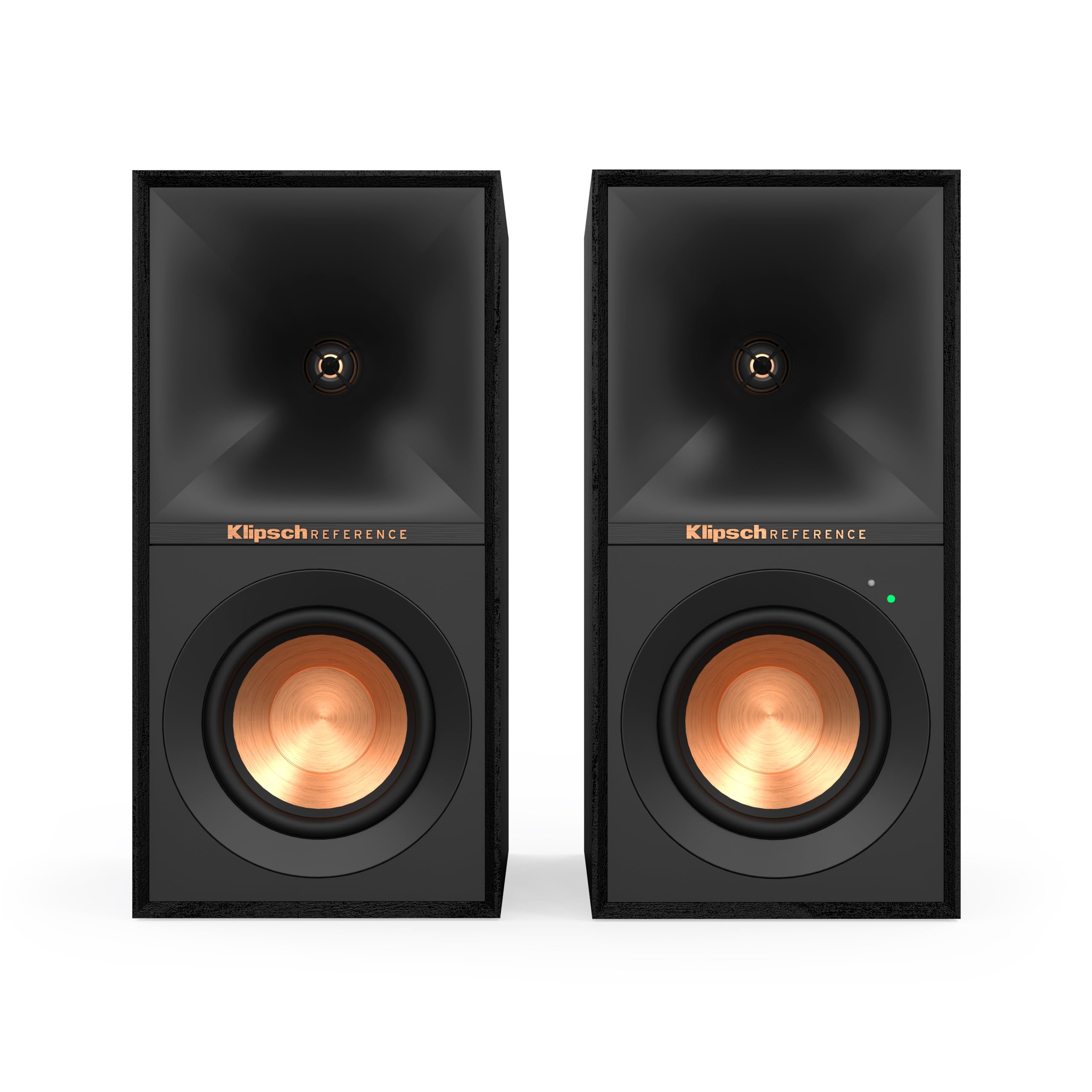
3

Best Premium All-Rounder

Klipsch R-51PM

92 /100
Sound Score Outstanding

Key details

Power
120W
Inputs
Bluetooth, phono, USB, 3.5mm
Sub Out
No
Controls
Remote
View on Amazon

The R-51PM pairs a 5.25-inch horn-loaded woofer with a built-in phono preamp, USB input, and Bluetooth in a single receiver-free package. That puts it a step above the all-rounder in this set for turntable-first listeners who want Klipsch dynamics without adding an amplifier. The 1-inch Tractrix horn adds presence to vocals, while the larger woofer gives kick drums more authority than the compact 4-inch Klipsch alternative here.

Sound stays energetic at moderate volumes, with a horn-forward presentation that makes Klipsch immediately recognizable. Bluetooth pairing works with phones and tablets, and the USB input accepts digital files from a computer; the same pair can move from TV to desk without swapping cables. Physical controls on the cabinet cover source and volume, which helps in a rack or shelf setup.

This is a premium-priced pair for turntable-first buyers: plug a phono table into the built-in preamp and you have a complete system without a receiver. Buyers who need guaranteed silence at high volume should respect the boundary — hum or static can appear at high volume or via certain inputs. In a typical living room with music playing, that won't dominate; in a dead-quiet near-field desk setup, it may.

Pros

  • Energetic, clear horn-loaded sound with strong vocal presence
  • Built-in phono, USB, and Bluetooth cover turntable, computer, and phone sources
  • Receiver-free setup saves the hassle of a separate amplifier

Cons

  • The IR remote only responds within a narrow angle; physical source buttons on the cabinet cover the rest.
  • Individual units can shut down during extended playback
Our verdict

A turntable-first powered speaker that brings Klipsch horn dynamics, phono, USB, and Bluetooth into a receiver-free pair.

Check Latest Price
4

Best Budget Bluetooth Pick

Saiyin DS6701S

88 /100
Sound Score Excellent

Key details

Power
30W per channel
Inputs
Bluetooth 5.3, optical, coaxial, RCA
Sub Out
No
Controls
Remote
View on Amazon

The Saiyin DS6701S is the budget option that keeps the digital inputs: Bluetooth 5.3, optical, coaxial, and RCA all drive a compact pair with a 3.75-inch woofer and silk-dome tweeter. That input set mirrors the category's mid-range all-rounder at a lower price, which makes this the first speaker to check for a desktop or small-room system with more than one source.

Tuning is warm and detailed rather than analytical. The silk-dome tweeter keeps vocals and cymbals clear, while the 3.75-inch woofer supplies enough low-end for casual music and TV dialogue at near-field distances. In a larger living room, the small woofer runs out of headroom, so these work best as computer speakers or turntable monitors in a compact space.

Best for phone or tablet streaming over Bluetooth and turntables with a built-in phono stage in a small room. Quality control and remote behavior vary between units, so test all connections and the handset inside the return window. This is not the speaker for HDMI ARC or a setup where absolute long-term certainty is non-negotiable.

💡 Aim the included remote at the speaker and keep the physical volume control as the backup; the handset is a convenience, not the core interface.

Pros

  • Bluetooth 5.3, optical, coaxial, and RCA inputs at a budget price.
  • Clear, rich sound for the money; the silk-dome tweeter adds detail without harshness.
  • Solid bass from a compact 3.75-inch woofer, enough for desktop and small-room listening.
  • Easy Bluetooth pairing; the speakers are ready to use quickly.

Cons

  • Remote response can be inconsistent from one unit to the next; some handsets need direct line of sight.
  • Input and power behavior can vary between units, so testing all connections on arrival is worthwhile.
Our verdict

Buy this for a desktop, office, or small-room turntable when Bluetooth and digital inputs matter more than absolute long-term certainty. The sound and input flexibility are the strongest value in the budget tier.

Check Latest Price
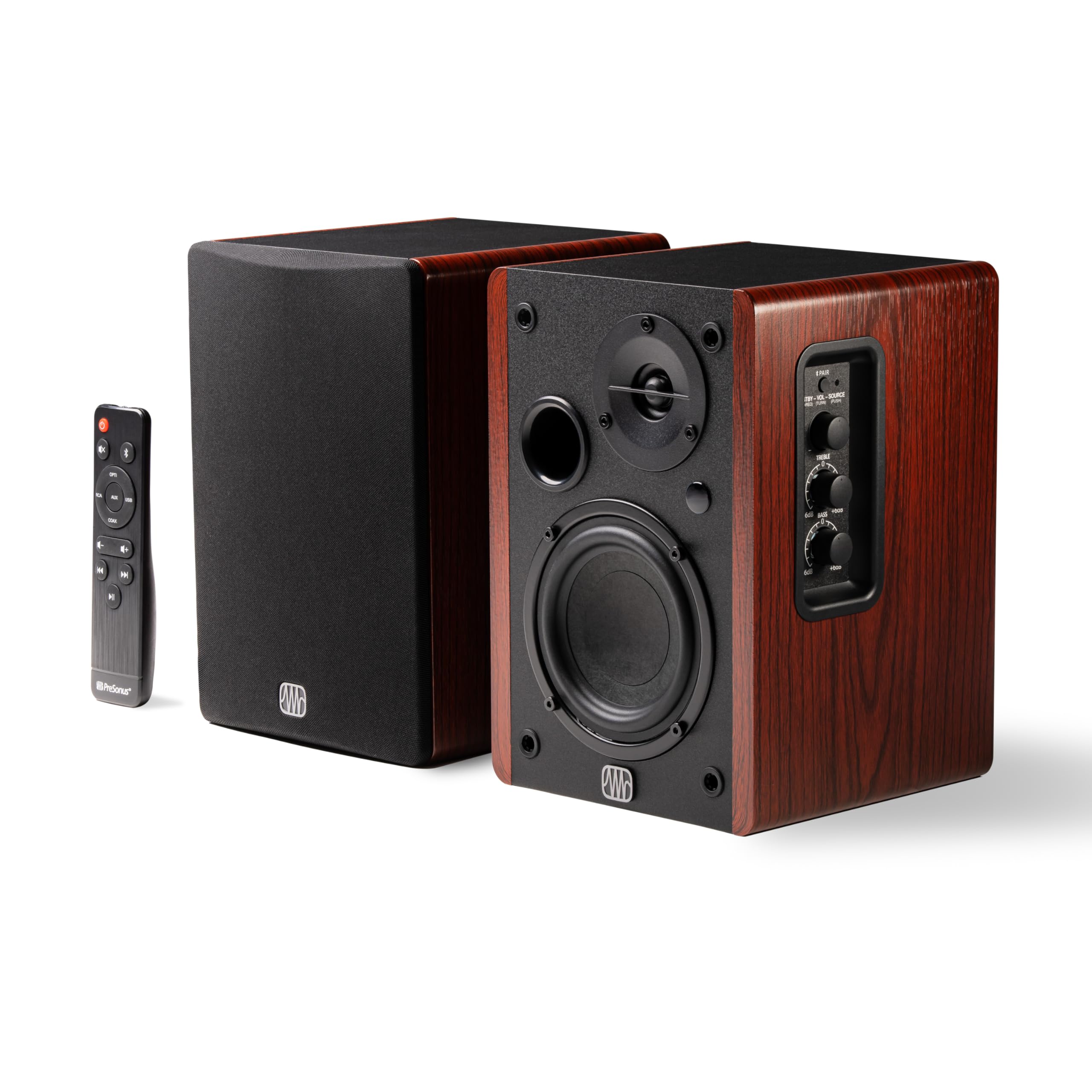
5

Best Studio-Tuned Desktop Pick

PreSonus Eris Accent BT

87 /100
Sound Score Excellent

Key details

Power
60W
Inputs
Bluetooth, USB-C, optical, coaxial, RCA
Sub Out
Yes
Controls
Remote, front EQ
View on Amazon

PreSonus' Eris Accent BT keeps the neutral, wide-sounding tuning of its wired near-field sibling and adds Bluetooth 5.3, optical, and coaxial inputs without changing the compact cabinet. The 60W amplifier drives the 4-inch woofer and 13mm silk-dome tweeter with enough headroom for desktop listening, and the front-panel EQ trims bass and treble without needing a receiver.

At desk distances the soundstage stays stable across the listening position, with present vocals and clean separation between instruments. The acoustic balance is flat enough for checking mixes, not just casual listening. Treble stays smooth on cymbals and sibilants, which keeps longer sessions comfortable.

Wireless pairing handles laptops and phones without extra hardware, while USB-C gives a computer a cleaner digital path than 3.5mm or RCA. The included remote controls volume and mute, which helps when the speakers sit behind a monitor or on a shelf.

This pair belongs on a desktop studio or home-office desk where several sources share one no-receiver setup. The 4-inch woofers keep low end controlled but shallow, so if bass-heavy genres are the main playlist, the sub out is the path rather than expecting deep bass from the cabinet alone.

💡 Keep the computer on USB-C for daily listening, use Bluetooth for quick phone playback, and adjust the front-panel EQ for room placement.

Pros

  • Flat, clean studio tuning keeps vocals and instruments separated at typical desk volumes.
  • The full input set means a computer, TV, turntable, and phone can stay connected without swapping cables.
  • Cost-effective for the studio-accuracy, wireless flexibility, and digital inputs at this price.

Cons

  • The 30W per channel output suits near-field listening; a larger living room will need more amplifier power.
  • TVs with only HDMI ARC need an adapter or optical route, since the Eris Accent BT has no ARC.
Our verdict

The Eris Accent BT is the near-field desk speaker for someone who wants studio-style tuning without losing the freedom to switch inputs.

Check Latest Price
6

Compact Premium Setups

Klipsch R-40PM

85 /100
Sound Score Excellent

Key details

Power
240W
Inputs
Bluetooth, phono, digital/analog
Sub Out
No
Controls
Remote
View on Amazon

The R-40PM carries 240W of system power and a copper-spun 4-inch woofer in a smaller cabinet than the 5.25-inch R-51PM, making it one of the most space-efficient ways to get Klipsch horn dynamics on a desktop or small-shelf setup. The built-in phono preamp removes the need for a receiver when spinning records, while Bluetooth and digital/analog inputs cover phone, TV, and computer sources without extra boxes. Clarity and output are strong for the size, with the horn tweeter lending presence that cuts through near-field listening. The tradeoff is clear: that 4-inch woofer cannot match the bass weight or maximum volume of the larger, lower-priced R-51PM, so this makes sense when footprint and Klipsch horn character outrank value.

Pros

  • Clear horn-driven sound with more output than the cabinet size suggests.
  • Compact cabinet and magnetic grilles fit tight desks and shelves without a receiver.
  • Phono, line, digital, and Bluetooth inputs mean no separate amplifier is needed.

Cons

  • Remote range can be limited to a few feet in some setups.
  • Unit-to-unit variation can surface as speaker-driver or Bluetooth connectivity problems, so an early input check is worthwhile.
Our verdict

If a compact desktop or small apartment is your listening space and you want Klipsch horns without an amp, the R-40PM fits; just don't expect the larger R-51PM's bass and output for the same money.

Check Latest Price
7

Turntable, Desk Setups

Audio-Technica AT-SP3X

93 /100
Sound Score Outstanding

Key details

Power
30W
Inputs
RCA, Bluetooth
Sub Out
No
Controls
No
View on Amazon

Audio-Technica's compact cabinet uses a 3-inch woofer and 30W of amplification to deliver clear, balanced near-field sound, with RCA plus Bluetooth multipoint for easy two-source switching. The clean, minimal build and plug-in setup suit a desk or turntable setup without adding a receiver.

The two-input layout means no digital connections and no subwoofer output, so rivals with optical/coaxial and subwoofer output offer more for the price. The small drivers set a firm ceiling on bass depth and room-filling volume, but that tradeoff buys a cabinet small enough for a cramped desk or turntable shelf.

Pros

  • Clear, balanced near-field sound from a compact cabinet.
  • Plug-in RCA/Bluetooth setup works without a receiver or extra box.
  • Bluetooth multipoint plus RCA switching covers two simple sources.

Cons

  • Bass-heavy music fans will find the 3-inch woofers run out of low-end headroom before filling larger rooms.
  • Connectivity stays at RCA/Bluetooth; digital inputs and subwoofer output are absent.
Our verdict

For a compact turntable or desk setup where minimal styling and Audio-Technica build take priority, the AT-SP3X fits when you can keep sources on RCA/Bluetooth and accept modest bass output.

Check Latest Price
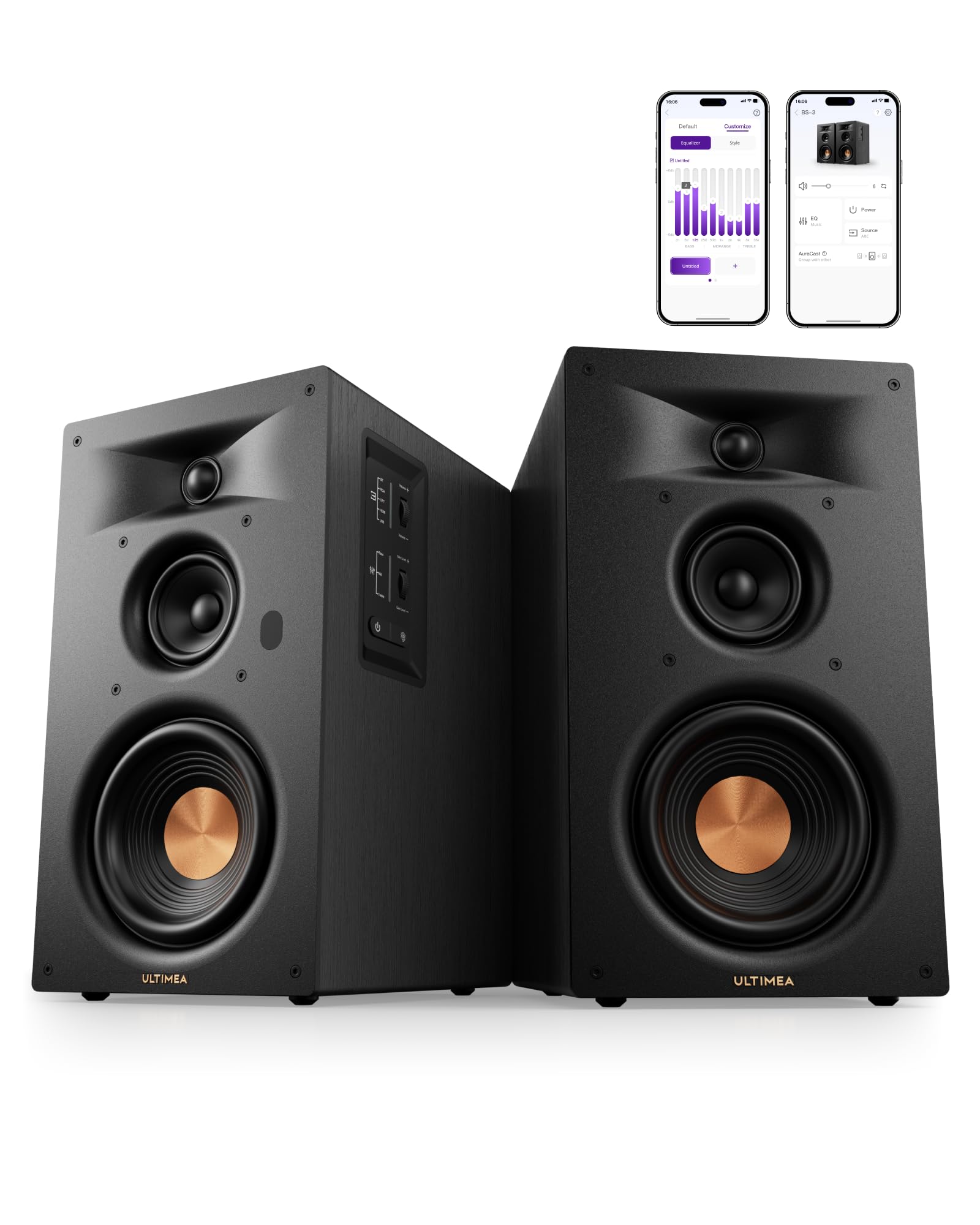
8

TV, Turntable Setups

ULTIMEA BS-3

83 /100
Sound Score Excellent

Key details

Power
70W
Inputs
Bluetooth, HDMI ARC, optical, RCA
Sub Out
Yes
Controls
App EQ
View on Amazon

The BS-3 pairs a 3-way driver layout with a 5.25-inch woofer and 70W RMS, so vocals stay clear and bass carries more weight than the typical 4-inch powered pair. HDMI ARC, optical, RCA, USB, and Bluetooth handle TV sound, line-level sources, and phones, while the app EQ adds tonal control from the listening position. This is a feature-first speaker, not a pure plug-and-play model; it expects a bit more from the buyer. That focus on inputs and EQ, rather than on the simplest possible setup, is why it settles below the category's lower-risk options.

Pros

  • Three-way setup keeps vocals and highs clear while the 5.25-inch woofer adds real bass weight for a bookshelf.
  • Input selection covers TV, line-level sources, and phones with HDMI ARC, optical, RCA, USB, and Bluetooth.
  • Plenty of volume for a medium-sized room without obvious strain at normal listening levels.

Cons

  • HDMI ARC connection can be inconsistent for some TV setups; a power cycle restores audio.
Our verdict

For setups centered on a television, the BS-3 lines up the features that matter — HDMI ARC, app EQ, and a subwoofer output — without forcing you into a receiver.

Check Latest Price
9

Dorm, Kitchen, Desk

RIOWOIS DS6701NP

86 /100
Sound Score Excellent

Key details

Power
40W
Inputs
Bluetooth 5.3, optical, ARC, AUX
Sub Out
No
Controls
Remote
View on Amazon

At entry-level pricing, the RIOWOIS DS6701NP brings Bluetooth 5.3, optical/ARC, AUX, and a remote to a compact pair of 2.75-inch powered speakers. The small cabinet fits easily on a desk, kitchen counter, or bedroom TV stand, and the silk-dome tweeter keeps dialogue and vocals clear at modest volume. It is not a full-range speaker: deep bass and high output are outside its reach, so larger rooms or bass-heavy listening will expose the small woofer. The bigger compromise is long-term durability — individual pairs may stop producing audio after several months of use, which is why this works best as a budget-minded solution for casual listening rather than a long-term main system.

💡 Use the optical/ARC input for TV audio if Bluetooth dropouts become noticeable.

Pros

  • Compact 2.75-inch cabinet fits tight desks, dorm shelves, and small TV stands.
  • Clear midrange and present highs deliver strong sound for such a small enclosure.
  • Budget buyers get Bluetooth, optical/ARC, AUX, and a remote in one small pair.

Cons

  • Bluetooth audio can drop out briefly in rooms crowded with wireless signals.
  • Long-term durability can vary; a pair may stop producing audio after several months.
Our verdict

For a small bedroom TV, dorm desk, or kitchen counter where modest volume is enough, this is a budget-friendly way to get optical/ARC, Bluetooth, and remote control. Treat it as an entry-level convenience rather than a long-term commitment.

Check Latest Price

How to Choose

Power

RMS power is the sustained wattage a speaker can deliver before distortion climbs. Peak wattage is a marketing number that lasts milliseconds and tells you almost nothing about real volume. Compare RMS per channel and total RMS before looking at the box.

Small rooms and desktop setups need only 20-40W RMS per channel. Medium rooms with a turntable or TV benefit from at least 40-60W RMS and a larger woofer. A lower-power speaker with efficient drivers can sound louder than a higher-peak model, so wattage alone never decides the match.

Woofer Size

A larger woofer moves more air, which means deeper bass and higher clean output before the driver strains. A 4-inch woofer is enough for desktop and small-room listening; a 5.25-inch woofer pressurizes a living room more comfortably.

Small 3-inch drivers are fine for bedside or kitchen use but roll off early in the low end. For bass-heavy music at moderate-to-high volume, skip anything smaller than 4 inches or plan to add a subwoofer.

Inputs

Input options decide which sources connect without adapters. Optical or coaxial inputs let a TV send digital audio directly to the speakers; HDMI ARC adds TV-remote volume control. Phono input removes the need for a separate preamp with a turntable.

Bluetooth is the most convenient input, but it is also the most likely to drop or lag. Keep a wired connection for the source that matters every day, especially if the speaker's only analog input is a single RCA pair.

Sub Out

Subwoofer output lets you send low bass to a powered sub instead of forcing the bookshelf woofers to handle it. Without a sub out, adding a sub later requires a different speaker pair or an external splitter.

Buyers who listen to bass-heavy music, watch action films, or sit in a medium room should prioritize sub out even if they don't plan to buy a sub today. It protects the upgrade path.

Controls

Controls determine how easily you adjust the speaker to the room. Front-panel bass and treble knobs are the most dependable; a remote is convenient for couch listening but usually infrared and line-of-sight.

App EQ offers precise tuning, but it adds setup friction and a second device. Desk users should check that volume is reachable without hunting for a small remote.

Frequently Asked Questions