7 Best Sennheiser Earbuds of 2026: Wired Picks That Last Longer

Which Sennheiser earbuds keep both ears working: replaceable-cable wired models for dependable sound, plus a true wireless pick for commuters who need ANC.

Sennheiser earbuds deliver the clarity the brand is known for, but the most common owner complaint is one channel going quiet or a cable wearing out near the connector. That outcome comes down to design choices. Models with a detachable cable avoid the most expensive repair.

The broader trade-off is wired versus wireless. Wireless models add ANC, Bluetooth 5.4, and a charging case, but those electronics live inside the earbud and vary more than the spec sheet suggests. Wired in-ears give up Bluetooth and noise cancellation and return a replaceable cord and consistent sound.

A commuter who needs a cable-free pocket and steady ANC has a clear wireless path. A listener who wants wired tuning to keep working after a cable snag should prioritize detachable-cable models. Pick the form factor that matches your listening habits, and the earbud choice becomes obvious.

About the Sound Score: This comparative score is calculated from a product's published customer rating and review volume. It is not a laboratory measurement or a hands-on test result.

1

Best Overall

IE 100 Pro

85 /100
Sound Score Excellent

Key details

Cable Type
Detachable 3.5mm cable
Sound Signature
Neutral monitor tuning
Fit And Ear Tips
Silicone and foam tips
Impedance And Source
20Ω, phone-friendly
View on Amazon

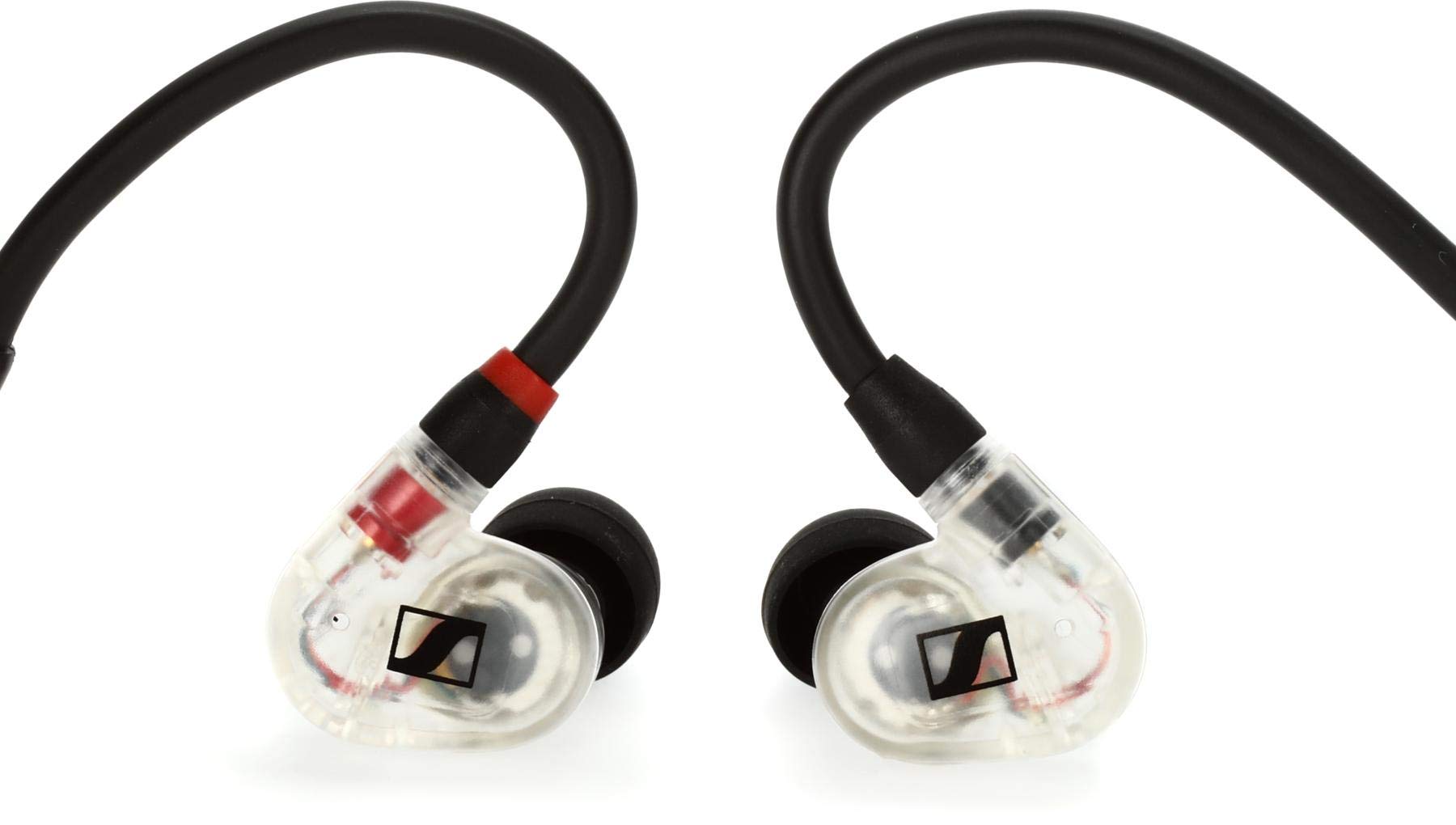
The IE 100 Pro pairs a detachable cable with studio-style tuning at a mid-range price, giving wired listeners a genuine Sennheiser monitor without the usual upgrade premium. It uses a 10mm dynamic driver, and the tuning favors clarity over impact. Low end stays controlled, instruments separate, and the overall signature reads as honest rather than hyped. This is the kind of neutral presentation that suits mix checking as much as live monitoring.

That honesty extends to the upper registers. Vocals sit near the center of the mix, cymbals keep a crisp edge without turning harsh, and small mix errors are easier to hear when nothing is masked by a bass bump. For monitoring, this means you don't have to raise the volume to catch details, which keeps longer sessions easier on the ears.

The included silicone and foam tips hold the shell securely enough for stage movement, and passive isolation already cuts a meaningful amount of room noise without any electronics. The detachable 3.5mm cable is the standout feature: a damaged cord can be swapped in seconds, so a cable problem doesn't become an IEM problem. That service advantage matters in live settings, where cable strain is constant, and it also lowers the cost of ownership compared with wired earbuds that lack a replaceable cable.

This is a wired-only monitor. No Bluetooth, no active noise cancellation, no battery to charge; the tradeoff is a cable to manage. It suits stage performers, practice rooms, and wired listeners who want Sennheiser's studio voicing without paying for wireless hardware. If wireless freedom or commute-friendly ANC is the priority, the true wireless flagship in this set is the better match. Listeners who want a bass-heavy consumer voicing are better served by the budget wired earbuds in the lineup.

In Sennheiser's wired earbud set, the IE 100 Pro occupies the practical middle: it costs less than the modular audiophile option and adds a replaceable cable the budget entries lack. The shells feel solid in the hand, and the whole package works as one IEM for monitoring and extended listening. It is not the cheapest way into Sennheiser sound, nor the fanciest, but it is the wired model that balances serviceability, secure fit, and studio tuning without asking you to adopt a wireless lifestyle. That balance is why a single product can cover stage work, practice, and casual listening.

💡 Try the foam and silicone tips in all sizes until the seal feels firm before judging low-end response.

Pros

  • Genuine Sennheiser monitor tuning at a price that undercuts the company's premium wired IEMs.
  • Build feels solid enough for regular stage handling, with a replaceable cable reducing repair costs.
  • Silicone and foam tips provide a comfortable, secure fit for longer sessions.
  • Clear, natural sound with realistic treble and enough separation for critical listening.

Cons

  • The neutral monitor tuning can sound light in the bass to ears accustomed to consumer low end.
  • In some cases, one side may lose output or sound quieter than the other; a quick channel check after unboxing is wise.
Our verdict

The IE 100 Pro is the wired monitor for musicians and cable-accepting listeners who want Sennheiser's studio voicing without the wireless markup.

Check Latest Price
2

Best True Wireless

Momentum True Wireless 4

80 /100
Sound Score Excellent

Key details

Cable Type
True wireless, no cable
Sound Signature
Balanced with strong dynamics
Fit And Ear Tips
Silicone tips, compact shell
Impedance And Source
Wireless, no amp needed
View on Amazon

The Momentum True Wireless 4 is the only fully wireless option in this Sennheiser set, combining adaptive ANC, Bluetooth 5.4, wireless charging, and app-based EQ in a cable-free shell. Compared with the top pick's replaceable cable, this model leans on Bluetooth convenience and smart features rather than repairability, making it the obvious pick for shoppers who want Sennheiser sound without a wire.

The 7mm TrueResponse driver shows strong clarity on vocals and acoustic instruments, while the low end stays controlled without needing a bass boost. The app EQ lets you dial in extra warmth or treble presence, which helps across genres. Multipoint pairing allows switching between a phone and laptop without digging into Bluetooth menus, and the case's wireless charging keeps top-ups simple. Touch controls are customizable through the app, so the wireless package feels complete once set up.

This is the pick for travelers and commuters who want ANC in a cable-free Sennheiser, and for multi-device users who value Bluetooth 5.4 and app control. Battery and connection behavior can vary between units; keep proof of purchase. It suits feature-focused buyers more than those who need maximum out-of-box consistency, and the full feature set is easier to justify at a discount.

💡 Track battery runtime during the first month of daily use to catch a weak unit early.

Pros

  • Detailed true wireless sound with Sennheiser tuning and strong clarity.
  • Adaptive ANC and transparency mode cover commuting and office noise.
  • Bluetooth 5.4, wireless charging, and app EQ create a feature-rich true wireless bundle.

Cons

  • Adaptive ANC is decent but not class-leading for the premium tier.
  • Battery runtime can shorten noticeably on some units within the first month.
Our verdict

Choose this when Bluetooth, ANC, and app control take priority; the wired top pick remains the lower-hassle default for long-term listening.

Check Latest Price
4

Best for Audiophiles

IE 200

80 /100
Sound Score Excellent

Key details

Cable Type
Detachable MMCX cable
Sound Signature
Neutral, dual bass tuning
Fit And Ear Tips
Tiny shells, silicone tips
Impedance And Source
18Ω, easy to drive
View on Amazon

The IE 200 is Sennheiser's audiophile upgrade platform: neutral, detailed TrueResponse tuning with dual-position bass and a detachable MMCX cable. The tuning avoids a consumer bass bump, so voices and instruments keep their natural weight and separation. The top pick leans stage-monitor; the IE 200 leans home/desk critical listening.

The tiny shells stay comfortable over long listening sessions, and the 7mm driver keeps separation and timbre clean at moderate levels. The 18Ω impedance is easy to drive from a laptop or a small dongle DAC. Across acoustic, jazz, and vocal material, the tuning stays composed. The dual-position bass insert is set before insertion, not on the fly; it shifts the low end from neutral to slightly fuller without changing the midrange character.

This is for home/desk listeners who want wired neutrality and treat eartip selection and aftermarket cables as part of the setup. Buyers who simply want a grab-and-go earbud should look elsewhere in Sennheiser's range.

The stock cable can be finicky and bass depends on a perfect seal. Both are workable if your routine already includes tip-rolling and a spare MMCX cable.

Pros

  • Neutral, detailed sound with clean separation and natural timbre.
  • Compact shells stay comfortable during long listening sessions.
  • Detachable MMCX cable and dual-position bass tuning allow an upgrade path.

Cons

  • There is no inline mic or remote, so commuters who need call controls would be better served elsewhere.
  • Long-term durability can vary between units; keeping proof of purchase is a reasonable precaution.
Our verdict

For wired-neutral listeners who treat tip selection and cable swaps as part of the ritual, the IE 200 delivers Sennheiser's most accessible audiophile tuning.

Check Latest Price
5

Best Flat-Tuned Studio/Sleeping Pick

IE 4

81 /100
Sound Score Excellent

Key details

Cable Type
Fixed 3.5mm cable
Sound Signature
Flat, natural response
Fit And Ear Tips
Three interchangeable tip sizes
Impedance And Source
140Ω, needs amp/DAC
View on Amazon

Flat, natural tuning sits at the center of the IE 4, and the shell is small enough for side-sleepers. The sound favors balance over excitement: controlled lows, present mids, and no spike in the treble. It keeps the wired setup simple, without the detachable-cable hardware of the modular model in this lineup. That simplicity is part of its appeal for listeners who want a small, neutral earbud and nothing extra.

The right buyer is a budget-focused studio listener or side-sleeper who does not need call controls on the cable. The 140Ω impedance is the boundary: a phone's basic headphone output may stay below 'loud,' while a headphone amp or DAC brings the IE 4 to full output. A desktop or portable DAC turns the IE 4 into a no-fuss monitoring tool, and buyers who already own one will not find the load unusual. That makes this a wired option for the sound-first user, not for someone expecting max volume from a dongle.

From a suitable source, the IE 4 shows a controlled low end, clear vocals, and a natural top end. The isolation is strong enough to block room noise, so it suits sleep, travel, or focused listening.

💡 Try all three eartip sizes before judging bass; a proper seal prevents the low end from sounding thin.

Pros

  • Flat, natural tuning with detail that suits critical listening.
  • Compact shell stays comfortable for side-sleepers and blocks moderate room noise.
  • Cost-effective entry to neutral in-ear sound for listeners with an amp or DAC.
  • Build quality has the classic Sennheiser feel at a mid-range price.

Cons

  • Needs a headphone amp or DAC to reach full volume from a phone source.
  • Long-term durability under heavy daily use can be a weak point.
Our verdict

The IE 4 makes sense for the listener who values voicing and small size over phone convenience.

Check Latest Price
6

High-End Audiophiles

IE 900

77 /100
Sound Score Very Good

Key details

Cable Type
3.5mm, 2.5mm, 4.4mm cables
Sound Signature
Bright reference tuning
Fit And Ear Tips
Small aluminum shells, silicone tips
Impedance And Source
18Ω, easy to drive
View on Amazon

Reference-grade detail and small aluminum shells make the IE 900 comfortable for long critical listening sessions. The 7mm TrueResponse driver resolves layering and bass texture with unusual control. The included 3.5mm, 2.5mm, and 4.4mm cables cover balanced and single-ended sources, and the machined shell feels like a collector piece. The luxury price carries an added requirement: warranty support is part of the purchase, so keep proof of purchase accessible. This is an instrument for committed audiophiles with a dedicated listening setup, not a broad recommendation.

Pros

  • Small aluminum shells stay comfortable through long critical listening sessions.
  • Precision and bass control hold up over long sessions.
  • Three included cables cover common balanced and single-ended sources.

Cons

  • Bright upper-mid response can fatigue listeners who prefer a warmer tuning.
  • A left-channel disconnect has been noted in some units.
Our verdict

Reserve this for dedicated home listening with a balanced source and keep the original packaging; the detail retrieval is the reason to own it.

Check Latest Price
7

Budget Side-Sleepers

CX 80S

81 /100
Sound Score Excellent

Key details

Cable Type
Fixed 3.5mm cable
Sound Signature
Bright budget tuning
Fit And Ear Tips
Tiny low-profile shells
Impedance And Source
28Ω, phone-friendly
View on Amazon

At its entry-level price, the CX 80S brings Sennheiser tuning and a shell small enough to sleep on, which is a rare combination. The inline one-button remote covers play/pause and calls without adding bulk, and the 28-ohm impedance is easy to drive from a phone. It remains a step below the crowd-pleasing budget all-rounder in this lineup: durability is a gamble, and bass is light. For budget buyers who want a recognizable audio brand at the lowest possible cost, this is the easiest on-ramp into Sennheiser's wired earbud range.

Pros

  • Lowest entry price into Sennheiser in-ear tuning
  • Tiny, low-profile shells sit flush enough for side-sleeping.

Cons

  • No active noise cancellation to help with constant engine drone on transit.
  • Office chatter and street noise can bleed through; the small shells offer only minimal passive isolation.
Our verdict

Best for side-sleepers and budget-conscious listeners who want the lowest-cost Sennheiser wired earbud.

Check Latest Price
8

Office, Gaming Users

CX 400-II

81 /100
Sound Score Excellent

Key details

Cable Type
Fixed 3.5mm cable
Sound Signature
Neutral detailed tuning
Fit And Ear Tips
Silicone tips, passive isolation
Impedance And Source
16Ω, phone-friendly
View on Amazon

The CX 400-II's passive isolation and stable fit deliver clear value at a budget price, with an inline volume control that suits seated listening. Office chatter and keyboard noise get pushed out effectively, keeping volume levels low and focus high. Sealing well without constant re-adjustment helps during extended gaming or work sessions.

Durability is the weak point — heavy daily handling can shorten the cable's lifespan — and the older design trails the CX 300S in polish. It fits as a desk-bound isolation tool, not a take-anywhere companion.

Pros

  • Passive isolation seals out office and household noise for focused listening.
  • Stable fit with comfortable eartips supports long listening sessions.
  • In-line volume control allows quick level changes without reaching for a device.

Cons

  • Walking around can introduce eartip popping and cable rustle.
  • Audio output can be lost within a few months in some cases.
Our verdict

For desk-bound listeners on a budget who need isolation and volume control, the CX 400-II serves the purpose.

Check Latest Price

How to Choose

Sound Signature and Bass

Sennheiser's wired in-ears generally lean neutral to bright, not bass-heavy. Low frequencies need a sealed air pocket in the ear canal; when the eartip leaks, the bass pressure escapes and the tuning sounds thin.

A model that sounds bass-light on first listen can sound full with a larger tip. Judge the tuning only after you have tried every included tip.

Fit and Ear Tips

Ear-tip size controls comfort, isolation, and frequency response at the same time. Foam tips seal better in irregular ear canals, while silicone tips are easier to insert and clean.

The largest tip that sits comfortably usually gives the strongest bass. If the shell is too large for your ear, look at the small-shell wired models rather than adding EQ.

Cable Type and Connector

The cable is the most common repair point on wired Sennheiser earbuds. Flexing near the earbud and strain near the plug eventually damages the internal conductor, especially when the cable is stuffed into a pocket or wrapped tightly.

Detachable cables solve this by making the cord a replaceable part. If the connector rotates or loses contact, that introduces a new weakness, so choose a model whose connector seats firmly or locks.

Impedance and Source

Impedance tells you how much voltage an earbud needs. Low-impedance models in the 16-28Ω range work with phone dongles and laptop jacks, while the 140Ω IE 4 needs a headphone amp or DAC to reach satisfying volume.

A high-impedance earbud plugged into a weak source sounds quiet and hollow, not defective. If you listen from a phone, pick a lower-impedance model or carry a USB dongle with enough output.

Wireless Battery and ANC

True wireless earbuds pack battery, antenna, and microphones into the shell, so every charge cycle ages the product. ANC also draws from the same battery, meaning battery life depends on whether you leave noise cancelling on.

ANC reduces steady low-frequency rumble, but it will not eliminate voices or sharp sounds. Buy wireless for a cable-free commute and multi-device convenience, not as an automatic sound upgrade.

Frequently Asked Questions