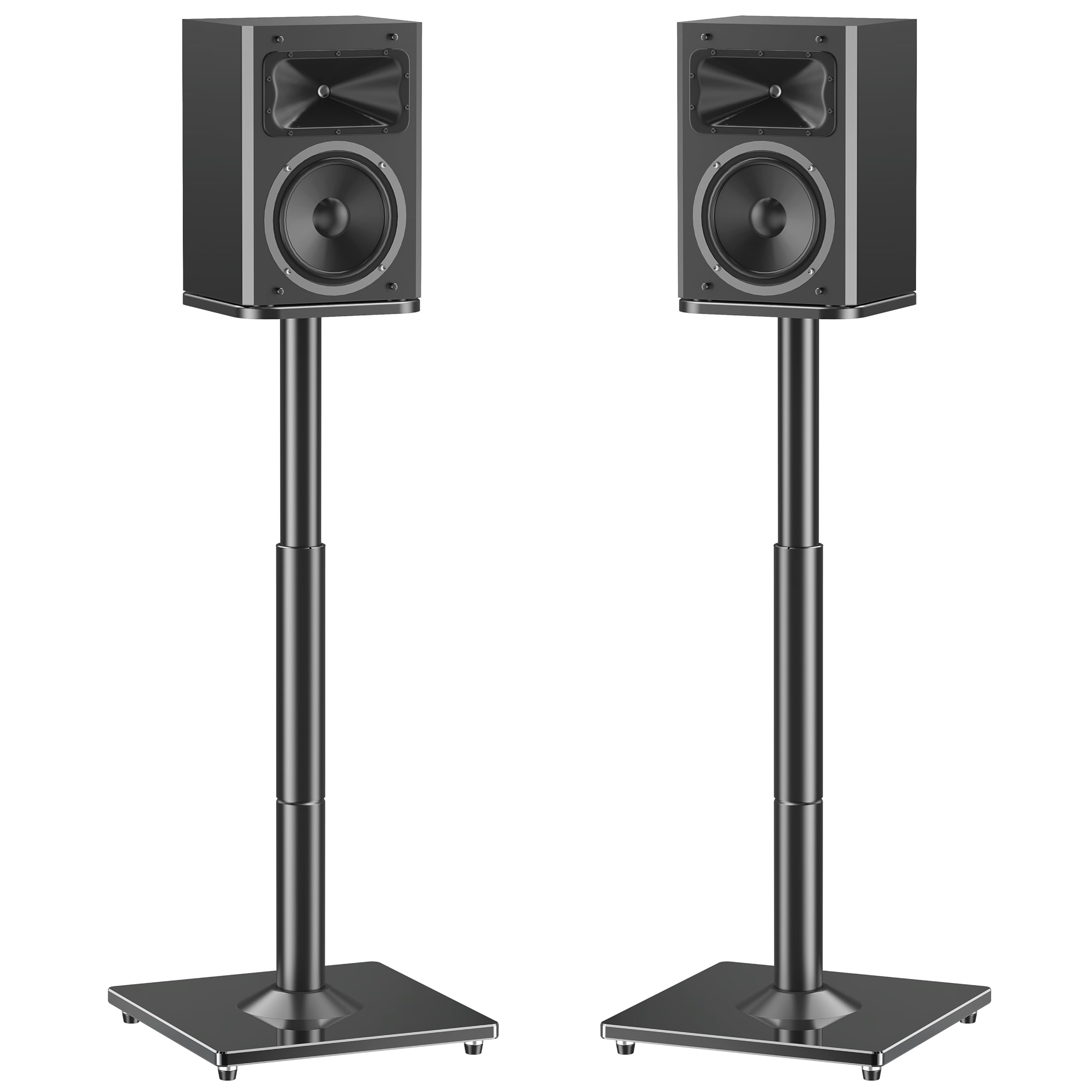
9 Best Studio Monitor Stands of 2026: Stable Picks for Real Desks

Which studio monitor stands get your tweeters to ear level without wobble, stripped hardware, or cable clutter — for floor, desk, and clamp setups.

A speaker stand's load rating looks like the only number that matters. In practice, stability comes from the base footprint and the hardware that locks the height in place, not the advertised capacity. A stand rated for 50 lb can still feel shaky if the base is narrow or the column lock has slop.

Floor stands trade a low starting height for a wide footprint, while clamp stands trade floor space for desk-edge grip. The useful choice is about your room, not the weight spec: measure the clamp range, check the base size, and confirm the top plate fits the speaker cabinet. Tweeter height and a solid lock do more for your mix than a number on the box.

About the Sound Score: This comparative score is calculated from a product's published customer rating and review volume. It is not a laboratory measurement or a hands-on test result.

1

Best Overall

Pyle PSTND32 Tripod

94 /100
Sound Score Outstanding

Key details

Height Range
34-53 in
Load Capacity
90 lb
Top Plate Size
8.9 x 8.9 in tray
Base / Footprint
Tripod legs, adjustable footprint
View on Amazon

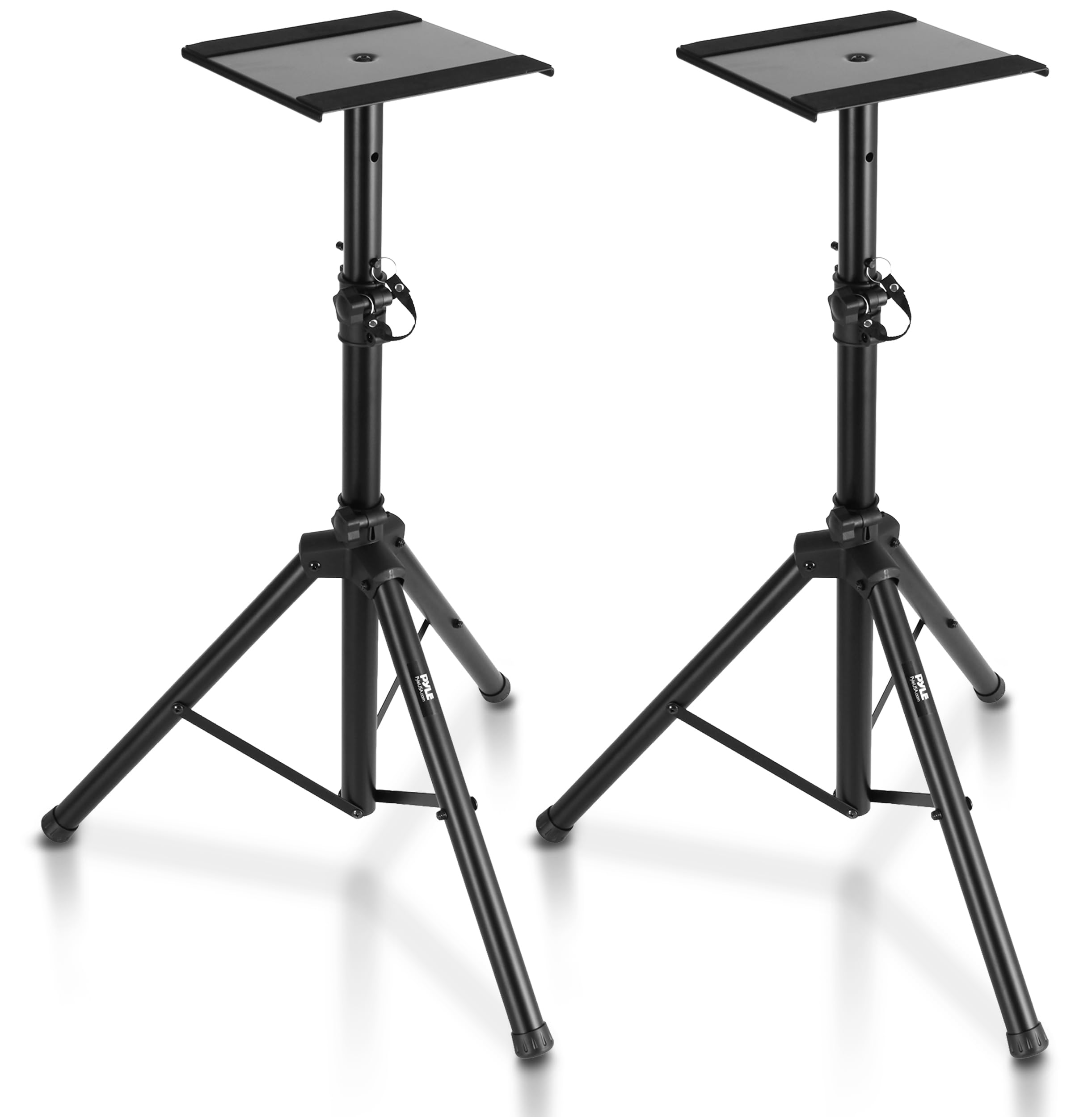
The Pyle floor stand puts a 90-lb load ceiling together with a 34-53 in height range, which covers standard floor-standing monitor and bookshelf speaker jobs. The 8.9 x 8.9 in metal tray leaves enough surface for large cabinets, and the anti-slip pads keep them from creeping during playback. Folding tripod legs can be adjusted wider for extra support or pulled inward for tighter floor layouts, so the base geometry can be tuned rather than locked into a fixed footprint. This combination makes it the default tripod floor stand for general use in the mid-range category.

Assembly is fast and does not require special tools: the column locks into the base, the tray mounts on top, and the height clamp does the rest. At typical nearfield listening heights, six- and eight-inch studio monitors feel planted, and the height adjustment sets tweeters at ear level without needing shims or blocks. The tripod legs stay stable when extended, which is where cheaper stands can get shaky. When you change rooms or pack up, the legs fold flat, giving it a transport advantage over fixed-base floor stands.

The 34-in minimum is the boundary to respect. Low couches, recliners, or short seated positions put tweeters below what this stand can reach, and the tripod look is utilitarian rather than furniture-grade. For floor-stand buyers who need a stable 90-lb platform above 34 in, the Pyle covers the standard job without a heavy-duty price.

Value is the second half of the story. The Pyle sits below heavier-duty floor stands on price while matching or beating their capacity, and the metal tray, anti-slip pads, and wide tripod stance give it a solid feel for the mid-range category. That is a strong fit for home studios and living-room setups that treat speaker stands as functional gear rather than furniture. The adjustable footprint also compensates for uneven floors: spread the legs wider before tightening, and the stand settles into a stable position.

The anti-slip pads and adjustable footprint work together to prevent speaker movement during playback. The tray is big enough for bookshelf speakers up to large sizes, and the base width can compensate for carpet or uneven surfaces. That gives the Pyle the kind of stability usually associated with heavier, fixed-base stands.

💡 Spread the tripod legs to their widest footprint before mounting heavy monitors to stabilize the stand at taller settings.

Pros

  • Sturdy tripod legs hold large studio monitors without wobble at normal listening heights.
  • Build quality is strong for the price, with a metal tray and anti-slip pads.
  • Assembly takes minutes and does not require special tools.
  • Height range from 34 to 53 in allows tweeter placement at ear level.
  • Tripod legs fold flat for transport and for room reconfiguration.

Cons

  • Packaging damage can produce cosmetic scuffs on the stand body.
  • In isolated cases, a missing hardware piece delays assembly until a replacement arrives.
Our verdict

For floor-stand buyers who need a stable 90-lb platform and a folding tripod base, the Pyle pairs the right height range with a competitive price.

Check Latest Price
2

Best Heavy-Duty Floor Stand

AxcessAbles SMS-101 Floor

90 /100
Sound Score Outstanding

Key details

Height Range
26-46 in
Load Capacity
80 lb
Top Plate Size
9 x 9 in
Base / Footprint
17.5 in triangular base
View on Amazon

The AxcessAbles floor stand pairs an 80-lb load rating with a 17.5-inch triangular base and a 26-inch minimum height — enough to put heavy nearfield monitors at seated ear level before tripod floor stands start at 34 inches.

Height adjustment spans 26 to 46 inches and holds its setting once tightened. The 9 x 9-inch top plate gives 8-inch monitors a secure platform, and 10-inch nearfields fit within the 80-lb rating as well. On carpet, the included spikes lock the base into place; on hard floors, the heavy steel base remains stable without them.

Buyers with 8-in nearfield monitors or home-theater bookshelf speakers get a direct fit for low seating positions and heavy cabinets. A 26-inch start also works for low seating. Finish QC can vary, so inspect a new unit for scratches or dents before assembly.

The tripod floor stand that leads this category resists lateral shake a bit better, but its 34-inch starting height cannot serve low seating positions. The AxcessAbles reaches those positions and still feels planted on its wide triangular base, which is why the tradeoff is worth accepting for a fixed listening spot.

Pros

  • 80-lb capacity supports heavy nearfield monitors without flex.
  • Low 26-inch starting height suits seated listening, while the height lock holds large monitors firmly in place.
  • Powder-coated alloy-steel frame and a wide base give it solid overall build quality.
  • Assembly is fast with supplied hardware and no special tools.

Cons

  • The 46-inch maximum falls short for standing-desk listening setups.
  • The fixed steel frame does not fold, so mobile or take-down use needs a different stand.
Our verdict

A lower 26-inch start and 80-lb capacity make this the floor stand for heavy monitors in low seating positions; it needs floor space and a fixed home in return.

Check Latest Price
3

Best Desktop Clamp-On

Liquid Stands MS112 Clamp

93 /100
Sound Score Outstanding

Key details

Height Range
9.5-13.5 in
Load Capacity
65 lb
Top Plate Size
9 x 12.5 in
Base / Footprint
Desk clamp, 0.5-2 in
View on Amazon

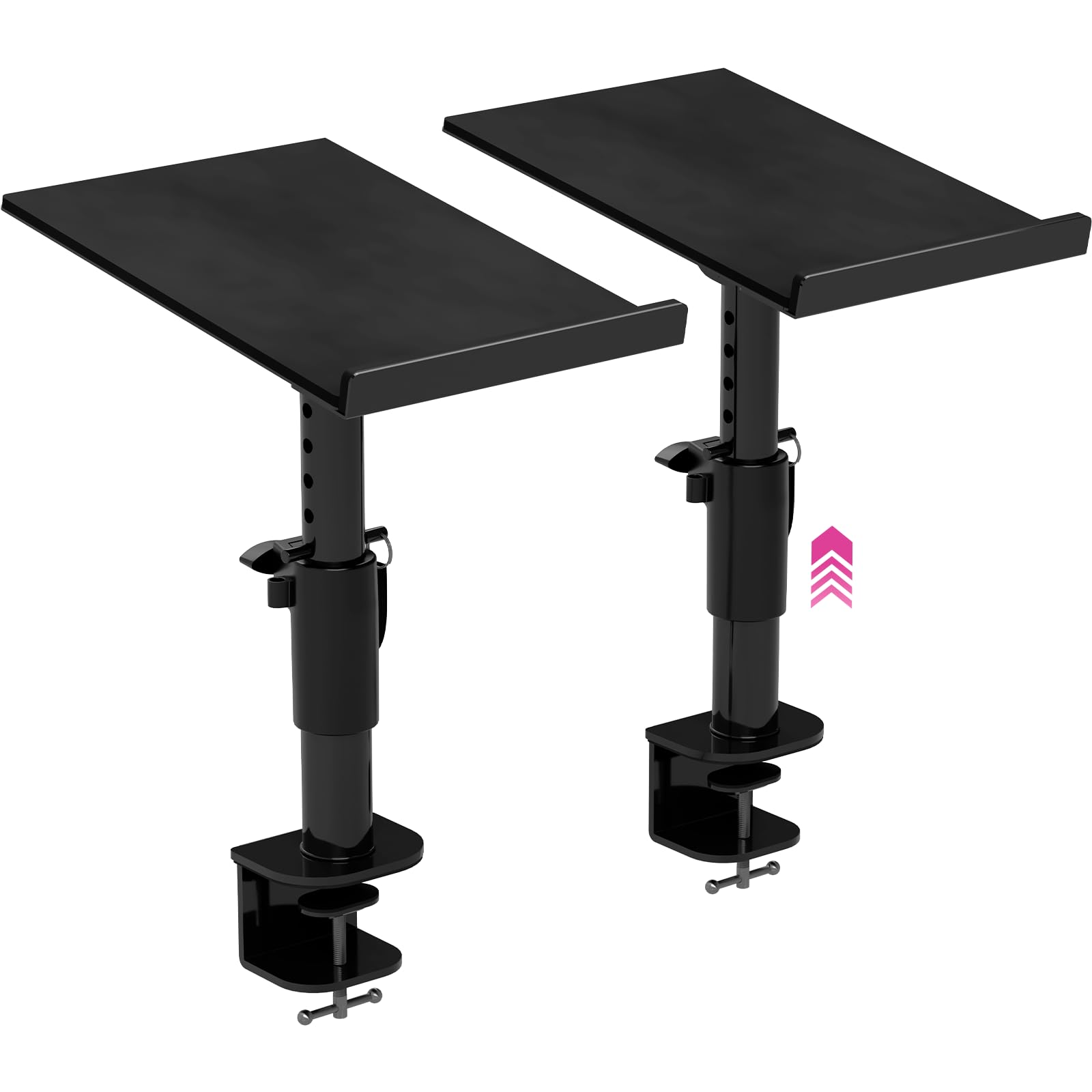
Stainless steel and a 10-year warranty set the Liquid Stands MS112 apart from the other clamp-on models in this set. The 65-lb capacity and 9 x 12.5 in top plate give nearfield monitors a stable platform, and the 0-20° tilt aligns tweeters with ear level before the clamp is fully tightened. Tool-free height and tilt locks make the initial setup feel less like furniture assembly and more like positioning a microphone.

The clamp locks to the desk edge and the steel column holds position during bass-heavy playback. Because the desk becomes part of the support structure, the stand gains stiffness that tripod floor stands can't match without a wider base. That grip matters more than the advertised load rating, because a speaker that shifts a few degrees off axis changes the stereo image. The 65-lb rating covers most 8-in and smaller monitors with headroom to spare.

Serious home studios and streamers who want a clamp-plus-tilt package in one unit will get the most from this stand. The clamp accepts desks 0.5-2 in thick and needs an accessible edge, so flush-to-wall desks and thick workbenches fall outside the fit range; for those rooms, a wall-offset clamp covers the same desktop idea.

Pros

  • Stainless-steel build keeps heavy monitors planted and resists flex.
  • 0-20° tilt covers nearfield listening angles without shims or wedges.
  • Tool-free assembly: clamp, set height, lock tilt in minutes.
  • 10-year warranty and mid-range price put the build cost in perspective.

Cons

  • Height tops out at 13.5 in, so floor-standing listening positions are outside this clamp's range.
Our verdict

The Liquid Stands MS112 is the clamp-on pick for studio owners who value a locked-down speaker position and want the security of steel backed by a 10-year warranty.

Check Latest Price
4

Best Isolation Performance

IsoAcoustics Iso-130

90 /100
Sound Score Outstanding

Key details

Height Range
2.8-8.25 in
Load Capacity
20 lb
Top Plate Size
5.1 x 6 in
Base / Footprint
5.1 x 6 in footprint
View on Amazon

The Iso-130's patented decoupling design is the reason to pick it over a rigid desk stand: it interrupts the mechanical path between monitors and the desk surface, then uses 14 height and tilt variations to aim small nearfield speakers at ear level. That combination makes it the isolation specialist among the desktop options in this guide, where the steel clamp alternative handles heavier loads but does nothing to filter vibration.

The fit between platform and column is snug, and the height and tilt positions hold once set. This is a premium small-monitor stand, so the adjustability is built around repeated fine-tuning rather than one fixed angle.

In desk use, the decouplers absorb energy that would otherwise rattle the desk, which tightens the low end and cleans up perceived detail. That behavior is the stand's main contribution; it is not what you buy when you already use rigid wall-mounted shelves.

This is for nearfield monitoring on a desk with 5-8 inch powered monitors under 20 lb. The compliant decoupling and the weight cap mean it feels less rigid than fixed steel stands; heavier monitors and full floor-standing setups should look to the steel floor stands in this guide.

Pros

  • Decoupling tightens bass and cleans up perceived midrange detail by keeping desk vibration out of the speakers.
  • Snug assembly and quality construction hold position when you adjust height or tilt.
  • Fourteen height and tilt configurations align tweeter height to ear level without shims.
  • Fits a wide range of powered 5-8 inch monitors under the 20-lb limit.

Cons

  • Premium price makes sense for critical listening, but less so for buyers who just need speaker height.
  • Rubber pads can work loose from the plastic platforms with extended use; fully detached pads may not re-seat.
Our verdict

For nearfield listeners chasing bass clarity on a shared desk, the Iso-130's isolation does what a rigid stand cannot.

Check Latest Price
5

Best for Home Theater Bookshelves

ELIVED Glass-Base Floor

91 /100
Sound Score Outstanding

Key details

Height Range
28-37.4 in
Load Capacity
22 lb
Top Plate Size
9.8 x 9.8 in
Base / Footprint
11.8 in glass base
View on Amazon

ELIVED pairs a tempered glass base with a 28-37.4 in height range, giving it a cleaner living-room profile than steel tripod floor stands. The 11.8-in square base spreads load across standard carpet or hard flooring, and the adjustable column locks down without much fuss. Build quality is a clear step above budget-priced metal stands.

Assembly is simple: slide the column into the base, set the top plate, and tighten the collar. The 9.8-in top plate fits typical bookshelf and Sonos Era enclosures, while the cable hole routes wire down the column so the setup reads as furniture rather than gear. Once positioned, the glass base stays planted under normal listening levels.

This pair is for home-theater surround speakers, Sonos Era models, and small bookshelf speakers in living rooms. The 22-lb capacity and 37.4-in maximum exclude large nearfield monitors, so anyone with heavy studio monitors or tower-adjacent bookshelf speakers should move up to the steel floor stands with much higher load ratings.

Pros

  • Tempered glass base keeps bookshelf speakers stable on typical floors
  • Assembly takes minutes with simple base-to-column hardware
  • Pairs well with Sonos Era and bookshelf speakers without adding audible resonance
  • Modern glass-and-steel look fits furnished rooms better than tripod stands

Cons

  • Cable slot is sized for standard wire; thicker pre-terminated cables may need an outside route.
  • Top plate is flat, so angle-sensitive tweeter alignment requires shims.
Our verdict

For living-room bookshelf and home-theater setups that value clean cable routing, this pair delivers stable support with a glass-base look tripods can't match.

Check Latest Price
6

Best Budget Desk Clamp with Tilt

Vondynote 12° Tilt Clamp

91 /100
Sound Score Outstanding

Key details

Height Range
10.4-15.4 in
Load Capacity
60 lb
Top Plate Size
9 x 12 in plate
Base / Footprint
Desk clamp, 0-2.6 in
View on Amazon

Vondynote's clamp handles up to 60 lb, tilts speakers from 0 to 12 degrees, and spans 10.4 to 15.4 inches in height. A clamp at this price can fix the angle flat or cut load capacity; this one does neither. The steel post and 9 x 12 inch metal top plate with EVA pad give the pair a solid feel once the clamp is snugged against the desk edge.

The top plate sits at one of four height positions, so nearfield monitors land close to ear level without a floor stand's footprint. The clamp mounts to the desk edge and leaves the top surface free for controllers or a laptop. Assembly needs only common hex hardware, and the EVA pad keeps small cabinets from sliding during playback.

This is for desktop producers in small studios who want angled monitors without dedicating floor space to stands. The friction tilt lets you dial in a downward or upward angle, but the lock can drift from its set angle under sustained bass; re-tightening is part of the routine. Buyers who need a detented lock that never moves should look at a stand with a positive tilt stop.

Pros

  • Steel post and padded metal plate hold monitors solidly once clamped.
  • Materials feel more finished than typical entry-level clamps.
  • Mounts to a desk edge in minutes with standard hex hardware.
  • Adds tilt and height adjustability at a budget-friendly price.

Cons

  • Clamp tops out at 2.6 inches, leaving thicker work surfaces unsupported.
  • Height changes in four fixed steps, so matching a specific ear height means accepting the closest position.
Our verdict

Desktop producers who want angled nearfield monitors and a compact footprint will find this clamp covers the essentials at a budget-friendly price.

Check Latest Price
7

Style-Conscious Buyers

MOUNTUP Glass-Base Floor

90 /100
Sound Score Outstanding

Key details

Height Range
28.3-37.4 in
Load Capacity
22 lb
Top Plate Size
9.8 x 9.8 in
Base / Footprint
11.8 in glass base
View on Amazon

The tempered glass base and internal cable hole give this floor stand a living-room-friendly look that steel tripods lack. With a 28.3-37.4 in height range, it positions bookshelf speakers at typical seated listening height. The 22-lb capacity suits bookshelf units but rules out heavy studio monitors, so this pair fits style-conscious home-theater buyers with compact speakers. The tradeoff is price: this premium-priced stand carries the same 22-lb limit as the category pick, so the extra money buys a mostly cosmetic upgrade. For a living-room setup where the stand's finish matters, that upgrade is worth it; the category pick keeps the edge for everyone else.

Pros

  • Tempered glass base and cable routing keep a living-room setup tidy.
  • Assembly is easy enough to complete without a second person.
  • Sturdy with bookshelf speakers at standard listening height.

Cons

  • Assembly instructions can be vague for some buyers.
  • Budget buyers seeking maximum capacity per dollar will find stronger value elsewhere.
Our verdict

Best for style-conscious living-room setups where the glass finish is part of the purchase decision, provided speakers stay within the 22-lb limit.

Check Latest Price
8

Budget Clamp Buyers

suptek SDM001B Clamp

89 /100
Sound Score Excellent

Key details

Height Range
8.9-13.9 in
Load Capacity
33 lb
Top Plate Size
9.6 x 8.8 in
Base / Footprint
C-clamp, up to 3.93 in
View on Amazon

The suptek clamp covers the common desktop-listening case: a 33-lb capacity, ±12° tilt, and a clamp range that clears desks up to 3.93 in. With that capacity it handles nearfield monitors and smaller bookshelf pairs, while the price fits a first monitor stand. The 8.9-13.9 in height window is shorter than the premium stainless clamp above it, and the adjustment set is leaner; taller nearfield positions will want more travel. The height lock should be tightened before seating the tray.

Pros

  • Clamp handles desk edges up to 3.93 in thick and holds firmly once tightened.
  • Tilt and height range allow on-desk tweeter aiming without extra shims.
  • Assembly does not require special tools or complicated parts.

Cons

  • Requires an exposed desk edge, so flush-wall desks need a wall-offset clamp instead.
  • The tray can be pulled sideways off the pole when the height lock is left loose.
Our verdict

For desktop listeners who need angled tweeters on a thicker desk without floor stands, this clamp is the cost-effective way in.

Check Latest Price
9

Desktop Bookshelf Speakers

Kanto SP6HD Desktop

91 /100
Sound Score Outstanding

Key details

Height Range
6 in fixed
Load Capacity
30 lb
Top Plate Size
4 in / 7 in plates
Base / Footprint
Desktop base, rubber feet
View on Amazon

At a fixed 6-in height with steel columns, closed-cell foam padding, and two top-plate sizes, the SP6HD treats desktop speaker positioning as a furniture decision rather than a utility purchase. The ±15° swivel lets you aim small bookshelf speakers toward ear level without moving the base, and the included 4-in and 7-in plates adapt to different cabinet widths. The narrow use case is the catch: this stand has no height adjustment and no clamp mount, so it only fits desks where 6 in is exactly the lift your ears need. The 30-lb limit covers typical Kanto-size monitors but not large 8-in studio models. Assembly is clean when hardware is worked gently; screw heads can snap and frame holes may sit slightly misaligned if over-tightened.

Pros

  • 6-in fixed lift places compact bookshelf speakers at ear level for a seated desk setup.
  • Swivel top plates allow ±15° of left-right aiming without moving the stand.
  • Steel frame and foam padding give a solid, furniture-grade feel under typical desktop monitors.

Cons

  • Screw heads can snap and frame holes may sit slightly misaligned when hardware is tightened.
  • Fixed 6-in height and no clamp mount narrow it to desks that need exactly this lift.
Our verdict

For desktop listeners who already sit at the right height and need a steady 6-in lift for smaller bookshelf speakers, the SP6HD delivers furniture-grade build — provided you don't over-tighten the hardware.

Check Latest Price

How to Choose

Height Range

Height range determines whether the tweeter lands at ear level without books. Tripods with a 34-in minimum suit seated mixing desks but not low couch seating. Clamp stands usually add 9-15 in above a desk; floor stands with a 26-in start cover bigger nearfields. Measure seated ear height, then check the bottom and top of the range.

Load Capacity

Load rating is a static vertical limit, not a wobble rating. A speaker under the limit can still rock a narrow base or loose locking joint because torque grows with height. Treat the rating as a ceiling and keep headroom for carpet or high-traffic rooms.

Base / Footprint

The base is the anti-tip story. Wide, heavy bases lower the center of gravity and resist sideways push. Tripod legs need a widened footprint and solid floor contact; glass or steel plates are more surface-sensitive. Clamp stands trade floor footprint for desk-edge grip, which is stable only if the clamp can bite the desk.

Top Plate Size

Top plate size matters for cabinet footprint, not weight. A small plate leaves the edges of an 8-in monitor unsupported and couples vibration unevenly. Match the plate to the cabinet base or choose a stand with multiple plate sizes.

Tilt / Angle Adjustability

Tilt aims the tweeter when stand height is not exact. The hidden cost is friction: plastic locks can drift under bass vibration. For a fixed angle, a swivel-only or wedge design may hold better than a partially tightened tilt lock.

Cable Management

Cable holes keep cables from pulling on speaker terminals, but small holes are a hidden constraint. Measure the hole before routing thick connectors. Pass cables before seating the speaker and leave a service loop for future swaps.

Frequently Asked Questions