9 Best TV Headphones of 2026: Clear Dialogue, Fewer Pairing Pains

The best TV headphones for clear dialogue, stable docks, and TV hookups that don't force Bluetooth pairing for seniors and shared households.

Most TV headphone listings promise plug-and-play senior-friendly sound, but the actual experience hinges on two things: whether the transmitter matches your TV's outputs and whether the wireless link keeps lip sync tight. A silent optical connection or a half-second audio delay can turn an evening of television into frustration. Plastic headbands and charging contacts add another durability variable that spec sheets rarely reveal.

The fix is not spending more; it is matching the connection type to the room and the listener. Dedicated dock-and-transmitter systems handle clear dialogue and charging, dual-headphone systems give two viewers independent volume, and wired long-cord sets remove battery and pairing worries entirely. A stable TV headphone should make late-night listening feel private and effortless, not like a second remote-control problem.

About the Sound Score: This comparative score is calculated from a product's published customer rating and review volume. It is not a laboratory measurement or a hands-on test result.

1

Best Overall

Avantree Ensemble

89 /100
Sound Score Excellent

Key details

Low Latency
<40ms
TV Compatibility
Optical / AUX / Bluetooth
Dialogue / Volume
Dialogue-focused tuning
Range / Stability
100ft range
View on Amazon

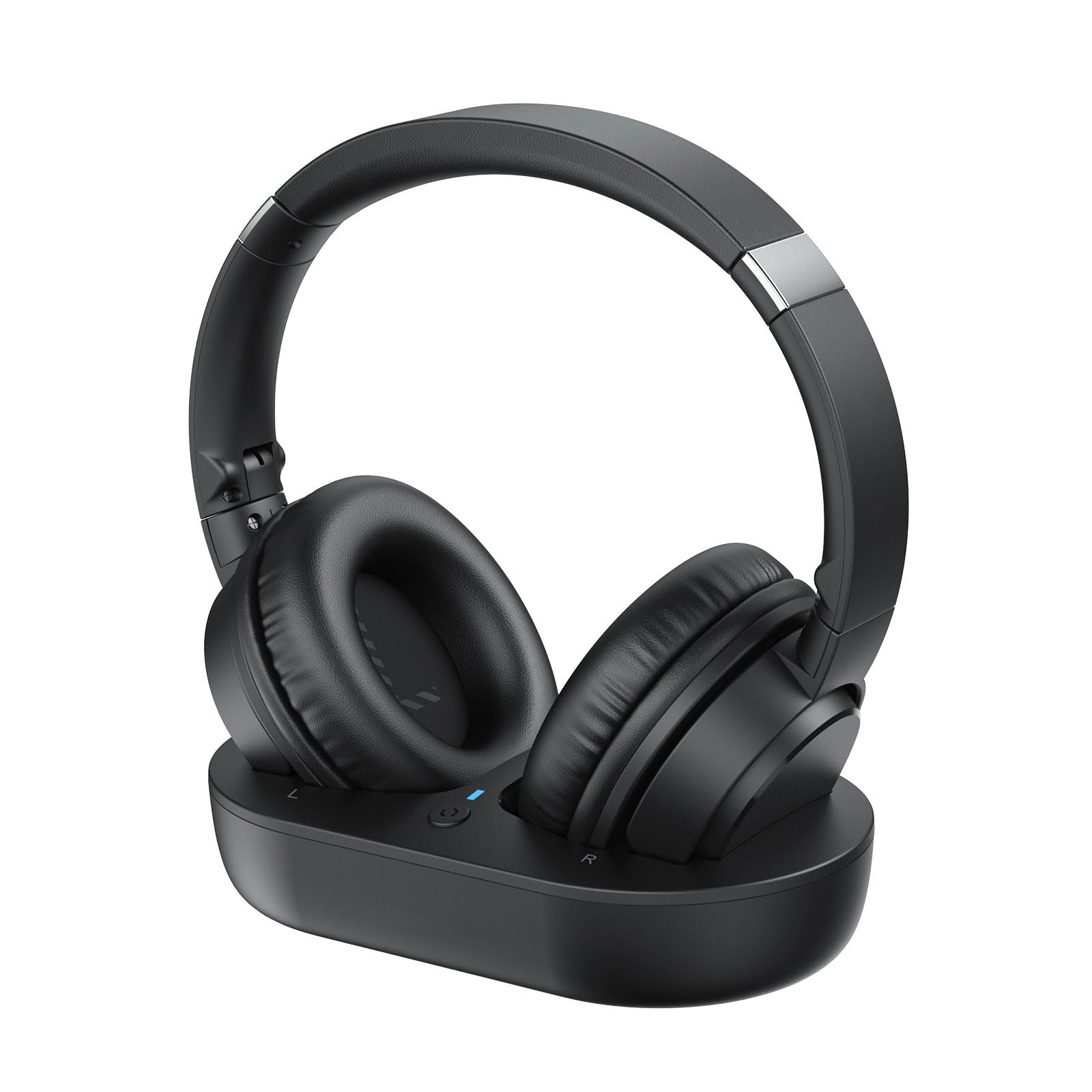
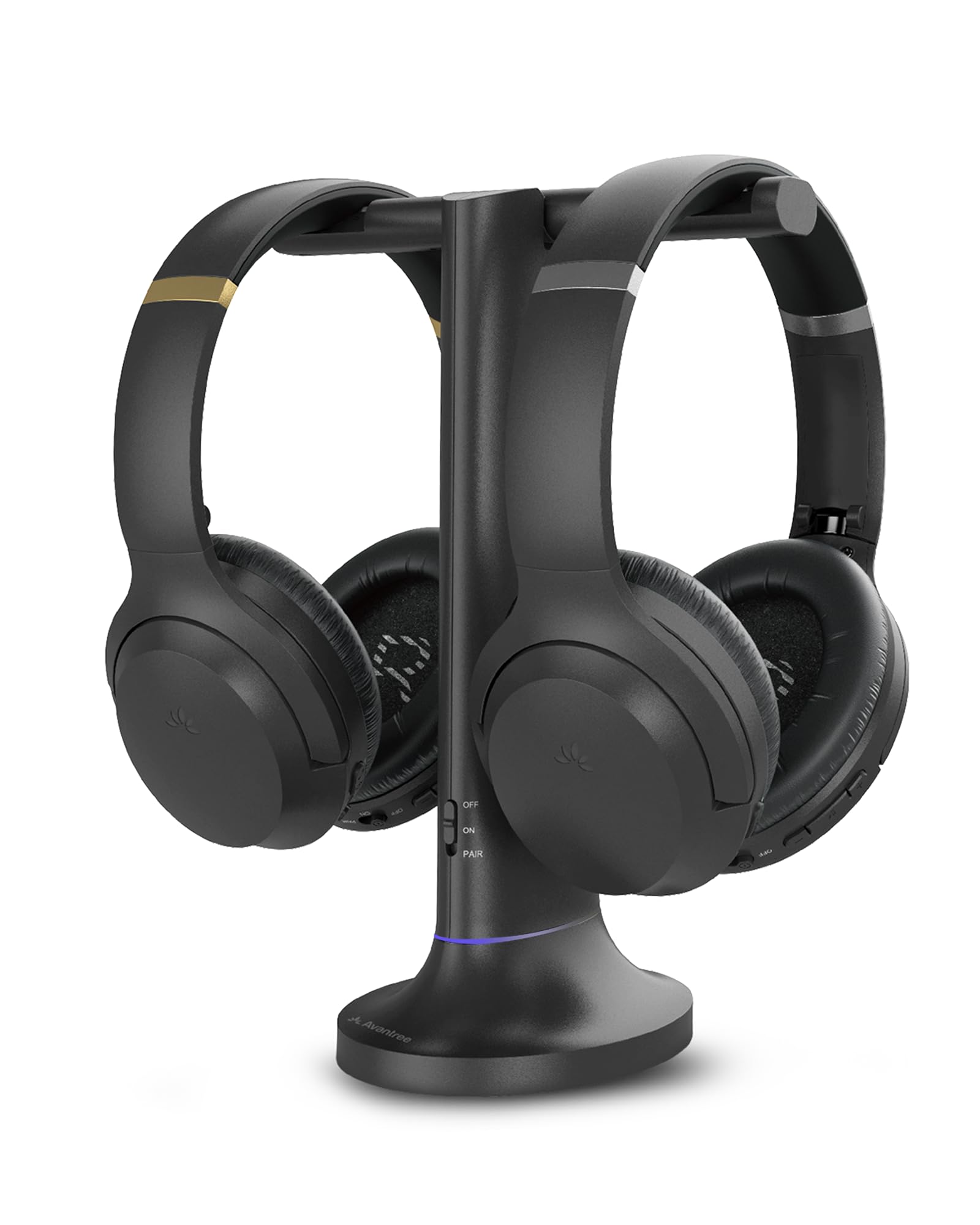
Dialogue-focused tuning puts TV speech front and center, keeping quiet scenes intelligible at moderate volume. The system connects through optical or AUX and adds Bluetooth as a secondary path for tablets and laptops, while latency below 40ms keeps lip-sync tight. A 35-hour battery and charging dock remove the nightly hunt for a cable, and the dock gives the headset a fixed home between sessions. The input set covers the TV audio outputs found on a wide range of living-room setups that still offer optical or AUX.

The sound signature favors speech over deep bass, which makes dramas, news, and late-night comedies clearer than a flat TV speaker. Movie effects still have enough body to avoid sounding thin, but this is not a bass-forward music headphone. The tuning choice aligns with TV audio rather than general music listening, so buyers wanting a music-first headphone should look beyond this category.

The dock-based routine fits shared households that want TV volume down without muting the room. The padded earcups and simple physical controls stay comfortable through long viewing sessions, and setup can be limited to connecting the optical cable and adjusting the audio output. The headset returns to the dock after each session, so the battery stays ready for the next evening.

Range up to 100ft allows a listener to move between rooms without dropping the TV feed, though walls and adjacent wireless gear can shorten that distance. The wireless link lets a viewer watch late at night without raising the TV speaker volume.

Comfort is built around staying put: the ear cushions are soft enough for a two-hour movie, and the physical controls are easy to use during a dark scene. There is no app to configure, which suits users who want a simple TV-only setup.

This is the single-user TV audio system for seniors and non-technical users who want clear dialogue without app dependence. Buyers with HDMI-only TVs should look to the HDMI ARC model, and dual-listener households should choose the two-headphone system. The main durability boundary is physical: the plastic headband and charging dock contacts can become less dependable after months in some units, so users who expect a rugged headband beyond a couple years should weigh that before buying.

💡 Store the headset on its dock after each session so the battery is ready for the next TV session.

Pros

  • Dialogue-focused audio keeps TV speech clear at moderate volume.
  • Day-to-day TV listening holds up across regular viewing sessions.
  • Fit and finish feel tidy for a dock-based TV system.
  • Optical and AUX setup is simple enough for non-technical users.
  • Padded over-ear fit stays comfortable through long movies.

Cons

  • Pairing over optical or Bluetooth can require a re-pairing step after moving the dock.
  • Dock charging may not engage until the headset is reseated and contacts are clean.
  • The plastic headband can crack or separate near the earcup after months of use.
Our verdict

For single-user TV audio with clear dialogue and dock-based convenience, the Avantree Ensemble remains the benchmark. Physical durability is the only caveat that should give long-term users pause.
Check Latest Price
2

Best Budget Wireless

SKYCOMET HS010

85 /100
Sound Score Excellent

Key details

Low Latency
<40ms
TV Compatibility
Optical / AUX / RCA
Dialogue / Volume
40mm drivers
Range / Stability
100ft Bluetooth 5.2
View on Amazon

The SKYCOMET HS010 pairs a 65-hour battery with a drop-in charging dock at a budget price, while keeping the TV-specific inputs and low-latency Bluetooth 5.2 that matter for clear dialogue and lip-sync. That combination makes it the value alternative to the top pick for single-user TV viewing.

Dialogue is the strongest part of the sound profile. The 40mm drivers keep speech clear and balanced, and passive isolation helps reduce room noise without active noise cancellation. Long viewing sessions stay comfortable, and the charging dock removes the nightly hunt for a charging cable.

The Bluetooth 5.2 link adds flexibility for tablets and laptops when the TV is off, while the optical, AUX, and RCA inputs remain the core path for television audio. Latency stays low enough that on-screen speech does not visibly trail, and setup is usually limited to selecting the right input on the base.

This is for budget-conscious TV viewers, late-night watchers, and seniors who want simple dock charging and week-long battery life between sessions. It is not the right pick for buyers who need guaranteed long-term structural durability or premium active noise cancellation. Occasional wireless reconnects can appear in RF-crowded rooms, so households with densely packed media cabinets may prefer a dedicated base station.

💡 Keep the charging base in clear line of sight to the TV and away from nearby routers or USB hubs if you hear intermittent reconnects.

Pros

  • 65-hour battery and dock charging keep late-night TV sessions going without constant cable management.
  • Clear, balanced dialogue from 40mm drivers makes news and movie speech easy to follow.
  • Optical, AUX, RCA, and Bluetooth 5.2 inputs cover most TV setups with minimal configuration.
  • Over-ear cushions remain comfortable for long sessions, which suits movie marathons and late-night viewing.

Cons

  • Wireless link can occasionally drop and reconnect in RF-crowded rooms, interrupting TV audio.
  • Structural durability varies between units, with stress possible at headband or earcup joints after months.
Our verdict

The SKYCOMET HS010 is the budget TV headphone for single-viewer households that want 65 hours of battery and dock charging without paying for premium RF range or active noise cancellation.

Check Latest Price
3

Best for Two Viewers

Avantree Duet

86 /100
Sound Score Excellent

Key details

Low Latency
30ms
TV Compatibility
—
Dialogue / Volume
Clear Voice + volume boost
Range / Stability
2.4GHz RF, no pairing
View on Amazon

The Avantree Duet is built around a different use case than the single-listener top pick: it includes two closed-back headphones and a 2.4GHz RF transmitter dock, so two people can watch the same TV at their own volume levels without pairing screens or Bluetooth audio lag. The signal path stays around 30ms, keeping speech locked to mouths on TV content.

This configuration fits households where two viewers want independent volume controls and a fixed dock that charges both headphones between sessions. Single viewers looking for the strongest all-round solo value should stay with the single-user top pick. The tradeoff is structural care and occasional dock resets: the plastic headband and earcup pivot can crack under rough handling, and charging or pairing may need a reset. Buyers who store the cups on the dock and handle the set by the headband rather than the ear pads will absorb those tradeoffs more comfortably.

Dialogue-forward sound is the main practical strength. Clear Voice plus a volume boost keeps voices intelligible at moderate levels, and the 20-hour battery per headphone is enough for several evenings before both cups return to the dock. The dock itself also solves the second-headphone storage problem, which matters more in a two-person household than in a solo setup.

💡 Connect the transmitter dock to the TV's optical output if possible, and place it at seated ear height for a more consistent 2.4GHz signal.

Pros

  • Clear dialogue and voice reproduction make TV speech easier to follow at moderate volume.
  • Optical or AUX setup through the dock avoids Bluetooth pairing menus for both headphones.
  • Over-ear pads and moderate clamp keep longer movie sessions comfortable.
  • 20-hour battery life per headphone covers several nights between charges.

Cons

  • The RF link can drop when a headphone is carried into another room and may need a reset.
  • The plastic headband and earcup pivot can crack if the set is packed tightly or flexed hard.
  • Dock charging can be interrupted when a headphone becomes unresponsive and needs a reset or replacement.
Our verdict

For two-person TV households that want independent volume controls, the Duet is the more focused dual-listener alternative to the single-user top pick.

Check Latest Price
4

Premium RF Pick

Sennheiser RS 175

88 /100
Sound Score Excellent

Key details

Low Latency
—
TV Compatibility
RF Kleer
Dialogue / Volume
Bass boost / surround
Range / Stability
100m RF Kleer
View on Amazon

The RS 175 separates itself from the newer Sennheiser option by prioritizing raw RF range over newer wireless features. Kleer RF transmission holds a signal up to 100 meters through walls and floors, and the dedicated link keeps latency low. That reach exceeds typical Bluetooth TV headphones without requiring line-of-sight.

Bass boost and surround modes add weight to explosions and space to ambient effects without burying dialogue. The tuning favors cinematic playback rather than clinical flatness, so late-night listening still carries body at moderate volume.

Setup follows the dock path: optical or 3.5mm input to the transmitter, headphones parked on the charging station. The over-ear pads and headband maintain comfort through a film or a full game.

That 100m range suits audiophile-minded TV viewers who move from room to room and want audio to follow. Battery life is shorter than the category norm at 18 hours, and long-term durability can vary between units. Buyers who prioritize Sennheiser tuning and broad RF coverage over marathon battery life will absorb those tradeoffs; budget-focused shoppers and 40-hour marathon viewers should look elsewhere.

💡 Keep the charging contacts clean and fully seat the headphones in the dock after each viewing session to get consistent charging.

Pros

  • Bass boost and surround modes add cinematic weight and spaciousness to TV audio.
  • 100m RF range carries the signal across a full home without line-of-sight.
  • Padded over-ear design keeps longer viewing sessions comfortable.
  • Simple dock hookup works with optical or 3.5mm TV outputs.

Cons

  • 18-hour battery means recharging more often than long-battery alternatives.
  • Charging dock contact alignment can affect whether headphones receive a full charge.
  • Long-term durability under daily use can vary between units.
Our verdict

The RS 175 suits a specific pair of priorities: broad RF reach and Sennheiser's bass-forward sound.

Check Latest Price
5

Best Wired Long-Cord

Joysico YL2

83 /100
Sound Score Excellent

Key details

Low Latency
No wireless latency
TV Compatibility
3.5mm wired
Dialogue / Volume
40mm drivers
Range / Stability
19.5ft coiled cord
View on Amazon

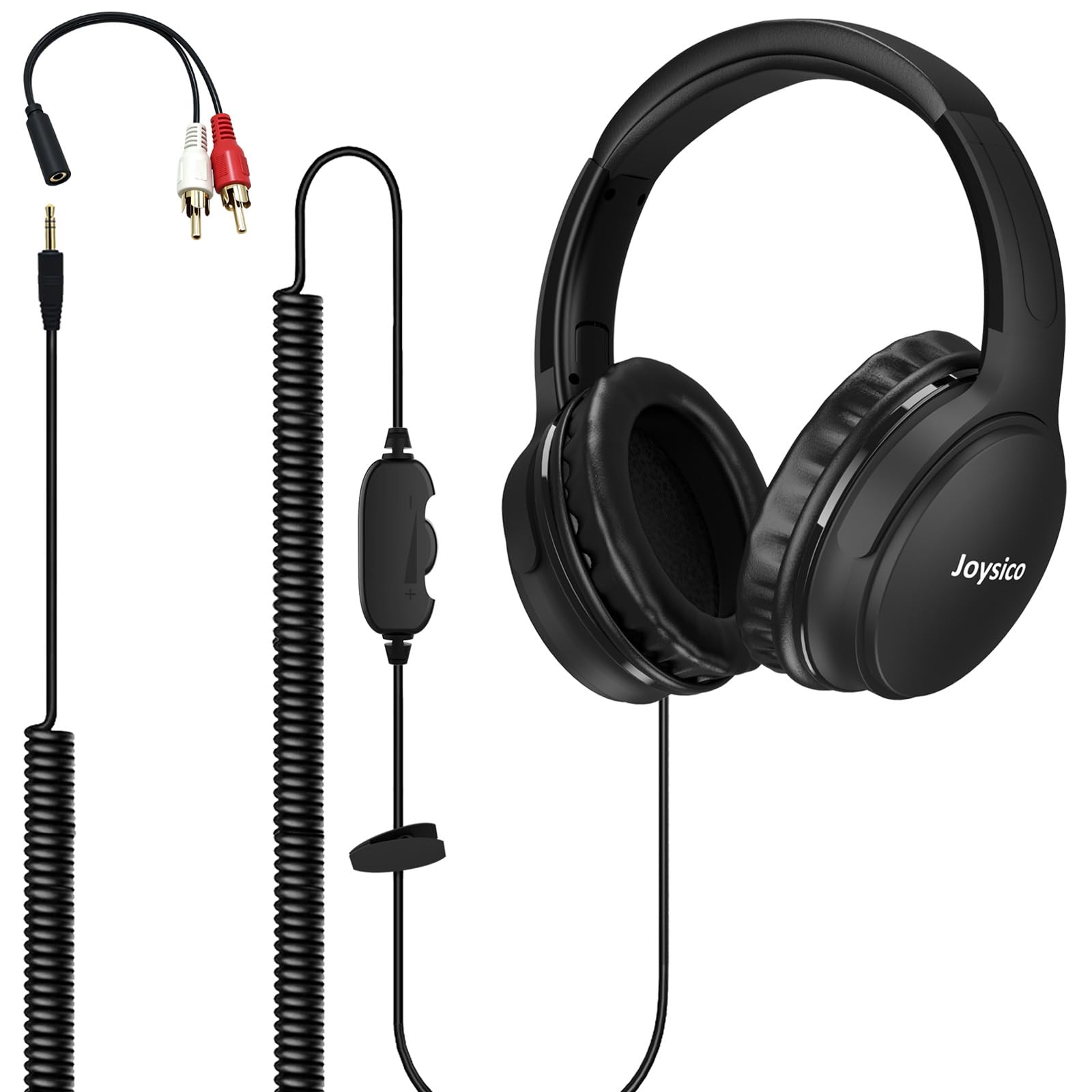
The 19.5-foot coiled cord gives this model a clear role against straight-cord budget alternatives: it stretches from TV to bed or couch while staying tidier, and it removes the need for charging, pairing, or a transmitter dock. The 40mm drivers keep television dialogue legible through the standard 3.5mm connection.

The audio performance is balanced around TV programming rather than heavy bass. Clarity matters here, and the sound signature supports spoken content, panel shows, and sports without adding the fatigue that some wireless TV audio chains can introduce.

The buyer profile is specific: a budget-conscious TV watcher with a 3.5mm headphone output who wants a corded, always-ready option. The plastic headband and moderate volume ceiling set the boundaries. Gentle handling and standard listening levels are part of the deal, making rough daily handling or severe hearing support the wrong use case.

No battery means no charging dock to align and no RF channel to manage; audio follows the cable as long as the TV has a headphone output. That keeps this headphone well matched to a fixed TV setup where the listener stays within cord range.

Pros

  • 19.5-foot coiled cord reaches from TV to seating without battery anxiety or pairing lag.
  • Dialogue comes through clearly for TV shows, movies, and sports.
  • Simple 3.5mm setup works with TVs that have a headphone output.
  • Budget-friendly wired design offers comfortable long-session TV listening.

Cons

  • Plastic headband can crack or snap under rough handling.
  • Maximum volume may be too low for certain hearing needs or low-output TV jacks.
Our verdict

For a corded TV headphone with this much reach, it is a pragmatic budget pick for gentle use and normal listening levels.

Check Latest Price
6

Best Independent-Volume Design

ZUPVIY M98A

85 /100
Sound Score Excellent

Key details

Low Latency
2.4GHz low latency
TV Compatibility
Optical / AUX / RCA / USB
Dialogue / Volume
Per-ear volume boost
Range / Stability
2.4GHz RF + Bluetooth 5.0
View on Amazon

The ZUPVIY M98A puts the emphasis on low-latency 2.4GHz RF TV audio rather than Bluetooth-native pairing. Independent volume controls on the headset let two viewers with different hearing needs listen at the same time without changing the TV's master volume. The transmitter accepts optical, AUX, RCA, or USB input, so it can sit between the television and an older display or a newer optical-only set. Bluetooth 5.0 is present as a secondary link for non-TV audio, while the dock auto-connects once the RF pairing is set.

The right buyer is a budget-conscious TV watcher, especially a senior or hearing-impaired viewer who wants independent volume without turning up the room for others. Sports fans who notice lip-sync drift also get the low-latency benefit, and the over-ear fit is comfortable enough for a full game day. The main boundary is unit-to-unit variation: some sets need repeated pairing steps or a quick input check before the transmitter is mounted permanently. This is not a pick for buyers expecting premium materials or a fully Bluetooth-native pairing experience; Bluetooth here is a secondary feature, not the main event.

💡 When setting up, select the optical or AUX input on the transmitter first, then power on the headphones to help the RF link connect more quickly.

Pros

  • Crystal-clear dialogue and effects for TV audio.
  • Low-latency 2.4GHz RF keeps lip sync tight for sports and dialogue.
  • Independent per-ear volume suits two viewers with different hearing needs.
  • Comfortable over-ear fit supports long viewing sessions.

Cons

  • Initial pairing can take repeated attempts before the dock locks in.
  • Out-of-box input behavior can vary, so check audio routing before placing the transmitter.
Our verdict

For budget TV watchers who need independent volume and tight lip sync, the ZUPVIY M98A is a focused value pick. Its strongest case is a single-TV setup for seniors or sports fans, not a Bluetooth-first accessory.

Check Latest Price
7

Budget Wireless Alternative

Swiitech CH-211

88 /100
Sound Score Excellent

Key details

Low Latency
<40ms
TV Compatibility
Optical / AUX / RCA
Dialogue / Volume
—
Range / Stability
100ft Bluetooth 5.3
View on Amazon

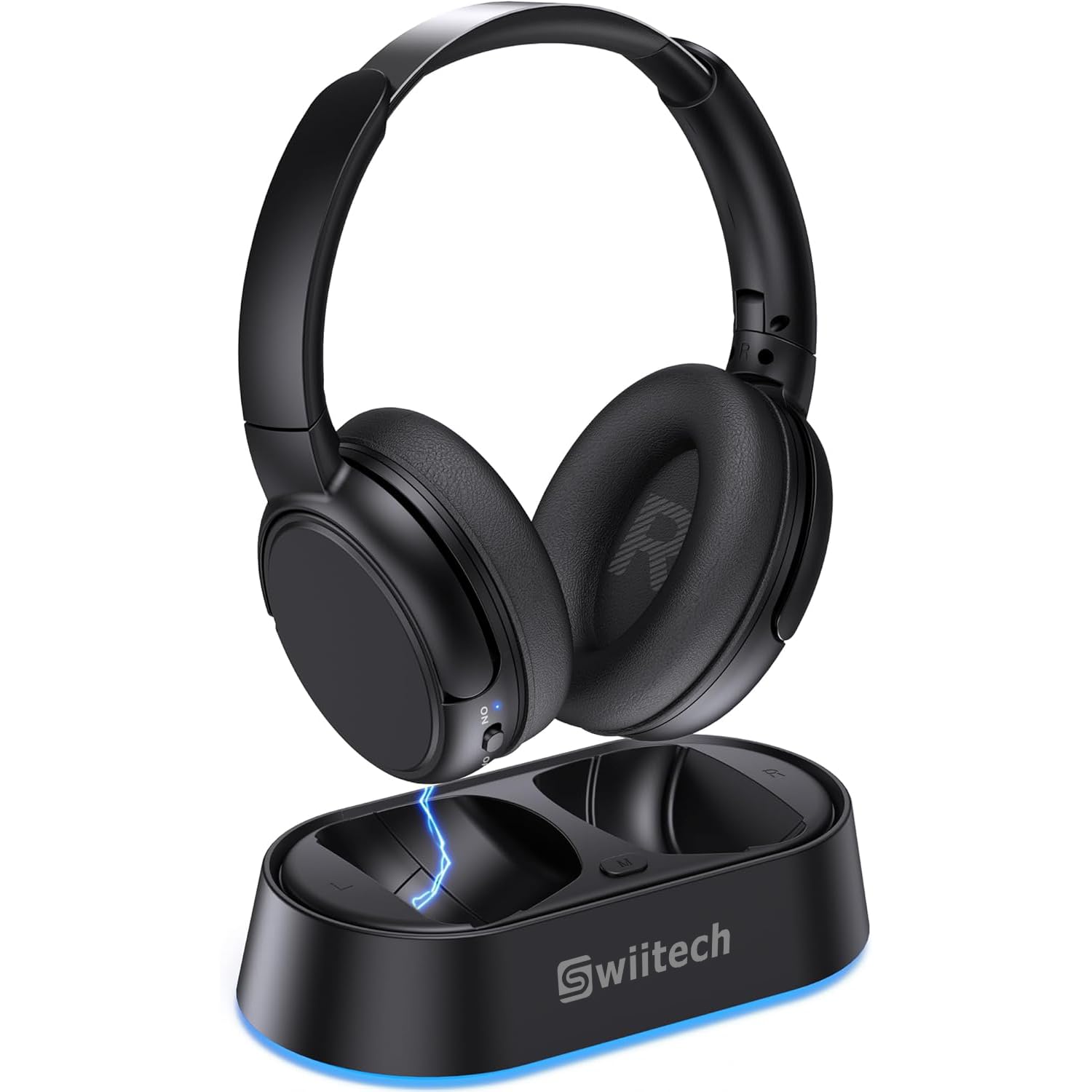
The Swiitech CH-211 gets the core TV-headphone equation right: a charging dock with optical, AUX, and RCA inputs, a 45-hour battery, and Bluetooth 5.3 for phone or computer audio. Clear voice reproduction and quick pairing support late-night viewing and senior listeners who want a low-hassle dock routine. The long-term durability picture is less documented than the budget benchmark, so this remains an alternative rather than the first budget choice. It is a single-user system, not a dual-headphone setup, and works best for solo viewers.

Pros

  • Plug-and-play dock setup with optical, AUX, and RCA inputs covers most TV audio outputs.
  • 45-hour battery with dock charging supports long sessions without frequent recharging.
  • Clear voice-forward sound keeps dialogue intelligible during quiet late-night viewing.

Cons

  • No passive wired mode when the battery is empty, so charging is required.
  • Does not support a second headphone pair with independent volume controls.
Our verdict

This is a sensible budget-tier option for late-night TV listeners who want dock charging and Bluetooth flexibility without paying for premium range.

Check Latest Price
8

Straight-Cord Wired

DUNGZDUZ TV-H6

80 /100
Sound Score Excellent

Key details

Low Latency
No wireless latency
TV Compatibility
3.5mm / RCA / USB-A
Dialogue / Volume
40mm drivers
Range / Stability
20ft straight cord
View on Amazon

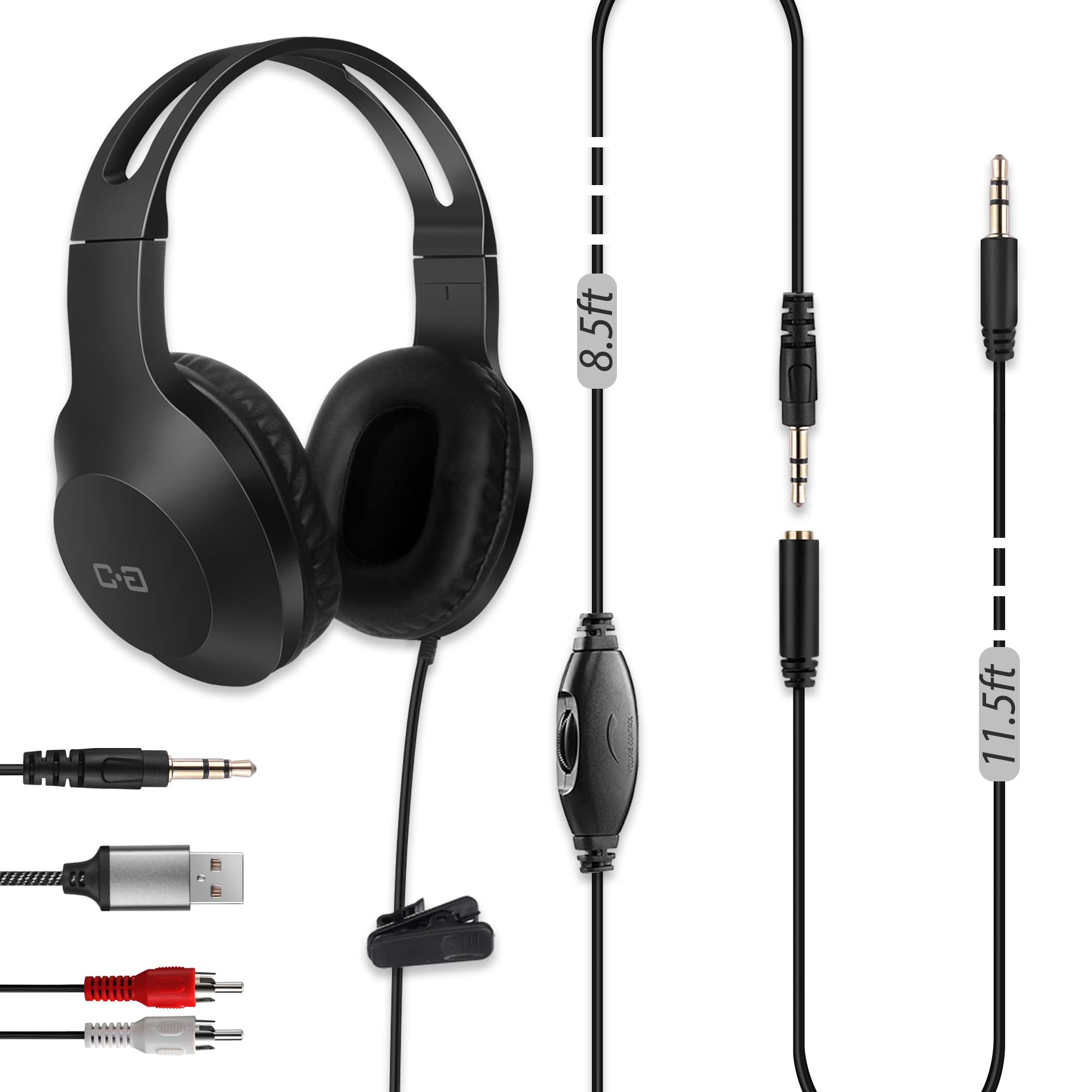
The strongest case for this set is simplicity. A 20-foot straight cord reaches from a TV or set-top box to a chair or bed with no charging dock, pairing step, or battery to replace. The 40mm driver keeps television dialogue clear enough for everyday viewing, and the padded over-ear fit stays comfortable through a movie.

The boundary is output support. This headphone needs a TV or source with a 3.5mm headphone jack, RCA stereo output, or USB-A audio output; setups without one of those outputs are outside its reach. Audio can sound thin for some content, but at this budget tier the value holds for compatible setups, keeping it a secondary wired option next to the coiled wired alternative.

Pros

  • 20-foot straight cord reaches a chair or bed without needing a dock
  • No battery or pairing eliminates charging and pairing steps for TV listening
  • Clear TV dialogue for everyday viewing from the 40mm driver

Cons

  • Audio can sound thin on music or bass-heavy programming
  • Requires a TV with 3.5mm, RCA, or USB-A audio output
Our verdict

This fits stationary viewers whose TV has a 3.5mm, RCA, or USB-A output and who want no charging or pairing. It is not for wireless walk-around use or TVs without one of those outputs.

Check Latest Price
9

Next-Gen Sennheiser

Sennheiser RS 275

80 /100
Sound Score Excellent

Key details

Low Latency
—
TV Compatibility
Bluetooth / Auracast
Dialogue / Volume
Speech Clarity / Virtual Surround
Range / Stability
50m Bluetooth Auracast
View on Amazon

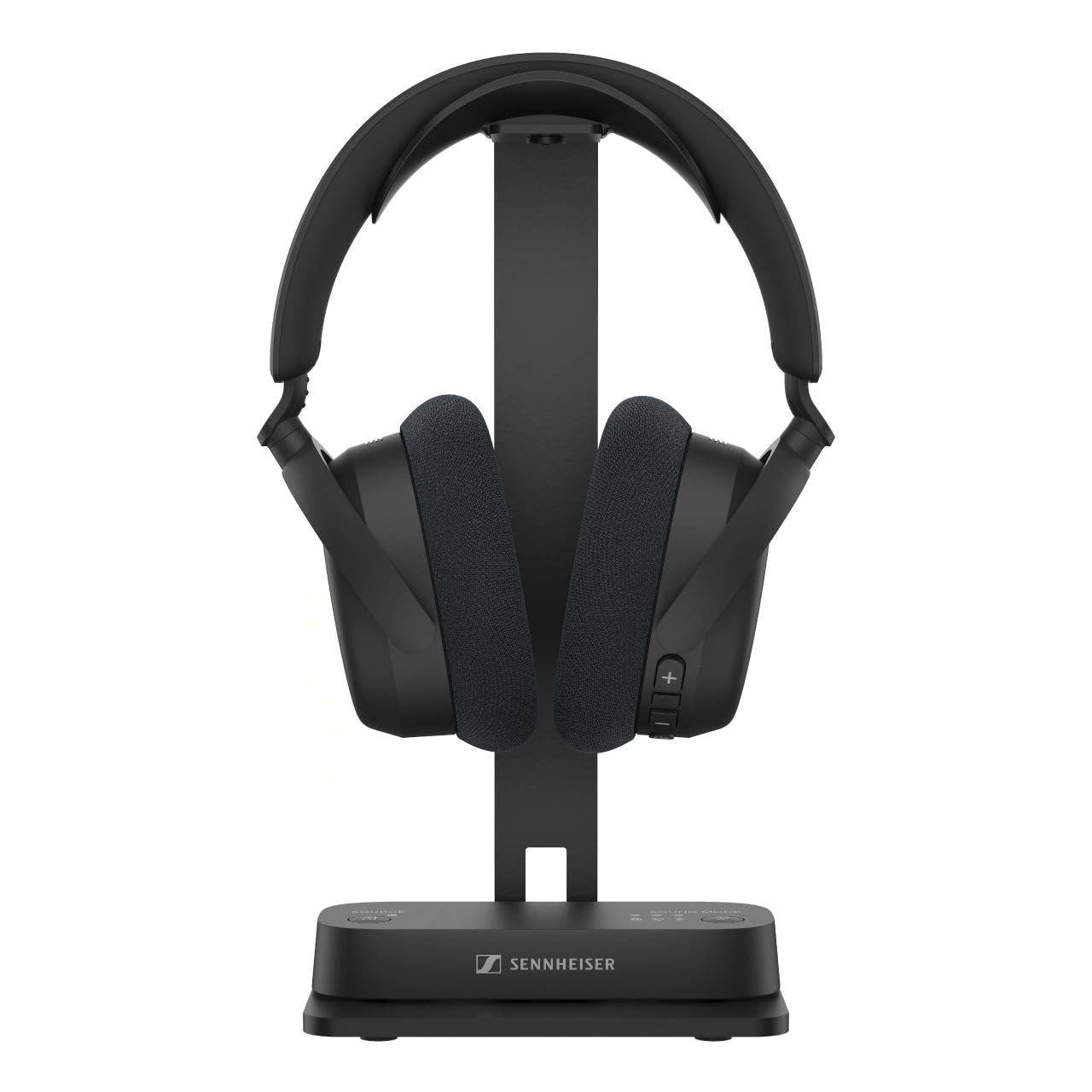
Sennheiser RS 275 centers on battery life and TV-specific sound modes. The 50-hour rating and charging stand keep the headphone out of daily charging interruptions, while speech clarity and virtual surround cover dialogue-heavy shows and movies. Auracast broadcasting offers a forward-looking option for households that want more than one compatible headphone on the same TV audio feed.

Long-term durability under heavy daily use is not yet established at this premium price. That makes the RS 275 a better fit for Sennheiser loyalists who prioritize the current feature set and comfort over a longer ownership record.

Pros

  • Clear speech and virtual surround modes support dialogue-heavy TV content.
  • Lightweight over-ear design suits long viewing sessions.
  • 50-hour battery and charging stand reduce charging interruptions.

Cons

  • Initial pairing can require more steps than the quick-start video suggests.
Our verdict

This fits a specific premium TV-listening niche for Sennheiser loyalists who want 50-hour battery life and Auracast readiness; budget-focused households should look at lower-cost dock systems.

Check Latest Price

How to Choose

Low Audio Latency

Latency is the gap between the picture and the sound. A Bluetooth music headphone may add 100ms to 200ms, which creates a subtle double-tap on dialogue and makes live sports and fast speech look dubbed.

TV-specific systems use dedicated RF or low-latency codecs below about 40ms. If you primarily watch dramas and news, a wireless set that stays at or under 40ms keeps mouth movements and voices locked together.

Range and Connection Stability

The wireless range printed on the box assumes a clear line of sight. Walls, Wi-Fi routers, and Bluetooth traffic can shorten that range and cause dropouts in the next room.

Dedicated 2.4GHz RF transmitters often hold a steadier signal through interior walls than Bluetooth, while Bluetooth and Auracast add flexibility for connecting phones and future devices. Choose based on where you actually sit, not the maximum listed on paper.

Battery Life and Dock Reliability

A 65-hour battery matters less if the charging dock pins lose contact after a few months. Dock-charged headphone batteries can also degrade faster when left on a constantly powered cradle.

Look for a dock that holds the earcups securely and check whether daily placement aligns the charging contacts. For a side-table headphone used every night, reliable dock contact beats an extra 20 hours of claimed battery.

TV Compatibility

Not every headphone works with every TV. Optical and AUX outputs are common on older TVs, while newer slim sets may only offer HDMI ARC or USB audio; a transmitter connected to the wrong output stays silent.

Set the TV audio output to PCM or Stereo for optical connections. Dolby and DTS bitstreams often produce no sound from TV headphone transmitters that lack decoding support, so a matched input and output setting is more important than cable type.

Dialogue Clarity and Volume

Driver size alone does not determine how easy speech is to hear. Midrange-heavy tuning and dedicated clear-voice modes lift the vocal band where consonants live, which helps with fast dialogue.

Hearing-impaired viewers should prioritize independent volume boost over raw driver specs. Many standard TV headphones top out too low for meaningful hearing assistance, so an explicit volume-boost setting is the safer choice.

Frequently Asked Questions