8 Best Loop Station of 2026: Match the Pedal to Your Playing

Find the loop station that fits your memory, rhythm, and workflow needs — no more guessing between simple stompboxes and complex workstations.

Loop stations look similar from the front panel, but the way they behave under your foot is the real difference. Many players buy on memory size and drum patterns, only to discover that footswitch timing and menu depth shape every practice session. The right loop station disappears into your playing; the wrong one makes you fight the pedal.

The main division in this category is instant one-button looping versus feature-dense multi-memory stations. A simple loop is fast to use but limits how many parts you can recall, while a memory-heavy station offers song structure, rhythms, and MIDI in exchange for a steeper learning curve. Choosing between those trade-offs matters more than any single spec.

This guide sorts the category by the specs that actually affect your workflow: loop slots, recording time, built-in rhythms, audio quality, and control design. Match those to the way you play, and you get a pedal that supports your next step instead of limiting it.

About the Sound Score: This comparative score is calculated from a product's published customer rating and review volume. It is not a laboratory measurement or a hands-on test result.

2

Easiest Looper

TC Ditto Looper

90 /100
Sound Score Outstanding

Key details

Loop Tracks
Single loop
UI & Workflow
One-button operation
Record & Memory
5 minutes, no storage
Rhythms & Drums
View on Amazon

The Ditto Looper is a one-button, no-menu dedicated looper with a five-minute loop window and clean analog dry-through. Tap once to record, again to overdub, and again to play back; there is no roster of modes to interpret mid-jam. True bypass preserves your guitar signal when the pedal is off, and the compact stompbox footprint leaves room on a small pedalboard. It is also fun to layer a simple chord progression into a full backing part before you think about recording.

That simplicity suits complete beginners and bedroom guitarists who want a loop under their fingers without studying a manual. It also rewards players who keep their pedalboard small: the Ditto takes up no more space than a standard stompbox, so you can pair it with a drive or delay without rearranging everything. The loop erases when power is removed and the 9V adapter is sold separately, so budget for an adapter and use the Ditto as a practice-time tool rather than a saved-idea library.

Pros

  • One-button operation removes the learning curve for recording, overdubbing, and playback.
  • Analog dry-through and true bypass keep the guitar signal clean and free of tone loss.
  • Compact size and immediate looping make it a natural practice companion.

Cons

  • No battery compartment for standalone practice away from an outlet.
  • Single loop slot limits live players who want to switch between song sections.
Our verdict

For players who value playing time over menu time, the Ditto is the most direct dedicated looper in this guide.

Check Latest Price
3

Best Budget Multi-Looper

LEKATO Looper (9 Slot)

88 /100
Sound Score Excellent

Key details

Loop Tracks
9 saveable loops
UI & Workflow
Single footswitch, tuner
Record & Memory
40 min, 9 loops
Rhythms & Drums
View on Amazon

The LEKATO Looper packs nine saveable loop slots, a built-in tuner, and USB WAV transfer into a single-footswitch pedal at budget pricing. The 40-minute total recording time splits into ten minutes per slot, and the 48kHz/24-bit audio path with analog dry-through keeps the guitar signal clean while the looper is off.

Loop start/stop timing holds steady for practice and small-venue playing, and the tuner responds quickly through the same control layout. That combination of memory depth and simple utilities is rare at this price, which is why the LEKATO works as a song-bank pedal rather than just a one-loop practice box.

This is a good fit for budget-conscious guitarists who want to store separate WAV-backed loops for different songs and have a tuner in the same housing. Quality control varies between units, so test the footswitch and all nine slots as soon as the pedal arrives.

Pros

  • Nine saveable WAV loops, a built-in tuner, and USB file transfer deliver a high memory-to-price ratio.
  • Simple operation and quick setup make it approachable for players new to looping.
  • Clean 48kHz/24-bit audio and analog dry-through preserve guitar tone while bypassed.

Cons

  • No stereo or multi-track looping, so layered live arrangements stay beyond its reach.
  • One footswitch cycles through slots sequentially, making direct mid-song loop jumps cumbersome.
Our verdict

A cost-effective way to keep a bank of WAV-backed song loops and a tuner on one small pedalboard without giving up clean audio.

Check Latest Price
4

Best Budget Looper + Drums

Donner Circle Looper

86 /100
Sound Score Excellent

Key details

Loop Tracks
40 memory slots
UI & Workflow
LCD screen, footswitch
Record & Memory
160 min, 40 slots
Rhythms & Drums
110 grooves, 11 styles
View on Amazon

Donner packs 110 drum grooves, 11 styles, and 40 loop slots into a single box with a bright LCD screen, making it a one-stop rhythm section for players who practice at home. The layout keeps the main functions visible, so you can start a groove and lay down an overdub without hunting through menus.

The 160-minute total memory (four minutes per slot) holds enough material for multipart practice sessions, and USB import/export makes it easy to move WAV files on and off the unit. For guitarists and bassists, the drum library removes the need for a separate metronome or backing track app.

This is a rhythm-companion practice tool rather than a multi-track live workstation. Home players and buskers who want a drum groove under every loop will get the most from it; footswitch consistency can vary between units, so test the switch with repeated stomps before relying on it at a gig.

Pros

  • Clear screen and logical controls get you from drum groove to overdub quickly.
  • One pedal replaces both looper and drum machine, saving space and setup time for practice rigs.
  • Drum sounds are solid and loop timing holds up for daily practice and busking.

Cons

  • In dense overdubs, loop playback can develop a choppy edge
  • Playback volume can drop during longer looping sessions in certain cases, so check levels after several layers.
Our verdict

The Circle's practical value is in giving guitarists and bassists a drum-backed practice partner with fewer cables and no second device.

Check Latest Price
5

Most Features for the Money

FLAMMA FF20

80 /100
Sound Score Excellent

Key details

Loop Tracks
100 loop slots
UI & Workflow
2-inch screen, menus
Record & Memory
300 min, 100 slots
Rhythms & Drums
220 grooves, 11 styles
View on Amazon

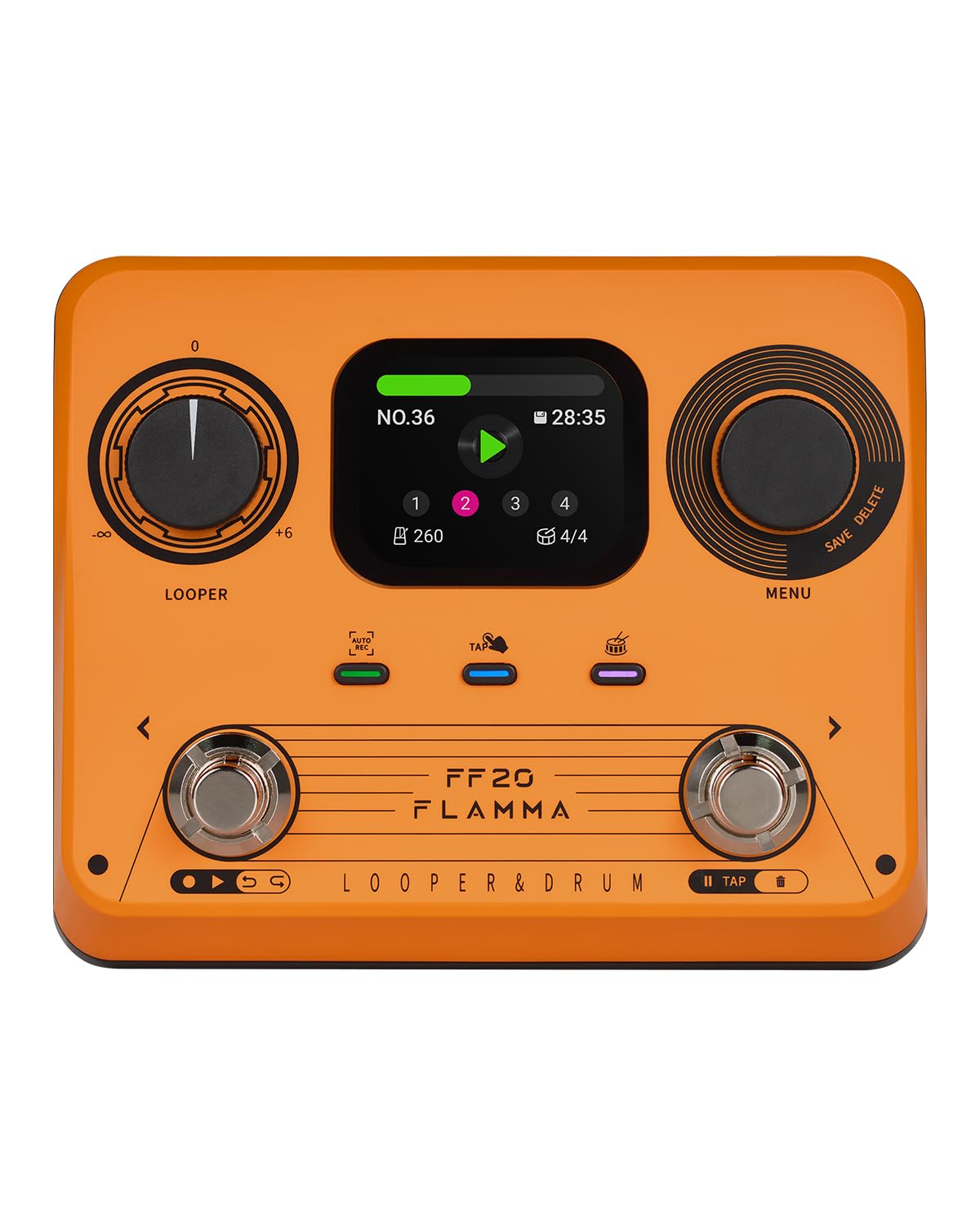
The FF20 is the most feature-dense looper in the budget class: 100 loop slots, 220 drum grooves, time-stretch, and a 2-inch color screen, with 300 minutes of recording space. The built-in drum machine and headphone out make it a complete practice station, and the BPM and tap controls sit close at hand for quick adjustments.

The color screen and dedicated BPM controls make navigation easier than the spec sheet suggests; this is not a zero-menu stompbox, but the front panel gets you to the important functions quickly.

The right owner is a feature-hungry budget guitarist who wants a looper, drum machine, and headphone practice in one box. The interface depth and live-loop quirks are the tradeoff for that density, making it a strong practice tool rather than a gig-workhorse.

💡 Pre-build a few loop slots with the drum grooves before a show; saved material means fewer menu moves on stage.

Pros

  • A deep practice hub: 100 loop slots, 220 drum grooves, and time-stretch in a budget floor pedal.
  • High feature-per-dollar value
  • BPM, drum patterns, and tap tempo are easy to adjust from the front panel.

Cons

  • The menu system is steeper than one-button loopers, and the first sessions can require map-reading before it feels natural.
  • In a live setting, loop timing can waver; bedroom and headphone practice are less demanding contexts.
Our verdict

The FF20 gives budget players a full practice room — loops, drums, and headphone out — without spending multi-pedal money.

Check Latest Price
6

Beatboxers, Vocalists

BOSS RC-505 Mk2

87 /100
Sound Score Excellent

Key details

Loop Tracks
5 stereo tracks
UI & Workflow
Tabletop controls
Record & Memory
Rhythms & Drums
Rhythm generator
View on Amazon

The RC-505 Mk2 puts five stereo loop tracks and two XLR mic inputs with phantom power on a desktop surface, giving vocalists and beatboxers immediate hands-on control over every overdub. Its tabletop layout suits a desk rig rather than a pedalboard, and the premium price plus large footprint doesn't make sense for guitarists who only need a simple floor looper. For electronic musicians and multi-instrumentalists working with mic and line signals, the five-track workflow and rhythm generator justify the desk space.

Pros

  • Dedicated XLR mic inputs with phantom power let vocalists and beatboxers plug directly in without an extra interface.
  • Five stereo loop tracks and hands-on fader/button controls support layered live performances from a desktop position.

Cons

  • The tabletop footprint and premium price shut out guitarists who just want a one-button floor looper.
Our verdict

When vocalists or beatboxers are tied to a desk anyway, the five-track workspace and phantom-powered mic inputs make that footprint worthwhile.

Check Latest Price
7

Song-Section Loops

Donner Triple Looper

84 /100
Sound Score Excellent

Key details

Loop Tracks
3 loop slots
UI & Workflow
Progress display
Record & Memory
90 min, 3 slots
Rhythms & Drums
View on Amazon

The Donner Triple Looper's three independent auto-saving loop slots with true bypass and a progress-bar display make verse, chorus, and solo sections easy to organize without workstation menus. Playback is clean enough for practice and home recording, though some units can freeze or refuse to power on — a unit-to-unit consistency issue that pushes it below higher-tier loopers. For songwriters on a budget, the three slots are strong value; for critical live gigs, test every slot before relying on it.

Pros

  • Three auto-saving loop slots keep verse, chorus, and solo sections separate for structured song practice.
  • Bright progress display and true bypass keep loop position visible and dry tone transparent.

Cons

  • In quiet practice, playback can carry an audible hiss on some units.
Our verdict

Best for songwriters who want separate song-section loops and auto-save without workstation menus; buy from a retailer with a flexible return policy.

Check Latest Price
8

Portable Practice

M-VAVE Circle Looper

79 /100
Sound Score Very Good

Key details

Loop Tracks
4 loop song slots
UI & Workflow
App editing, compact
Record & Memory
11 min, 4 slots
Rhythms & Drums
30 preset patterns
View on Amazon

The M-VAVE Circle Looper is a portable practice tool with 30 preset drum patterns, a built-in tuner, headphone out, USB power, and app editing in a small pedal. The four loop slots and 11-minute total recording cap keep it in practice territory, not full-set live performance. Mobile players and beginners who want a grab-and-go looper/drum machine will find the size and price easy to live with.

Pros

  • Pocket-sized shell with USB power and headphone out works as a grab-and-go practice companion.
  • App editing and 30 drum presets deliver strong budget value.

Cons

  • Sound quality can be uneven at the margins, which matters most for critical listening.
Our verdict

For mobile players and beginners who want a portable practice looper with drum patterns, this is a budget-friendly fit.

Check Latest Price
9

Compact Practice

LEKATO Sync Looper

85 /100
Sound Score Excellent

Key details

Loop Tracks
3 saveable loops
UI & Workflow
Graphic display, sync
Record & Memory
18 min, 3 loops
Rhythms & Drums
View on Amazon

The LEKATO Sync Looper puts three saveable loops, synchronous recording, a built-in tuner, and a graphic progress display in a mini pedal that fits crowded boards. Budget pricing and a metal casing make it an easy pick for quick practice loops. The compact sync focus is its main identity; players with more than three saved loops should step up to the LEKATO 9, and noise-sensitive users should plan around clean power and low-gain amp settings.

Pros

  • Combines sync recording, a tuner, and three saveable loops at a budget-friendly price.
  • Graphic progress display makes loop timing easy to see during live play.

Cons

  • In quiet or high-gain rigs, a hiss can sit alongside the dry signal.
Our verdict

For small-board practice sessions, the LEKATO Sync Looper's combo of tuner, sync, and visual loop position makes it an easy addition.

Check Latest Price

How to Choose

Independent Loops and Song Sections

A single-loop pedal is one timeline: you can layer overdubs, but you cannot jump to a separate verse or chorus without erasing everything. Multi-slot pedals store distinct loops in memory and recall them with a switch, and multi-track loopers play several loops at once.

If you practice single riffs, one slot is enough. If you perform original songs or loop multiple instruments, look for three or more slots or at least two tracks.

Recording Time and Memory

Record time is set by the pedal's internal memory and audio quality. A 5-minute loop is plenty for daily practice, while a 13-hour looper can hold full arrangements. The bigger issue is whether loops survive a power cycle: models without flash memory erase everything when unplugged.

If you want to keep song sketches or build a repeatable live set, check for phrase memory or save slots and confirm loops are retained automatically after power-off.

Built-In Drums and Rhythms

The drum engine locks loop recording to a selected BPM, which keeps layers tight and exposes timing mistakes. More patterns and kits sound musical instead of synthetic, which is why drum-equipped loopers are popular practice tools.

Solo performers get a backing band from the same box, but the menus that control rhythms add complexity. For players who never play to a beat, a looper without drums is simpler.

Stereo Signal Path and Audio Quality

Stereo I/O preserves wide delays, modulation, and dual-amp tones; a mono looper sums them. Higher-resolution processing reduces noise buildup as layers accumulate. Analog dry-through keeps your unaffected tone clean when the looper is off, which matters when the pedal is always in the signal chain.

Controls, Menus, and Workflow

One-button loopers map record, overdub, stop, and undo to different switch actions. The simplicity is attractive, but double-tap timing can feel risky on stage. Menu-driven loopers offer deeper control but force you to navigate screens for basic settings.

Match the interface to your playing environment. Live looping rewards pedals where every function is one obvious step away; bedroom practice leaves room for menu exploration.

Frequently Asked Questions