5 Best MIDI Foot Controller of 2026: Match Programming to Your Rig

Find a MIDI foot controller that matches how you actually work — programming ease, connection stability, and footswitch feel.

MIDI foot controllers are easy to compare on paper: switch counts, presets, and wireless specs dominate the spec sheet. The real difference shows up in the first programming session, where a full-size floorboard can demand an editor and a few tutorials before it sends a single program change. This guide focuses on models whose workflow you can live with, not just the longest feature list.

A second quiet divide sits between size and control. Full-size boards with expression pedals give you a complete live setup but dominate a pedalboard, while compact 10-switch units pack modern features into a smaller footprint with a steeper setup curve. Matching that trade-off to your playing situation matters more than chasing the most MIDI messages.

Wireless adds a boundary: Bluetooth is convenient for home use, but a dropped connection rules it out for a critical gig unless tested first. The right controller keeps you in the workflow rather than in the manual.

About the Sound Score: This comparative score is calculated from a product's published customer rating and review volume. It is not a laboratory measurement or a hands-on test result.

1

Best Overall

Behringer FCB1010

86 /100
Sound Score Excellent

Key details

Connectivity
5-pin MIDI
MIDI Message Support
PC, CC, Note On
Programming Workflow
Manual or editor
Programmable Switches
10 switches
View on Amazon

The FCB1010 stores 100 user presets across 10 banks, with 10 footswitches and two expression pedals on a single 5-pin MIDI output. It sends PC, CC, and note messages to Axe-FX, Kemper, Eleven Rack, V-Amp, and DAW rigs, and the MIDI merge lets a second controller chain into the same output. Two relay-controlled switch jacks extend control to external amp channels, and the heavy-metal chassis with firm footswitches suits regular stage use.

This is the floorboard for guitarists running modelers through traditional 5-pin MIDI who need a large preset set and expression-pedal control. Programming is dated and the manual is dense; expect a learning curve or plan to use an external editor. The payoff is one unit that handles program changes, continuous control, and amp switching without a second controller.

The FCB1010 has been a standard MIDI floorboard for years, so preset maps for common modelers are not hard to find. Its long history and a price below typical multi-switch boards with expression pedals make it a practical choice for gigging players.

Pros

  • Dual expression pedals, 10 footswitches, and 100 presets cover large live sets without a second controller.
  • Full-size floorboard features at a price well under typical competitors.
  • Heavy-duty metal housing and firm footswitches handle the wear of regular stage use.

Cons

  • No USB-MIDI port; a computer-only rig requires a separate 5-pin MIDI interface.
  • Roughly 27 inches wide, so it dominates smaller pedalboards and tight floor space.
Our verdict

For a 5-pin MIDI modeler rig that needs full preset and expression control, this is the floorboard to build around.
Check Latest Price
2

Budget Wireless Pick

M-VAVE Chocolate Plus

83 /100
Sound Score Excellent

Key details

Connectivity
Bluetooth LE + USB
MIDI Message Support
PC, CC, Note, SysEx
Programming Workflow
CubeSuite app
Programmable Switches
4 buttons
View on Amazon

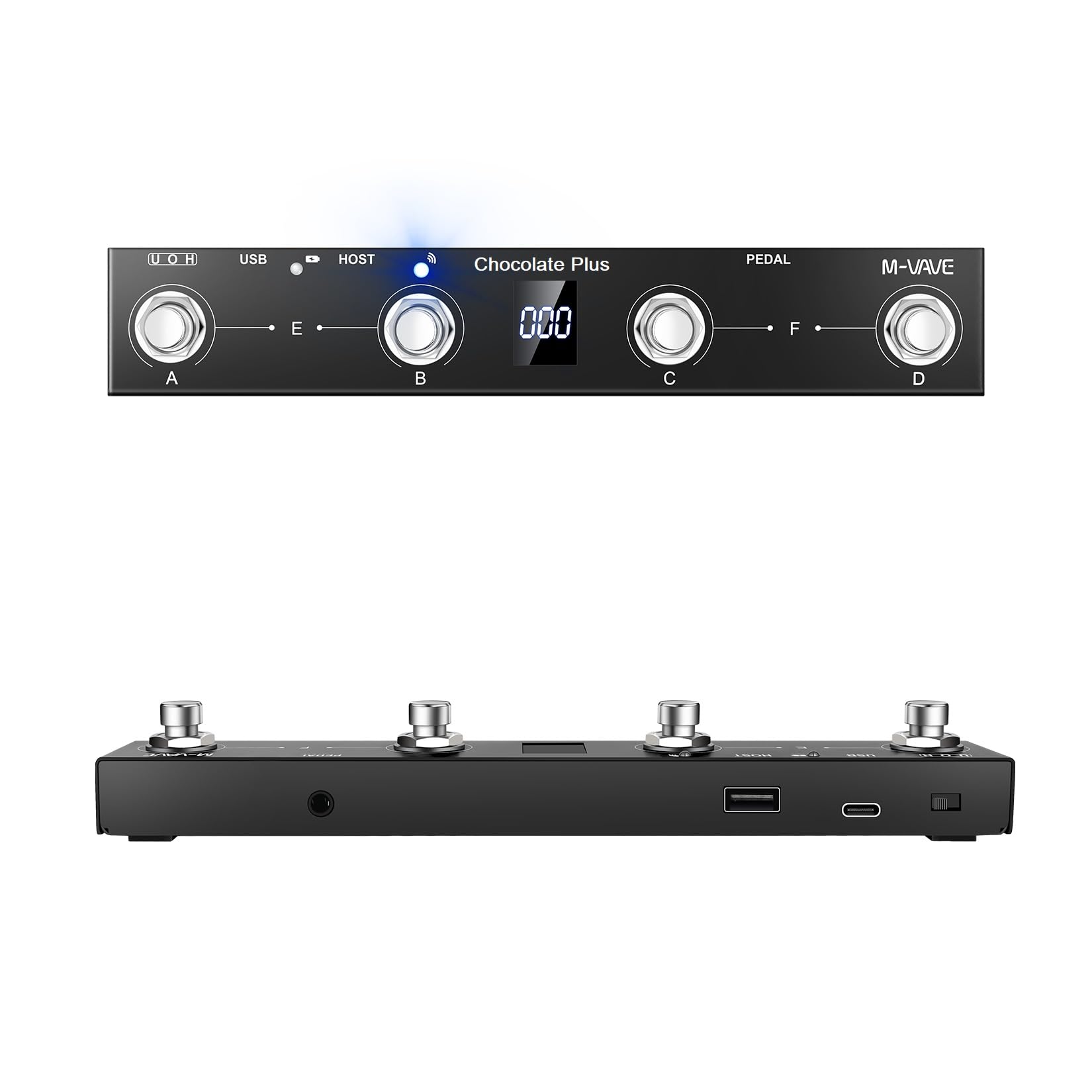
The Chocolate Plus is a compact four-switch wireless MIDI controller that sends PC, CC, Note, and SysEx messages at an entry-level price. The CubeSuite app handles preset editing and firmware updates, which covers the basics without the bulk of a full floorboard. Unlike a two-switch page-turner, it gives four assignable buttons for actual MIDI program changes. A tiny footprint makes it gig-bag friendly.

It fits budget players who want simple patch switching for modelers, amps, or DAW apps from the floor. Bluetooth can drop in some environments, and USB host mode requires external power, so stage use calls for a pre-check.

Pros

  • Four assignable switches send PC, CC, Note, and SysEx in a small wireless pedal.
  • Light and compact enough for a gig bag, with a rechargeable battery.
  • CubeSuite app provides offline preset editing and firmware updates.

Cons

  • No expression pedal input and four switches cap it at basic preset control.
Our verdict

For budget players who want a small wireless MIDI switcher, this covers the essential patch-change duties without floorboard bulk.

Check Latest Price
3

Compact Feature-Packed Choice

MIDI Captain (PAINTAUDIO)

82 /100
Sound Score Excellent

Key details

Connectivity
USB MIDI
MIDI Message Support
PC, CC, Note
Programming Workflow
File-based editing
Programmable Switches
10 switches
View on Amazon

The MIDI Captain fits ten switches with separate press/release commands plus a Time Engine for automated multi-action sequences into a board smaller than full-size floor units. It sits between a full-size floorboard with expression pedals and the slim two-switch options in this set: more logic per switch, though with fewer on-board presets.

It suits guitarists running modelers on a compact board, keyboardists and synth players needing ten switchable MIDI commands, and power users who accept a text-file setup workflow. The programming has a real learning curve, and unit-to-unit consistency can vary, so inspect the unit on arrival and buy from a return-friendly seller.

Pros

  • Ten fully customizable switches with separate push/release commands in a pedalboard-friendly footprint.
  • Prebuilt modes for major modelers plus deep CC, PC, and Note assignment options.
  • Mid-range price with good build quality for the feature set.

Cons

  • Larger feet can brush the neighboring switch when the board is crowded.
Our verdict

The MIDI Captain is the compact board to choose when small size and per-switch macro depth matter more than expression pedals and a 100-preset floorboard.

Check Latest Price
4

Premium Studio/DAW Choice

Nektar Pacer

83 /100
Sound Score Excellent

Key details

Connectivity
USB, MIDI DIN
MIDI Message Support
PC, CC, Note
Programming Workflow
On-unit programming
Programmable Switches
10 + 4 optional
View on Amazon

The Pacer stands apart from the full-size floorboard in this lineup by making DAW control the centerpiece: Nektar transport integration, relay outputs, dual expression inputs, and ten quiet, solid switches in a metal chassis. It connects cleanly with Logic, Reaper, and Bitwig workflows, and it can drive hardware loopers like the Boss RC505 without additional setup.

This is for DAW-based musicians who want transport and MIDI control from the floor, plus room to expand with expression pedals, aux switches, or relay outputs. The configuration workflow has a learning curve, and the unit’s size and weight are significant; measure your pedalboard and confirm you need the expansion options before committing.

💡 Keep a paper cheat sheet of your MIDI sends while you build presets.

Pros

  • Quiet, solid switches in a metal chassis that feels road-worthy underfoot.
  • Nektar DAW integration plus MIDI DIN, relay outputs, and dual expression inputs covers studio and live setups.
  • Each button can send multiple MIDI commands, with expansion for expression pedals and aux switches.

Cons

  • On-unit programming can be awkward until the button-mapping process becomes familiar.
  • The metal chassis is heavy and large, which may overwhelm a small pedalboard.
Our verdict

The Pacer suits DAW-based players who want transport control, expansion options, and a stage-ready chassis as long as the pedalboard has room for it.

Check Latest Price
5

Tablet Page Turns

AirTurn BT500S-2

83 /100
Sound Score Excellent

Key details

Connectivity
Bluetooth
MIDI Message Support
Keystrokes, macros, MIDI
Programming Workflow
AirTurn Manager app
Programmable Switches
2 switches
View on Amazon

The BT500S-2 is a compact two-switch Bluetooth pedal for tablet readers and solo performers who need hands-free page turns and simple app macros, with 200+ hour battery life. It is not a general-purpose MIDI footboard: two switches and app-based setup cap it at page-turning and light trigger duty. Audible switch click and occasional double-page skip can be noticeable in quiet spaces.

Pros

  • Bluetooth page-turning works across iPads, tablets, and common sheet music apps.
  • Sturdy steel switches in a compact polymer housing suit on-stage use.

Cons

  • Only two switches, so it cannot take over multi-preset MIDI footboard duties.
Our verdict

Choose this only when hands-free tablet page turns and simple app macros are the job; multi-switch MIDI program control needs a larger footboard.

Check Latest Price

How to Choose

Programmable Footswitches

Switch count determines how many actions you can trigger without bending down, but it also sets the physical footprint. A 10-switch board gives one-touch access to presets, looper transport, and effects toggles, while a 4-switch unit forces bank or patch scrolling. That trade-off matters most when a song calls for instant changes across several device parameters. If you mostly play one patch per song, a smaller board is enough.

MIDI Message Support

Controllers are defined by the message types they send: PC for patch recall, CC for expression-style parameter changes, and Note commands for looper or drum triggers. Some models add SysEx for device-specific control beyond standard command messages. Many modelers respond to PC for preset recall but ignore CC messages set to the wrong channel, so check the receiving device's MIDI map before relying on a footswitch. If your modeler only needs patch changes, even a basic PC/CC set is enough.

Expression Pedal Inputs and Relay Outputs

Expression pedals add continuous control over wah, volume, or synth parameters, but they take up board space and add cost. Relay outputs let the controller act as a plain switch for amp channel switching or external relay loops, useful in hybrid guitar rigs. The hidden cost is size and weight: these features make a floorboard significantly larger, so they are worth it only if your board actually uses them.

Connectivity Type

Bluetooth simplifies cable management and works well at home, but it shares the 2.4 GHz band with Wi-Fi and can drop under distance or interference. Wired USB-MIDI and 5-pin MIDI are more predictable on stage, but they add routing constraints and, in some cases, require an extra interface. The practical rule: wireless is fine for practice and low-stakes gigs, wired matters when a missed change would be audible.

Programming Workflow and Editor Support

The editor is where most buyers get stuck. Hardware with deeply nested menus or no USB-MIDI port requires a dedicated interface and often a third-party editor, while app-based systems shorten setup but can introduce pairing or update quirks. Choose a workflow you can comfortably revisit, because you will reprogram patches whenever your rig changes.

Frequently Asked Questions